
Bay Area
Final Environmental Impact Report Released for Possible New A’s Stadium Ballpark
“Releasing the final Environmental Impact Report (FEIR) is a major milestone on our path to build a new waterfront ballpark district that will create up to 18 acres of beautiful public parks, more affordable housing, and good jobs for Oaklanders,” Mayor Schaaf said in a statement. “The 3,500-page document is thorough and exhaustive, and it ensures that the project is environmentally safe and sustainable,” said Oakland Mayor Libby Schaaf.


Draft Report not amended to address community concerns, short timeline means minimal public input
By Keith Burbank, Bay City News and the Post News Group staff
Oakland officials have released a final environmental impact report for the A’s proposed new stadium and development at Howard Terminal, a process with a short timeline over the holidays allowing only for minimal public comment.
The report is required by the California Environmental Quality Act and analyzes potential effects of the project on the surrounding environment.
The timing of the release of the port was of concern to many. It was released on Friday, a week before Christmas, and goes to the Planning Commission mid-January, a small window of time during a busy time of year for the public to read and comment on the report.
Further, the final report does not include any significant changes to the draft version, which means it was not amended to consider more than 400 comments made on the draft version. However, city staff did respond to each comment.
Oakland Mayor Libby Schaaf, a strong supporter of Oakland A’s owner John Fisher’s stadium deal, was enthusiastic about the report.
“Releasing the final Environmental Impact Report (FEIR) is a major milestone on our path to build a new waterfront ballpark district that will create up to 18 acres of beautiful public parks, more affordable housing, and good jobs for Oaklanders,” Mayor Schaaf said in a statement. “The 3,500-page document is thorough and exhaustive, and it ensures that the project is environmentally safe and sustainable,” Schaaf said.

The mayor said the report’s timing keeps the city on track to bring about the final vote to the city council in 2022, bringing the city “one step close to keeping our beloved A’s rooted in Oakland.”
Others were less enthusiastic. The East Oakland Stadium Alliance and port business leaders are raising concerns and urging caution.
“During the Draft EIR (Environmental Impact Report) phase, our coalition and others submitted detailed comments regarding the need for the city to revise and recirculate the Draft EIR, which was inadequate on numerous fronts, but it appears the city has chosen to ignore these requests and refused to re-circulate,” Mike Jacob, Vice President and General Counsel of the Pacific Merchant Shipping Association in a press release from the East Oakland Stadium Alliance.
Jacob also said that the timing of the report, released just before the holidays, reads like the city playing “hard-ball” with the community. “Port stakeholders are working around the clock to keep goods moving during an unprecedented supply chain crisis and community advocates are focusing on issues like feeding and housing those in need,” he said.
Jacobs also decried the city’s lack of progress on Seaport Compatibility Measures or a Community Benefits Agreement, despite the challenges he says the project presents for the maritime and West Oakland communities. “Until these items are presented to the public for review, in addition to a thoroughly vetted financial plan, the City and County cannot in good faith make judgments about whether this project is worth the numerous costs to our taxpayers and community,” he said.
“We ultimately anticipate the FEIR will confirm what we already know: the A’s and the City are simply not interested in funding the significant investments necessary to prevent this project’s disruption to the Port of Oakland’s supply chain or address its significant negative impacts to West Oakland and the environment.”
A’s president Dave Kaval also called the release of the report a milestone, one that is three years in the making. But the team needs a decision from the elected officials in Oakland as soon as possible, he said.
Keeping the pressure on Oakland, the A’s are also still considering moving the team to Las Vegas, paving paths for the team in both cities. He said there is momentum on both paths.
Kaval said the A’s are in the final stages of selecting a potential site in Las Vegas, which he thinks will be announced in the next month or so.
City officials will recommend to the Oakland Planning Commission that it certify the report and send it to the city council for approval.
City officials and the A’s are now negotiating the final agreements. The Planning Commission will take up the city’s recommendation on Jan. 19, and the city council may vote on the report in February, which, if approved, would complete the environmental review process.
This article is by Keith Burbank, Bay City News, and the Post News Group staff.













Activism
Oakland Post: Week of September 16 – 22, 2026
The printed Weekly Edition of the Oakland Post: Week of September 16 – 22, 2026

To enlarge your view of this issue, use the slider, magnifying glass icon or full page icon in the lower right corner of the browser window.
Activism
Oakland Post: Week of September 9 – 15, 2026
The printed Weekly Edition of the Oakland Post: Week of September 9 – 15, 2026

To enlarge your view of this issue, use the slider, magnifying glass icon or full page icon in the lower right corner of the browser window.
Activism
Oakland Post: Week of September 2 – 8, 2026
The printed Weekly Edition of the Oakland Post: Week of September 2 – 8, 2026
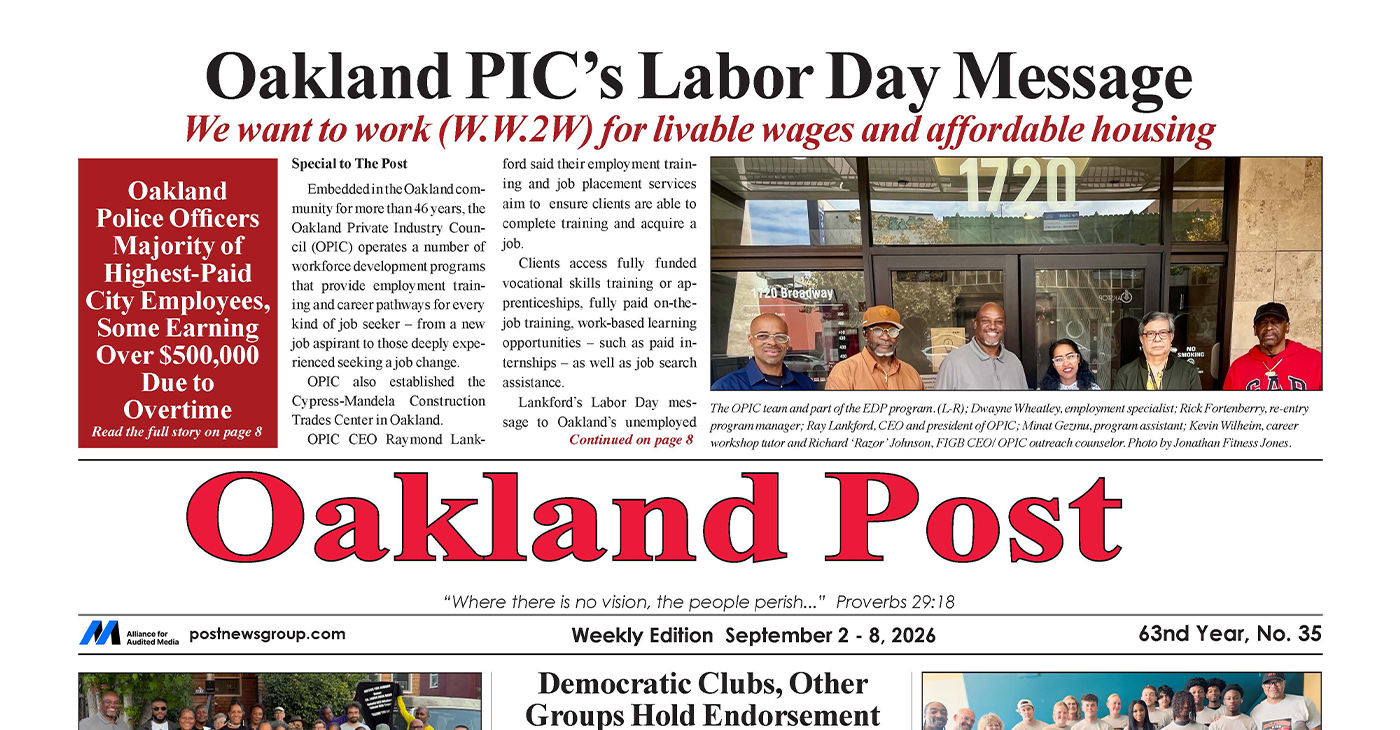
To enlarge your view of this issue, use the slider, magnifying glass icon or full page icon in the lower right corner of the browser window.



Oakland Mayor Reads to Children at Bookout Block Party at Marcus Books Store

Tradition Comes to the Streets in 11th Annual Black-Eyed Pea Festival at the Freedom Farmers Market

Attorney General Rob Bonta Continues Opposition to President Trump’s Tariff Regime

Neighborhood Empowerment Day in Deep East Oakland Brings Community Together After Recent Tragedy

Community Action Group ‘Friends of Zakiya’ Ask Sheriff for Time

Oakland Launches Aerbits Program to Identify, Report Abandoned Trash

Mayor Lee Announces $1 Million Kaiser Permanente Grant for Pilot Program to Address Homelessness, Clean Up Public Spaces throughout Oakland

Alameda County DA Ursula Jones Dickson Says Key to Optimal Use of DA’s Office Is Knowledge

Oakland Post: Week of September 16 – 22, 2026

NFL: Week Two Recap | Jalen Hurts did not fold; Caleb Williams exits game with injury

The Complete Negotiation Framework — Every Stage, Every Tactic, Every Win

Mazda CX-90 Luxury: Heated Seats & Premium Comfort! #shorts

Car Dashboard Glare: Avoid This Distraction! #shorts

Mazda CX-90 Safety: All Driver Assistance Features Explained #shorts

Subaru Outback: 19-Inch Wheels & 8.8″ Ground Clearance! #shorts

Department of Homeland Security Demands California Secretary of State Shirley N. Weber Scrub Voter Rolls

“The Power to See Threats Sooner”: Gov. Newsom, Safety Officials Showcase California’s Investments in Hi-Tech Wildfire Prevention

California Sen. Padilla Joins Colleagues to Introduce Bill Imposing Term Limits on Supreme Court Justices

Less Affluent School Districts, Including Sacramento City, Face Threat of State Takeover

Car Wash Workers Cope with Lingering Impacts of ICE Raids

ESSAY: California Can Close Its Colorectal Cancer Gap

As Part of Your Back-to- School Checklist, Vaccinate

Oakland ‘Port Serves as a Powerful Engine for Good Jobs and Economic Development

Gov. Newsom Announces $109.6 Million in Funding for 278 Supportive Homes in Bakersfield, Contra Costa, Sacramento and Fresno

California Hispanic Chambers of Commerce Unveils: ‘Powering the Future’ Theme for 47th Annual Statewide Convention

Congresswoman Simon Demands Investigation into Trump’s Abuse of Emergency Powers for Coal Export Terminal in West Oakland

Four Candidates, Including Incumbent Barbara Lee, Qualify for Oakland Mayor’s Race

Oakland Post: Week of August 12 – 18, 2026

From Blueprint to Breakthrough: Tackling Affordable Housing in Oakland

Oakland Observes Black August with Block Parties, Film Showings, Workshops

The Conversation With Al McFarlane 6/23/26

Media Monday 6/22/26

LIVE! ASK ALMA! — TUES. 6.23.26 7PM EST

Car Buying Secrets: 4 Hidden Checks Before You Sign!

Is This 550 HP Charger Worth YOUR Money? AutoNetwork Review

Celebrating Juneteenth – Frederick Douglass on education and resistance

LIVE! — ASK ALMA! — TUES. 6.19.26 7PM EST

Hyundai Ioniq 5 Parking, Safety, and 360 View #shorts

2025 Ioniq 5 New Wiper & Powerful Performance! #shorts

Electric SUV Range: Is 259 Miles Enough? #shorts

EV Charging: How Fast Can You Charge an Electric Vehicle? #shorts

Biometric Cooling… Messaging Seats…Come on! 2025 Infiniti QX80 Autograph 4WD

Charged Up: Witness the Magic of a Fully Electric Car! #shorts

Range Rover Sport PHEV Included…: See What’s Inside This Luxury SUV! #shorts

Invisible Hood View: Perfect Parking with X-Ray Vision! #shorts
-

 Commentary3 weeks ago
Standoff for Justice: Our Homes Are Worth Fighting For
-

 Activism3 weeks ago
Oakland Post: Week of August 26 – September 1, 2026
-

 Business3 weeks ago
Gubernatorial Candidate Steve Hilton Blasts California New Tire Rules; Newsom Hits Back
-

 Business3 weeks ago
Frontier Airlines’ Return to Oakland Airport Brings Flights, Jobs and Opportunity
-

 Business3 weeks ago
Chef Sharon Lee Blends Culinary Excellence, Education and Empowerment
-

 Education3 weeks ago
Gov. Newsom’s Latest Appointees Include Sacramento Advocate for Formerly Incarcerated Students; State’s New Tech Chief
-

 Business3 weeks ago
Oakland Coliseum Project Opens Door for Small Businesses to Build Bigger
-

 Community3 weeks ago
Big City Mayors Ask for “Yes” Vote on Housing Bond Measure; Conservatives Say “No”
