
Activism
Facebook’s “We the Culture” Panel Discusses Black Portrayals in Mainstream News
The increase in Black representation in the news media was discussed when the topic turned to controversy surrounding Rachel Nichols, an NBA sportscaster on ESPN. In a July 2020 leaked recording, she appeared to be uncomfortable sharing hosting duties with Maria Taylor, another ESPN personality who is African American. In the recording, Nichols, who is white, suggested Taylor had been promoted because she is Black.

By McKenzie Jackson, California Black Media
When Erica Cobb, co-host of the Daily Blast Live, first stepped into the world of mainstream news over two decades ago, she overheard a conversation in which an industry person considered Cobb the perfect minority for a particular role because, although she is Black, to them she “didn’t come across like a Black person” based on stereotypes in their head.
“Those convos now are few and far between because we have more seats at the table,” said Cobb, who is also a podcaster with a background in radio. She was referring to the growing numbers of Black faces appearing regularly in the news media. “The pipeline has opened for more people of color.”
However, Cobb said, the news industry still needs more African Americans.
Independent journalist Georgia Fort, the founder of BLCK Press, said the lack of Black professionals in newsrooms across the U.S. contributes to African Americans being portrayed in a negative way.
“The media industry since its inception has capitalized on exploiting our stories and disproportionately portraying us in a negative light,” said Cobb, who identifies as biracial.
“You can go back to blackface; even modern-day newscasts are saturated with Black mug shots,” she said.
The current state of Black representation in the mainstream media was the subject of a recent online discussion hosted by Facebook’s “We The Culture,” a content initiative created and managed by a team of Black Facebook employees focused on amplifying content from Black creators.
The social networking giant launched the platform in February with an inaugural class of over 120 creators specializing in news and social media content.
Cobb and Fort were panelists on We The Culture’s video chat on how Blacks are depicted in mainstream media.
The third panelist was Zyahna Bryant, a student activist, community organizer, and online content creator who is known for spearheading the movement to take down a statue of Confederate Gen. Robert E. Lee in in Charlottesville, Va.
The 53-minute discussion was moderated by Rushadd Hayard, a freelance web producer.
The quartet’s webcast happened a year after the murder of George Floyd, an African American man who died after Derek Chauvin, a white former Minneapolis police officer kneeled on his neck for nearly nine minutes.
Video of Floyd’s death shined a light on the aggressive tactics law enforcement officers sometimes employ when engaging Black Americans. The horror of his violent murder sparked national conversations on racial inequity, motivating many businesses and organizations in the U.S. to support African American causes and take steps to increase diversity, equity and inclusion in their organizations.
The increase in Black representation in the news media was discussed when the topic turned to controversy surrounding Rachel Nichols, an NBA sportscaster on ESPN. In a July 2020 leaked recording, she appeared to be uncomfortable sharing hosting duties with Maria Taylor, another ESPN personality who is African American.
In the recording, Nichols, who is white, suggested Taylor had been promoted because she is Black.
“A privileged woman like Nichols,” Fort said, “refusing to support — or even accept — the advancement of a person from a disenfranchised community like Taylor is a problem.”
“You have people like Rachel, she wants something to be done as long as it doesn’t require her to make a sacrifice,” Fort continued. “In order for our nation to be more equitable, it is going to require all the Rachels to step aside and make space. Performative ally-ship is the best way I can describe her.”
Cobb noted that Nichols, who has since been pulled from appearing on the sporting network but continues to be paid, put herself in the forefront of a perception in the industry that ESPN had a diversity issue.
Bryant said media groups’ desires to increase the number of Blacks as employees are empty gestures if they don’t come with institutional change.
“I noticed we needed more Black voices after the George Floyd incident,” she said. “After the entire summer of organizing and moving into the election cycle, I felt that there was a disconnect. Not just with white people talking about Black issues, but the media altogether not having their ear to the ground.”
Hayard cited a 2019 Pew Research Center analysis that revealed that Black media professionals only make up 7% of newsroom staffers nationally.
Cobb said she first realized more Black representation was needed in the media when former President Barack Obama, began his initial run for the country’s highest office and a controversy ignited around him attending the church of controversial pastor Rev. Jeremiah Wright.
“I was the only one speaking out in defense of Obama,” she said. “I remember my co-host turning off my mic and people calling in saying I was racist. I left in the middle of the show. A Black reporter from the Chicago Tribune called me and first asked if I was OK and secondly, what happened and how it went down, and if I thought it was racist.”
The same realization came to Fort when she was assigned to cover the shooting of a Black man by a police officer for a news station. She was directed to pull up the criminal history of the man, but Fort also investigated the officer and found he had a litany of complaints against him, including racial-profiling ones.
“This was omitted from the five o’clock news because my white superiors didn’t feel it was relevant to the story,” she said. “I found myself being characterized in the newsroom as the angry Black woman.”
Cobb said for more African Americans to be present in front of news cameras, more Blacks need to be in positions of power behind the camera, beyond just the editor and producer roles.
Fort said a change in culture could also be helpful.
“The industry standard is AP-Style English and a certain image,” she said. “Not all Black people or people of color use AP English as their natural dialect, and we need to stop expecting people to conform to that. Allow people to be their authentic selves. Why are we saying we want diversity, but we want people to conform? To me that’s not diversity.”
When Bryant began her drive to get the Confederate statue removed, a Black reporter interviewed her. She said talking with a person from the same race, from possibly a similar background, and who was empathetic helped the interview go smoother
“I’m looking forward to seeing more journalists with their Blackness on display,” Bryant said.













Activism
Oakland Post: Week of September 23 – 29, 2026
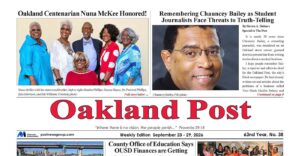
The printed Weekly Edition of the Oakland Post: Week of September 23 – 29, 2026

To enlarge your view of this issue, use the slider, magnifying glass icon or full page icon in the lower right corner of the browser window.
Activism
Oakland Post: Week of September 16 – 22, 2026
The printed Weekly Edition of the Oakland Post: Week of September 16 – 22, 2026
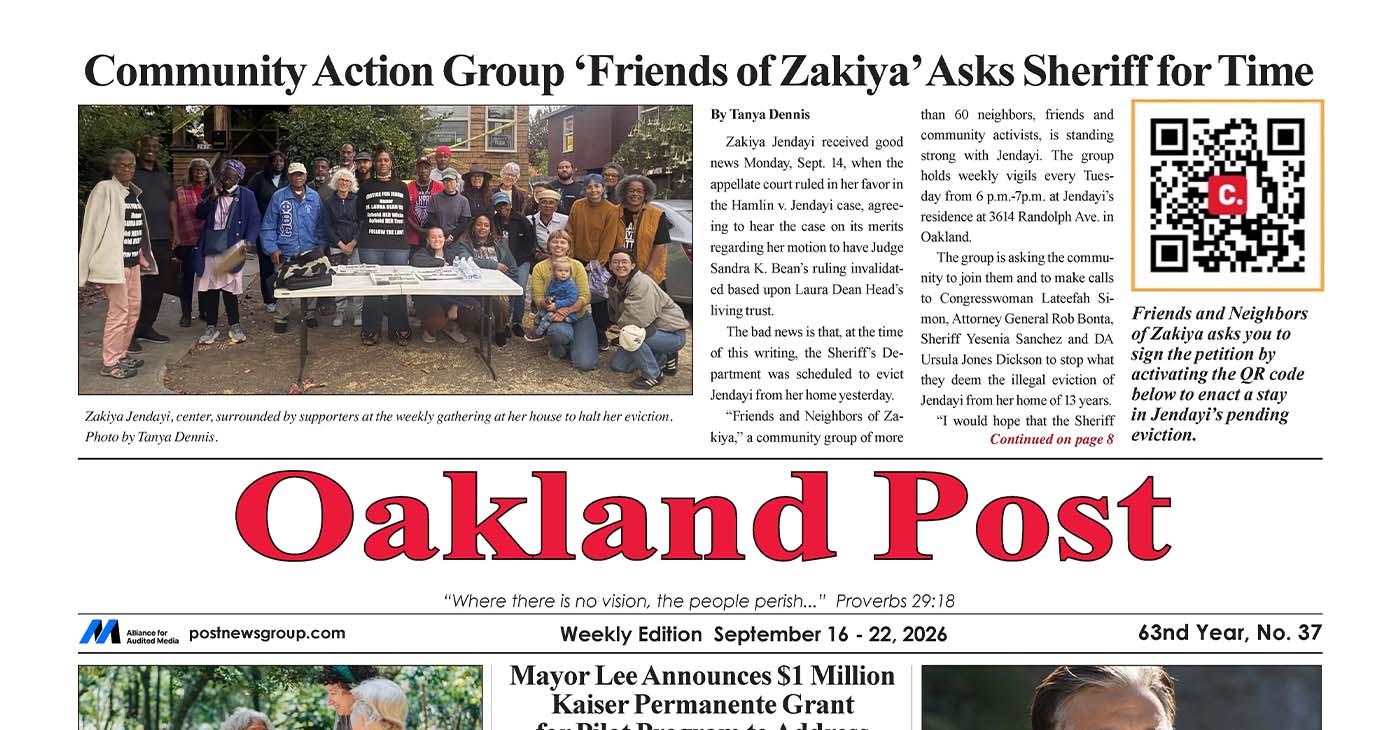
To enlarge your view of this issue, use the slider, magnifying glass icon or full page icon in the lower right corner of the browser window.
Activism
Oakland Post: Week of September 9 – 15, 2026
The printed Weekly Edition of the Oakland Post: Week of September 9 – 15, 2026
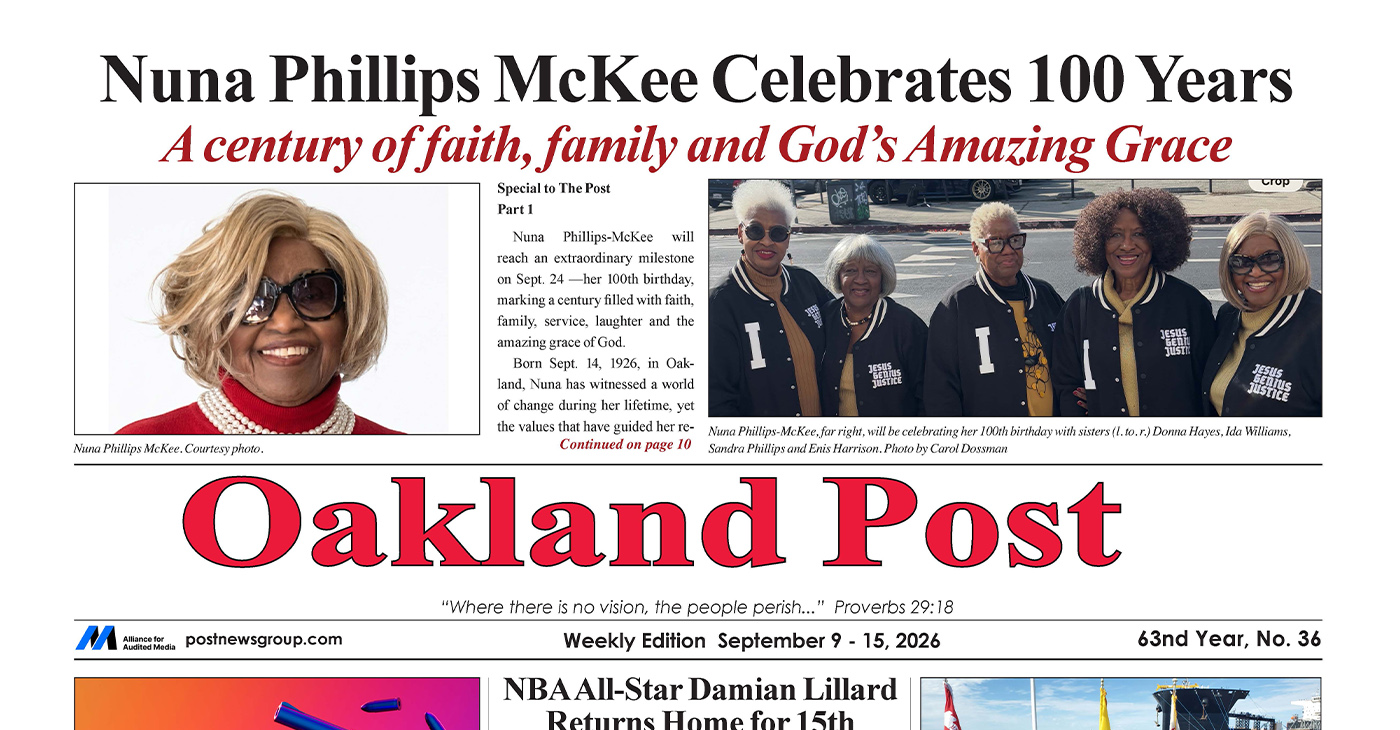
To enlarge your view of this issue, use the slider, magnifying glass icon or full page icon in the lower right corner of the browser window.


Asm. Corey Jackson Announces Launch of 24-Hour Childcare in His District

IN MEMORIAM: The Rev. Leon “Sonny” Clark, Longtime Orange County Pastor and Community Leader, Dies at 72

Poll: Becerra Widens His Lead Over Hilton; Californians Split on Wealth Tax

From Historic Memories to New Possibilities: Oakland Celebrates Coliseum 60

County Office of Education Says OUSD Finances Are Getting Healthier, Materially Stronger

LIVE FREE Sunday Dinner Brings Faith, Fellowship and Civic Conversation to Oakland

Remembering Chauncey Bailey as Student Journalists Face Threats to Truth-Telling

BLACspace Cooperative Invites Bay Area to Experience Oakland’s Black Cultural Ecosystem Through a BLAC Map Tour + Party

In Wake of Death on Doorstep, Williams Chapel Baptist Church Calls for Better Care, Funding for Unhoused

Oakland Centenarian Nuna McKee Honored!

Caribbean Nations Produce Action Plan Calling for UK Reparations Over Slavery

Oakland Post: Week of September 23 – 29, 2026

Doulas Are Helping Black California Moms Navigate Pregnancy–Even as High Mortality Rates Persist

Newsom Signs Addictive Social Media Law to Protect Kids

On Your November Ballot: Prop 38 Would Allocate $8.4 Billion to Immunology and Immunotherapy Funding

Standoff for Justice: Our Homes Are Worth Fighting For

Oakland Post: Week of August 26 – September 1, 2026

Frontier Airlines’ Return to Oakland Airport Brings Flights, Jobs and Opportunity

Gubernatorial Candidate Steve Hilton Blasts California New Tire Rules; Newsom Hits Back

Chef Sharon Lee Blends Culinary Excellence, Education and Empowerment

Jackie Wright Champions Bay Area Stories, Filmmakers and Cultural Institutions

Big City Mayors Ask for “Yes” Vote on Housing Bond Measure; Conservatives Say “No”

Oakland Coliseum Project Opens Door for Small Businesses to Build Bigger

Gov. Newsom’s Latest Appointees Include Sacramento Advocate for Formerly Incarcerated Students; State’s New Tech Chief

Misnamed ‘Parent’ PAC Seeks to Influence Oakland School Board Elections

Longtime BWOPA Member Brendalyn Goodall Appointed to California Workforce Development Board

Gov. Newsom Signs Law Shielding Immigration Aid Workers From Doxing Threats

Secretary of State Shirley N. Weber Urges Californians to Vote Early as Voter ID Battle Intensifies

From Palestine to Oakland: Seeds for Liberation Examines Shared Struggles for Freedom

IN MEMORIAM: Dolly Parton Dead at 80 — How She Built a Legacy of Love and Earned Her Place in Black Culture

The Conversation With Al McFarlane 6/23/26

Media Monday 6/22/26

LIVE! ASK ALMA! — TUES. 6.23.26 7PM EST

Car Buying Secrets: 4 Hidden Checks Before You Sign!

Is This 550 HP Charger Worth YOUR Money? AutoNetwork Review

Celebrating Juneteenth – Frederick Douglass on education and resistance

LIVE! — ASK ALMA! — TUES. 6.19.26 7PM EST

Hyundai Ioniq 5 Parking, Safety, and 360 View #shorts

2025 Ioniq 5 New Wiper & Powerful Performance! #shorts

Electric SUV Range: Is 259 Miles Enough? #shorts

EV Charging: How Fast Can You Charge an Electric Vehicle? #shorts

Biometric Cooling… Messaging Seats…Come on! 2025 Infiniti QX80 Autograph 4WD

Charged Up: Witness the Magic of a Fully Electric Car! #shorts

Range Rover Sport PHEV Included…: See What’s Inside This Luxury SUV! #shorts

Invisible Hood View: Perfect Parking with X-Ray Vision! #shorts
-
 Community2 weeks ago
Misnamed ‘Parent’ PAC Seeks to Influence Oakland School Board Elections
-

 Activism3 weeks ago
Oakland Post: Week of September 2 – 8, 2026
-

 Community2 weeks ago
Richmond Tiny House Village Farm & Garden Set to Open Gates on Sept. 26
-

 Black History2 weeks ago
OPINION: Nolan Wells’ Death One of Several Signifying Racial Terror Lives on in U.S. South
-

 Black History2 weeks ago
Latest Massacre in Haiti Reveals Cruelty U.S. Deportations
-

 Activism2 weeks ago
Oakland Post: Week of September 9 – 15, 2026
-

 Community2 weeks ago
Democratic Clubs Interview Candidates for Oakland School Board
-
 Featured2 weeks ago
‘Ready to See These Bills Become Law’: Sen. Weber’s Package of 15 Bills Advance to Gov. Newsom’s Desk
