
Bay Area
Does Holy Names University Need to Close Down? HNU’s Bond-Holder Says No
When the Holy Names University Board of Trustees declared in December 2022 that the college was closing, they said they could not afford to remain open and were under pressure to repay a recent $50 million loan.


By Ken Epstein
When the Holy Names University Board of Trustees declared in December 2022 that the college was closing, they said they could not afford to remain open and were under pressure to repay a recent $50 million loan.
However, the lender, Preston Hollow Community Capital (PHCC), is saying something quite different. In a recent letter to City of Oakland officials, the lender wrote:
“It is important that we make two things abundantly clear. 1) HNU decided, on its own and over PHCC’s objections, to close down – despite the fact that we have expressed a clear and ongoing commitment to help them overcome their challenges; and 2) PHCC is committed to doing everything it can to keep this campus as an institution of higher education rather than watch it be bought and sold to the highest bidder for some other purpose,” including “potentially for luxury real estate development.”
In the letter, Preston Hollow describes itself as “a leading social impact investor in the United States. We invest in and assist projects of significant social and economic importance to local communities.”
For example, in January they created a project to assist Howard University, assist the historically Black college, in Wash., D.C., with a $300 million tax-exempt bond-financing arrangement.
In its letter to Oakland officials, Preston Hollow reached out to work with the city to save the campus as a center for higher education in Oakland.
“Please accept this letter as the beginning of a line of dialogue between PHCC and Oakland city leaders,” the letter said. “We are committed to working with you collaboratively – and hopefully with HNU’s collaboration as well.”
Some people in the Oakland community are questioning whether HNU’s leaders are interested in seeking alternatives to closing the institution and selling the property.
After HNU’s trustees closure announcement in December, several community leaders asked for a meeting with Board of Trustees Chair Steven Borg to offer assistance, a meeting he refused to attend.
In January, other leaders asked for a meeting with Borg to discuss a specific proposal for a partnership to keep the campus open. That meeting request was also refused.
Recently, Oakland City Council members have been working to find a way to preserve the mission of educating the university’s multiracial student body as teachers, nurses, social workers and undergraduates at the beautiful 60-acre campus with gorgeous views overlooking Oakland and the San Francisco Bay.
In response to Oakland Post questions, Borg did not offer to collaborate with Preston Hollow but criticized the letter for “false and misleading information while also claiming to be operating in good faith with HNU.”
He said HNU’s commitment is to operate the college until May 2023 and to “get the highest value for the property.”
He said that HNU had not missed any payments on its $50 million loan. “Instead, the default was technical in nature.”
This week, faculty and staff at HNU are meeting to discuss these new developments and to consider options that may exist to continue a higher education institution on the campus.
One possibility that excites many members of the Oakland community is the possibility of a partnership with a Historically Black College or University as part of a comprehensive plan to maintain the campus as a center of higher education.
Holy Names is an accredited, Roman Catholic, co-educational university founded by the Sisters of the Holy Names of Jesus and Mary in 1868. Originally established as the Convent of Our Lady of the Sacred Heart by six members of a teaching order from Quebec, Canada, the original site of the convent was on the shores of Lake Merritt. In 1957, the school moved to its present location in the Oakland hills.





Activism
Oakland Post: Week of August 12 – 18, 2026
The printed Weekly Edition of the Oakland Post: Week of August 12 – 18, 2026

To enlarge your view of this issue, use the slider, magnifying glass icon or full page icon in the lower right corner of the browser window.
Activism
Oakland Post: Week of August 5 – 11, 2026
The printed Weekly Edition of the Oakland Post: Week of August 5 – 11, 2026
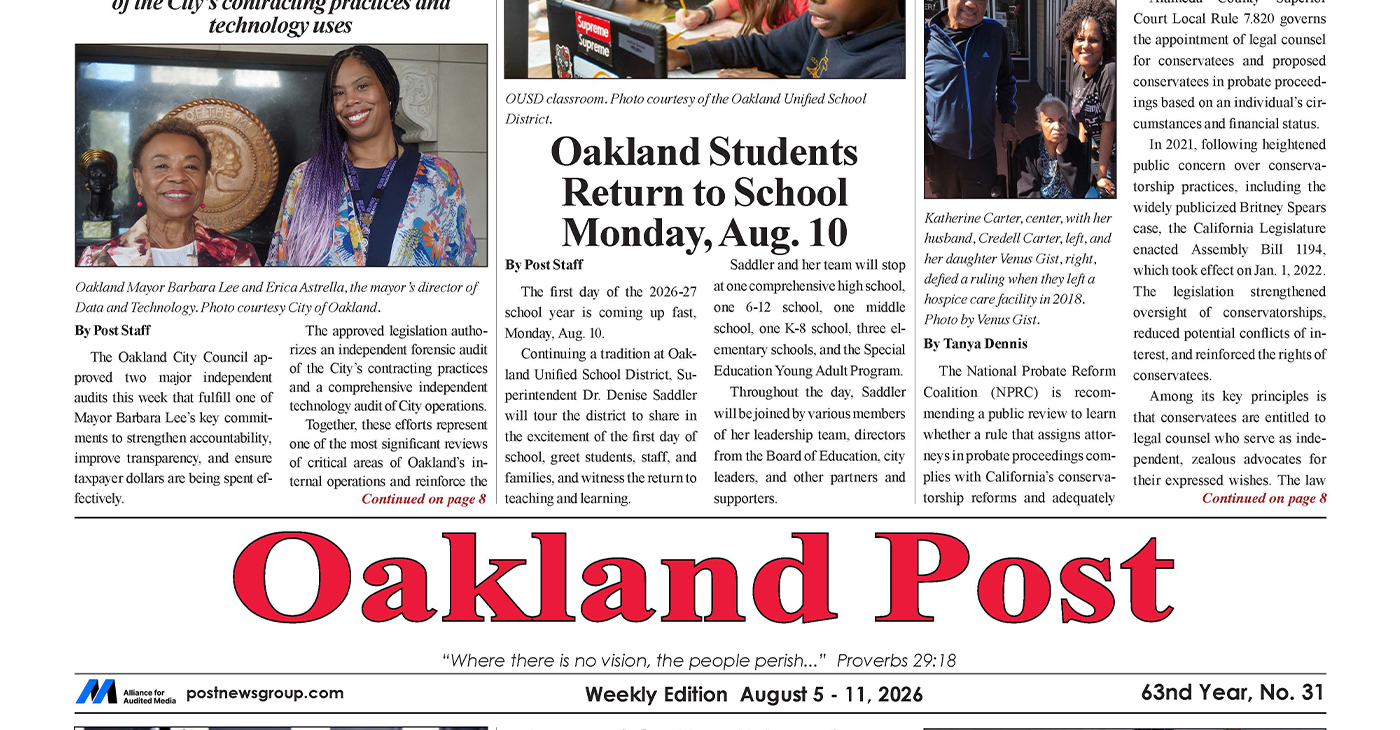
To enlarge your view of this issue, use the slider, magnifying glass icon or full page icon in the lower right corner of the browser window.
Activism
Oakland Post: Week of July 29 – August 4, 2026
The printed Weekly Edition of the Oakland Post: Week of July 29 – August 4, 2026

To enlarge your view of this issue, use the slider, magnifying glass icon or full page icon in the lower right corner of the browser window.

WORK FROM HOME
Home-based business with potential monthly income of $10K+ per month. A proven training system and website provided to maximize business effectiveness. Perfect job to earn side and primary income. Contact Lynne for more details: Lynne4npusa@gmail.com 800-334-0540


OPINION: 57,000 Empty Apartments and Not a Word of Apology – City Limits

Oakland Protesters Rally to Defend Haitian Immigrants and TPS

First 5 Alameda County Celebrates First Year of Measure C’s Implementation

From Palestine to Oakland: Seeds for Liberation Examines Shared Struggles for Freedom

NABJ Convention Brings Black Journalists, Civic Leaders Together in Atlanta

At Sacramento Summit, Becerra Discusses Policy; Uses “Family” Metaphor to Frame Case for National Political Unity

$5 Billion Coliseum Vision Puts Oakland Jobs, Businesses at Center

Gov. Newsom Nominates 3 Black Women Judges to Serve on State Courts of Appeal

Oakland Observes Black August with Block Parties, Film Showings, Workshops

NPRC Elder Justice Symposium Invites Community to Join Effort to Protect Alameda County Elders
Episode 4: Grow Stronger After 50
Episode 4: Grow Stronger After 50

Four Candidates, Including Incumbent Barbara Lee, Qualify for Oakland Mayor’s Race

Oakland Observes Black August with Block Parties, Film Showings, Workshops

Oakland Post: Week of August 12 – 18, 2026

Department of Homeland Security Demands California Secretary of State Shirley N. Weber Scrub Voter Rolls

New Judge Could Decide if Karmelo Anthony Gets a New Trial

Oakland Children’s Hospital Workers and Patients Rally for Pediatric Medical Care

“The Power to See Threats Sooner”: Gov. Newsom, Safety Officials Showcase California’s Investments in Hi-Tech Wildfire Prevention

Alpha Kappa Alpha Sorority, Inc. Celebrates New North Atlantic Regional Director

Surveillance Pricing Fight: State Senate Debates Bill Banning Retailers from Using AI to Set Prices Based on a Buyer’s Profile

Mount Zion MBC, Church of Jesus Christ of Latter-day Saints Partner to Bring 29,000 Meals to Alameda County

California Sen. Padilla Joins Colleagues to Introduce Bill Imposing Term Limits on Supreme Court Justices

Less Affluent School Districts, Including Sacramento City, Face Threat of State Takeover

Car Wash Workers Cope with Lingering Impacts of ICE Raids

Starting This Summer, California Car Buyers Can Get an Instant $3500 Off the Cost of Electric Vehicles

COMMENTARY: You Are Already Paying for the AI Boom

California Bill Would Let Abuse Victims Use Trauma as Legal Defense for Violent Crime

Fed Court to Decide Landmark First Amendment Case

Gov. Gavin Newsom Signs Law Streamlining Affordable Housing Rules

The Conversation With Al McFarlane 6/23/26

Media Monday 6/22/26

LIVE! ASK ALMA! — TUES. 6.23.26 7PM EST

Car Buying Secrets: 4 Hidden Checks Before You Sign!

Is This 550 HP Charger Worth YOUR Money? AutoNetwork Review

Celebrating Juneteenth – Frederick Douglass on education and resistance

LIVE! — ASK ALMA! — TUES. 6.19.26 7PM EST

Hyundai Ioniq 5 Parking, Safety, and 360 View #shorts

2025 Ioniq 5 New Wiper & Powerful Performance! #shorts

Electric SUV Range: Is 259 Miles Enough? #shorts

EV Charging: How Fast Can You Charge an Electric Vehicle? #shorts

Biometric Cooling… Messaging Seats…Come on! 2025 Infiniti QX80 Autograph 4WD

Charged Up: Witness the Magic of a Fully Electric Car! #shorts

Range Rover Sport PHEV Included…: See What’s Inside This Luxury SUV! #shorts

Invisible Hood View: Perfect Parking with X-Ray Vision! #shorts
-
 Featured2 weeks ago
Department of Homeland Security Demands California Secretary of State Shirley N. Weber Scrub Voter Rolls
-
 #NNPA BlackPress3 weeks ago
New Judge Could Decide if Karmelo Anthony Gets a New Trial
-
 Business4 weeks ago
Oakland Children’s Hospital Workers and Patients Rally for Pediatric Medical Care
-
 Environment2 weeks ago
“The Power to See Threats Sooner”: Gov. Newsom, Safety Officials Showcase California’s Investments in Hi-Tech Wildfire Prevention
-
 Black History3 weeks ago
Alpha Kappa Alpha Sorority, Inc. Celebrates New North Atlantic Regional Director
-
 Business4 weeks ago
Surveillance Pricing Fight: State Senate Debates Bill Banning Retailers from Using AI to Set Prices Based on a Buyer’s Profile
-
 Business4 weeks ago
Mount Zion MBC, Church of Jesus Christ of Latter-day Saints Partner to Bring 29,000 Meals to Alameda County
-
 Featured2 weeks ago
California Sen. Padilla Joins Colleagues to Introduce Bill Imposing Term Limits on Supreme Court Justices
