
Activism
Democrats in Sacramento Take Steps to Make Voting Easier
Recently, in some states, most notoriously Georgia and Florida, lawmakers have taken steps to restrict voting access and rights for many Americans. But in California, policymakers and legislators are doing the opposite, making proposals to simplify the voting process and expand access to the polls.


The electoral process is foundational to the durability of America’s democratic structure.
And as the battle for fairer voting laws rages on, politicians and activists on the political Right claim they are responding to allegations of widespread voter and election fraud. Those on the Left say they are rallying to fight a coordinated political offensive to restrict access to the polls and increasing reports of voter suppression.
Recently, in some states, most notoriously Georgia and Florida, lawmakers have taken steps to restrict voting access and rights for many Americans.
But in California, policymakers and legislators are doing the opposite, making proposals to simplify the voting process and expand access to the polls.
Invoking the violent history of voter suppression in the South that her parents endured, which sometimes involved murders — California Secretary of State Shirley Weber says it is a priority of hers to “ensure the right to vote.”
“I tell people all the time that no number is good unless it’s 100% in terms of voter participation,” Weber told the Public Policy Institute of California. “Why didn’t 5 million go to the polls? We need to figure out where they are and what stopped them from going.”
In the California Legislature, an amendment to Senate Bill (SB) 29, which passed earlier this year, was one bill in a broader legislative effort to secure the right to vote in vulnerable communities.
Before that amendment passed, California law dictated that a ballot would be mailed to all eligible voters for the November 3 statewide general election in 2020 as well as use a Secretary of State vote-by-mail tracking system to ensure votes are counted.
SB 29, which the governor signed into law in February, extended those requirements to any election “proclaimed or conducted” prior to Jan. 1, 2022.
A record number of voters participated in California elections in 2020. Some political observers attribute that spike to the vote-by-mail system instituted last year.
“To maintain a healthy democracy in California, it is important to encourage eligible voters to vote and to ensure that residents of the state have the tools needed to participate in every election,” the bill reads.
Senate Bill (SB) 583, introduced by California State Sen. Josh Newman (D-Fullerton), would require the Secretary of State to register or preregister eligible citizens to vote upon retrieving the necessary paperwork from the Department of Motor Vehicles (DMV).
Citizens who do not wish to be registered can opt-out of the process altogether.
Newman stressed the importance of access and simplifying the voter registration process.
“In our state there are an estimated 4.6 million U.S. citizens who are eligible to vote who have not yet registered,” Newman said. “Our obligation as the people’s elected representatives is to make the process simpler and more accessible for them.”
On April 27, the Senate Transportation Committee passed SB 583 with a 13 to 3 vote. The Appropriations Committee has set a hearing for May 10.
Senate Bill (SB) 503, introduced by Sen. Josh Becker (D-Menlo Park), proposes that if a signature shares enough characteristics with a previous signature from the same voter, then it would be recognized as official on voting paperwork.
Current law dictates that a signature has to match exactly for it to be considered valid.
Disability Rights California (DRC), a non-profit advocacy organization that advances and protects the rights of Californians living with disabilities, has come out in support of SB 503.
“Studies have shown that signature matches disproportionately impact voters with disabilities,” Eric Harris, director of public policy for the DRC wrote in a letter.
“Voters with disabilities, including seniors, are more likely to vote by mail and would have to sign their name on their ballots,” Harris argued. “A voter’s signature changes over time and for people with disabilities, a signature can change nearly every other time one is written. Some people with disabilities might have conditions that make it difficult to sign your name the same way multiple times.”
For now, the Senate Appropriations Committee has tabled SB 503, placing the bill in what the Legislature calls a “suspense file,” where it awaits further action by lawmakers.
At the federal level, lawmakers have introduced two bills in the U.S. Congress to expand voting rights, the For The People Act of 2021 and the John L. Lewis Voting Rights Advancement Act.
The For The People Act, or H.R.1, proposes a three-pronged approach to expanding election access: Voting, campaign finance, and ethics.
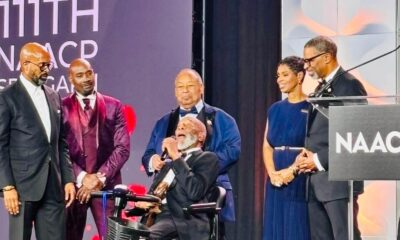
Hilary Shelton, director of the NAACP’s Washington Bureau and senior vice president for Advocacy and Policy, compared the current voting rights battle to that of the Civil Rights Movement in a press conference about H.R.1 and the John L. Lewis Voting Rights Advancement Act.
“If you look at some of those 1960s shots of the C.T. Vivians of the world, of the Joe Lowerys and so many others that helped lead Americans to those registration sites, you’ll see them actually literally being beaten to the ground,” Shelton said, referring to well-known Civil Rights Movement activists.
The John L. Lewis Voting Rights Advancement Act of 2021, or S.4263, would amend the Voting Rights Act of 1965 to restore the powers it lost after the Supreme Court’s 2013 ruling in Shelby v. Holder. In that case, the U.S. Supreme Court ruled that laws requiring states and local communities to first clear any changes to voting their local laws with the feds, was unlawful.
“Well, we’ve become more sophisticated in our disenfranchisement,” Shelton continued. “We want to make sure that we stop that disenfranchisement all along the way and that’s why we’re convinced that a bill named for John Lewis and a bill that speaks for the people are bills that need to pass.”












Activism
Oakland Post: Week of September 16 – 22, 2026
The printed Weekly Edition of the Oakland Post: Week of September 16 – 22, 2026

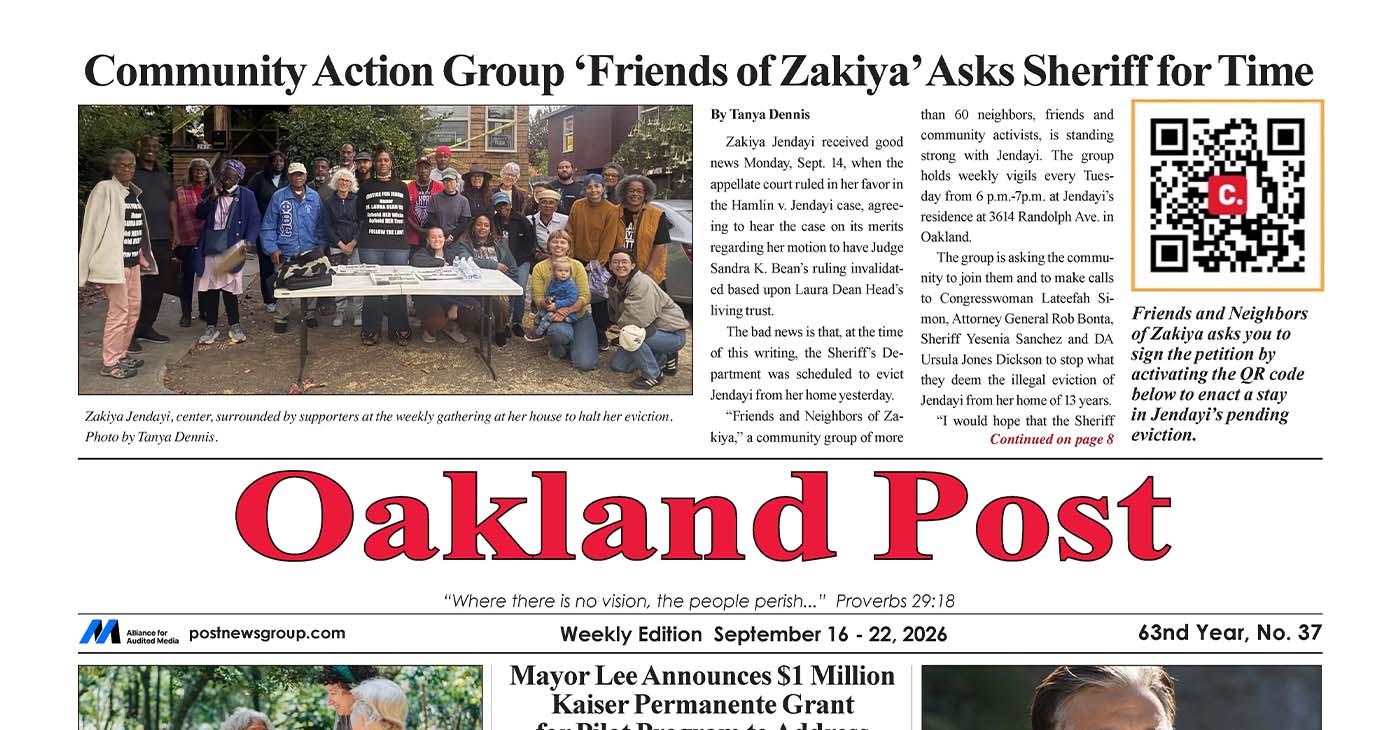
To enlarge your view of this issue, use the slider, magnifying glass icon or full page icon in the lower right corner of the browser window.

Activism
Oakland Post: Week of September 9 – 15, 2026
The printed Weekly Edition of the Oakland Post: Week of September 9 – 15, 2026

To enlarge your view of this issue, use the slider, magnifying glass icon or full page icon in the lower right corner of the browser window.
Activism
Oakland Post: Week of September 2 – 8, 2026
The printed Weekly Edition of the Oakland Post: Week of September 2 – 8, 2026
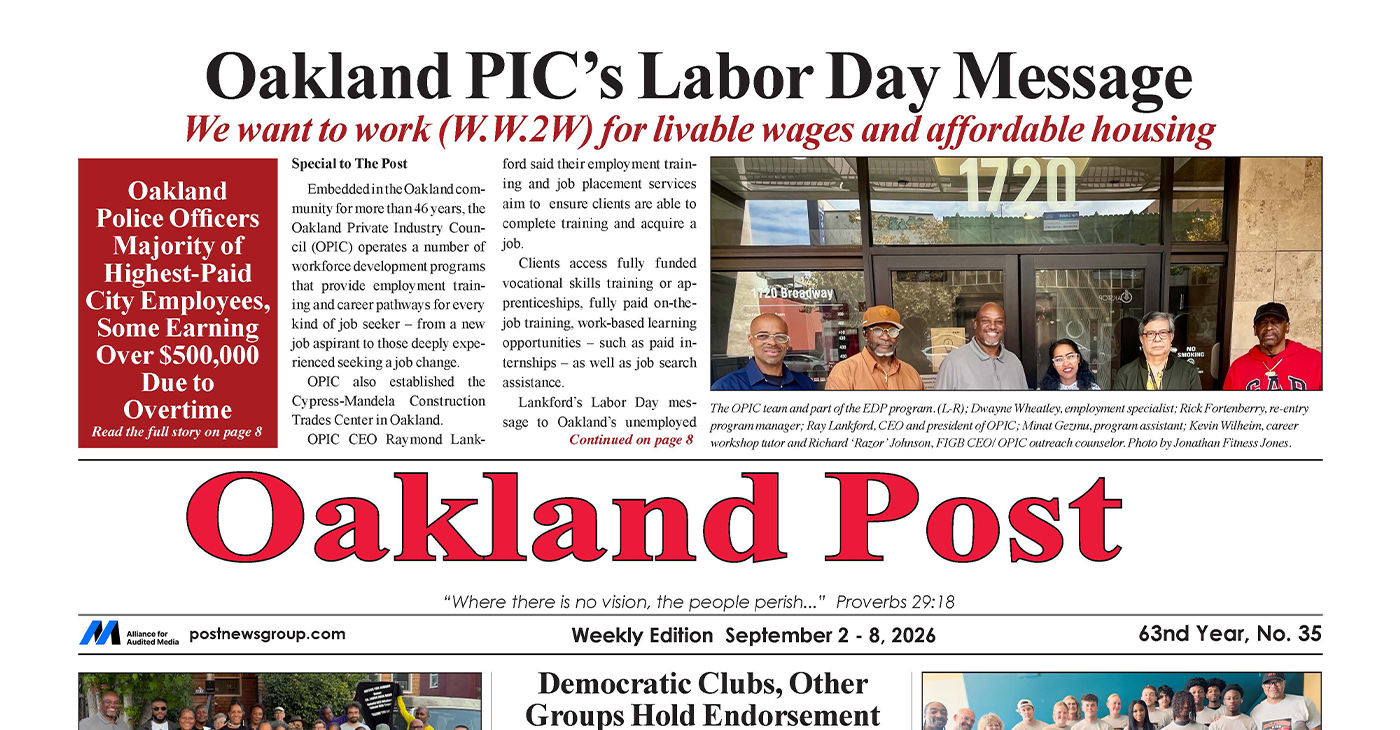
To enlarge your view of this issue, use the slider, magnifying glass icon or full page icon in the lower right corner of the browser window.



Newsom Signs Addictive Social Media Law to Protect Kids

On Your November Ballot: Prop 38 Would Allocate $8.4 Billion to Immunology and Immunotherapy Funding

Ask California: Golden State Releases New AI Chatbot

Asm. Isaac Bryan’s Bill Banning California Police From ICE Side Jobs Reaches Newsom’s Desk

Assemblymember LaShae Sharp-Collins’s Bill Would Pause Law Enforcement’s Use of Shock Gloves Pending Study

BOOK REVIEW: ‘Laws of Solomon’ Reveals Tender Heart of Former Child Soldier

OPINION: The New American Fear – From 9-11 to AI

Passing for White, Fighting for Black America: The Courage of Walter White

Oakland People’s Arms Embargo Coalition Demands End to Military Shipments Thru Oakland

Barbara Lee Mourns Gloria Steinem, Remembers a Friendship Rooted in Equality

Event Preview: ‘Fashion v. Fascism’ – A Runway Revolution Is Coming to the Bay Area

Two Looming Threats Every Alameda County Elder Should Know About

Oakland Mayor Reads to Children at Bookout Block Party at Marcus Books Store

Tradition Comes to the Streets in 11th Annual Black-Eyed Pea Festival at the Freedom Farmers Market

Attorney General Rob Bonta Continues Opposition to President Trump’s Tariff Regime

Less Affluent School Districts, Including Sacramento City, Face Threat of State Takeover

Car Wash Workers Cope with Lingering Impacts of ICE Raids

ESSAY: California Can Close Its Colorectal Cancer Gap

California Hispanic Chambers of Commerce Unveils: ‘Powering the Future’ Theme for 47th Annual Statewide Convention

Four Candidates, Including Incumbent Barbara Lee, Qualify for Oakland Mayor’s Race

Oakland Post: Week of August 12 – 18, 2026

From Blueprint to Breakthrough: Tackling Affordable Housing in Oakland

Oakland Observes Black August with Block Parties, Film Showings, Workshops

Misty Copeland Shapes Ballet’s Tomorrow

COMMENTARY: Why Local School Tax Measure G1 Will Not Be on the November Ballot

Standoff for Justice: Our Homes Are Worth Fighting For

Returning to Its Roots, the Oakland Black-Eyed Pea Festival Partners with the Freedom Farmers Market Sept. 12

NPRC Scores First Advocacy Victory: David Shaw Finally Gets His Wish to ‘Go Home’

Oakland Post: Week of August 26 – September 1, 2026

Gubernatorial Candidate Steve Hilton Blasts California New Tire Rules; Newsom Hits Back

The Conversation With Al McFarlane 6/23/26

Media Monday 6/22/26

LIVE! ASK ALMA! — TUES. 6.23.26 7PM EST

Car Buying Secrets: 4 Hidden Checks Before You Sign!

Is This 550 HP Charger Worth YOUR Money? AutoNetwork Review

Celebrating Juneteenth – Frederick Douglass on education and resistance

LIVE! — ASK ALMA! — TUES. 6.19.26 7PM EST

Hyundai Ioniq 5 Parking, Safety, and 360 View #shorts

2025 Ioniq 5 New Wiper & Powerful Performance! #shorts

Electric SUV Range: Is 259 Miles Enough? #shorts

EV Charging: How Fast Can You Charge an Electric Vehicle? #shorts

Biometric Cooling… Messaging Seats…Come on! 2025 Infiniti QX80 Autograph 4WD

Charged Up: Witness the Magic of a Fully Electric Car! #shorts

Range Rover Sport PHEV Included…: See What’s Inside This Luxury SUV! #shorts

Invisible Hood View: Perfect Parking with X-Ray Vision! #shorts
-
 Commentary4 weeks ago
Standoff for Justice: Our Homes Are Worth Fighting For
-
 Activism4 weeks ago
Oakland Post: Week of August 26 – September 1, 2026
-
 Business3 weeks ago
Gubernatorial Candidate Steve Hilton Blasts California New Tire Rules; Newsom Hits Back
-

 Business3 weeks ago
Frontier Airlines’ Return to Oakland Airport Brings Flights, Jobs and Opportunity
-

 Business3 weeks ago
Chef Sharon Lee Blends Culinary Excellence, Education and Empowerment
-

 Education3 weeks ago
Gov. Newsom’s Latest Appointees Include Sacramento Advocate for Formerly Incarcerated Students; State’s New Tech Chief
-

 Business3 weeks ago
Oakland Coliseum Project Opens Door for Small Businesses to Build Bigger
-

 Community3 weeks ago
Big City Mayors Ask for “Yes” Vote on Housing Bond Measure; Conservatives Say “No”
