
Politics
Clinton: U.S. Needs Solutions to Income Inequality


Former Secretary of State Hillary Rodham Clinton speaks at an event hosted by the Center for American Progress (CAP) and the America Federation of State, County and Municipal Employees (AFSCME), Monday, March 23, 2015, in Washington. (AP Photo/Pablo Martinez Monsivais)
Ken Thomas, ASSOCIATED PRESS
WASHINGTON (AP) — Approaching a likely presidential campaign announcement next month, Hillary Rodham Clinton said Monday that income inequality and wage stagnation are problems that go hand-in-hand and the nation needs creative solutions to bolster job opportunities and living conditions in the cities.
Clinton, at a discussion about urban areas, cited the benefits of partnerships between the private and public sectors and updated policies to improve social mobility. The policy event offered a preview of economic themes she is likely to address in a campaign.
“We need to think hard about what we’re going to do now that people are moving back into and staying in cities to make sure that our cities are not just places of economic prosperity and job creation on average,” Clinton said. “But do it in a way that lifts everybody up to deal with the overriding issues of inequality and lack of mobility.”
Her appearance at the Center for American Progress, a Democratic think tank founded by allies of her husband, former President Bill Clinton, offered no new clues on the timing of her announcement, but plenty of presidential atmospherics. Clinton was joined by Housing Secretary Julian Castro, considered a potential running mate for Clinton by some Democrats, and the heads of a public workers union and teachers union, two of Clinton’s most ardent labor allies.
Neera Tanden, a former Hillary Clinton policy adviser, is president of the center and moderated the discussion while the think tank’s founder, John Podesta, sat in the front row. Podesta, a former Bill Clinton chief of staff, is expected to take a senior position in Hillary Clinton’s presidential campaign.
Many Democrats support boosting wages and household income and argue that many families have yet to benefit from an improving job market. Liberals, led most visibly by Massachusetts Sen. Elizabeth Warren, say the party has become too intertwined with Wall Street and needs bold strategies to address inequality.
Clinton said economic problems have been acutely felt by young people, with more than 5 million people between the ages of 16 and 24 not in school or employed and in need of job skills and training. She urged leaders to get out of their “ideological bunkers” and said they could learn from the work of one panelist, Mayor Aja Brown of Compton, Calif., on curbing gang violence.
“Don’t be surprised if you get a call to come and maybe we’ll start not too far from here in a beautiful domed building,” Clinton said to laughter, referring to the U.S. Capitol. “Get everybody in the same room and start that conversation that could lead to collaboration and better results for our cities and our country.”
Joined at the event by Lee Saunders of the American Federation of State, County and Municipal Employees and Randi Weingarten of the American Federation of Teachers, Clinton made no mention of a trade proposal backed by President Barack Obama called the Trans-Pacific Partnership. Some labor unions worry she might support the initiative, which they see as undermining jobs, environmental standards and worker rights. They call it “NAFTA on steroids” in a reference to the North American trade pact Clinton’s husband piloted with Canada and Mexico in the 1990s.
After an evening event, she has nothing more on her public schedule the rest of March.
___
Follow Ken Thomas on Twitter: https://twitter.com/KThomasDC.
Copyright 2015 The Associated Press. All rights reserved. This material may not be published, broadcast, rewritten or redistributed.
###




Community
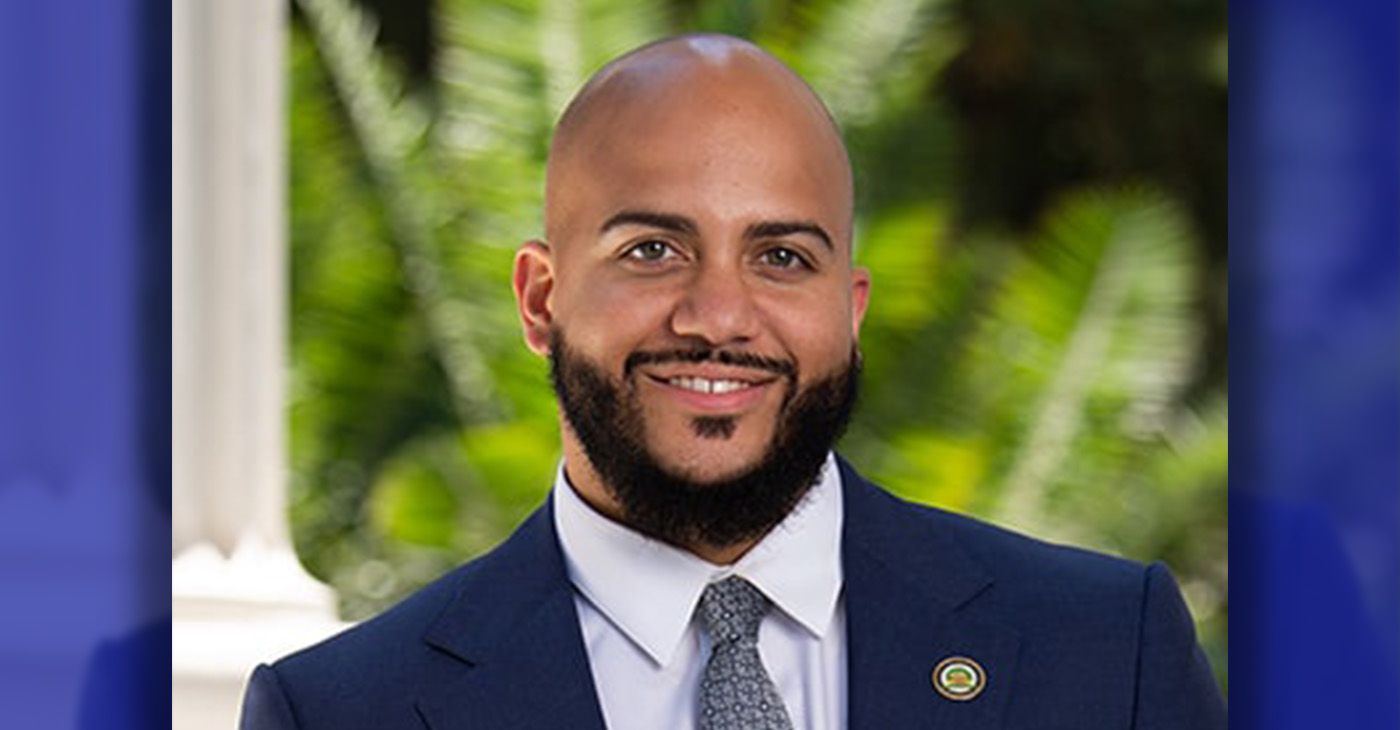
Asm. Isaac Bryan’s Environmental Reparations Bill Passes on Assembly Floor
“All this bill does is allocate resources from that repair fund and direct cash assistance to families that have had negative health impacts as a result of living next to that oil field,” said Bryan during remarks on the Assembly floor.

By Bo Tefu, California Black Media
On May 26, the California State Assembly passed legislation to provide direct financial assistance to families harmed by pollution from a major urban oil field in South Los Angeles.
Assembly Bill (AB) 1661, introduced by Assemblymember Isaac Bryan (D-Ladera Heights), cleared the Assembly floor with a 44-10 vote after lawmakers concluded debate on the measure.
The bill would direct money from a community repair fund toward families who suffered negative health effects from living near what Bryan described as the state’s largest toxic urban oil field. The repair fund was created under legislation approved two years ago that shut down the oil field and required polluters to contribute financially to community recovery efforts.
“All this bill does is allocate resources from that repair fund and direct cash assistance to families that have had negative health impacts as a result of living next to that oil field,” said Bryan during remarks on the Assembly floor.
Bryan called the proposal “the largest environmental reparations opportunity for South LA” and told lawmakers the bill had not received opposition during the legislative process.
The legislation is part of California’s broader push to address environmental justice concerns in communities historically exposed to industrial pollution. South Los Angeles residents and environmental advocates have long raised concerns about health risks associated with oil drilling operations near homes, schools and parks.
Supporters say the measure represents a new approach to environmental accountability by ensuring that communities affected by pollution directly benefit from funds collected from responsible companies.
After debate concluded, Assembly leadership opened the roll call vote, and the measure passed with majority support from lawmakers.
AB 1661 now moves to the Senate for further review.

Black History
COMMENTARY: Black Alliance for Just Immigration Supports Black Voting Rights!
OAKLAND POST — Historically, white conservative forces have sought to suppress Black political participation because Black communities have consistently organized, voted, and fought for policies rooted in justice, equity, and collective survival.

Special to The Post
The Black Alliance for Just Immigration (BAJI) condemns the continued gutting of the Voting Rights Act (VRA) and the broader assault on Black political power unfolding across the United States.
Black immigrants in the United States — whether citizens or not — share a common condition with Black Americans. Our ability to access housing, healthcare, education, labor protections, safety, and political representation is deeply tied to the political power of Black communities in this country.
When Black communities lose political power, all Black people across the diaspora become more vulnerable to displacement, criminalization, disenfranchisement, and state violence.
The U.S. cannot claim to be a multiracial democracy while systematically dismantling Black political representation and participation. An attack on Black voting power is an attack on all Black people across the diaspora and on the very possibility of a just democracy.
Voting is more than a civic exercise. Voting is about representation, access to resources, and the ability of communities to shape policies that determine whether we survive, thrive, or are left vulnerable to harm. It is both a right and an expectation of participation in public life.
For generations, however, Black people in the United States were systematically excluded from that right through both legal and extralegal violence — especially across the Deep South. The Voting Rights Act (VRA) of 1965 was won through bloodshed, sacrifice, organizing, and mass resistance led by Black communities demanding full participation in democracy.
The VRA sought to remedy generations of racial exclusion by requiring states with histories of racist voter suppression to receive federal approval before changing election laws or voting procedures, a process known as preclearance. Section 2 of the VRA also created protections to ensure that Black voters and other historically marginalized communities could elect candidates who would represent their interests.
Historically, white conservative forces have sought to suppress Black political participation because Black communities have consistently organized, voted, and fought for policies rooted in justice, equity, and collective survival.
For more than a decade, the Supreme Court has steadily dismantled the VRA protections.
In 2013, the Court’s Shelby v. Holder decision removed the federal preclearance requirement, opening the floodgates for states to pass voter suppression laws and redraw districts designed to dilute Black political power.
On April 29, the Supreme Court ruled that Louisiana’s congressional map was unconstitutional because it included two majority-Black districts. In a state where more than one-third of the population is Black, the Court has effectively declared that Black political representation itself is suspect.
This is not simply about maps or district lines. Gerrymandering is one tactic in a much larger project to weaken Black political power, undermine multiracial democracy, and consolidate power away from working-class communities and communities of color.
What the Supreme Court has done is allow racial gerrymandering to exclude Black people from political power, while the effort to ensure Black communities have representation is now considered unconstitutional. Gutting of the VRA is simply the latest chapter in a long history of efforts to silence Black voices and roll back the gains of the Civil Rights Movement.
At the same time, the rise of authoritarian, xenophobic politics under Pres. Donald Trump and the broader far right seeks to codify anti-Blackness, anti-immigrant policies, attacks on women, LGBTQ+ communities, and other marginalized groups into law. These attacks are interconnected.
“The United States cannot claim to be a multiracial democracy while systematically dismantling Black political power,” said Nana Gyamfi, executive director of BAJI. “Black immigrants understand that our conditions are tied to the conditions of Black Americans; together then, together now. When Black communities lose political power, all Black people become more vulnerable to displacement, criminalization, disenfranchisement, and state violence. Protecting Black voting rights is not just about elections. It is about protecting the possibility of collective freedom and self-determination for our communities.”
BAJI remains committed to defending Black political power, strengthening Black migrant civic participation, and building a future rooted in Black freedom, dignity, and collective liberation.
Activism
Oakland Post: Week of June 10 – 16, 2026
The printed Weekly Edition of the Oakland Post: Week of June 10 – 16, 2026
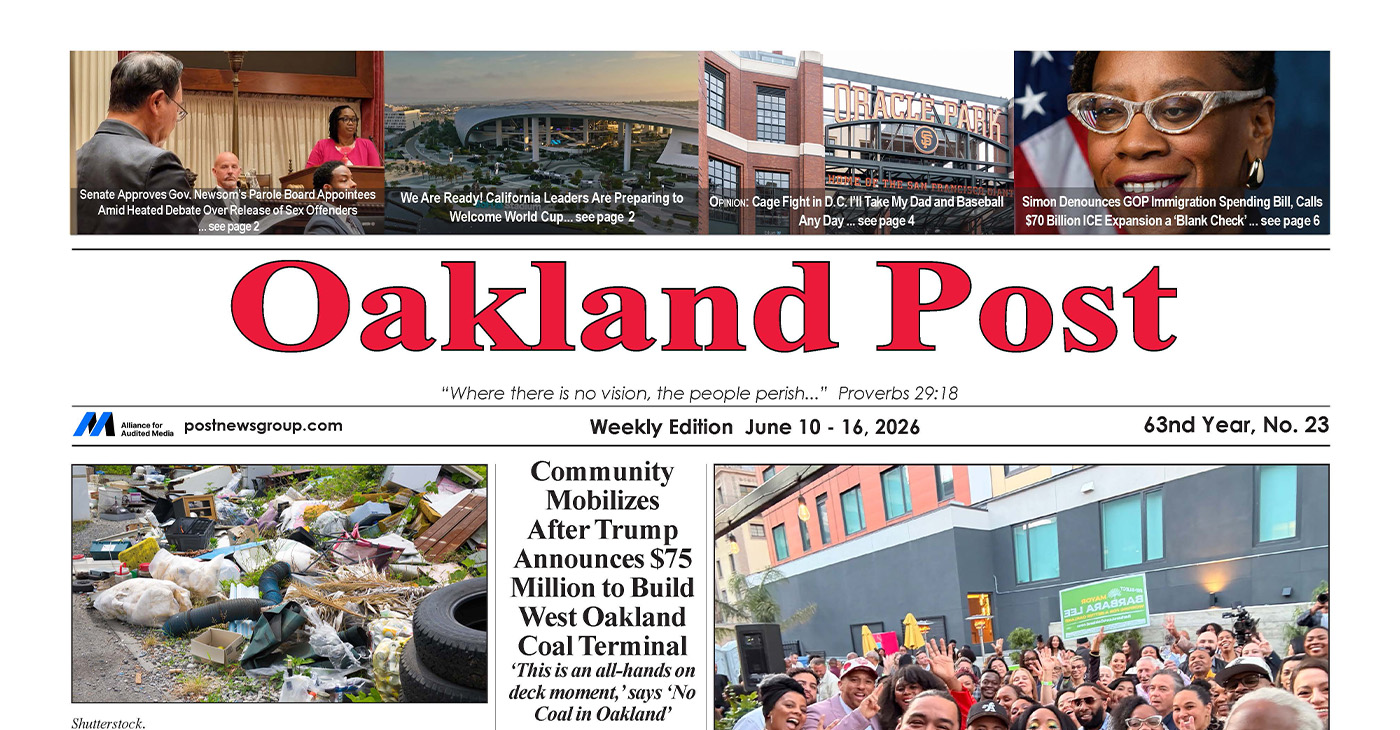
To enlarge your view of this issue, use the slider, magnifying glass icon or full page icon in the lower right corner of the browser window.
WORK FROM HOME
Home-based business with potential monthly income of $10K+ per month. A proven training system and website provided to maximize business effectiveness. Perfect job to earn side and primary income. Contact Lynne for more details: Lynne4npusa@gmail.com 800-334-0540


California Birth Rate Falls Below “Replacement Level”

Book Review: Something We Said: Richard Pryor, A Notorious Word, and Me

IN MEMORIAM: Longtime OUSD Employee Debra King-Cooper, 73

Asm. Isaac Bryan’s Environmental Reparations Bill Passes on Assembly Floor

COMMENTARY: Black Alliance for Just Immigration Supports Black Voting Rights!

Sale of Coliseum to African American Developers Moves Toward Completion

Celebrating Juneteenth – Frederick Douglass on education and resistance

LIVE! — ASK ALMA! — TUES. 6.19.26 7PM EST

Kansas City Launches Juneteenth Season with Parade Along 18th Street

Birmingham Launches In-Person Community Service Hub, Dynamic Website to Connect Residents to Essential Services

Saloon doors: How Black bars are reclaiming western style

Oakland Post: Week of June 10 – 16, 2026

Oakland Director Boots Dazzles Once Again in ‘I Love Boosters’

After 10-Year Wait, Fillmore Heritage Center Reopens in San Francisco

COMMENTARY: Black Music is the Sound of Black Freedom: Let Us Reclaim Both This Juneteenth

Book Review: Books for College-Bound Students

Against All Odds: Mary Jackson’s Journey to NASA Engineer

Q&A with Steven Bradford: Why He Wants Your Vote for California Insurance Commissioner

OPINION: The Fire of Oakland’s Justin Jones

The Marin City Flea Market Is Back

The Ladies of Delta Sigma Theta Hold Day of Advocacy at the Capitol in Sacramento

EBMUD Enshrines the Legacy of its First Black Board Member William ‘Bill’ Patterson

California Launches Free Diaper Program for Newborns Statewide

Oakland Mayor Pushes Charter Overhaul to Clarify Roles in City Government, Increase Accountability and Improve Service Delivery

Mayor Barbara Lee Declares ‘Delroy Lindo Day,’ Presents Acclaimed Actor with Key to the City

How Is AI Affecting California? The State Wants You to Share Your Story

Oakland Post: Week of May 6 – 12, 2026

Rep. Kamlager-Dove Introduces Bill to Protect Women in Custody After Reports Detailing Miscarriages and Neglect

Snoop Dogg Celebrates 10 Til’ Midnight at the Compound

OP-ED: Small Businesses Need Minnesota to Act on Pass-Through Tax Policy
Celebrating Juneteenth – Frederick Douglass on education and resistance
LIVE! — ASK ALMA! — TUES. 6.19.26 7PM EST

Hyundai Ioniq 5 Parking, Safety, and 360 View #shorts

2025 Ioniq 5 New Wiper & Powerful Performance! #shorts

Electric SUV Range: Is 259 Miles Enough? #shorts

EV Charging: How Fast Can You Charge an Electric Vehicle? #shorts

Biometric Cooling… Messaging Seats…Come on! 2025 Infiniti QX80 Autograph 4WD

Charged Up: Witness the Magic of a Fully Electric Car! #shorts

Range Rover Sport PHEV Included…: See What’s Inside This Luxury SUV! #shorts

Invisible Hood View: Perfect Parking with X-Ray Vision! #shorts

AI Is Reshaping Black Healthcare: Promise, Peril, and the Push for Improved Results in California

ESSAY: Technology and Medicine, a Primary Care Point of View

Sanctuary Cities

The RESISTANCE – FREEDOM NOW

STATE OF THE PEOPLE: Freddie
-

 #NNPA BlackPress1 week ago
5 Cleveland Police Officers Injured, Gunfire Erupts During East Side Pursuit
-

 Activism1 week ago
Oakland Post: Week of June 3 – 9, 2026
-

 #NNPA BlackPress1 week ago
2026 World Cup is Here and Atlanta is Ready For It
-
 #NNPA BlackPress1 week ago
COMMENTARY: Using Art, Healing, And Community to Transform Mental Health Dialogue
-
 Art1 week ago
After 10-Year Wait, Fillmore Heritage Center Reopens in San Francisco
-
 Activism3 weeks ago
Oakland Post: Week of May 27 – June 2, 2026
-

 #NNPA BlackPress1 week ago
Venus Williams Calls a Sabalenka Exit a Tragedy
-
 Arts and Culture1 week ago
COMMENTARY: Black Music is the Sound of Black Freedom: Let Us Reclaim Both This Juneteenth
