
Bay Area
California Reconsiders Potential of College Work-Study Jobs
When she returned to school to become a nurse, Karina Mendez wanted a work-study job that she could balance with classes at City College of San Francisco. Thanks to a new program in California, she landed one that does more than pay the bills — it gives her a career boost. Mendez works to support patients with cancer at UCSF, helping her get a foot in the door of a hospital where she’d love to be a nurse


By Emma Gallegos
EdSource

When she returned to school to become a nurse, Karina Mendez wanted a work-study job that she could balance with classes at City College of San Francisco. Thanks to a new program in California, she landed one that does more than pay the bills — it gives her a career boost.
Mendez works to support patients with cancer at UCSF, helping her get a foot in the door of a hospital where she’d love to be a nurse.
“It gives me a sense of hope that I could be a part of the UCSF department,” Mendez said.
She is one of the first beneficiaries of a new state-funded work-study program called the Learning-Aligned Employment Program. It pays the wages of students who are considered underrepresented in a job that aims to give them a leg up in their careers — unlike traditional work-study positions in campus cafeterias or bookstores that have little connection to students’ future career goals.
Besides medicine, the fields include tech, engineering, clean energy, education and university research.
The state invested $500 million of its budget surplus into the program, which is run by the California Student Aid Commission. Over 98% of public colleges and universities have signed on to participate.
The program is in its early days. Funds were rolled out to the state’s public colleges and universities this fall, and institutions have until 2031 to use them. Some colleges and universities have small pilot programs, but most are in the planning stages of using this funding.
It’s too soon to say how many students are participating statewide. In the long run, state funding could provide opportunities for about 100,000 students like Mendez — who makes $20 an hour — working 15 hours weekly for a semester.
Ohlone College in the East Bay has a small pilot, and it is hearing from other colleges in the Bay Area Community College Consortium looking for ideas of how best to spend the funding.
“It has taken a fair amount of time to figure out how we will use these LAEP funds, because it’s in its infancy,” said Kelsey Bensky, program manager for the college’s Career Services.
Eloy Ortiz Oakley, president and CEO of the College Futures Foundation, applauded California for using work-study funds this way. He called it “an important piece of a larger puzzle.”
“Students are hungry for this experience,” said Oakley, former chancellor of California Community Colleges. “They want to see that their work in the classroom is connected to their employment.”
Mendez said her role in the UCSF Patient Support Corps is giving her a preview of what a nurse’s duties look like. She reviews patients’ charts and checks in with them during telehealth appointments.
“I see words that I’m studying at school,” she said. “I’m learning how to communicate with cancer patients at a sensitive time in their life.”
Fixing The Disconnect Between School and Work
Most students work their way through college, but often these jobs have nothing to do with their career aspirations. The state and federal governments are working to change that.
Adele Burnes, deputy chief of Californa’s Division of Apprenticeship Standards, put it this way: “What if that work was really, intentionally connected to their education?”
Critics say that the lack of opportunities for college students to learn on the job is a symptom of the larger disconnect between the California economy and higher education. The state is making important strides on this front, Oakley said, but it is still behind many European countries, Singapore and even states like Indiana and Texas.
“Employers have not invested time and effort to make this work,” said Oakley. “Colleges don’t always have the resources to make this work.”
A lot of work goes into creating a high-quality internship, such as figuring out which students are eligible and vetting opportunities from employers, said Gina Del Carlo, the founding director of Earn & Learn. The Bay Area Community College Consortium contracted with Earn & Learn to guide 25 Bay Area colleges pursuing this work-study funding.
“It’s not as simple as: ‘Here’s an opportunity, here’s a student,’” said Alejandro Sandoval, director of product delivery and expansion for Earn & Learn.
Ohlone College has partnered with 11 organizations, including a local biotech company, an engineering company, a consulting firm and several community nonprofits. Del Carlo has noticed that many colleges are using the funds to pay students to conduct research relevant to their major.
Many fields, such as health care, technology, education and government, face shortages of educated workers.
But work-based learning opportunities that help students get a foothold in a new career have often been limited to building-trade apprenticeships like electrician or welder. Critics say white-collar professional internships — often unpaid — tend to go to well-connected students who can afford to forgo salaries.
This hurts both employers seeking workers and workers who fear college will leave them with debt rather than better career prospects, according to the Governor’s Council for Post-Secondary Education.
Despite placing a greater emphasis on vocational education, this has even been a problem at community colleges, said Sonya Christian, who was recently named chancellor of California Community Colleges.
She said the academic transfer mission should be better integrated with the vocational mission, and every student should expect a chance to learn on the job. She said “earn and learn” opportunities unite these two missions while opening higher education to students who thought they couldn’t afford it.
The Next Big Wave
The Learning-Aligned Employment Program launched in the 2021-21 budget after a report from the Governor’s Council for Post-Secondary Education warned: “Connections between higher education and the workforce are insufficient to meet the economic and workforce needs of California.”
The funds are intended for students who are considered underrepresented. That includes students are low-income, parents, displaced workers, formerly incarcerated, undocumented or have disabilities.
Those who are first generation in their families to attend college, current or former foster youth, homeless or at risk of becoming homeless are also eligible and given priority for the opportunities through state guidelines. Majors in science, technology, engineering or math (STEM) also have priority.
“This new approach to hiring low-income, first-generation college students to work in vital, growth industries provides students with valuable career opportunities, while also helping make those fields become more inclusive and diverse in the process,” said Marlene Garcia, executive director of the California Student Aid Commission.
This money from the state supports the UCSF Patient Support Corps’ efforts to recruit community college students whose diversity, language and culture mirror the patient population, said Jeff Belkora, director of the program.
“The whole idea of me being a Latina in this program, it makes me feel like I belong,” said Mendez. “It gives me hope that I could do this.”
The state opted to give colleges the money in a lump sum to give campuses the time and money to plan the program.
State funds will pay for up to half of student wages at for-profit employers, 90% at a public educational institution or a nonprofit and 100% of the wages at the UC, CSU or community colleges.
Only 5% of the funds can be spent on administration and the rest must be spent directly on students’ wages. Students should be paid a rate comparable to regular employees doing similar work in the company or in the same field. The state recommends that students be given academic credit as well.
Funds are distributed based on the share of students receiving a federal Pell Grant. That makes community colleges one of the biggest beneficiaries. They will receive 56% of funds, while 31.8% will go to the CSU system and the remaining 12.2% will go to the UCs.
Oakley believes the state is on the right track, but he hopes that these partnerships are not just short-lived, successful “boutique programs.” Programs should reach poor, underserved students and communities in the state, he said, and the state and federal governments don’t have a successful track record of making these programs accessible.
“The more streamlined we can make it, the less friction, the more we can make sure that it’s helping the people who need it the most,” he said.
One of the early programs is the Junior Leadership Academy at Ohlone College. Cohorts of 20 students receive coaching in a 15-week career readiness class for credit, while working on a project for a local employer that involves research connected to their field.
This includes business students working for a consulting firm and engineering students at an engineering firm.
Some employers and students have enjoyed the opportunity enough to seek to extend projects beyond their 75 hours-a-semester commitment.
While it has taken time to sort through funding restrictions, such as figuring out exactly which students are eligible, Bensky, the program manager at Ohlone, appreciates the flexibility the state has offered.
“It’s been quite a bit of work, but I’m happy,” said Bensky.












Activism
Oakland Post: Week of September 30 – October 6, 2026
The printed Weekly Edition of the Oakland Post: Week of September 30 – October 6, 2026

To enlarge your view of this issue, use the slider, magnifying glass icon or full page icon in the lower right corner of the browser window.
Activism
Oakland Post: Week of September 23 – 29, 2026
The printed Weekly Edition of the Oakland Post: Week of September 23 – 29, 2026
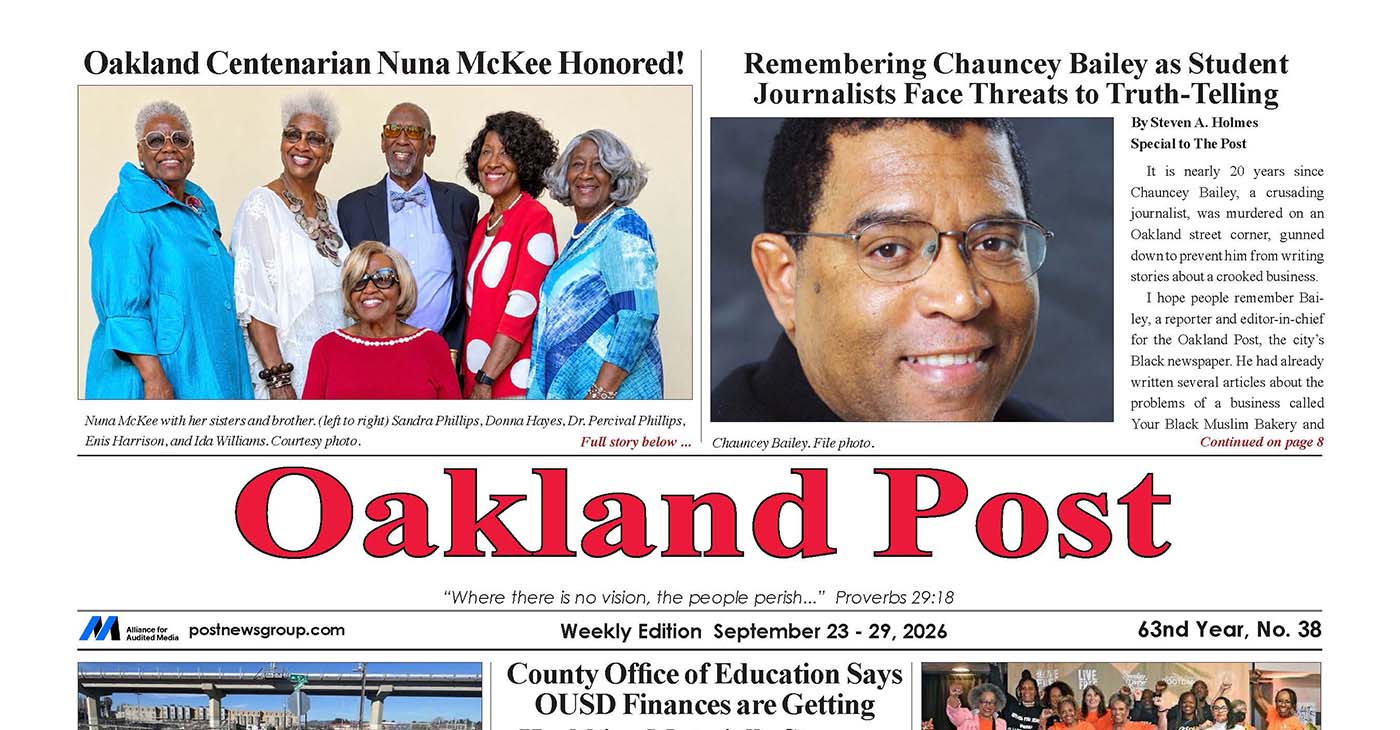
To enlarge your view of this issue, use the slider, magnifying glass icon or full page icon in the lower right corner of the browser window.
Activism
Oakland Post: Week of September 16 – 22, 2026
The printed Weekly Edition of the Oakland Post: Week of September 16 – 22, 2026

To enlarge your view of this issue, use the slider, magnifying glass icon or full page icon in the lower right corner of the browser window.



OP-ED: Proposition 44 Would Put a Price on Trust

OP-ED: Proposition 40: It’s Time to Play Chess, Not Checkers

Listening as a Lifeline: A Doula’s Witness to Black Maternal Health

New Protections for Ticket Buyers: Gov. Newsom Signs Assemblymember Isaac Bryan’s Bill

‘We Don’t Talk Trash — We Pick Up Trash!’

Zakiya Jendayi Arrested, Locked Out of Home by Sheriff’s Deputies

Oakland Post: Week of September 30 – October 6, 2026

Asm. Corey Jackson Announces Launch of 24-Hour Childcare in His District

IN MEMORIAM: The Rev. Leon “Sonny” Clark, Longtime Orange County Pastor and Community Leader, Dies at 72

Poll: Becerra Widens His Lead Over Hilton; Californians Split on Wealth Tax

From Historic Memories to New Possibilities: Oakland Celebrates Coliseum 60

County Office of Education Says OUSD Finances Are Getting Healthier, Materially Stronger

LIVE FREE Sunday Dinner Brings Faith, Fellowship and Civic Conversation to Oakland

Remembering Chauncey Bailey as Student Journalists Face Threats to Truth-Telling

BLACspace Cooperative Invites Bay Area to Experience Oakland’s Black Cultural Ecosystem Through a BLAC Map Tour + Party

Standoff for Justice: Our Homes Are Worth Fighting For

Oakland Post: Week of August 26 – September 1, 2026

Frontier Airlines’ Return to Oakland Airport Brings Flights, Jobs and Opportunity

Gubernatorial Candidate Steve Hilton Blasts California New Tire Rules; Newsom Hits Back

Chef Sharon Lee Blends Culinary Excellence, Education and Empowerment

Jackie Wright Champions Bay Area Stories, Filmmakers and Cultural Institutions

Misnamed ‘Parent’ PAC Seeks to Influence Oakland School Board Elections

Oakland Coliseum Project Opens Door for Small Businesses to Build Bigger

Big City Mayors Ask for “Yes” Vote on Housing Bond Measure; Conservatives Say “No”

Gov. Newsom’s Latest Appointees Include Sacramento Advocate for Formerly Incarcerated Students; State’s New Tech Chief

Longtime BWOPA Member Brendalyn Goodall Appointed to California Workforce Development Board

Gov. Newsom Signs Law Shielding Immigration Aid Workers From Doxing Threats

Secretary of State Shirley N. Weber Urges Californians to Vote Early as Voter ID Battle Intensifies

Oakland Post: Week of September 2 – 8, 2026

IN MEMORIAM: Dolly Parton Dead at 80 — How She Built a Legacy of Love and Earned Her Place in Black Culture

The Conversation With Al McFarlane 6/23/26

Media Monday 6/22/26

LIVE! ASK ALMA! — TUES. 6.23.26 7PM EST

Car Buying Secrets: 4 Hidden Checks Before You Sign!

Is This 550 HP Charger Worth YOUR Money? AutoNetwork Review

Celebrating Juneteenth – Frederick Douglass on education and resistance

LIVE! — ASK ALMA! — TUES. 6.19.26 7PM EST

Hyundai Ioniq 5 Parking, Safety, and 360 View #shorts

2025 Ioniq 5 New Wiper & Powerful Performance! #shorts

Electric SUV Range: Is 259 Miles Enough? #shorts

EV Charging: How Fast Can You Charge an Electric Vehicle? #shorts

Biometric Cooling… Messaging Seats…Come on! 2025 Infiniti QX80 Autograph 4WD

Charged Up: Witness the Magic of a Fully Electric Car! #shorts

Range Rover Sport PHEV Included…: See What’s Inside This Luxury SUV! #shorts

Invisible Hood View: Perfect Parking with X-Ray Vision! #shorts
-
 Community3 weeks ago
Misnamed ‘Parent’ PAC Seeks to Influence Oakland School Board Elections
-
 Activism4 weeks ago
Oakland Post: Week of September 2 – 8, 2026
-

 Activism3 weeks ago
Oakland Post: Week of September 9 – 15, 2026
-

 Community3 weeks ago
Richmond Tiny House Village Farm & Garden Set to Open Gates on Sept. 26
-

 Black History3 weeks ago
Latest Massacre in Haiti Reveals Cruelty U.S. Deportations
-

 Black History3 weeks ago
OPINION: Nolan Wells’ Death One of Several Signifying Racial Terror Lives on in U.S. South
-

 Business2 weeks ago
Mayor Lee Announces $1 Million Kaiser Permanente Grant for Pilot Program to Address Homelessness, Clean Up Public Spaces throughout Oakland
-

 Community3 weeks ago
Democratic Clubs Interview Candidates for Oakland School Board
