
California Black Media
California Black Media Political Roundup
Last week, Gov. Gavin Newsom and the Legislature reached an agreement on a state budget totaling $310.8 billion for the 2023-24 fiscal year. It came into effect July 1. The agreement includes provisions for trailer bills that support clean transportation, expanded Medi-Cal coverage, expedited judicial review, advanced mitigation by Caltrans, the conversion of San Quentin into a rehabilitation center and wildlife crossings on I-15, among other initiatives.

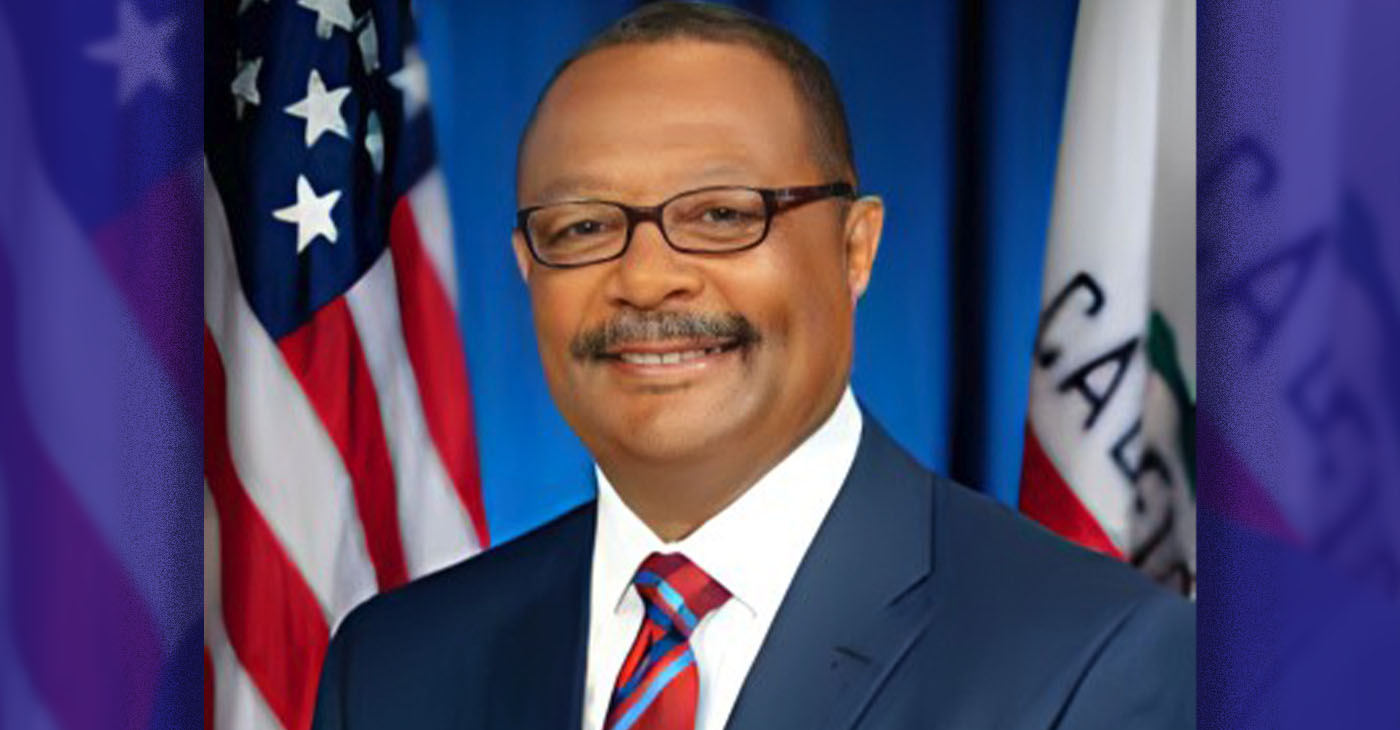
By Joe W. Bowers Jr. and Edward Henderson California Black Media
Your roundup of stories you might have missed last week.
Gov. Newsom, Legislature Agree on $310.8 Billion Budget
Last week, Gov. Gavin Newsom and the Legislature reached an agreement on a state budget totaling $310.8 billion for the 2023-24 fiscal year. It came into effect July 1.
The agreement includes provisions for trailer bills that support clean transportation, expanded Medi-Cal coverage, expedited judicial review, advanced mitigation by Caltrans, the conversion of San Quentin into a rehabilitation center and wildlife crossings on I-15, among other initiatives.
“In the face of continued global economic uncertainty, this budget increases our fiscal discipline by growing our budget reserves to a record $38 billion, while preserving historic investments in public education, health care, climate, and public safety,” said Newsom.
Negotiations had been delayed because of Newsom’s demands, including an infrastructure proposal that lawmakers opposed. A compromise was reached by limiting the types of projects eligible for expedited approval permits and excluding a proposed water conveyance tunnel under the Sacramento-San Joaquin River Delta.
“We started our budget process this time around with tough economic challenges, but one overarching goal: to protect California’s progress,” said Senate President pro Tempore Toni G. Atkins (D-San Diego).
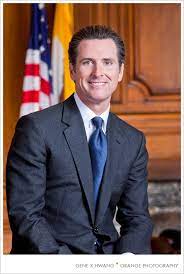
Gov. Gavin Newsom. Official portrait.
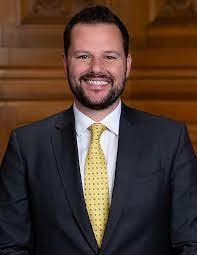
Assemblymember Matt Haney (D-San Francisco), chair of the Rental Caucus, introduced Senate Bill 555 which aims to cap security deposits by no more than one month’s rent. Official portrait.
On July 1, California Officially Recognized Juneteenth as a State Holiday
On July 1, Assembly Bill (AB) 1655, which declares Juneteenth an official California state holiday, took effect.
AB 1655, introduced by Assemblymember Reggie Jones-Sawyer (D-Los Angeles), a member of the California Legislative Black Caucus, was signed into law by Gov. Newsom last September.
On June 19 of next year, California state employees can elect to take the day off work to commemorate the holiday celebrating the emancipation of formerly enslaved Black Americans.
California “Renters Caucus” Announces Pro-Tenant Bills
On June 29, The California Legislative Renters Caucus — a group of five lawmakers who are all renters — held a press conference to announce a package of bills aimed to protect the rights of tenants in California.
The Renters’ Caucus was formed in 2022 in response to the state’s dire housing crisis. This unique caucus is committed to ensuring that the interests of California’s 17 million renters are represented in state government.
Each member of the caucus is responsible for introducing a bill for consideration. Assemblymember Matt Haney (D-San Francisco), chair of the Rental Caucus, hosted the press conference and introduced Senate Bill (SB) 555. The bill aims to cap security deposits by no more than one month’s rent.
“Each of the pieces of our legislative agenda is addressing a different challenge that renters are facing,” said Haney.
Assemblymember Isaac Bryan (D- Ladera Heights), vice chair of the elections caucus, introduced AB 1248. This bill limits independent redistricting to fight gerrymandering.
Assemblymember Alex Lee (D-San Jose) introduced AB 309. The bill would set eligibility criteria for residents of social housing and establish a lottery system for selecting residents.
Assemblymember Tasha Boerner (D-Encinitas) introduced AB 548, which protects renters by giving more authority to inspectors to ensure safe living conditions.
Sen. Aisha Wahab (D-Hayward) introduced SB 555 which creates a practical, data-driven masterplan that outlines a plan to produce 1.2 million affordable housing units over the next 10 years.
Attorney General Bonta Releases 2022 Hate Crime Report: Blacks Still Most Targeted Group
California Attorney General Rob Bonta on June 27 released the 2022 Hate Crime in California Report. The document also highlighted resources to support ongoing efforts across the state to combat hate.
In California, hate crime events rose by 20.2% from 1,763 in 2021 to 2,120 in 2022.
Reported hate crimes targeting Black people remain the most prevalent and increased 27.1% from 513 in 2021 to 652 in 2022, while reported anti-Asian hate crime events decreased by 43.3% from 247 in 2021 to 140 in 2022.
Hate crimes involving sexual orientation bias rose by 29% from 303 in 2021 to 391 in 2022.
“This report is a stark reminder that there is still much work to be done to combat hate in our state. I urge local partners and law enforcement to review these findings and recommit to taking action,” said Bonta. “The alarming increases in crimes committed against Black, LGBTQ+ and Jewish people for the second year in a row illustrates the need for our communities to join together unified against hate.”
Controller Malia Cohen Updates her Office’s Compensation in Government
State Controller Malia M. Cohen published 2022 self-reported payroll data for cities and counties on the Government Compensation in California website. The data cover 688,912 positions and a total of more than $54.65 billion in 2022 wages.
Users of the site can view compensation levels on maps and search by region, narrow results by name of the entity or by job title and export raw data or custom reports.
The data covers 459 cities and 53 counties. The City of Hayward had the highest average city employee wage, followed by Pleasant Hill, Atherton, and Hillsborough.
Topping the list for highest average county employee wage were Alameda, Los Angeles, San Mateo, Monterey, and Sacramento counties.
The highest-salaried city employee in California was the City Manager for the City of Montebello. The top 25 highest-paid county employees work in health care.










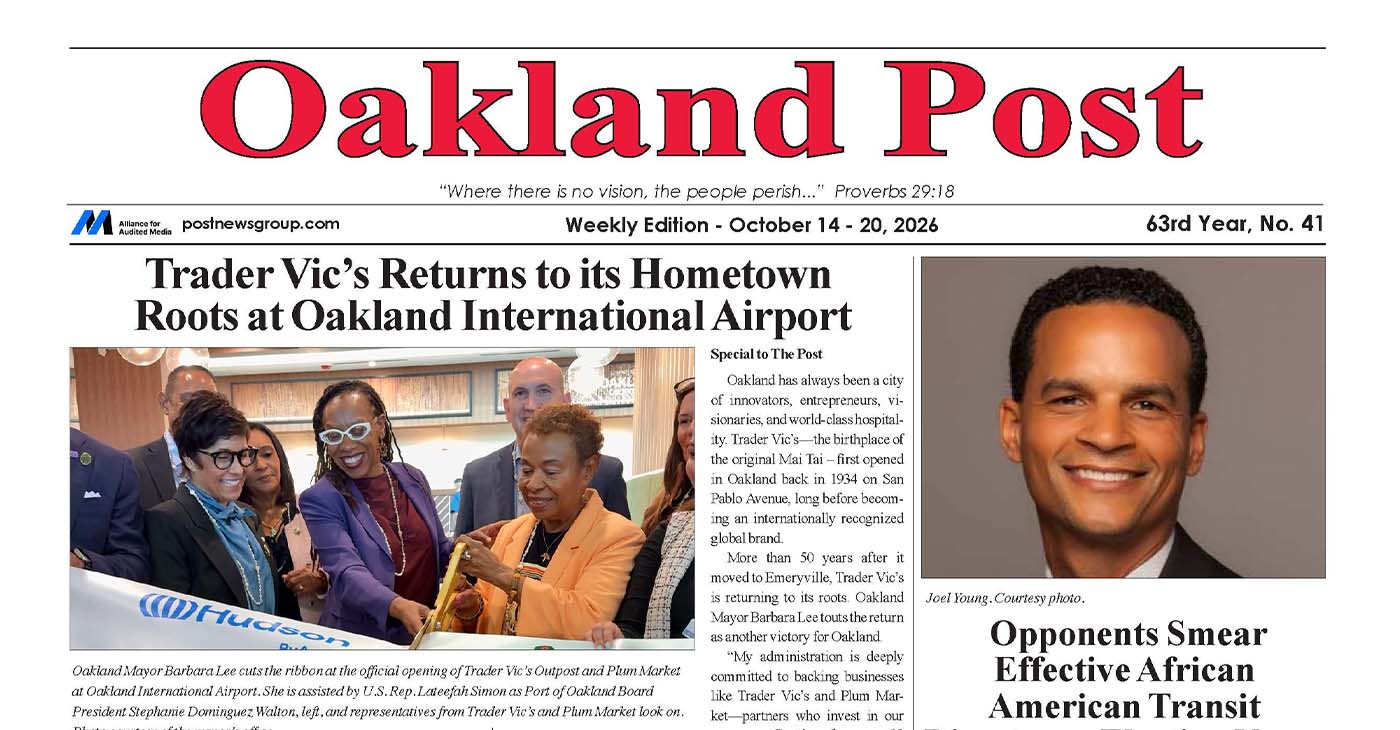
To enlarge your view of this issue, use the slider, magnifying glass icon or full page icon in the lower right corner of the browser window.

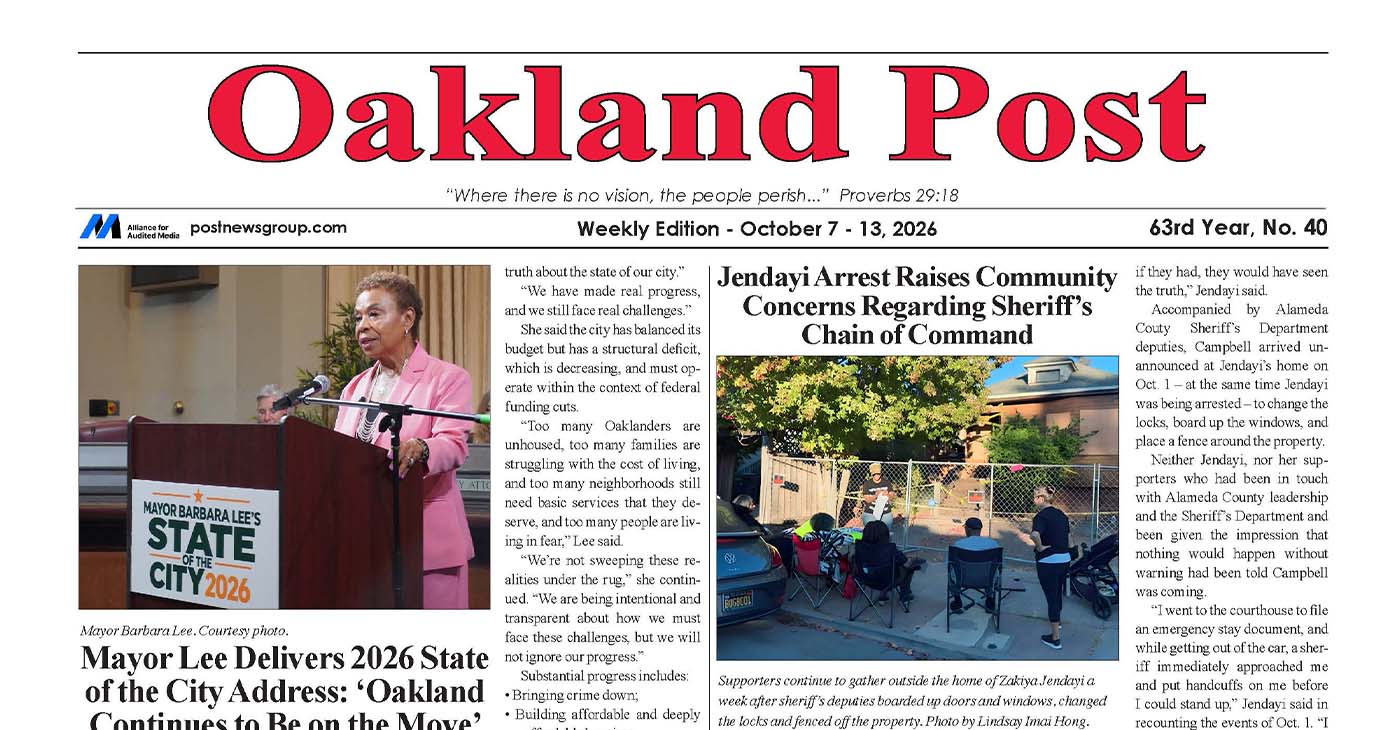
To enlarge your view of this issue, use the slider, magnifying glass icon or full page icon in the lower right corner of the browser window.
Activism
Oakland Post: Week of September 30 – October 6, 2026
The printed Weekly Edition of the Oakland Post: Week of September 30 – October 6, 2026

To enlarge your view of this issue, use the slider, magnifying glass icon or full page icon in the lower right corner of the browser window.


Mayor Barbara Lee Holds Special State of the City Address in Deep East Oakland

Practitioners of African Traditional Spirituality Offer Ancestral Reverence Ritual Oct. 31

It’s Time to Lose Weight Before the Holidays

Trader Vic’s Returns to Its Oakland Roots

Oakland Coal Terminal Backed by Trump Would Be Bigger, Dirtier Than Promised, Says Report

Opponents Smear Effective African American Transit Director as Election Nears

Oakland Post: Week of October 14 – 20, 2026

OP-ED: The Black Church Writes AI’s Next Chapter

OP-ED: The Black Church Writes AI’s Next Chapter

WCCUSD Joins Statewide Organic School Food Purchasing Cooperative

Democrats, Community Groups Back Measure EE to Change How Oakland Is Governed

Four Tips to Help You Plan a Holiday “Staycation”

Veterans Housing Project Proposed for South Richmond
PRESS ROOM: Transformative Justice Coalition 2026 Voting Rights Champion Awards Reception ‘Yesterday Is Today: The Battle For Voting Rights

Mayor Lee Delivers 2026 State of the City Address: ‘Oakland Continues to Be on the Move’

Misnamed ‘Parent’ PAC Seeks to Influence Oakland School Board Elections

Listening as a Lifeline: A Doula’s Witness to Black Maternal Health

Poll: Becerra Widens His Lead Over Hilton; Californians Split on Wealth Tax

County Office of Education Says OUSD Finances Are Getting Healthier, Materially Stronger

Oakland Post: Week of September 9 – 15, 2026

Doulas Are Helping Black California Moms Navigate Pregnancy–Even as High Mortality Rates Persist

Mayor Lee Announces $1 Million Kaiser Permanente Grant for Pilot Program to Address Homelessness, Clean Up Public Spaces throughout Oakland

Richmond Tiny House Village Farm & Garden Set to Open Gates on Sept. 26

Zakiya Jendayi Arrested, Locked Out of Home by Sheriff’s Deputies

Latest Massacre in Haiti Reveals Cruelty U.S. Deportations

OPINION: Nolan Wells’ Death One of Several Signifying Racial Terror Lives on in U.S. South

BLACspace Cooperative Invites Bay Area to Experience Oakland’s Black Cultural Ecosystem Through a BLAC Map Tour + Party

Democratic Clubs Interview Candidates for Oakland School Board

Oakland Post: Week of September 16 – 22, 2026

Oakland People’s Arms Embargo Coalition Demands End to Military Shipments Thru Oakland

The Conversation With Al McFarlane 6/23/26

Media Monday 6/22/26

LIVE! ASK ALMA! — TUES. 6.23.26 7PM EST

Car Buying Secrets: 4 Hidden Checks Before You Sign!

Is This 550 HP Charger Worth YOUR Money? AutoNetwork Review

Celebrating Juneteenth – Frederick Douglass on education and resistance

LIVE! — ASK ALMA! — TUES. 6.19.26 7PM EST

Hyundai Ioniq 5 Parking, Safety, and 360 View #shorts

2025 Ioniq 5 New Wiper & Powerful Performance! #shorts

Electric SUV Range: Is 259 Miles Enough? #shorts

EV Charging: How Fast Can You Charge an Electric Vehicle? #shorts

Biometric Cooling… Messaging Seats…Come on! 2025 Infiniti QX80 Autograph 4WD

Charged Up: Witness the Magic of a Fully Electric Car! #shorts

Range Rover Sport PHEV Included…: See What’s Inside This Luxury SUV! #shorts

Invisible Hood View: Perfect Parking with X-Ray Vision! #shorts
-
 Black History3 weeks ago
Listening as a Lifeline: A Doula’s Witness to Black Maternal Health
-
 Economy4 weeks ago
Poll: Becerra Widens His Lead Over Hilton; Californians Split on Wealth Tax
-
 Business4 weeks ago
County Office of Education Says OUSD Finances Are Getting Healthier, Materially Stronger
-
 Lead Story3 weeks ago
Zakiya Jendayi Arrested, Locked Out of Home by Sheriff’s Deputies
-
 Art4 weeks ago
BLACspace Cooperative Invites Bay Area to Experience Oakland’s Black Cultural Ecosystem Through a BLAC Map Tour + Party
-
 Business4 weeks ago
From Historic Memories to New Possibilities: Oakland Celebrates Coliseum 60
-
 Community4 weeks ago
Asm. Corey Jackson Announces Launch of 24-Hour Childcare in His District
-

 Black History4 weeks ago
IN MEMORIAM: The Rev. Leon “Sonny” Clark, Longtime Orange County Pastor and Community Leader, Dies at 72
