
Activism
Black Leaders: Redistricting Process Is “Rushed, Inconsistent, Incomplete”
According to the California Citizens Redistricting Commission, because the proposed maps chop up and split districts where African Americans live, Black political power will be diluted in Los Angeles County, San Diego County, the Central Valley, the Bay Area and the Inland Empire. To address the problem, they have submitted proposed maps to the redistricting commission that will protect Black political power and representation.


By Tanu Henry | California Black Media
African American leaders in California are keeping a close eye on the commission drafting congressional, state Senate, state Assembly and Board of Equalization voting maps. They are concerned about the outcome of the redistricting process.
On November 10, the California Citizens Redistricting Commission released the first draft maps of the redrawn lines for the state’s voting districts. By state law, the finalized versions of the new political districts have to be completed by December 27.
But advocates like James Woodson, the policy director of the California Black Census and Redistricting Hub (CBCRH), are asking the commission to press pause and re-evaluate the maps they have come up with so far.
The CBCRH, also called “the Black Hub” is a statewide coalition focused on “racial equity” and “fairness” in the redistricting process.
“The Black Hub appreciates the commission’s hard work and its early release of the maps for public input. At the same time, the Black Hub is deeply concerned that the process for developing the maps has been rushed, inconsistent, and incomplete,” said Woodson. “It has resulted in maps that have ignored the interests of many Black communities and millions of residents in the state’s most populated areas.”

For example, draft maps released by the commission last month collapsed the only two congressional districts in Los Angeles County represented by Black U.S. Congressmembers, Maxine Waters (D-CA-43) and Karen Bass (D-CA-37), into one district. After advocates and activists complained about African Americans losing political power, the commission separated the single district it was proposing into two constituencies again.
But because California lost one seat in the U.S. Congress due to an overall drop in the state’s population, according to the U.S. 2020 Census numbers, advocates worry that it will cause a ripple effect, which will change the racial and political composition of districts across the state.
The “Black Hub” leaders and other advocates in the state are urging Black Californians to speak up and provide input to ensure their communities do not lose representation or resources.
“It’s not just about us losing political power. It’s also about us losing assets,” said Kellie Todd Griffin, a resident of the Los Angeles County city of Carson, where the number of Black residents accounts for more than 25% of the city’s total population. Los Angeles County, where California is expected to lose one congressional seat, is home to about 40% of African Americans in the state.
Griffin, who is an organizer and entrepreneur, is known in California’s political circles for her outspoken advocacy on behalf of Black Californians. She says with the Olympics coming to Los Angeles in 2028, there will be a lot of development and an increase in revenue for government and businesses in Carson. Redrawn political districts, she fears, could hurt her city and others nearby economically.
“When you look at the maps, you see that our congressional district in Carson has been attached more to Redondo Beach and Rancho Palos Verdes instead of being connected to cities like Long Beach and Compton and places like that,” Griffin said. “There is also an assumption that Blacks and other minorities in the area vote the same on issues. As we know, that is not always true. We have specific issues that affect us Blacks differently. So, we vote differently on them – from some criminal justice reforms to the Crown Act.”
One of the realities driving the leaders’ concern is the possibility that the Black vote in five different regions of California will be diluted.
“Rather than adhere to map priorities from BIPOC communities, we are concerned that, in an effort to prioritize all voices, some commissioners have mistakenly and unknowingly elevated voices from less diverse, affluent communities in the process, and at the expense of BIPOC communities,” said Woodson.
According to CBCRH, because the proposed maps chop up and split districts where African Americans live, Black political power will be diluted in Los Angeles County, San Diego County, the Central Valley, the Bay Area and the Inland Empire. To address the problem, they have submitted proposed maps to the redistricting commission that will protect Black political power and representation.
Another major concern is the compressed timeline on which the commission is working, which limits the time for citizens to influence the line-drawing process. This year, due to pandemic-related federal delays, census data the commission relies on to redraw maps was delayed. Instead of its usual release in March, the U.S. Census Bureau did not provide that information until September 21.
“The Black Hub is deeply concerned that the process for developing the maps has been rushed, inconsistent, and incomplete. It has resulted in maps that have ignored the interests of many Black communities and millions of residents in the state’s most populated areas,” said a statement released by CBCRH last week.
Every 10 years, California appoints a new redistricting commission after the U.S. Census. It is tasked with mapping or re-drawing the state’s electoral lines based on population shifts in the state population over the decade between census counts.
According to Census 2020 numbers, California’s Black population decreased from about 2.5 to nearly 2.2 million over the last decade. However, there was a dramatic increase in the number of Californians who identify as more than one race — from 4.9% in 2010 to 14.6% in 2020.
In 2008, California voters approved the Citizens Redistricting Commission through a constitutional amendment called The Voters First Act or Proposition 11. It handed the function of drawing electoral maps to citizens. The policy was set up to avoid the political influence of government officials or special interest groups on the redistricting process.
Before the passage of Prop 11, the state Legislature was responsible for drawing its own electoral districts. There are five Democrats, five Republicans, and four members who are not affiliated with any political party on the committee.
When redrawing maps, the number of voters in all districts across the state has to be equal. That is roughly 761,000 people in each congressional district. For all state Senate districts that number is 988,000, and 494,000 people in Assembly districts.
In California, Blacks make up a little over 5% of the state’s population of about 40 million people. There are 52 congressional districts; 80 Assembly districts; and 40 Senate districts. For the state Board of Equalization, the body responsible for representing taxpayer interests and “equalizing” county-by-county tax assessments across California, there are four districts.
The commission has to comply with a number of constitutional mandates, including Voting Rights Act provisions that all minority groups must be able to elect a representative of their choice; a district must be whole or contiguous (connected geographically); among other rules.
Starting November 17 there will be a series of meetings during which the public will be able to provide their input to commissioners. Another round of map drawing sessions will commence November 30.
“We need to lift our voices and make sure we have said something. That we didn’t just sit by and let these lines be redrawn without us fighting for our interests. We have to define what community means to us,” said Griffin. “We have to make sure we are submitting written comments and letting people know the things that work for us and the things that don’t.”
To make a public comment to the commission, email votersfirstact@crc.ca.gov or complete the Community Feedback Form.
____________________________________________________________
Photo Caption:
Website Tags and Keywords:
Twitter Tags/Handles:
@Tanu_Henry @CaliforniaBlack2 @RepMaxineWaters @RepKarenBass @CACalls @jdublu44 @BlackPressUSA @NNPA_BlackPress












Activism
Oakland Post: Week of September 16 – 22, 2026
The printed Weekly Edition of the Oakland Post: Week of September 16 – 22, 2026

To enlarge your view of this issue, use the slider, magnifying glass icon or full page icon in the lower right corner of the browser window.
Activism
Oakland Post: Week of September 9 – 15, 2026
The printed Weekly Edition of the Oakland Post: Week of September 9 – 15, 2026

To enlarge your view of this issue, use the slider, magnifying glass icon or full page icon in the lower right corner of the browser window.
Activism
Oakland Post: Week of September 2 – 8, 2026
The printed Weekly Edition of the Oakland Post: Week of September 2 – 8, 2026
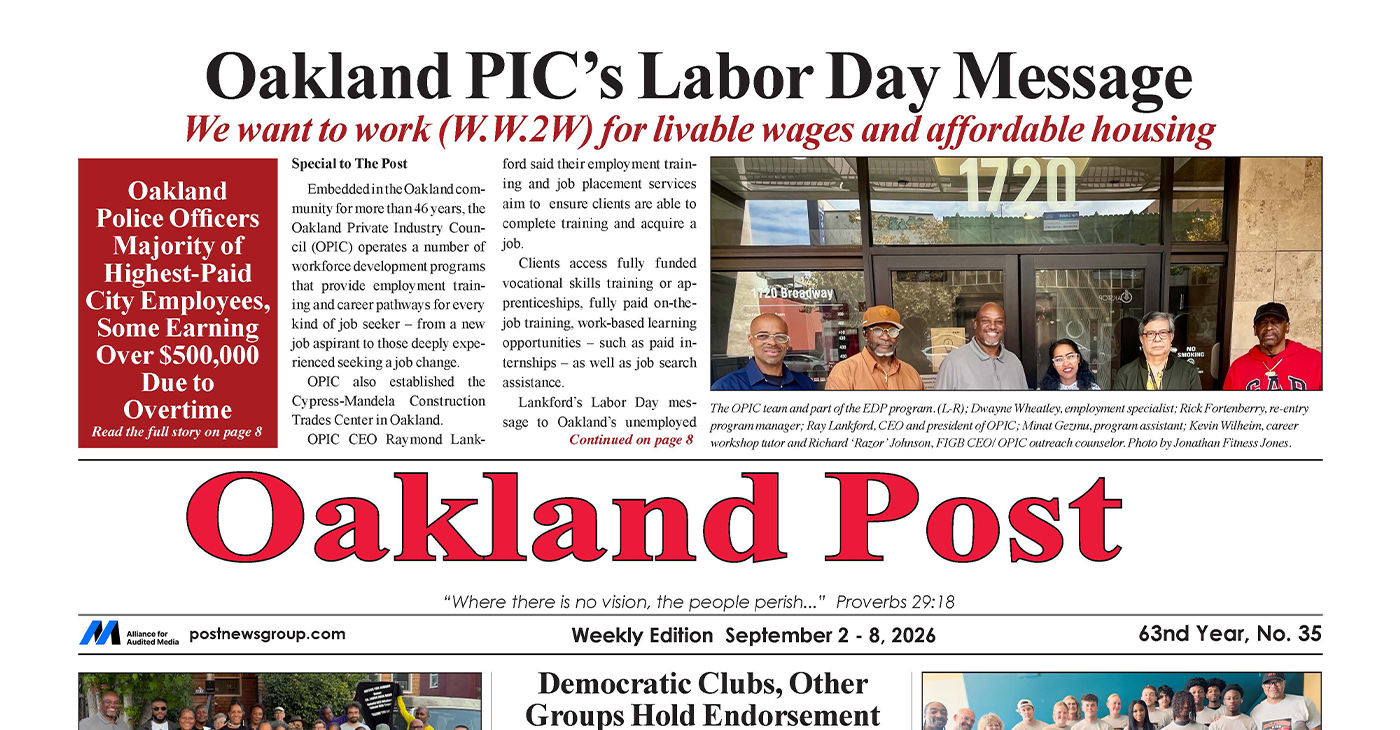
To enlarge your view of this issue, use the slider, magnifying glass icon or full page icon in the lower right corner of the browser window.



Doulas Are Helping Black California Moms Navigate Pregnancy–Even as High Mortality Rates Persist

Newsom Signs Addictive Social Media Law to Protect Kids

On Your November Ballot: Prop 38 Would Allocate $8.4 Billion to Immunology and Immunotherapy Funding

Ask California: Golden State Releases New AI Chatbot

Asm. Isaac Bryan’s Bill Banning California Police From ICE Side Jobs Reaches Newsom’s Desk

Assemblymember LaShae Sharp-Collins’s Bill Would Pause Law Enforcement’s Use of Shock Gloves Pending Study

BOOK REVIEW: ‘Laws of Solomon’ Reveals Tender Heart of Former Child Soldier

OPINION: The New American Fear – From 9-11 to AI

Passing for White, Fighting for Black America: The Courage of Walter White

Oakland People’s Arms Embargo Coalition Demands End to Military Shipments Thru Oakland

Barbara Lee Mourns Gloria Steinem, Remembers a Friendship Rooted in Equality

Event Preview: ‘Fashion v. Fascism’ – A Runway Revolution Is Coming to the Bay Area

Two Looming Threats Every Alameda County Elder Should Know About

Oakland Mayor Reads to Children at Bookout Block Party at Marcus Books Store

Tradition Comes to the Streets in 11th Annual Black-Eyed Pea Festival at the Freedom Farmers Market

Less Affluent School Districts, Including Sacramento City, Face Threat of State Takeover

ESSAY: California Can Close Its Colorectal Cancer Gap

California Hispanic Chambers of Commerce Unveils: ‘Powering the Future’ Theme for 47th Annual Statewide Convention

Four Candidates, Including Incumbent Barbara Lee, Qualify for Oakland Mayor’s Race

Oakland Post: Week of August 12 – 18, 2026

From Blueprint to Breakthrough: Tackling Affordable Housing in Oakland

Oakland Observes Black August with Block Parties, Film Showings, Workshops

COMMENTARY: Why Local School Tax Measure G1 Will Not Be on the November Ballot

Standoff for Justice: Our Homes Are Worth Fighting For

Returning to Its Roots, the Oakland Black-Eyed Pea Festival Partners with the Freedom Farmers Market Sept. 12

NPRC Scores First Advocacy Victory: David Shaw Finally Gets His Wish to ‘Go Home’

Oakland Post: Week of August 26 – September 1, 2026

Frontier Airlines’ Return to Oakland Airport Brings Flights, Jobs and Opportunity

Gubernatorial Candidate Steve Hilton Blasts California New Tire Rules; Newsom Hits Back

Chef Sharon Lee Blends Culinary Excellence, Education and Empowerment

The Conversation With Al McFarlane 6/23/26

Media Monday 6/22/26

LIVE! ASK ALMA! — TUES. 6.23.26 7PM EST

Car Buying Secrets: 4 Hidden Checks Before You Sign!

Is This 550 HP Charger Worth YOUR Money? AutoNetwork Review

Celebrating Juneteenth – Frederick Douglass on education and resistance

LIVE! — ASK ALMA! — TUES. 6.19.26 7PM EST

Hyundai Ioniq 5 Parking, Safety, and 360 View #shorts

2025 Ioniq 5 New Wiper & Powerful Performance! #shorts

Electric SUV Range: Is 259 Miles Enough? #shorts

EV Charging: How Fast Can You Charge an Electric Vehicle? #shorts

Biometric Cooling… Messaging Seats…Come on! 2025 Infiniti QX80 Autograph 4WD

Charged Up: Witness the Magic of a Fully Electric Car! #shorts

Range Rover Sport PHEV Included…: See What’s Inside This Luxury SUV! #shorts

Invisible Hood View: Perfect Parking with X-Ray Vision! #shorts
-
 Commentary4 weeks ago
Standoff for Justice: Our Homes Are Worth Fighting For
-
 Activism4 weeks ago
Oakland Post: Week of August 26 – September 1, 2026
-
 Business4 weeks ago
Frontier Airlines’ Return to Oakland Airport Brings Flights, Jobs and Opportunity
-
 Business4 weeks ago
Gubernatorial Candidate Steve Hilton Blasts California New Tire Rules; Newsom Hits Back
-
 Business4 weeks ago
Chef Sharon Lee Blends Culinary Excellence, Education and Empowerment
-

 Education4 weeks ago
Gov. Newsom’s Latest Appointees Include Sacramento Advocate for Formerly Incarcerated Students; State’s New Tech Chief
-

 Community4 weeks ago
Big City Mayors Ask for “Yes” Vote on Housing Bond Measure; Conservatives Say “No”
-

 Business4 weeks ago
Oakland Coliseum Project Opens Door for Small Businesses to Build Bigger
