
Activism
Black Developers Forum Celebrates Accomplishments
“Black developers should have the same opportunities that any other developer has to build great projects that benefit the community,” said Don Gilmore, executive director of the Community Housing Development Corporation and BDF’s vice president. “But the inequities in funding and related regulations have been and continue to be a barrier, and we will no longer be silent. We’re using our collective voice and resources to demand that Black developers be provided the equitable opportunities that have eluded us for so long.”

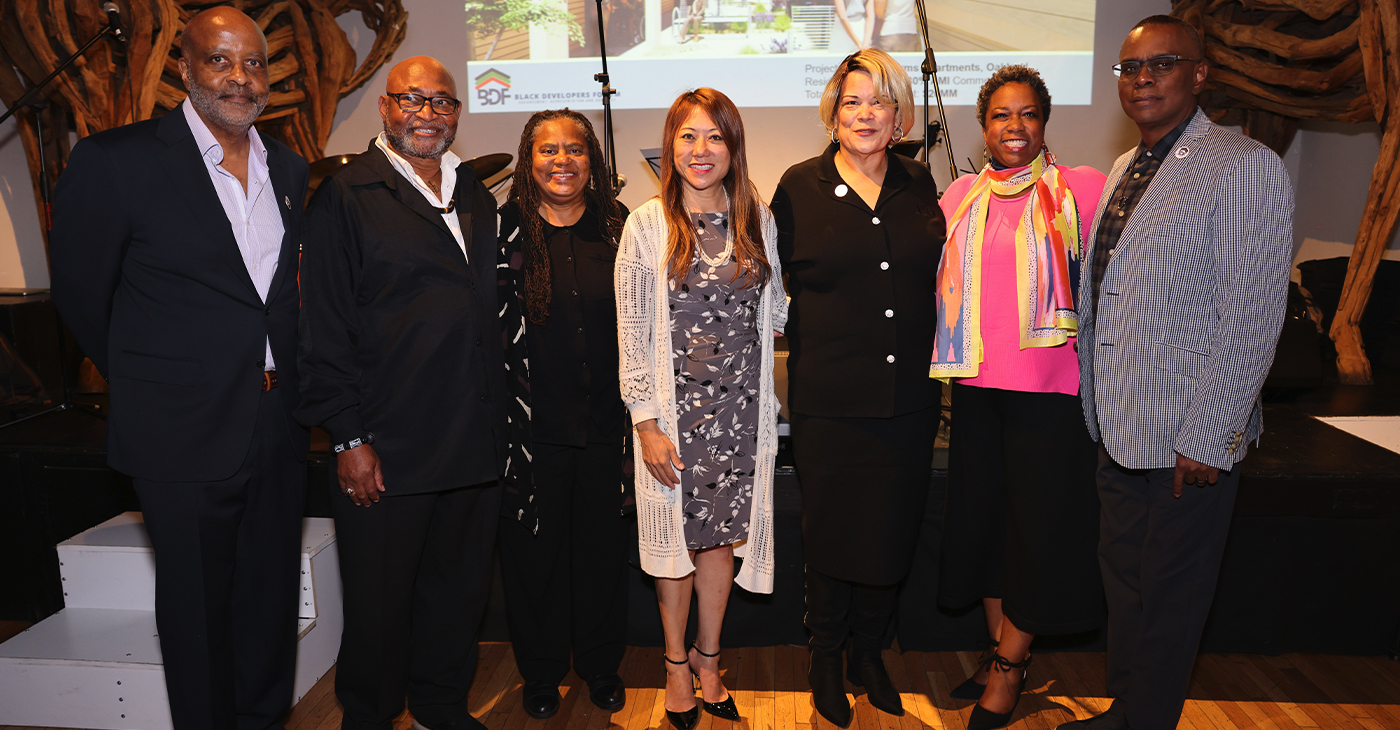
Caption: Black Developers Forum Board of Directors with State Treasurer Fiona Ma, center. Photo courtesy of the Black Developers Forum.
By Marla A. Matime
On October 3, the Black Developers Forum (BDF), held a cocktail reception at the Minna Gallery in San Francisco. A standing-room-only event, many of the state’s Black developers filled the room, to celebrate BDF’s first year as a California-based non-profit advocacy organization striving to eradicate inequities in the development of affordable housing. The event followed the 43rd annual Non-Profit Housing (NPH) Conference also held in San Francisco.
BDF is a network of Black affordable housing developers and industry supporters committed to creating communities that provide safe, healthy living environments, educational opportunities, and housing to people of the African Diaspora.
The reception was also a means for raising money to support the work and advocacy of BDF. The funds raised go to support BDF in creating workshops and trainings for Black developers and industry professionals.
Black developers need allies in positions of influence and decision-making to receive equitable consideration for housing dollars for communities of color. The BDF Cocktail Reception provided a great opportunity to bring these critical parties together.
Keynote speaker, California State Treasurer Fiona Ma, spoke about the BIPOC allocation pool, a $112 million set aside for Blacks and other minority developers which was initiated by former Deputy Treasurer Jovan Agee and created in 2021.
This set aside addresses the needs of minority developers who lacked access to capital and relationships with the major banks to provide lines of credit and other financing products. Creating this allocation pool was a significant priority for the Black Developers Forum and Treasurer Ma.
Ma also explained that without the allocation, Black developers would not only lack equitable access to funding capital, but also be left out of the loop to build affordable housing that addresses a primary goal: to reduce harmful carbon emissions. This would be accomplished through the production and logistics of delivering the materials to the development sites and use of clean energy components that would go into the final touches of building structures.
She went on to specify why these opportunities are important not just for the developers, but also for the communities that they serve. Providing affordable housing, workforce housing, and access to education and resources will help underrepresented communities of color by hopefully inspiring them to become homeowners, which in turn will help pull these families out of a cycle of poverty. Ma is up for re-election on November 8.
“Building back our sustainable communities through a lens of equity is a top priority,” said Cherene Sandidge, president of the Sandidge Urban Group, Inc and president of BDF.
Her passion and drive to ensure Black developers receive equitable opportunities is why she accepted the position to lead BDF. Sandidge also acknowledged partners who were in attendance, specifically Lourdes Castro Ramirez who is secretary of California’s Business, Consumer Services and Housing Agency, who has “had our back since the beginning.”
Don Gilmore, executive director of the Community Housing Development Corporation and BDF’s vice president said “Black-led affordable housing developers have been subjected to the systemic inequities in State funding of affordable housing projects, which created barriers to us receiving the opportunity to build in our own communities. The Black Developers Forum formed to provide us with a collective voice to call out these inequities and positively impact how current and future legislation is shaped.”
He also noted that, “Black developers should have the same opportunities that any other developer has to build great projects that benefit the community, but the inequities in funding and related regulations have been and continue to be a barrier, and we will no longer be silent. We’re using our collective voice and resources to demand that Black developers be provided the equitable opportunities that have eluded us for so long.”
When asked about the responses from the state on equitable policies, practices and laws, Gilmore said, “We have received positive responses from all levels of our government and have been awarded for taking a stand and being change agents for a system of equitable policies, practices and laws. This represents forward progress and we’re happy to be a grassroots advocacy organization whose work will create a system of equitable practices that future generations can benefit from.”
BDF addresses institutional issues that have prohibited wealth-building and the continued disenfranchisement of Black developers, Black-led organizations, and Black individuals. There are over 50 members within the Forum including developers, both in the for-profit and non-profit sectors, as well as from the finance, construction, property management, and other industry professionals.
Further, BDF advocates for federal and state policies that have historically discriminated against and disenfranchised Black developers and Black-led organizations.
A goal that has not been met, and is an ongoing effort, is to ensure that practices, policies, and regulations are instated to allow Black developers and other people of color within the industry, fair and equitable scoring on development applications, equitable funding opportunities, and equitable experience requirements through the BIPOC Set Aside. Additionally, BDF was able to change the CDLAC regulations to allow more Black developers to access capital and create the BIPOC set aside.











Activism
Oakland Post: Week of September 23 – 29, 2026
The printed Weekly Edition of the Oakland Post: Week of September 23 – 29, 2026

To enlarge your view of this issue, use the slider, magnifying glass icon or full page icon in the lower right corner of the browser window.
Activism
Oakland Post: Week of September 16 – 22, 2026
The printed Weekly Edition of the Oakland Post: Week of September 16 – 22, 2026

To enlarge your view of this issue, use the slider, magnifying glass icon or full page icon in the lower right corner of the browser window.
Activism
Oakland Post: Week of September 9 – 15, 2026
The printed Weekly Edition of the Oakland Post: Week of September 9 – 15, 2026

To enlarge your view of this issue, use the slider, magnifying glass icon or full page icon in the lower right corner of the browser window.



Asm. Corey Jackson Announces Launch of 24-Hour Childcare in His District

IN MEMORIAM: The Rev. Leon “Sonny” Clark, Longtime Orange County Pastor and Community Leader, Dies at 72

Poll: Becerra Widens His Lead Over Hilton; Californians Split on Wealth Tax

From Historic Memories to New Possibilities: Oakland Celebrates Coliseum 60

County Office of Education Says OUSD Finances Are Getting Healthier, Materially Stronger

LIVE FREE Sunday Dinner Brings Faith, Fellowship and Civic Conversation to Oakland

Remembering Chauncey Bailey as Student Journalists Face Threats to Truth-Telling

BLACspace Cooperative Invites Bay Area to Experience Oakland’s Black Cultural Ecosystem Through a BLAC Map Tour + Party

In Wake of Death on Doorstep, Williams Chapel Baptist Church Calls for Better Care, Funding for Unhoused

Oakland Centenarian Nuna McKee Honored!

Caribbean Nations Produce Action Plan Calling for UK Reparations Over Slavery

Oakland Post: Week of September 23 – 29, 2026

Doulas Are Helping Black California Moms Navigate Pregnancy–Even as High Mortality Rates Persist

Newsom Signs Addictive Social Media Law to Protect Kids

On Your November Ballot: Prop 38 Would Allocate $8.4 Billion to Immunology and Immunotherapy Funding

Four Candidates, Including Incumbent Barbara Lee, Qualify for Oakland Mayor’s Race

Standoff for Justice: Our Homes Are Worth Fighting For

Oakland Post: Week of August 26 – September 1, 2026

Frontier Airlines’ Return to Oakland Airport Brings Flights, Jobs and Opportunity

Gubernatorial Candidate Steve Hilton Blasts California New Tire Rules; Newsom Hits Back

Chef Sharon Lee Blends Culinary Excellence, Education and Empowerment

Jackie Wright Champions Bay Area Stories, Filmmakers and Cultural Institutions

Big City Mayors Ask for “Yes” Vote on Housing Bond Measure; Conservatives Say “No”

Gov. Newsom’s Latest Appointees Include Sacramento Advocate for Formerly Incarcerated Students; State’s New Tech Chief

Oakland Coliseum Project Opens Door for Small Businesses to Build Bigger

Misnamed ‘Parent’ PAC Seeks to Influence Oakland School Board Elections

Longtime BWOPA Member Brendalyn Goodall Appointed to California Workforce Development Board

Gov. Newsom Signs Law Shielding Immigration Aid Workers From Doxing Threats

Secretary of State Shirley N. Weber Urges Californians to Vote Early as Voter ID Battle Intensifies

From Palestine to Oakland: Seeds for Liberation Examines Shared Struggles for Freedom

The Conversation With Al McFarlane 6/23/26

Media Monday 6/22/26

LIVE! ASK ALMA! — TUES. 6.23.26 7PM EST

Car Buying Secrets: 4 Hidden Checks Before You Sign!

Is This 550 HP Charger Worth YOUR Money? AutoNetwork Review

Celebrating Juneteenth – Frederick Douglass on education and resistance

LIVE! — ASK ALMA! — TUES. 6.19.26 7PM EST

Hyundai Ioniq 5 Parking, Safety, and 360 View #shorts

2025 Ioniq 5 New Wiper & Powerful Performance! #shorts

Electric SUV Range: Is 259 Miles Enough? #shorts

EV Charging: How Fast Can You Charge an Electric Vehicle? #shorts

Biometric Cooling… Messaging Seats…Come on! 2025 Infiniti QX80 Autograph 4WD

Charged Up: Witness the Magic of a Fully Electric Car! #shorts

Range Rover Sport PHEV Included…: See What’s Inside This Luxury SUV! #shorts

Invisible Hood View: Perfect Parking with X-Ray Vision! #shorts
-
 Business4 weeks ago
Chef Sharon Lee Blends Culinary Excellence, Education and Empowerment
-
 Black History4 weeks ago
Jackie Wright Champions Bay Area Stories, Filmmakers and Cultural Institutions
-
 Community4 weeks ago
Big City Mayors Ask for “Yes” Vote on Housing Bond Measure; Conservatives Say “No”
-
 Community2 weeks ago
Misnamed ‘Parent’ PAC Seeks to Influence Oakland School Board Elections
-
 Business4 weeks ago
Longtime BWOPA Member Brendalyn Goodall Appointed to California Workforce Development Board
-
 Community4 weeks ago
Gov. Newsom Signs Law Shielding Immigration Aid Workers From Doxing Threats
-

 Activism3 weeks ago
Oakland Post: Week of September 2 – 8, 2026
-
 Featured4 weeks ago
‘Passing a Law Isn’t The Finish Line’: California Assembly Evaluates Implementation, Results
