
#NNPA BlackPress
Bill Pickett Invitational Rodeo provides rare glimpse at African American cowboys, cowgirls
NNPA NEWSWIRE — The main event – playfully named “The Greatest Show on Dirt” — is the rodeo itself. Thousands of spectators gather to watch black cowboys and cowgirls compete in eight major rodeo events. Among them (abbreviations intact): Bare Back Ridin’, Bull Doggin’, Calf Ropin’, Steer Undecoratin’, Barrel Racin’, Kid’s Calf Scramblin’, Relay Racin’, and Bull Ridin’. “Nobody ever leaves disappointed,” said Barbara “Miss Kitty” Love.

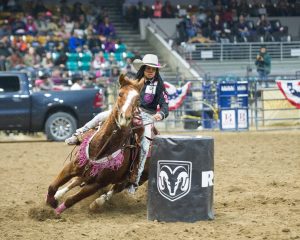
(Photo: Marvin Kelly)
By Lee Eric Smith, The New Tri-State Defender
lesmith@tsdmemphis.com
The Bill Pickett Invitational Rodeo saddles up at Agricenter International this weekend, showcasing some of America’s top African-American cowboys and cowgirls. And if you thought black folk don’t go to rodeos, let alone ride bulls and rope calves in them, you’re in for a treat – and a history lesson.
Long before #OscarsSoWhite became a thing, Barbara Love knew something was off. Like a lot of people, she grew up watching Westerns on TV and at the theatres. It was who she didn’t see that caught her attention.
“It fascinated me because television glorified the cowboy,” said Love, better known as “Miss Kitty” on the rodeo circuit. “I grew up on John Wayne, Gary Cooper and Henry Fonda. And I thought, ‘My great-grandfather ran a livery stable in Alabama.”
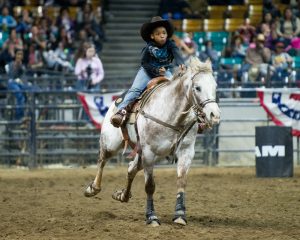
(Photo: Marvin Kelly)
“Why is it that all the cowboys are white?” she asked.
Of course, there were plenty of black cowboys. Cowgirls, too. Many of their names are forever lost to history, but one name still stands tall: William Pickett.

Born near Austin, Texas in 1870, Pickett’s list of accomplishments belongs in history books – he invented the “grab-‘em-by-the-horns” style of bull wrestling called bulldogging. He performed around the world, became the first black cowboy movie star and performed for the British Royal Family.
Picket died in 1932. And although he was enshrined in multiple halls of fame, it wasn’t until 1984 that a cowboy named Lu Vason launched the Bill Pickett Rodeo to pay homage to the iconic figure. Unfortunately, even in the 1980s, America needed a black rodeo for the same reasons Pickett never got the universal appreciation he deserved.
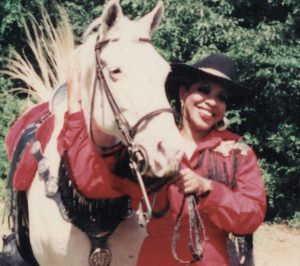
Miss Kitty with horse
“White rodeos really weren’t open to us,” Miss Kitty said. “Either black cowboys weren’t invited, or they weren’t scored fairly. That’s just how it was.”
These days, the Bill Pickett Invitational Rodeo is the world’s only African American touring rodeo, bringing joy to sell-out crowds across America. Other than Memphis, additional rodeo stops include Denver, Los Angeles, Atlanta, Washington, D.C., and Trenton, N.J.
After Lu Vason became ill and passed away, his then-wife Valeria took over the rodeo operations to continue his legacy. Under the leadership of Valeria Howard Cunningham, the rodeo has continued to thrive. You read that right: In an industry dominated by white males who typically scoff at women and/or people of color, a black woman is running the show.
That brings us to how Barbara Love, the Memphis coordinator for the Pickett Rodeo, came to be known as “Miss Kitty.” In the extra-macho world of rodeos, the name started as a sexist jab, the retired teacher said.
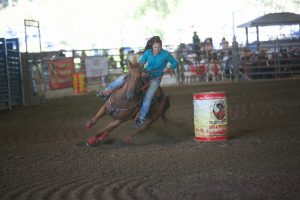
Barrel Racer (Photo by Ed Miller)
“It was from ‘Gunsmoke,’” Miss Kitty said, referring to the classic TV western. “There was only one woman on the show – Miss Kitty. And often, I was the only woman at these rodeos. So, people started calling me that. I hated it.”
That only added fuel to the fire, she continued.
“I used to cry,” she added. “And when people find out something like that bothers you, that’s when they really pick at you.”
Stuck with a nickname she hated, she adapted and made it work for her.
“It spread like wildfire to the point where I just had to go on and accept it,” Miss Kitty said. “If I was trying to call (the Mayor’s office) and used my real name, they were like, ‘Who?’ But when I said, ‘Miss Kitty,’ they knew who I was.
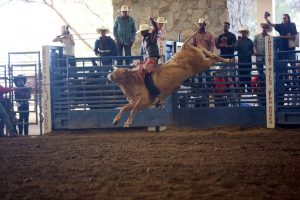
Bull Rider (Photo by Ed Miller)
“I didn’t name me that,” she said. “Memphis named me that.”
For 28 years, Miss Kitty has brought the Bill Pickett Rodeo to Memphis, and she’s always made sure to mix education in with entertainment. Rodeo events routinely include the “Rodeo for Kidz Sake,” which exposes youngsters to animals, cowboys and cowgirls. “The kids show (In Memphis) is sold out. I could have done two kids shows this year,” she said.
The rodeo experience teaches the kids about the importance of Black Americans in the development of the West.
“When I started working with rodeos, I had to dig to find information about the Buffalo Soliders,” Miss Kitty said, referring to the historic. “Nobody knew about them. We’re creating an awareness about this history.”
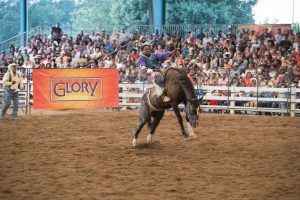
Bareback Rider (Photo:Ccyril Bailleul)
The main event – playfully named “The Greatest Show on Dirt” — is the rodeo itself. Thousands of spectators gather to watch black cowboys and cowgirls compete in eight major rodeo events. Among them (abbreviations intact): Bare Back Ridin’, Bull Doggin’, Calf Ropin’, Steer Undecoratin’, Barrel Racin’, Kid’s Calf Scramblin’, Relay Racin’, and Bull Ridin’.
“Nobody ever leaves disappointed,” she said.
Miss Kitty said that though she extends invitations to schools all around the Mid-South, the only schools to respond are typically in Memphis and Shelby County. Which is a shame, she said.
“You can’t force somebody to participate,” Miss Kitty said. “All you can do is invite them.
“I don’t understand why little white children don’t get to learn about this history.”







#NNPA BlackPress
NFL: Week Two Recap | Jalen Hurts did not fold; Caleb Williams exits game with injury
Philadelphia Eagles quarterback Jalen Hurts found Darius Cooper with nine seconds left for the game winning touchdown as his team beat the Tennessee Titans 24-20 in Nashville. Hurts finished the day 26/37 for 264 yards. He threw for two touchdowns and two interceptions. Prior to the final drive, the Eagles ran 25 plays for 45 […]
The post NFL: Week Two Recap | Jalen Hurts did not fold; Caleb Williams exits game with injury appeared first on BlackPressUSA.

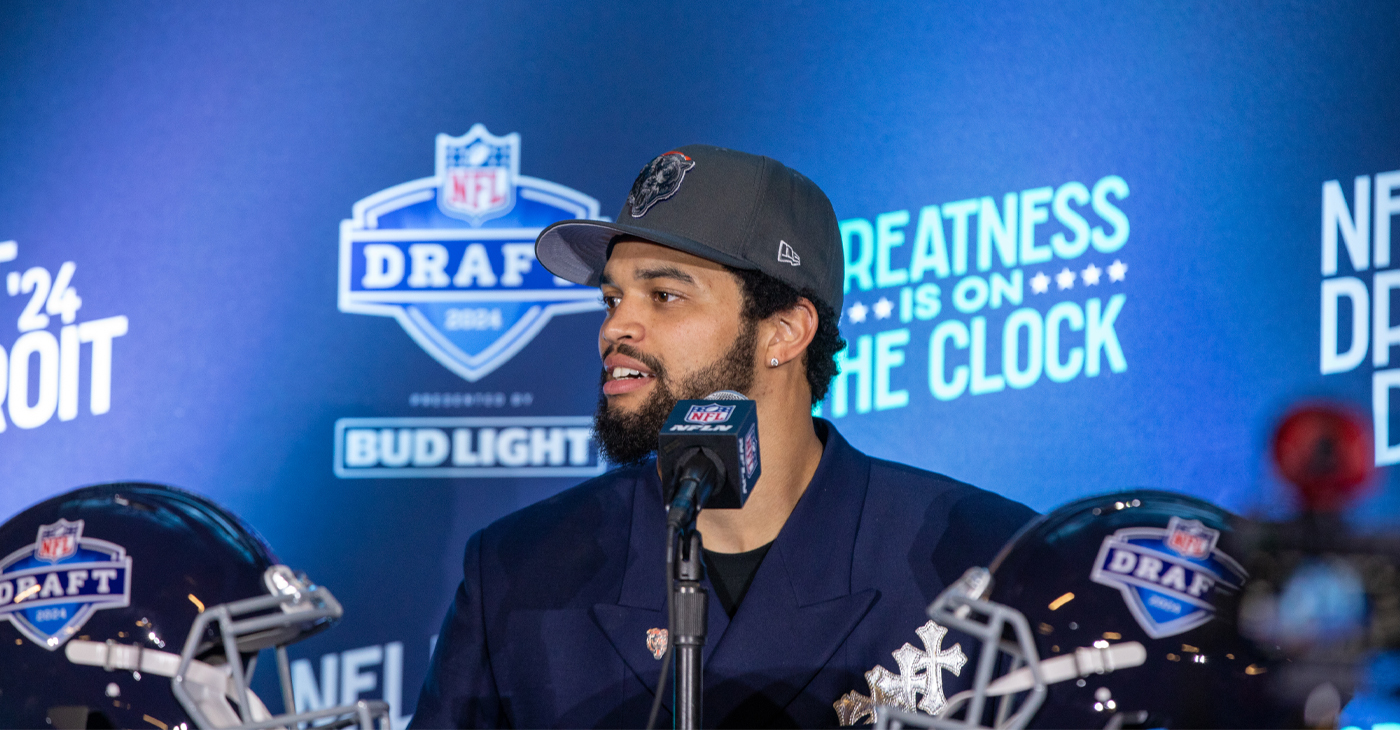
Philadelphia Eagles quarterback Jalen Hurts found Darius Cooper with nine seconds left for the game winning touchdown as his team beat the Tennessee Titans 24-20 in Nashville. Hurts finished the day 26/37 for 264 yards. He threw for two touchdowns and two interceptions.
Prior to the final drive, the Eagles ran 25 plays for 45 yards. During the final drive Hurts went 6-8 with 61 passing yards and the touchdown. Titans defensive tackle — and team captain — Jeffery Simmons said this week that the way to defend Jalen Hurts is to make him “play quarterback.”
Hurts said to Simmons after today’s game: “You started that sh**. I had to finish it.”
Running back Saquon Barkley suffered a stinger in the first half but he ultimately finished the game. He had four carries and nine yards and one catch for eleven yards. He will get an MRI for his injury, but admitted to Cameron Wolfe of the NFL Network he was fine.
Caleb Williams leaves game against Vikings with apparent lower-body injury
Chicago Bears quarterback Caleb Williams was helped off the field with a right leg injury with 7:42 remaining in the fourth quarter. Williams was down, writhing in pain after scrambling to his left. After departing the injury tent, Williams raised his right fist, acknowledging the crowd while expressing his frustration. Testing will commence on Monday to find out more details about his injury.
“We’ll know tomorrow,” Johnson admitted regarding Williams’ injury. “He’s in good spirits. He’s a team player.”
Williams finished the day with 138 passing yards and one interception.
“I’m actually happy it’s nothing with the knee — that was my first inclination,” Johnson said. “But, a hamstring could be pretty damaging as well. So, we’ll see. We’ll see how bad it is tomorrow and we’ll go from there.”
Bryce Young once again dominated the Falcons
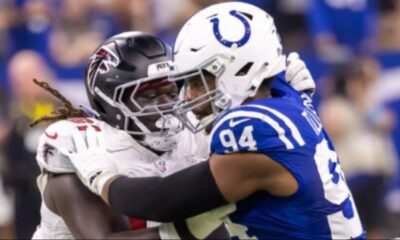
Carolina Panthers quarterback Bryce Young is 5-1 against the Atlanta Falcons and is undefeated at Mercedes-Benz Stadium. Today, Young threw for 287 yards and three touchdowns as he led the Panthers to a 34-3 dismembering of the Atlanta Falcons. Georgia Tech alumnus Darren Waller caught two touchdowns and linebacker Devin Lloyd returned one of his two interceptions for a touchdown.
Cooper Rush started his second straight game for the Falcons and it did not go well. The partisan crowd voiced their displeasure after Rush completed 10/17 passes for 86 yards and two interceptions. Jack Strand entered the game for Rush prompting cheers from the Falcons fans. The rookie threw a pick-six on his first career pass attempt. Strand was the first QB to accomplish that feat since Sam Darnold in 2018 and is the first Falcons player to do that since Brett Favre in 1991. Strand finished the day with 59 passing yards and 16 rushing yards.
According to reports, quarterback Michael Penix, Jr. is expected to make his season debut this Thursday at the Green Bay Packers. His return should help the Falcons. They are the first team since the 2008 Rams to not run any plays in the red zone after the first two games to open a season.
The bright spots for the Falcons today were the Spelman College Jaguarettes performing with the Falcons cheerleaders and Florida A&M’s marching band, The Marching 100, also performed during halftime!
Jayden Daniels gets carted off after apparent arm injury
Washington Commanders quarterback Jayden Daniels appeared to injure his left elbow on the final play of the first half in his game against the Dallas Cowboys. During the play, Daniels got stepped on, braced himself for the fall, and his elbow bent the wrong way. Daniels draped a towel over his head as he exited the field on the cart.
He was later ruled out.
Daniels suffered a dislocated elbow to the same arm during week nine of last season against the Washington Commanders, which led to him being shut down for the remainder of the season.
The post NFL: Week Two Recap | Jalen Hurts did not fold; Caleb Williams exits game with injury appeared first on BlackPressUSA.

#NNPA BlackPress
The Complete Negotiation Framework — Every Stage, Every Tactic, Every Win
Master the complete vehicle-purchase negotiation framework with Roosevelt Gist and Roosevelt. Learn every stage, tactic, and win!
The post The Complete Negotiation Framework — Every Stage, Every Tactic, Every Win appeared first on BlackPressUSA.
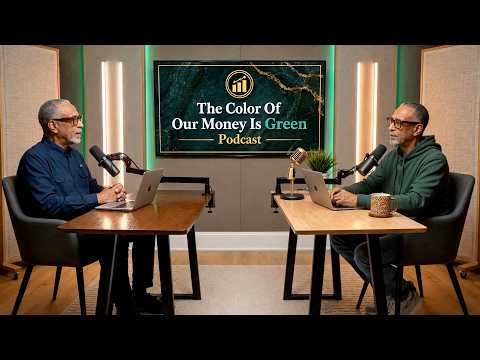
Roosevelt Gist and Roosevelt deliver the complete vehicle-purchase negotiation framework in Episode 8 of The Color of Our Money Is Green. This episode covers the three foundations of every effective negotiation, the full seven-stage negotiation sequence with exact language for every stage, and five of the most common dealership tactics with the specific response each one requires.
What You Learn in This Episode:
The three foundations that make every negotiation tactic work
The complete seven-stage car-buying negotiation sequence
Exact language for every stage of the dealership conversation
Five common dealership tactics — the turnover, the four-square, the packed payment, spot delivery, and forced add-ons — and how to counter each one
Why signing preliminary paperwork isn’t the same as signing the final contract
___________________________________________________________________
“The Color of Our Money Is Green: A Buyer’s Guide to What Cars Actually Cost” — stan.store/RGist
____________________________________________________________________
AutoNetwork helps serious car shoppers inspect any new vehicle online before walking into a dealership. I’m Roosevelt — I’ve been reviewing cars and shaping digital car buying and credit union auto leasing since before YouTube car reviews existed.
You’ll find detailed walkaround reviews, POV test drives, and buyer-focused breakdowns covering comfort, space, features, and real-world value.
How to use the channel:
Watch the walkaround of the car you’re considering
Visit AutoNetwork.com for the full review
Check CouponsOffersAndDeals.com for current dealer specials
Walk in already knowing what you want — and what it should cost
 AutoNetwork.com
 CouponsOffersAndDeals.com
Affiliate disclosure: some links earn a small commission at no cost to you and help support the channel. Insta360 is one of those partners.
The post The Complete Negotiation Framework — Every Stage, Every Tactic, Every Win appeared first on BlackPressUSA.
#NNPA BlackPress
Mazda CX-90 Luxury: Heated Seats & Premium Comfort! #shorts
Stay toasty in the CX-90! Plush Nappa leather, heated/ventilated seats, and a memory-equipped heated steering wheel deliver ultimate luxury.
The post Mazda CX-90 Luxury: Heated Seats & Premium Comfort! #shorts appeared first on BlackPressUSA.
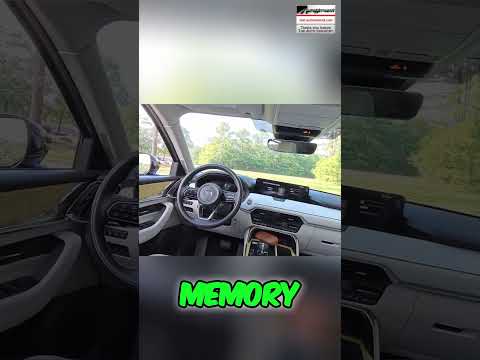
Experience ultimate comfort in the CX-90. Nappa leather, heated/ventilated seats, 8-way power adjustments, and memory settings for both front passengers. The heated steering wheel with memory tilt/telescope adds premium convenience.
 Watch the full video: https://youtu.be/EH5A4eQ4ipY
#AutoNetwork
The post Mazda CX-90 Luxury: Heated Seats & Premium Comfort! #shorts appeared first on BlackPressUSA.



Doulas Are Helping Black California Moms Navigate Pregnancy–Even as High Mortality Rates Persist

Newsom Signs Addictive Social Media Law to Protect Kids

On Your November Ballot: Prop 38 Would Allocate $8.4 Billion to Immunology and Immunotherapy Funding

Ask California: Golden State Releases New AI Chatbot

Asm. Isaac Bryan’s Bill Banning California Police From ICE Side Jobs Reaches Newsom’s Desk

Assemblymember LaShae Sharp-Collins’s Bill Would Pause Law Enforcement’s Use of Shock Gloves Pending Study

BOOK REVIEW: ‘Laws of Solomon’ Reveals Tender Heart of Former Child Soldier

OPINION: The New American Fear – From 9-11 to AI

Passing for White, Fighting for Black America: The Courage of Walter White

Oakland People’s Arms Embargo Coalition Demands End to Military Shipments Thru Oakland

Barbara Lee Mourns Gloria Steinem, Remembers a Friendship Rooted in Equality

Event Preview: ‘Fashion v. Fascism’ – A Runway Revolution Is Coming to the Bay Area

Two Looming Threats Every Alameda County Elder Should Know About

Oakland Mayor Reads to Children at Bookout Block Party at Marcus Books Store

Tradition Comes to the Streets in 11th Annual Black-Eyed Pea Festival at the Freedom Farmers Market

Less Affluent School Districts, Including Sacramento City, Face Threat of State Takeover

ESSAY: California Can Close Its Colorectal Cancer Gap

California Hispanic Chambers of Commerce Unveils: ‘Powering the Future’ Theme for 47th Annual Statewide Convention

Four Candidates, Including Incumbent Barbara Lee, Qualify for Oakland Mayor’s Race

Oakland Post: Week of August 12 – 18, 2026

From Blueprint to Breakthrough: Tackling Affordable Housing in Oakland

Oakland Observes Black August with Block Parties, Film Showings, Workshops

COMMENTARY: Why Local School Tax Measure G1 Will Not Be on the November Ballot

Standoff for Justice: Our Homes Are Worth Fighting For

Returning to Its Roots, the Oakland Black-Eyed Pea Festival Partners with the Freedom Farmers Market Sept. 12

Oakland Post: Week of August 26 – September 1, 2026

NPRC Scores First Advocacy Victory: David Shaw Finally Gets His Wish to ‘Go Home’

Frontier Airlines’ Return to Oakland Airport Brings Flights, Jobs and Opportunity

Gubernatorial Candidate Steve Hilton Blasts California New Tire Rules; Newsom Hits Back

Chef Sharon Lee Blends Culinary Excellence, Education and Empowerment

The Conversation With Al McFarlane 6/23/26

Media Monday 6/22/26

LIVE! ASK ALMA! — TUES. 6.23.26 7PM EST

Car Buying Secrets: 4 Hidden Checks Before You Sign!

Is This 550 HP Charger Worth YOUR Money? AutoNetwork Review

Celebrating Juneteenth – Frederick Douglass on education and resistance

LIVE! — ASK ALMA! — TUES. 6.19.26 7PM EST

Hyundai Ioniq 5 Parking, Safety, and 360 View #shorts

2025 Ioniq 5 New Wiper & Powerful Performance! #shorts

Electric SUV Range: Is 259 Miles Enough? #shorts

EV Charging: How Fast Can You Charge an Electric Vehicle? #shorts

Biometric Cooling… Messaging Seats…Come on! 2025 Infiniti QX80 Autograph 4WD

Charged Up: Witness the Magic of a Fully Electric Car! #shorts

Range Rover Sport PHEV Included…: See What’s Inside This Luxury SUV! #shorts

Invisible Hood View: Perfect Parking with X-Ray Vision! #shorts
-
 Commentary4 weeks ago
Standoff for Justice: Our Homes Are Worth Fighting For
-
 Activism4 weeks ago
Oakland Post: Week of August 26 – September 1, 2026
-
 Business4 weeks ago
Frontier Airlines’ Return to Oakland Airport Brings Flights, Jobs and Opportunity
-
 Business4 weeks ago
Gubernatorial Candidate Steve Hilton Blasts California New Tire Rules; Newsom Hits Back
-
 Business4 weeks ago
Chef Sharon Lee Blends Culinary Excellence, Education and Empowerment
-

 Education4 weeks ago
Gov. Newsom’s Latest Appointees Include Sacramento Advocate for Formerly Incarcerated Students; State’s New Tech Chief
-

 Community4 weeks ago
Big City Mayors Ask for “Yes” Vote on Housing Bond Measure; Conservatives Say “No”
-

 Business4 weeks ago
Oakland Coliseum Project Opens Door for Small Businesses to Build Bigger

1 Comment