
Activism
Bay Area Soda Taxes Don’t Just Affect Sales: They Help Change People’s Minds


UC Berkeley researchers found that taxes on sugar-sweetened beverages, coupled with media attention, coincided with significant changes in social norms around sugary drinks.
By Jason Pohl
UC Berkeley News
It wasn’t that long ago when cigarettes and soda were go-to convenience store vices, glamorized in movies and marketed toward, well, everyone.
Then, lawmakers and voters raised taxes on cigarettes, and millions of dollars went into public education campaigns about smoking’s harms. Decades of news coverage chronicled how addictive and dangerous cigarettes were and the enormous steps companies took to hide the risks and hook more users.
The result: a radical shift in social norms that made it less acceptable to smoke and pushed cigarette use to historic lows, especially among minors.
New UC Berkeley research suggests sugar-sweetened beverages may be on a similar path.
The city of Berkeley’s first-in-the-nation soda tax a decade ago, along with more recent Bay Area tax increases on sugar-sweetened drinks, have not only led to reduced sales. They are also associated with significant changes in social norms and attitudes about the healthfulness of sweet drinks, said Kristine A. Madsen, a professor at UC Berkeley’s School of Public Health and senior author of a paper published Nov. 25 in the journal BMC Public Health.

Over the span of just a few years, taxes coupled with significant media attention significantly affected the public’s overall perceptions of sugar-sweetened beverages, which include sodas, some juices, and sports drinks. Such a shift in the informal rules surrounding how people think and act could have major implications for public health efforts more broadly, Madsen said.
“Social norms are really powerful. The significant shift we saw in how people are thinking about sugary drinks demonstrates what else we could do,” Madsen said. “We could reimagine a healthier food system. It starts with people thinking, ‘Why drink so much soda?’ But what if we also said, ‘Why isn’t most of the food in our grocery stores food that makes us healthy?’”
Madsen and colleagues from UC San Francisco and UC Davis analyzed surveys from 9,128 people living in lower-income neighborhoods in Berkeley, Oakland, San Francisco, and Richmond. Using data from 2016 to 2019 and 2021, they studied year-to-year trends in people’s perception of sugar-sweetened beverages.
They wanted to understand how the four taxes in the Bay Area might have affected social norms surrounding sugary beverages — the unwritten and often unspoken rules that influence the food and drinks we buy, the clothes we wear and our habits at the dinner table.
Although social norms aren’t visible, they are incredibly powerful forces on our actions and behaviors; just ask anyone who has bought something after an influencer promoted it on TikTok or Instagram.
Researchers asked questions about how often people thought their neighbors drank sodas, sports drinks, and fruity beverages. Participants also rated how healthy several drinks were, which conveyed their own attitudes about the beverages.
The researchers found a 28% decline in the social acceptability of drinking sugar-sweetened beverages.
In Oakland, positive perceptions of peers’ consumption of sports drinks declined after the tax increase, relative to other cities. Similarly, in San Francisco, attitudes about the healthfulness of sugar-sweetened fruit drinks also declined.
In other words, people believed their neighbors weren’t drinking as many sugar-sweetened beverages, which affected their own interest in consuming soda, juices, and sports drinks.
“What it means when social norms change is that people say, ‘Gosh, I guess we don’t drink soda. That’s just not what we do. Not as much. Not all the time,’” Madsen said. “And that’s an amazing shift in mindsets.”
The research is the latest from UC Berkeley that examines how consumption patterns have changed in the decade since Berkeley implemented the nation’s first soda tax.
A 2016 study found a decrease in soda consumption and an increase in people turning to water. Research in 2019 documented a sharp decline in people turning to sugar-sweetened drinks. And earlier this year, Berkeley researchers documented that sugar-sweetened beverage purchases declined dramatically and steadily across five major American cities after taxes were put in place.
The penny-per-ounce tax on beverages, which is levied on distributors of sugary drinks — who ultimately pass that cost of doing business on to consumers — is an important means of communicating about health with the public, Madsen said.
Researchers tallied more than 700 media stories about the taxes on sugar-sweetened beverages during the study period. That level of messaging was likely a major force in driving public awareness and norms.
It’s also something Madsen said future public health interventions must consider. It was part of the progress made in cutting cigarette smoking and seems to be working with sugary drinks. And it’s those interventions that can lead to individual action.
“If we change our behaviors, the environment follows,” Madsen said. “While policy really matters and is incredibly important, we as individuals have to advocate for a healthier food system.”










Activism
Oakland Post: Week of March 18 – 24, 2026
The printed Weekly Edition of the Oakland Post: Week of March 18 – 24, 2026
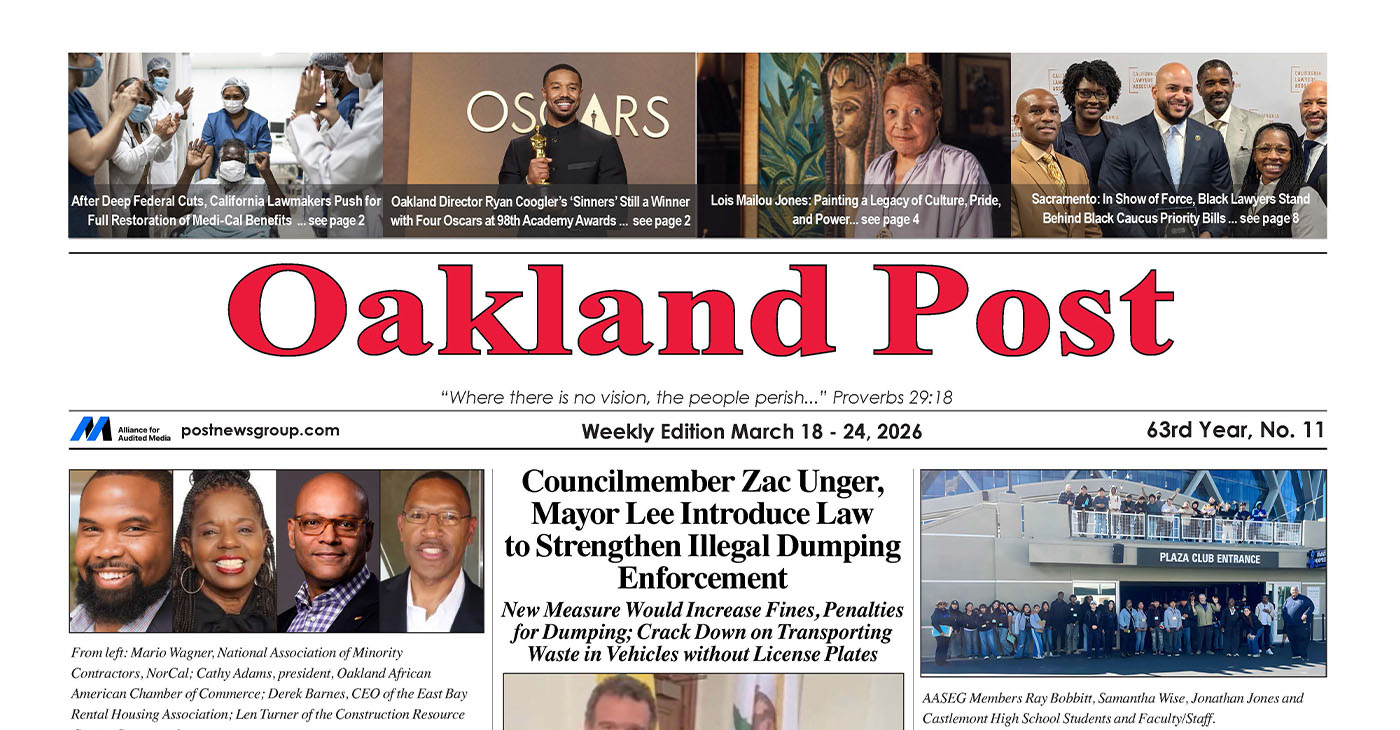
To enlarge your view of this issue, use the slider, magnifying glass icon or full page icon in the lower right corner of the browser window.
Activism
Oakland Post: Week of March 11 -17, 2026
The printed Weekly Edition of the Oakland Post: Week of March 11 – 17, 2026
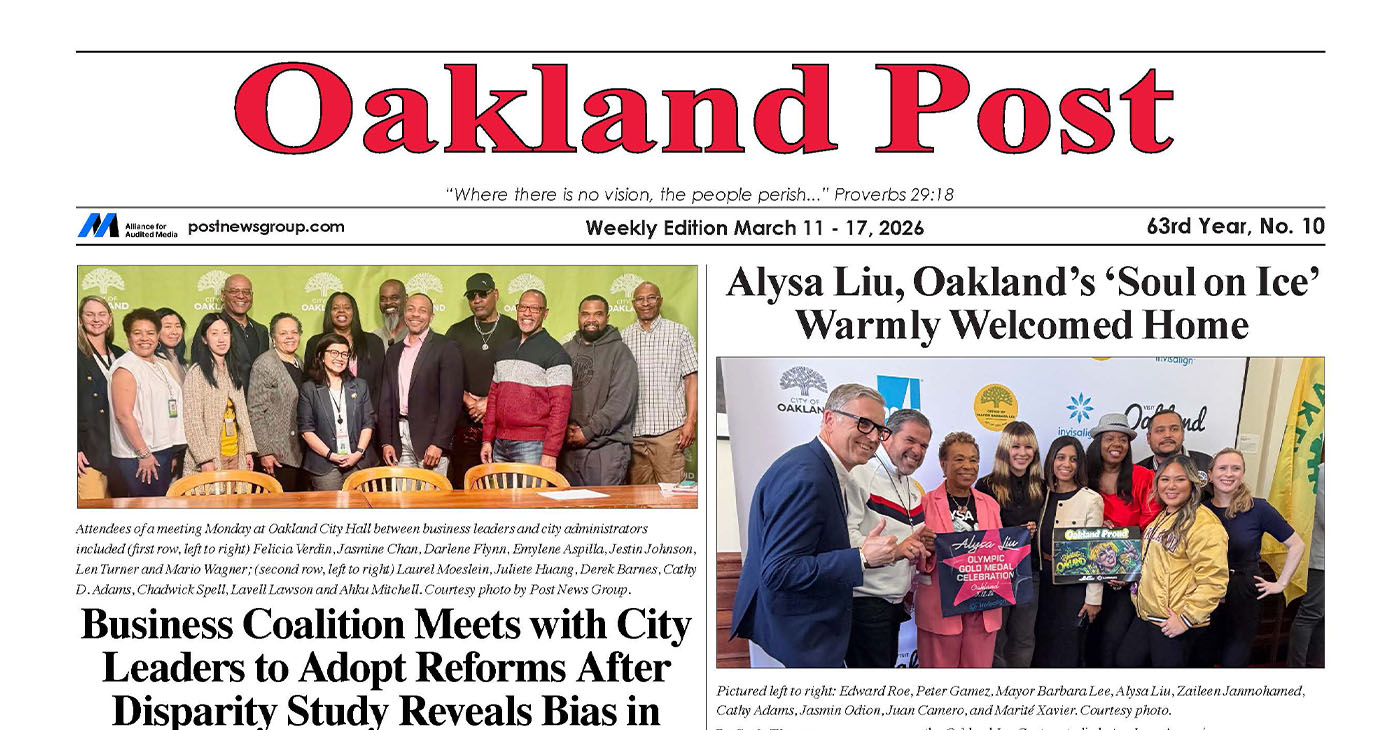
To enlarge your view of this issue, use the slider, magnifying glass icon or full page icon in the lower right corner of the browser window.
Activism
Oakland Post: Week of March 4 – 10, 2026
The printed Weekly Edition of the Oakland Post: Week of March 4 – 10, 2026
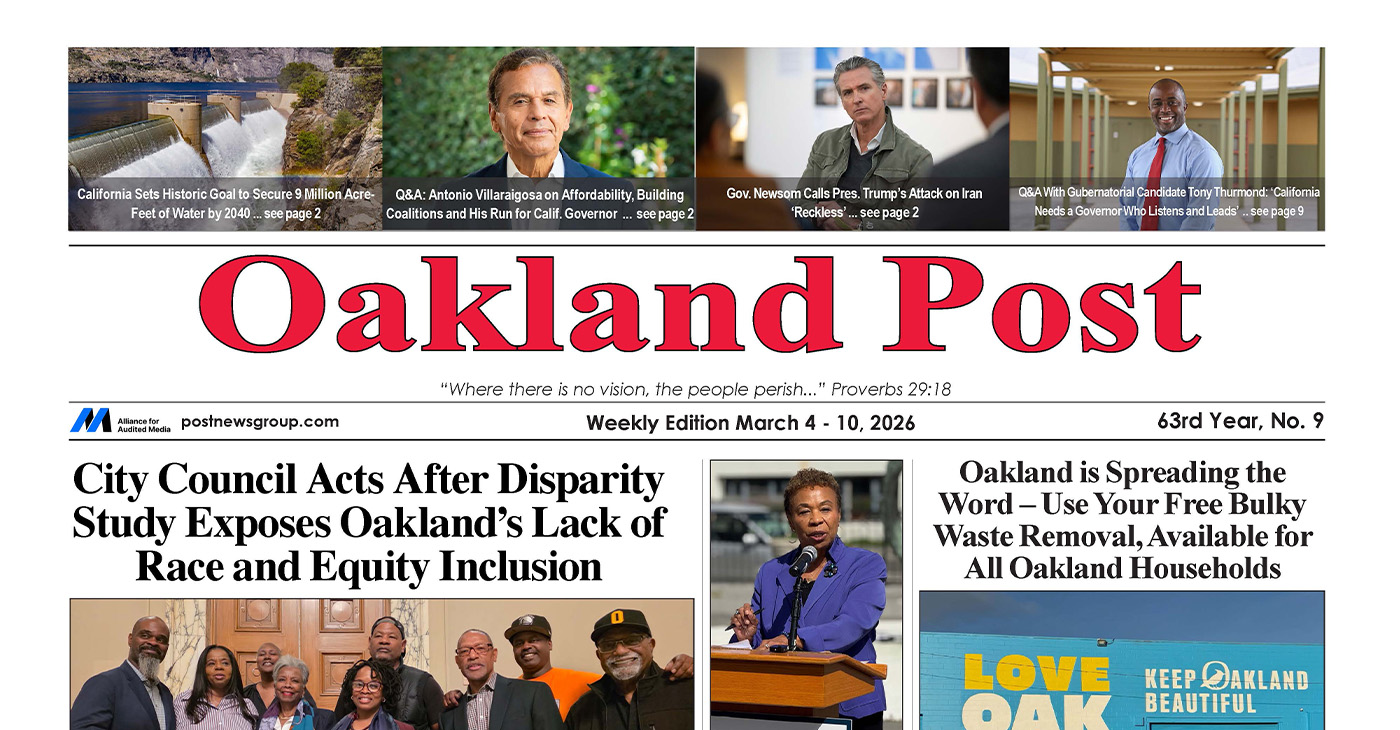
To enlarge your view of this issue, use the slider, magnifying glass icon or full page icon in the lower right corner of the browser window.

WORK FROM HOME
Home-based business with potential monthly income of $10K+ per month. A proven training system and website provided to maximize business effectiveness. Perfect job to earn side and primary income. Contact Lynne for more details: Lynne4npusa@gmail.com 800-334-0540


Black Artists in America, Installation Three Wraps at the Dixon Gallery and Gardens

Grief, Advocacy, and Education: A Counselor Reflects on Black Maternal Health

Future of Florida’s Black History Museum in Limbo

New Research Shows the Many Benefits of Early Learning

South Hampton K-8 Students Among Top 10 Finalists for Samsung’s ‘Solve for Tomorrow’ Competition

Cuba: No Negotiation with US on the President or Political System

Brooklyn Academy of Music Names Jamaican-Born Tamara McCaw as President

Trinidad & Tobego – U.S. Launches WhatsApp Channel for American Citizens in the Country

Oakland Post: Week of March 18 – 24, 2026

AI Innovation vs. Ethics and Environmental Impact

AI, Web3, and Digital Reparations

What If You Owned Your AI Agent?

Season 7, Episode 3 – January Reporter’s Roundtable 📱

Season 7, Episode 3 – January Reporter’s Roundtable

AI, Media, and Power | Part 2, Real-World Impacts and Tradeoffs

Oakland Post: Week of February 11 – 17, 2026

Reflecting on Black History Milestones in Birmingham AL

CITY OF SAN LEANDRO STATE OF CALIFORNIA PUBLIC WORKS DEPARTMENT ENGINEERING DIVISION NOTICE TO BIDDERS FOR ANNUAL STREET OVERLAY/REHABILITATION 2019-21 – PHASE III

Oakland Post: Week of February 18 – 24, 2026

Oakland Post: Week of February 25 – March 3, 2026

PRESS ROOM: NBA Hall of Fame Nominee Terry Cummings Joins 100 Black Men of DeKalb County to Launch Victory & Values Initiative

Trump’s MAGA Allies are Creating Executive Order Plan to Steal the 2026 Midterms

U.S. manufacturing rebounds – how foundry services are adapting to rising demand

OP-ED: One Hundred Years of Black Workers Telling the Truth

Oakland Post: Week of March 4 – 10, 2026

Chase Oakland Community Center Hosts Alley-Oop Accelerator Building Community and Opportunity for Bay Area Entrepreneurs

Poll Shows Support for Policies That Help Families Afford Child Care

Advancements in solar technology that are changing the way we power the world

PRESS ROOM: Civil Rights TV Launches in Selma as the World’s First 24/7 Civil Rights Television Network

Woman’s Search for Family’s Roots Leads to Ancestor John T. Ward – A Successful Entrepreneur and Conductor on the Underground Railroad

Hyundai Ioniq 5 Parking, Safety, and 360 View #shorts

2025 Ioniq 5 New Wiper & Powerful Performance! #shorts

Electric SUV Range: Is 259 Miles Enough? #shorts

EV Charging: How Fast Can You Charge an Electric Vehicle? #shorts

Biometric Cooling… Messaging Seats…Come on! 2025 Infiniti QX80 Autograph 4WD

Charged Up: Witness the Magic of a Fully Electric Car! #shorts

Range Rover Sport PHEV Included…: See What’s Inside This Luxury SUV! #shorts

Invisible Hood View: Perfect Parking with X-Ray Vision! #shorts

AI Is Reshaping Black Healthcare: Promise, Peril, and the Push for Improved Results in California

ESSAY: Technology and Medicine, a Primary Care Point of View

Sanctuary Cities

The RESISTANCE – FREEDOM NOW

STATE OF THE PEOPLE: Freddie

ECONOMIC BOYCOTT DAY!!!!!

I told You So
-
 Activism4 weeks ago
Oakland Post: Week of March 4 – 10, 2026
-
 #NNPA BlackPress3 weeks ago
Woman’s Search for Family’s Roots Leads to Ancestor John T. Ward – A Successful Entrepreneur and Conductor on the Underground Railroad
-

 #NNPA BlackPress4 weeks ago
OP-ED: NNPA Launches 2026 “Leadership Matters” Video Series
-

 #NNPA BlackPress3 weeks ago
Advocates Raise Alarm Over ICE Operation, MOU and Detention Risks in Baltimore County
-

 #NNPA BlackPress3 weeks ago
COMMENTARY: Women of Color Shape Our Past and Future
-

 #NNPA BlackPress3 weeks ago
Pete Buttigieg to Join Mayor Randall Woodfin for Community Town Hall in Birmingham
-
 Activism2 weeks ago
Oakland Post: Week of March 11 -17, 2026
-

 #NNPA BlackPress4 weeks ago
PRESS ROOM: PMG and Cranbrook Horizons-Upward Bound Launch Journey Fellowship Cohort 2
