
Politics
Arkansas Panel Rejects Removing Lee from King Holiday


Dewey Spencer, of Judsonia, Ark., holds a portrait of Confederate Gen. Robert E. Lee after a meeting of the House Committee on State Agencies and Governmental Affairs, Wednesday, Jan. 28, 2015, at the State Capitol in Little Rock, Ark. A bid to end Arkansas’ practice of commemorating Confederate Gen. Robert E. Lee and civil rights icon Martin Luther King Jr. on the same day has failed before a state House panel. (AP Photo/Danny Johnston)
ANDREW DeMILLO, Associated Press
LITTLE ROCK, Ark. (AP) — A bid to end Arkansas’ practice of commemorating Confederate Gen. Robert E. Lee and civil rights icon Martin Luther King Jr. on the same day was rejected by lawmakers Wednesday after opponents said the move would belittle Southern heritage.

The proposal would have removed Lee from the state holiday honoring King. Arkansas is one of three states to jointly celebrate the two on the third Monday in January. The House State Agencies and Governmental Affairs Committee rejected the proposal by a voice vote.
The proposal called for designating Nov. 30 as “Patrick Cleburne – Robert E. Lee Southern Heritage Day,” a state memorial day but not a legal holiday. Cleburne was a Confederate general who lived in east Arkansas. The legislation also would have repealed a state law declaring June 3 as a state memorial day in honor of former Confederacy President Jefferson Davis’ birthday.
“This bill is not a bill meant to disregard heritage or to downplay history. It is not a bill to cause division of conflict,” said Rep. Charles Blake, D-Little Rock, who presented the measure to the panel. “The spirit of this bill is to allow Arkansans to honor our heritage and honor our progress without them being in conflict with each other.”
But opponents of the measure packed the committee hearing room, with several saying the Legislature was insulting their heritage.
John Crain, an attorney from Mountain Home, said removing Lee from the holiday would tell him “my ancestry and my heritage is not worth honoring.”
“I think Martin Luther King, if he were here today standing beside me, would tell you, ‘Why can’t we celebrate a birthday of two men, one of color and a white man?'” Crain said. “Surely we’ve progressed that far in our race relationships.”
The proposal also faced opposition from the top Democrat in the House, who questioned why lawmakers were taking up the issue.
“Why are we chasing a non-problem to identify a solution to something?” House Minority Leader Eddie Armstrong, D-North Little Rock, said.
Arkansas has recognized Lee’s birthday since the 1940s. State lawmakers voted to recognize King’s birthday as a state holiday in 1983, and combined the celebrations two years later. A photo of a sign noting the King-Lee holiday circulated on social media last week, drawing comments from across the country.
Rep. Nate Bell, R-Mena, the bill’s sponsor and the panel’s chairman, said he hadn’t ruled out bringing the proposal back before the committee, and Rep. Fred Love, D-Little Rock, said he would likely ask the committee to consider a similar proposal he’s filed.
___
Follow Andrew DeMillo on Twitter at www.twitter.com/ademillo
Copyright 2015 The Associated Press. All rights reserved. This material may not be published, broadcast, rewritten or redistributed.









Activism
Oakland Post: Week of March 18 – 24, 2026
The printed Weekly Edition of the Oakland Post: Week of March 18 – 24, 2026

To enlarge your view of this issue, use the slider, magnifying glass icon or full page icon in the lower right corner of the browser window.
Activism
Oakland Post: Week of March 11 -17, 2026
The printed Weekly Edition of the Oakland Post: Week of March 11 – 17, 2026
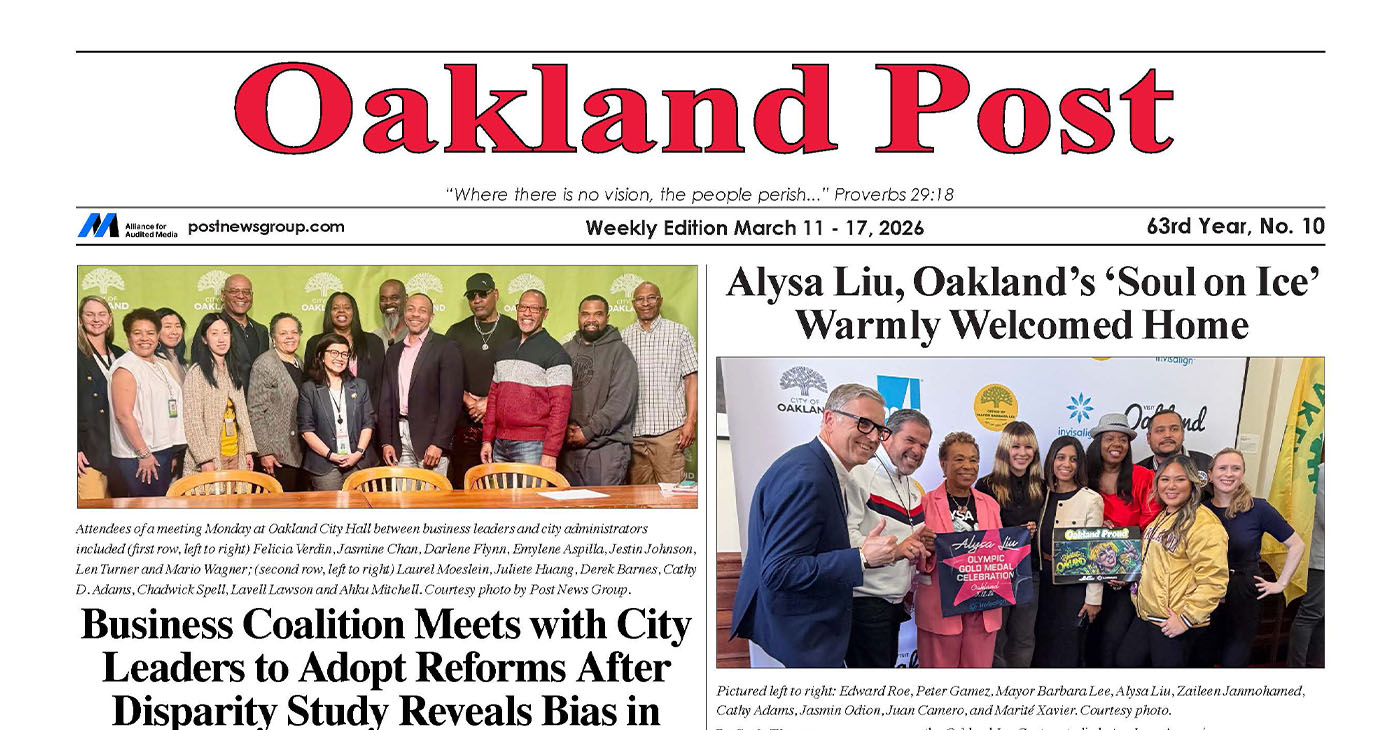
To enlarge your view of this issue, use the slider, magnifying glass icon or full page icon in the lower right corner of the browser window.
Activism
Oakland Post: Week of March 4 – 10, 2026
The printed Weekly Edition of the Oakland Post: Week of March 4 – 10, 2026

To enlarge your view of this issue, use the slider, magnifying glass icon or full page icon in the lower right corner of the browser window.


WORK FROM HOME
Home-based business with potential monthly income of $10K+ per month. A proven training system and website provided to maximize business effectiveness. Perfect job to earn side and primary income. Contact Lynne for more details: Lynne4npusa@gmail.com 800-334-0540


Black Artists in America, Installation Three Wraps at the Dixon Gallery and Gardens

Grief, Advocacy, and Education: A Counselor Reflects on Black Maternal Health

Future of Florida’s Black History Museum in Limbo

New Research Shows the Many Benefits of Early Learning

South Hampton K-8 Students Among Top 10 Finalists for Samsung’s ‘Solve for Tomorrow’ Competition

Cuba: No Negotiation with US on the President or Political System

Brooklyn Academy of Music Names Jamaican-Born Tamara McCaw as President

Trinidad & Tobego – U.S. Launches WhatsApp Channel for American Citizens in the Country

Oakland Post: Week of March 18 – 24, 2026

AI Innovation vs. Ethics and Environmental Impact

AI, Web3, and Digital Reparations

What If You Owned Your AI Agent?

Season 7, Episode 3 – January Reporter’s Roundtable 📱

Season 7, Episode 3 – January Reporter’s Roundtable

AI, Media, and Power | Part 2, Real-World Impacts and Tradeoffs

Reflecting on Black History Milestones in Birmingham AL

CITY OF SAN LEANDRO STATE OF CALIFORNIA PUBLIC WORKS DEPARTMENT ENGINEERING DIVISION NOTICE TO BIDDERS FOR ANNUAL STREET OVERLAY/REHABILITATION 2019-21 – PHASE III

Oakland Post: Week of February 18 – 24, 2026

Oakland Post: Week of February 25 – March 3, 2026

PRESS ROOM: NBA Hall of Fame Nominee Terry Cummings Joins 100 Black Men of DeKalb County to Launch Victory & Values Initiative

Trump’s MAGA Allies are Creating Executive Order Plan to Steal the 2026 Midterms

U.S. manufacturing rebounds – how foundry services are adapting to rising demand

Oakland Post: Week of March 4 – 10, 2026

Chase Oakland Community Center Hosts Alley-Oop Accelerator Building Community and Opportunity for Bay Area Entrepreneurs

Poll Shows Support for Policies That Help Families Afford Child Care

OP-ED: One Hundred Years of Black Workers Telling the Truth

Advancements in solar technology that are changing the way we power the world

Woman’s Search for Family’s Roots Leads to Ancestor John T. Ward – A Successful Entrepreneur and Conductor on the Underground Railroad

PRESS ROOM: Civil Rights TV Launches in Selma as the World’s First 24/7 Civil Rights Television Network

COMMENTARY: Women of Color Shape Our Past and Future

Hyundai Ioniq 5 Parking, Safety, and 360 View #shorts

2025 Ioniq 5 New Wiper & Powerful Performance! #shorts

Electric SUV Range: Is 259 Miles Enough? #shorts

EV Charging: How Fast Can You Charge an Electric Vehicle? #shorts

Biometric Cooling… Messaging Seats…Come on! 2025 Infiniti QX80 Autograph 4WD

Charged Up: Witness the Magic of a Fully Electric Car! #shorts

Range Rover Sport PHEV Included…: See What’s Inside This Luxury SUV! #shorts

Invisible Hood View: Perfect Parking with X-Ray Vision! #shorts

AI Is Reshaping Black Healthcare: Promise, Peril, and the Push for Improved Results in California

ESSAY: Technology and Medicine, a Primary Care Point of View

Sanctuary Cities

The RESISTANCE – FREEDOM NOW

STATE OF THE PEOPLE: Freddie

ECONOMIC BOYCOTT DAY!!!!!

I told You So
-
 Activism4 weeks ago
Oakland Post: Week of March 4 – 10, 2026
-
 #NNPA BlackPress4 weeks ago
Woman’s Search for Family’s Roots Leads to Ancestor John T. Ward – A Successful Entrepreneur and Conductor on the Underground Railroad
-
 #NNPA BlackPress4 weeks ago
COMMENTARY: Women of Color Shape Our Past and Future
-

 #NNPA BlackPress4 weeks ago
OP-ED: NNPA Launches 2026 “Leadership Matters” Video Series
-

 #NNPA BlackPress4 weeks ago
Advocates Raise Alarm Over ICE Operation, MOU and Detention Risks in Baltimore County
-

 Activism2 weeks ago
Oakland Post: Week of March 11 -17, 2026
-

 #NNPA BlackPress4 weeks ago
Pete Buttigieg to Join Mayor Randall Woodfin for Community Town Hall in Birmingham
-

 Advice2 weeks ago
Financial Wellness and Mental Health: Managing Money Stress in College
