
#NNPA BlackPress
Alfred Liggins is the Other Half of Urban One’s Success Story
OMAHA STAR — “Look, my mother has an amazing story from where she came, and she’s always been more of a forefront person. A lot of people tend to think this woman built this company and she made her son the CEO, but they don’t realize how long I’ve been at the company and that it was really a joint effort. They tend to think it’s a traditional family business. But my mother is very good at giving me credit. She did it when we were in Omaha.”

By Leo Adam Biga, The Omaha Star

The oft-told entrepreneurial success narrative of Urban One founder and chair Cathy Hughes tends to leave out a crucial part of the story: her son and company CEO Alfred Liggins III is an equal partner in the journey of this black multimedia and entertainment enterprise.
By now, the tale of this single mother’s rise from Omaha dreamer to Washington, D.C. icon is the stuff of legend. But what gets lost in translation is that her son also came out of Omaha. He was only 7 when he moved with his mom to D.C., but he was there long enough to form fond memories of school (Sacred Heart, Mammoth Park), recreation (Kellom Pool, Fontenelle Park) and spending time with extended family (his maternal grandparents Helen Jones Woods and William Alfred Woods).
For years, he came back annually to visit family. He twice lived with his biological father Alfred Liggins II.
Contrary to popular belief, he didn’t enter or inherit the family business after it was already rolling. He was there from its fledgling start and helped make it a success. He’s since taken it to unimagined heights.
But even he is in awe of his mom.
 “Yeah, I marvel at her gumption and her fearlessness,” he said. “You have to remember, she’s only 17 years older than I am. The business was founded in 1980. I joined full time in 1985 when we had the one radio station, so I’ve had a front-row seat on the business journey from almost the beginning.
“She was very open in making me her business partner very early. It’s really a joint journey.”
Along the way, there’s been little time to admire what they’ve done together.
“It wasn’t like we were sitting back watching, going, ‘Oh, look at what we did.’ You’re too busy trying to keep doing what you’re doing on the right track and figuring out how to fix the stuff that’s not working and figuring out what the next thing is.”
He doesn’t mind her getting most of the pub.
“Look, my mother has an amazing story from where she came, and she’s always been more of a forefront person. A lot of people tend to think this woman built this company and she made her son the CEO, but they don’t realize how long I’ve been at the company and that it was really a joint effort. They tend to think it’s a traditional family business.
“But my mother is very good at giving me credit. She did it when we were in Omaha.”
Last May, Omaha feted Hughes at events celebrating her life, including naming a street in her honor. Liggins was content letting his mom have the spotlight.
“I never spend a bunch of time doing press or correcting people because that’s just not who I am. I love our partnership. I’m grateful and happy that people are inspired by her story, our story, and it’s a great story and a great journey. I don’t feel a need to build my own story separate and apart from hers.
“But if I get called for an interview and we start talking about it, I’m happy to lay out what my role was and what our relationship is.”
Before coming on full time at age 20 in 1985, Liggins worked at the station as a sportscaster and weekend talk-show host while a high school teenager.
“I guess it was cool I worked at a radio station, but I didn’t really want to do it. I was kind of required to do it. I didn’t really want to be in the radio business at first. I wanted to be in the record business.”
He went to L.A. to live with his stepfather, Dewey Hughes, looking to break into the music biz.
“I ended up unemployed and my mother suggested I come back to D.C., work at the station, go to college at night and get my act together and figure out what to do next, so I did that.”
What was then known as Radio One consisted of a single station. Within a decade, the mother and son built the company into a nationwide network.
“I always had a talent for sales. I went into the sales department and started to be successful pretty early on,” Liggins said.
He kept doubling his earnings from year to year until, by his early 20s, he was pulling down $150,000.
“I was young making a lot of money. That was the time I realized this would be a great career path if we could grow the business beyond where we were.”
Between his earnings and social life, he dropped out of night school. It was only some years later he applied to the Wharton School of Business executive management master’s program. Despite not being a college graduate, he got in on the strength of managing a $25 million a year company and recommendations from the likes of the Rev. Jesse Jackson.
“The idea that I had doubled-back and ended up getting in an Ivy League business school was exciting to me. It kind of felt like I was beating the system in some way.
My diploma says the same thing everyone else’s diploma says. In the end, I feel like I got my ticket punched, my certification, my bona fides.”
While he took care of business behind the scenes, Cathy Hughes made her presence known on air.
“My mother was doing the morning show and I was a stabilizing force in the sales department. She did some things on the air, like lead the Washington Post boycott, which really started to brand her as the voice of the black community. I was able to sell that to mainstream advertisers. We started to make money. It wasn’t a ton, but we went from losing four, five hundred thousand dollars to making a couple hundred thousand dollars.”
Reaching a more substantial audience came next.
“We owned one AM radio station, and FM radio at that time was really exploding. It was where all the audience was, AM was dying. We set out and put together a plan to expand into FM radio. I identified an FM we could afford. Investors worked with my mother and me to figure out how to finance it. It was like a $7.5 million purchase. I think they needed like 10 different minority-focused, venture-capital entities to put up the funding. And we got our first FM.
“That first year the bank required us to keep it in an adult contemporary format that wasn’t black-targeted because they wanted to have the cash flow. But we didn’t do that very well and we fell out of the ratings book. We were like, ‘OK, can we change the format to something we know?’ So, we changed to an urban adult contemporary and it took off like a rocket.”
For the first time, the company recorded serious profits.
 “Five years later the AM and the FM were doing $10 million of revenue and $5 million of profitability. We became a wild success. Then we bought into the Baltimore market – our first market outside of Washington. Then we kept going from there. I felt like we were on this mission to build this business. I felt optimistic and empowered and energetic and vigorous.”
In charge of day-to-day operations for more than two decades, Liggins has led subsequent strategic moves – from taking the company public in 1998 to brokering deals that created TV One and Interactive One (now iOne Digital) to entering the casino-gaming industry. He’s also guided the company in divesting itself of low-performing stations and other media segment drags and in acquiring Reach Media, whose national radio lineup includes Tom Joyner, Erica Campbell, DL Hughley and the Rev. Al Sharpton.
“We built our company around serving the black community,” he said.
That’s why getting into television was key.
“BET was created in Washington in 1980 – the same year Radio One was formed. We knew BET founder Robert Johnson. The people who invested in Radio One were also involved in BET. One of our lead investors was actually on the BET board, so we had a front-row seat to see that success.
“It was clear there was only one network targeting black people in the entire country, and that didn’t make any sense. But we were building the radio station and TV remained off our radar for a time.”
But there was no getting around that radio was “a tertiary medium,” Liggins said, “and if you wanted to really grow the platform to serve African-Americans you had to be in the places where they’re at – and they don’t just listen to radio.
“I’ve always looked at us as in the black people business and not just the media business. BET was wildly successful and there was only one of it, so I always wanted to get into the television business.”
The opportunity to enter the TV space came, he said, when “Comcast decided they wanted to expand in content, and I went in and made a big pitch to them.
“I said, ‘Look, I know we’ve never done television before, but we know how to market and program to black people. You have the distribution, but we’ll put up all the money.’
Lots of people were wanting to start a cable network, but they wanted Comcast to put up all the money. Eventually, $134 million was raised. Comcast invested $15 million in it. They got a big piece of the company just for giving us the distribution. We invested $74 million and I raised another $30 million from people I had done business with before. That’s how we got started in TV.”
The once monolithic TV industry, he said, “is disintermediating now with cord cutting” and streaming.
“We’re trying to figure out how to pay for and deliver more content and what other distribution opportunities or systems there are for us to monetize that content.”
To hedge against media volatility, the company’s diversified into the casino gaming business with partners MGM and a casino resort in D.C.
“It’s been a great investment for us,” Liggins said.
Meanwhile, the radio business that’s been the foundation of the company, he said, is “a declining, mature legacy media business that probably will have further consolidation.” He added, “We’ve got to figure out what our role in that is.”
Urban One carries “a lot of debt,” he said, “because we piled up a bunch of debt buying radio stations over the years, and then when the Internet hit all traditional media took a hit – print taking the worst of the brunt.”
“Our debt’s come way down but still not low enough, so were continuing to reduce our leverage. We’ve been buying back stock for 10 years, which is good, because we’ve been buying it back at low prices and paying down debt. Hopefully, we’ll make that transition to the new media ecosystem and have a reasonable level of debt and have increased holdings for the shareholders who decided not to sell.”
Then there’s the new phenomenon of black culture and content being in great demand.
“Everyone wants to be in that space,” Liggins said, “which makes it more competitive for us because we’re up against big guys like Viacom, A&E, HBO, Warner. Everybody’s got black content, and some of these players have got a lot more money than we do, so we’ve got to be smart and nimble in what we produce and how we finance it.”
He’s arrived at a leadership style that suits him.
“I’m an information-gatherer. I ask a lot of questions of a lot of people and I throw a lot of ideas on the wall. Then I debate them with folks. Even though I ask people a lot of questions I’m not necessarily a manager by consensus all the time. I’ll take that info and chart the path. I’m a big believer in hiring people who know more than I do in certain areas and have skill sets I don’t.
“When we were building the radio company, I made a point of hiring people who had worked for larger radio companies. People we brought in taught us about research and disciplined programming and sales techniques, so I’m a big believer in importing knowledge. What happens in a family business when it’s the only place you’ve really worked at is that you don’t know what you don’t know. You have to import that knowledge in order to grow the business.”
He nurtures the team he’s cultivated around him.
“I try to be collegial in my style with folks even though like my mother I can be very direct. Some people may say I’m aloof. I would say generally though the people who work with me like working with me. I nurture a positive relationship with those people.
“Sometimes when you have to ask people to do difficult things or you have to address negative issues or shortcomings it’s better if it’s coming from a place of constructive criticism in a joint goal as opposed to an ego-driven place where you’re trying to prove your smarter than that person.”
Ego has no place in his business approach.
“In a corporate environment I could see where infighting could cause managers to want to make sure they get credit for the idea and they look like they’re the smartest person in the room – because they want to get that next promotion. Well, fortunately, being in your own business I don’t have to worry about that. I’m more focused on just getting to the right answer and I don’t care who gets the credit.”
Liggins, a single father of one son, acknowledges he’s given some thought to a third generation in this family legacy business.
“It would be great. My son’s 10. He talks as if he wants to. It’s still early on. He’s got to earn his way into that, too. But I like the idea that he would want to follow in our footsteps. But it’s up to me he’s got a company to even consider taking over by the time he comes of age.
“I’m still trying to navigate our transition in the media business – reducing our leverage so the company isn’t at risk and so it is set up for the future.”
Whatever happens, Omaha remains home for him and his mother – a reality impressed upon him when they visited last spring.
“It’s like you come full circle. This is where we both recognize we’re from. We’ve got deep roots there. There’s a track record of successful African-Americans from that community. We’ve always come back.
“To have a street named in her honor is a big deal. You feel like your business career and your life have meant something. It was an amazing experience.”
(Read more of Leo Adam Biga’s work at leoadambiga.com.)






#NNPA BlackPress
Poll Shows Support for Policies That Help Families Afford Child Care
BLACKPRESSUSA NEWSWIRE — New national polling shows persistent voter concern about the affordability and availability of child care for working parents, alongside broad support across key demographic groups for federal child care policies that help families afford care.

By First Five Years Fund
New national polling shows persistent voter concern about the affordability and availability of child care for working parents, alongside broad support across key demographic groups for federal child care policies that help families afford care.
The national survey was conducted by UpOne Insight on behalf of the First Five Years Fund from January 13–18, 2026.
Key findings include:
• Parents need help: 80% of voters say the ability of working parents to find and afford child care is either in a state of crisis or a major problem.
• This is an affordability issue: 82% believe federal child care funding will help lower costs for working families — including 69% of Republicans, 84% of Independents, and 94% of Democrats.
• And there continues to be strong support (62%) for the Child Care and Development Block Grant (CCDBG), a federal program that makes it possible for hundreds of thousands of families to afford safe, quality care for their children while parents work or go to school, including a majority of Republicans, 63% of Independents and 72% of Democrats.
• Support for funding child care programs remains strong: 75% believe child care funding should be increased or kept at current levels — including 75% of Republicans, 85% of Independents, and 97% of Democrats.
• 74% say funding for child care is an important and good use of tax dollars, including a majority of Republicans, three-quarters of Independents, and nine in ten Democrats.
FFYF Executive Director Sarah Rittling said, “Voters across the country are sending a clear message: federal child care and early learning programs work. These investments help parents stay in the workforce, strengthen families, and support healthy child development. They have also long had strong bipartisan support in Congress. At a time when affordability is top of mind for families, continued federal funding is essential to ensure child care remains accessible and within reach.”
First Five Years Fund works to protect, prioritize, and build bipartisan support for quality child care and early learning programs at the federal level. Reliable, affordable, and high-quality early learning and child care can be transformative, not only enhancing a child’s prospects for a brighter future but also bolstering working parents and fostering economic stability nationwide.
We work with Congress and the Administration to identify federal solutions that work for families with young children, as well as states and communities. We work with policymakers to identify ways to increase access to affordable, high-quality child care and early learning programs for children. And we collaborate with advocacy groups to help align best practices with the best possible policies. http://www.ffyf.org
#NNPA BlackPress
Trump’s MAGA Allies are Creating Executive Order Plan to Steal the 2026 Midterms
NNPA NEWSWIRE — The document that could lead to an executive order proposes using the claim that China interfered with the 2020 elections as grounds to “declare a national emergency.” The move would be an unprecedented step that would grant Trump new authority over the voting systems in the U.S.

By Lauren Victoria Burke, NNPA Newswire Correspondent
A group of MAGA pro-Trump activists, who say they are working in coordination with the White House, are circulating a 17-page draft executive order that would claim without evidence that China interfered with the 2020 presidential election. Donald Trump lost the 2020 presidential to President Joe Biden by over 7 million votes. Since Trump lost to Biden in 2020, he has repeatedly claimed that the election was “stolen” without evidence. The report of a group of “Trump allies” preparing an executive order to give Trump power over elections was first reported by The Washington Post.
The lies around the right-wing campaign that pushed falsehoods that the 2020 election was stolen was trafficked through right-wing media, particularly Fox News. Fox News was then sued for defamation for the claims by Dominion Voting Systems. Fox lost the case and had to settle for the largest defamation amount on record of $787.5 million in April 2023.
The document that could lead to an executive order proposes using the claim that China interfered with the 2020 elections as grounds to “declare a national emergency.” The move would be an unprecedented step that would grant Trump new authority over the voting systems in the U.S.
The story in The Washington Post arrives as Trump increasingly signals that he may take actions that would alter the result of the 2026 midterms. The Republicans are widely expected to lose as their approval ratings plummet as a result of a failing economy under Trump. Over 50 members of Congress have announced they will retire this year and not return in 2027.
The Trump Department of Justice, which now has a large image of Trump on the side of it, “sued five new states Thursday [Feb. 26, 2026] demanding access to their unredacted voter rolls — escalating a campaign that has been rejected by multiple federal courts and faces resistance from Republican-led states as well,” according to Democracy Docket, a group that works to protect voting rights.
Trump claimed back in late 2020, the last year of his first term, that he had the authority to issue an executive order related to mail-in voting for the 2020 elections — which he would then lose. But the Constitution states that control of elections lies with the states. As the GOP works to place hurdles in front of voting, Democrats worked to make voting easier.
In March 2021, President Biden signed an executive order calling on federal agencies to expand voting access as part of the Biden Administration’s effort “to promote and defend the right to vote for all Americans who are legally entitled to participate in elections.”
Trump’s focus is clearly on altering the November 2026 midterm elections. Trump’s polling numbers and the elections and special elections that have taken place around the U.S. over the last year clearly indicate that Republicans are about to be hit by a blue wave of Democratic victories.
Lauren Victoria Burke is an independent investigative journalist and the founder of Black Virginia News. She is a political analyst who appears on #RolandMartinUnfiltered and hosts the show LAUREN LIVE on YouTube @LaurenVictoriaBurke. She can be contacted at LBurke007@gmail.com and on twitter at @LVBurke
#NNPA BlackPress
PRESS ROOM: NBA Hall of Fame Nominee Terry Cummings Joins 100 Black Men of DeKalb County to Launch Victory & Values Initiative
NNPA NEWSWIRE — NBA Hall of Fame nominee and Basketball Legend Terry Cummings was administered the official member’s oath and ceremonially pinned during a special induction ceremony held on Friday, February 20th.

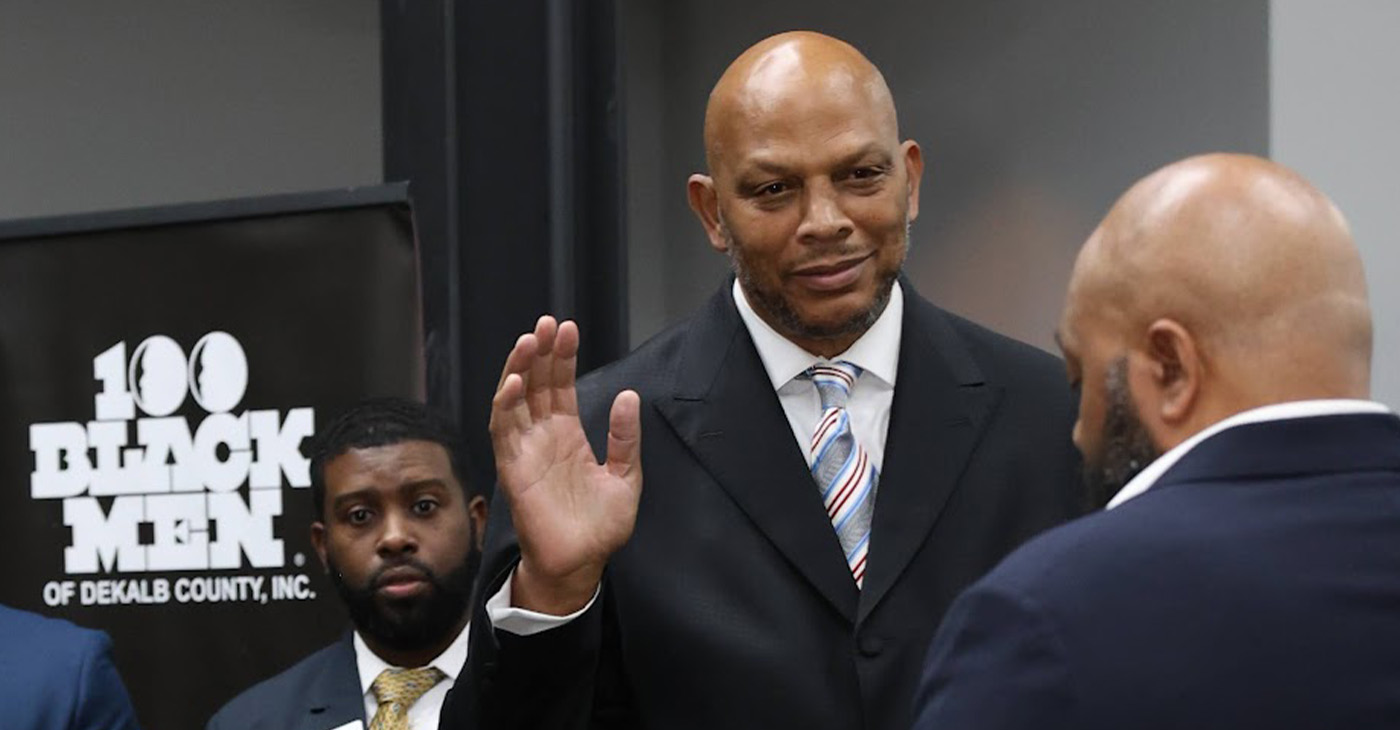
Cummings becomes an honorary member, joining other role model sports stars
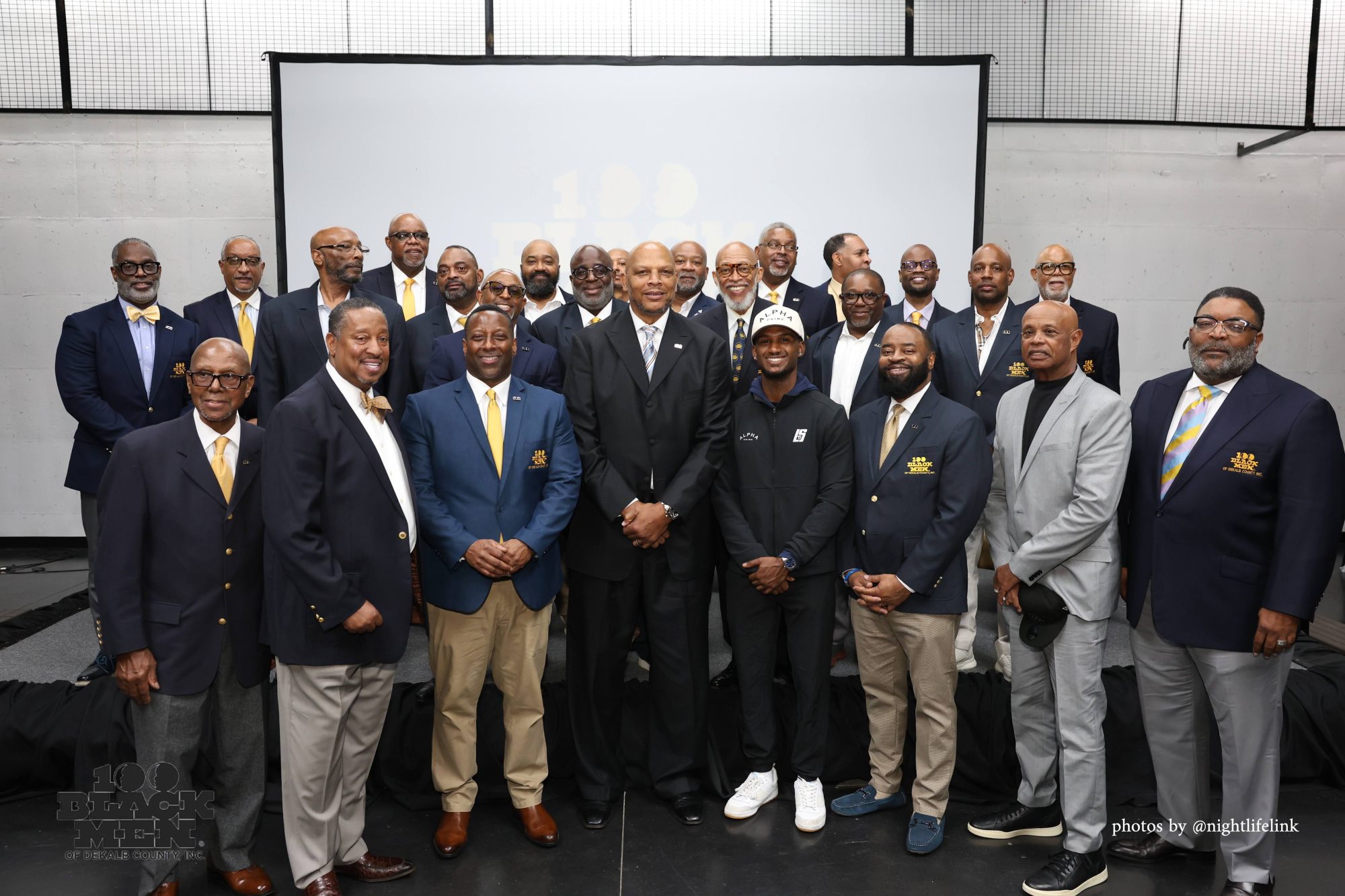
NBA Hall of Fame nominee and Basketball Legend Terry Cummings has officially become an honorary member of the 100 Black Men of DeKalb County, marking a powerful new chapter for the 100 Black Men and youth development across the region.
Cummings was administered the official member’s oath and ceremonially pinned during a special induction ceremony held on Friday, February 20th. The moment signified more than membership — it marked the launch of the organization’s transformative new platform, the Victory & Values Initiative.
The Victory & Values Initiative is a groundbreaking youth development program designed to empower elementary and middle school students through a dynamic blend of sports, mentorship, and STEM exposure. The initiative focuses on building health, discipline, character, leadership, and access to opportunity — creating pathways for long-term academic and personal success.
“This is about more than sports,” said Cummings during the ceremony. “It’s about using the platform of athletics to teach life lessons, create access, and build the next generation of leaders.”
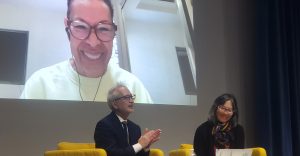
The induction ceremony also featured notable guests including NASCAR’s newest Star Driver, Lavar Scott and NASCAR Director of Athletic Performance, Phil Horton, who joined Cummings for a powerful Victory & Values Town Hall discussion. The Town Hall was moderated by renowned Sports Emcee John Hollins and focused on leadership, resilience, discipline, and the importance of mentorship in shaping young lives.
A “Day at NASCAR” for 75+ Youth
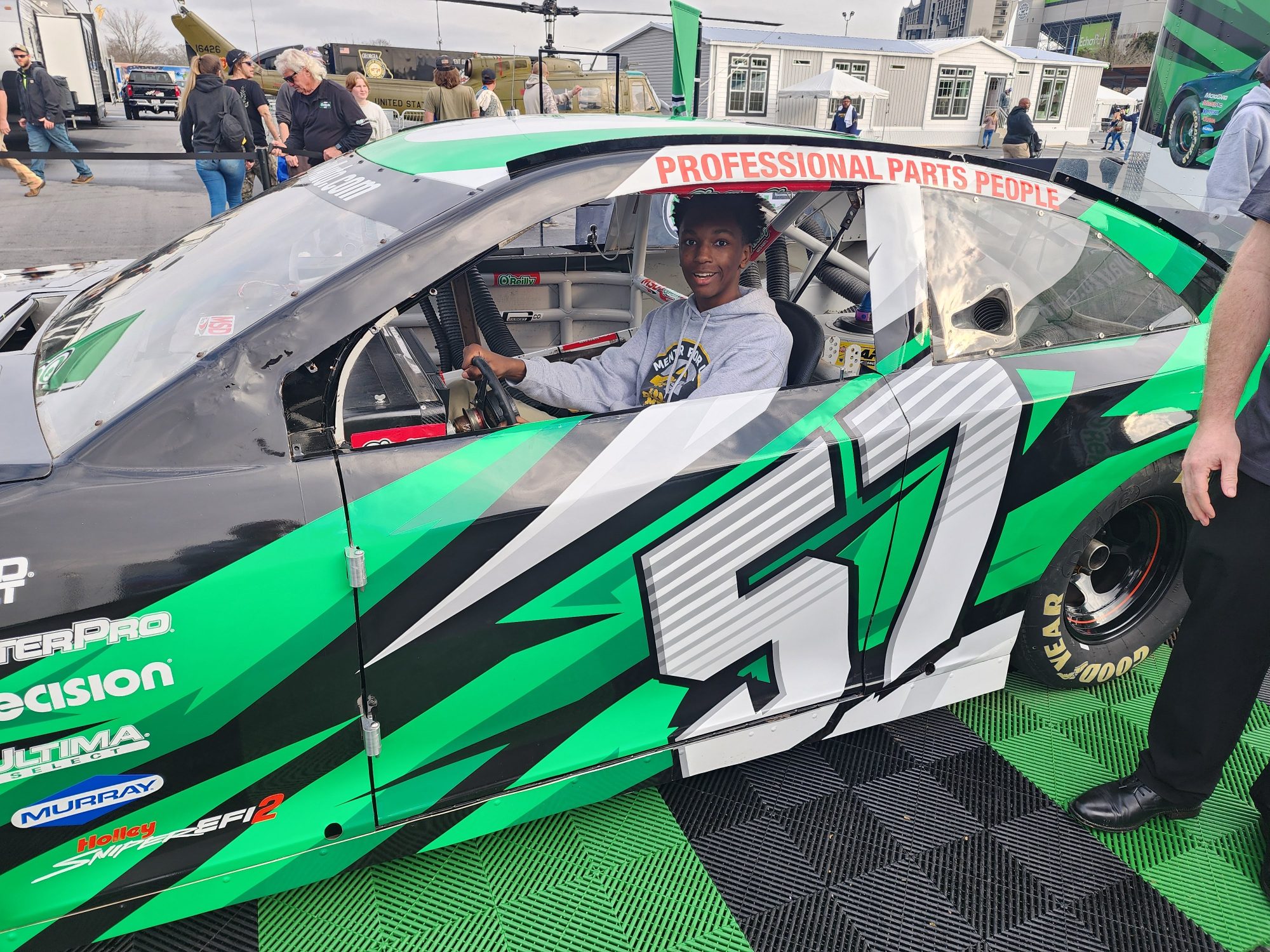
Cummings wasted no time getting to work. On his first full day as an honorary member, he joined his new brothers of the 100 Black Men of DeKalb County to host a “Day at NASCAR,” escorting more than 75 youth to a once-in-a-lifetime experience at EchoPark Motor Speedway (formerly Atlanta Motor Speedway).
The youth participants received behind-the-scenes access including: an exclusive tour of Pit Row, access to the Garage Area and exploration of the interactive Fan Zone.
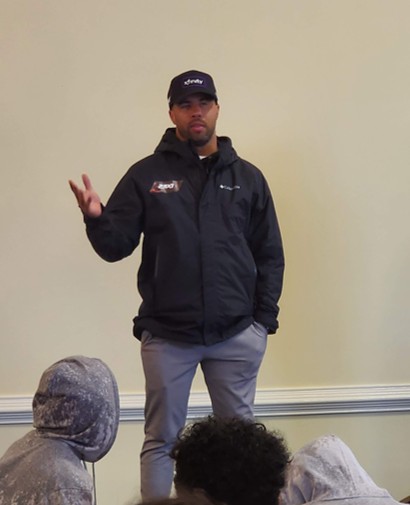
The experience culminated with a surprise meet-and-greet and Q&A session with NASCAR Superstar Bubba Wallace, who shared insights on perseverance, preparation, and breaking barriers in professional sports.
The day served as a living example of the ‘Victory & Values’ Initiative in action — exposing youth to new industries, expanding their vision for the future, and connecting them directly with high- level mentors and role models.
Building Leaders Through Access and Mentorship
The 100 Black Men of DeKalb County – a chapter of the largest, national mentoring organization in the county – continues to expand its footprint with programs focused on academic excellence, economic empowerment, leadership development, and health & wellness.
The launch of ‘Victory & Values’ represents a strategic expansion of the organization’s impact
- intentionally integrating athletics and STEM to engage youth at an early age while reinforcing core principles such as integrity, accountability, teamwork, and perseverance.
“Our mission has always been to mentor the next generation,” said Vaughn Irons, President-Elect of the 100 Black Men of DeKalb County. “With Terry Cummings joining the brotherhood, along with partners in NASCAR and professional sports, we are creating unprecedented access and exposure for our youth. Victory & Values is about turning inspiration into structured opportunity.”
By connecting elementary and middle school students to professional athletes, executives, STEM professionals, and community leaders, the initiative aims to:
- Increase youth exposure to careers in sports business, engineering, and performance science
- Strengthen mentorship pipelines
- Promote physical wellness and mental resilience
- Build character-driven leadership at an early age
Open Invitation to Youth and Families
All youth are invited to participate in the Victory & Values Initiative, along with the other countless, impactful programs offered by the 100 Black Men of DeKalb County.
Parents and guardians seeking mentorship, leadership development, academic enrichment, and transformative exposure opportunities for their children are encouraged to connect with the organization.
As NBA Legend Terry Cummings’ induction demonstrates, Victory & Values is more than a program — it is a movement designed to build champions in life, not just in sports.
For more information about the Victory & Values Initiative or to enroll a student, contact: 100 Black Men of DeKalb County at Phone at 404.241.1338, info@100bmod.org or Tee Foxx at 404.791.6525,

WORK FROM HOME
Home-based business with potential monthly income of $10K+ per month. A proven training system and website provided to maximize business effectiveness. Perfect job to earn side and primary income. Contact Lynne for more details: Lynne4npusa@gmail.com 800-334-0540


Poll Shows Support for Policies That Help Families Afford Child Care

Oakland Post: Week of February 25 – March 3, 2026

Trump’s MAGA Allies are Creating Executive Order Plan to Steal the 2026 Midterms

PRESS ROOM: NBA Hall of Fame Nominee Terry Cummings Joins 100 Black Men of DeKalb County to Launch Victory & Values Initiative

Reflecting on Black History Milestones in Birmingham AL

OP-ED: One Hundred Years of Black Workers Telling the Truth

PRESS ROOM: Civil Rights TV Launches in Selma as the World’s First 24/7 Civil Rights Television Network

Advancements in solar technology that are changing the way we power the world

U.S. manufacturing rebounds – how foundry services are adapting to rising demand

Why has blood testing become so popular in today’s world?

Ghana Mourns a Son of the African World

OP-ED: Trump’s Policies Hurt Black America—and Everyone Else

OP-ED: Meta Deleted Me. I Still Don’t Know Why. And neither will you.

More than a Mission: Paying It Forward for the Future of Education

Avoid Eviction This Season: Landlord Checklist for Stable Tenancies

Oakland Post: Week of January 28, 2025 – February 3, 2026

Life Expectancy in Marin City, a Black Community, Is 15-17 Years Less than the Rest of Marin County

Community Celebrates Turner Group Construction Company as Collins Drive Becomes Turner Group Drive

California Launches Study on Mileage Tax to Potentially Replace Gas Tax as Republicans Push Back

Discrimination in City Contracts

Oakland Post: Week of January 21 – 27, 2026

Book Review: Books on Black History and Black Life for Kids

COMMENTARY: The Biases We Don’t See — Preventing AI-Driven Inequality in Health Care

Post Newspaper Invites NNPA to Join Nationwide Probate Reform Initiative

Medi-Cal Cares for You and Your Baby Every Step of the Way

Black History Events in the East Bay

Art of the African Diaspora Celebrates Legacy and Community at Richmond Art Center

COMMENTARY: The National Protest Must Be Accompanied with Our Votes

After Don Lemon’s Arrest, Black Officials Raise Concerns About Independent Black Media

New Bill, the RIDER Safety Act, Would Support Transit Ambassadors and Safety on Public Transit

Hyundai Ioniq 5 Parking, Safety, and 360 View #shorts

2025 Ioniq 5 New Wiper & Powerful Performance! #shorts

Electric SUV Range: Is 259 Miles Enough? #shorts

EV Charging: How Fast Can You Charge an Electric Vehicle? #shorts

Biometric Cooling… Messaging Seats…Come on! 2025 Infiniti QX80 Autograph 4WD

Charged Up: Witness the Magic of a Fully Electric Car! #shorts

Range Rover Sport PHEV Included…: See What’s Inside This Luxury SUV! #shorts

Invisible Hood View: Perfect Parking with X-Ray Vision! #shorts

AI Is Reshaping Black Healthcare: Promise, Peril, and the Push for Improved Results in California

ESSAY: Technology and Medicine, a Primary Care Point of View

Sanctuary Cities

The RESISTANCE – FREEDOM NOW

STATE OF THE PEOPLE: Freddie

ECONOMIC BOYCOTT DAY!!!!!

I told You So

-
 Activism3 weeks ago
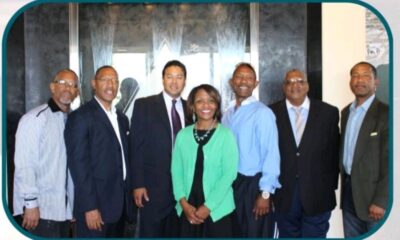
Community Celebrates Turner Group Construction Company as Collins Drive Becomes Turner Group Drive
-
 Business3 weeks ago
California Launches Study on Mileage Tax to Potentially Replace Gas Tax as Republicans Push Back
-
 Activism3 weeks ago
Discrimination in City Contracts
-
 Arts and Culture3 weeks ago
Book Review: Books on Black History and Black Life for Kids
-
 Activism3 weeks ago
COMMENTARY: The Biases We Don’t See — Preventing AI-Driven Inequality in Health Care
-
 Activism3 weeks ago
Post Newspaper Invites NNPA to Join Nationwide Probate Reform Initiative
-
 Alameda County4 weeks ago
Black History Events in the East Bay
-
 Activism4 weeks ago
Art of the African Diaspora Celebrates Legacy and Community at Richmond Art Center

1 Comment