
Bay Area
Black, Vulnerable and Trafficked – Who’s Buying Black Girls?
Although California Senate Bill 357 was intended to alleviate arrests of willing sex workers under anti-loitering laws, it opened a Pandora’s box loophole that hinders the ability of law enforcement to halt human trafficking, especially of young Black and Brown girls. This segment explores who is ‘buying’ people for sex exploitation.

By Tanya Dennis and Vanessa Russell
Although California Senate Bill 357 was intended to alleviate arrests of willing sex workers under anti-loitering laws, it opened a Pandora’s box loophole that hinders the ability of law enforcement to halt human trafficking, especially of young Black and Brown girls. This segment explores who is ‘buying’ people for sex exploitation.
The overlying unintended effect of SB 357 is that it gives priority to the needs of the person ‘buying’ sex over the predicament of those forced into the sex trade through human trafficking.
In Part 1, the Post shared that 40% of the victims of human trafficking in our nation are Black women and girls.
This statistic is alarming especially when we look at who is ‘buying’ them. A 2006 online research project by Commercial Sexual Exploitation of Children (CSEC) revealed the following ‘buyer’ demographics: 99% of the buyers are men; 86% are 26 and older; 42% earned more than $50,000 a year; 29% graduated from college; 69% are employed and 49% are married.
The public wonders if ‘buyers’ are consciously purchasing Black girls and women or if they are merely purchasing whoever is available. Top search results on sites like Pornhub, reveal that demand for Black bodies is intentional. Black girls are in the top three search results for Pornhub and other exploitative sites.
In 2020, Pornhub was investigated for showing 118 videos of confirmed cases of child abuse and human trafficking and hosting videos titled “Black Slave” and “Black Slave Pleasures White Master.” In one case, a set of videos with this theme was watched 527,000 times and received 70% ‘thumbs up’ from the viewers. These racist themes confirm that the purchase of Black girls for the purpose enslavement is part of the ‘buyer’s’ fantasy.
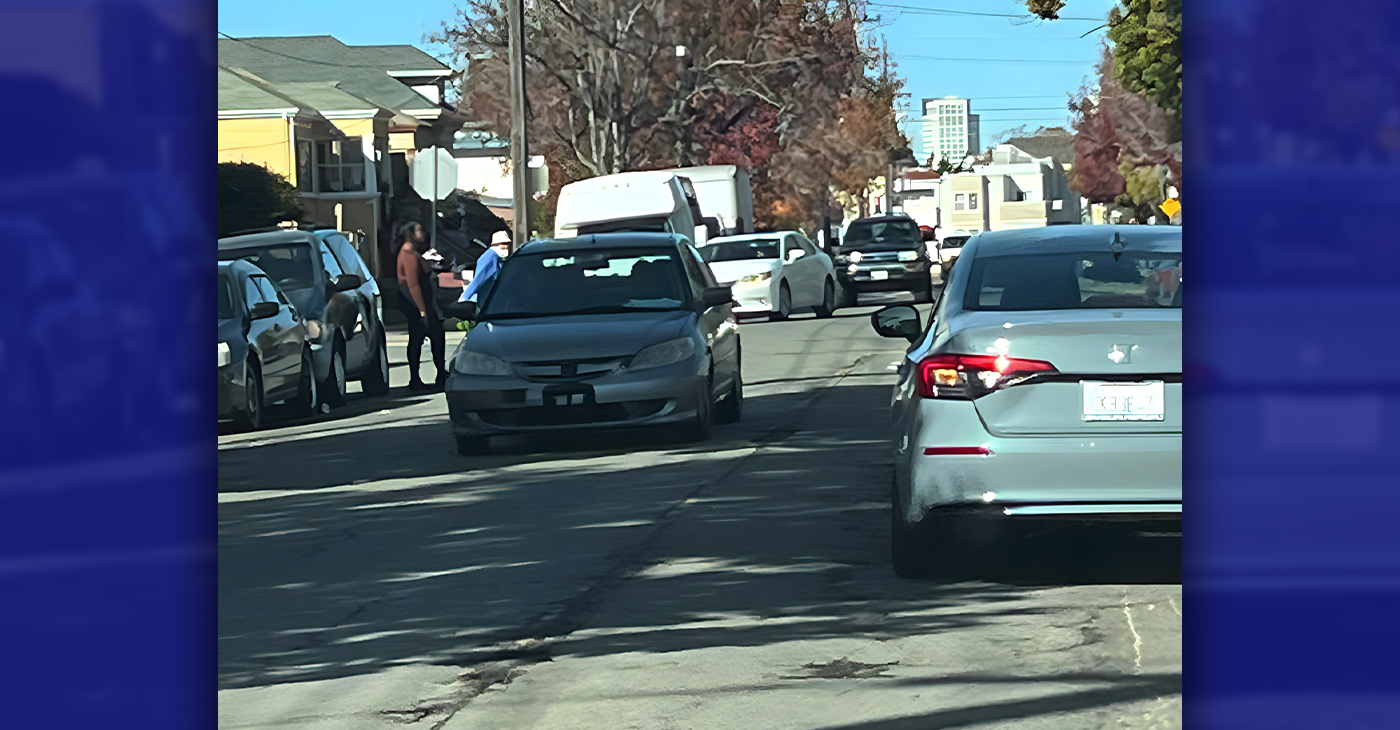
Several different approaches have been attempted to deter sex buying. In the mid-1970s, the Oakland Police Department engaged in reverse stings, placing an undercover female officer on a street corner to catch buyers in the act.
Convicts had their vehicles seized and paid fees of up to 20% of the cost of the vehicle as well as towing and storage fees. “Between 1997 and 1999 the Oakland City Attorney seized and impounded over 350 vehicles.”
A federal court later ruled that seizure ordinances violated state laws. One interesting point from this program that holds true today is that 60% of those who were caught buying sex were not from Oakland.
Other Oakland approaches to deterring sex buying included getting buyers fired from their jobs and placing buyers on neighborhood ‘stay-away’ lists. The EPIK Project, which is devoted to disrupting the demand for sex trafficking and increase the capacity of law enforcement, attempted to solve sex buying by creating a decoy trafficking site which was accessed up to 40,000 times a month and using it to engage with buyers and have men speak with them about their behaviors.
In 2014, Oakland attempted to address demand by launching a Buyer Shaming website. Then in 2016, the Alameda County CEASE (Cities Empowered Against Sexual Exploitation) Network and the City of Oakland launched a coalition and a tool titled ReportJohn.org, which was based on the “Dear John” initiative by Oakland non-profit East Bay Asian Youth Center (EBAYC) that sent a letters to the registered owner of every car that neighbors reported as trolling for sex.
Melissa Farley, a Bay Area trafficking expert and researcher, studied a group of sex buyers in Boston. She found that individuals who purchased sex feared female rejection and endorsed rape myths, such as the belief that “prostitution reduces the likelihood of rape.”
These men revealed their violent tendencies toward women, sharing that they would “force a woman to have sex or rape them if they could get away with it, and engaged in sexually aggressive behavior with very little empathy for the exploited, believing that “prostituted women are intrinsically different from other women.”
One buyer comment perfectly and horrifically summarizes buyer sentiment toward the women and girls he purchased. He said the transaction is like disposing of a coffee cup after you’ve finished drinking it, “When you’re done, you throw it out.”
Buyer diversion programs — like those provided to domestic violence perpetrators bring survivors in to tell their story in hopes of creating a more human narrative in the minds of buyers — have been successfully rolled out in Fresno and Orange County resulting in very low recidivism rates.
When the group of buyers from the Boston study were asked what would change their behavior, a few said a fee and a few days in jail would be enough of a deterrent. One hundred percent said that a 30-day jail stay would deter their buying behavior completely.
Tanya Dennis, is CEO Adamika Village and serves on the Board of Oakland Frontline Healers (OFH). Vanessa Russell, the author of “Love Never Fails Us,” is the COO of the Violence Prevention Coalition and a member of OFH













Activism
Oakland Post: Week of September 23 – 29, 2026
The printed Weekly Edition of the Oakland Post: Week of September 23 – 29, 2026

To enlarge your view of this issue, use the slider, magnifying glass icon or full page icon in the lower right corner of the browser window.
Activism
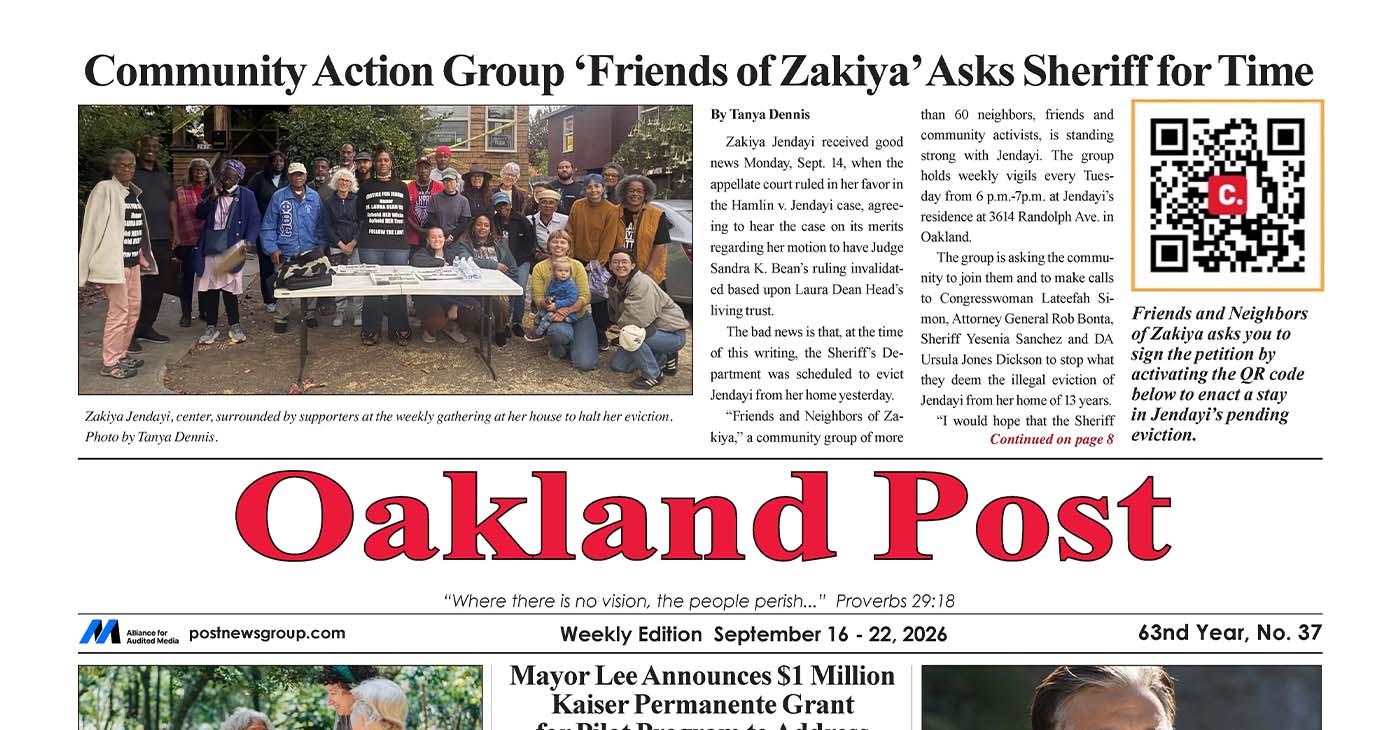
Oakland Post: Week of September 16 – 22, 2026
The printed Weekly Edition of the Oakland Post: Week of September 16 – 22, 2026
To enlarge your view of this issue, use the slider, magnifying glass icon or full page icon in the lower right corner of the browser window.
Activism
Oakland Post: Week of September 9 – 15, 2026
The printed Weekly Edition of the Oakland Post: Week of September 9 – 15, 2026

To enlarge your view of this issue, use the slider, magnifying glass icon or full page icon in the lower right corner of the browser window.



Asm. Corey Jackson Announces Launch of 24-Hour Childcare in His District

IN MEMORIAM: The Rev. Leon “Sonny” Clark, Longtime Orange County Pastor and Community Leader, Dies at 72

Poll: Becerra Widens His Lead Over Hilton; Californians Split on Wealth Tax

From Historic Memories to New Possibilities: Oakland Celebrates Coliseum 60

County Office of Education Says OUSD Finances Are Getting Healthier, Materially Stronger

LIVE FREE Sunday Dinner Brings Faith, Fellowship and Civic Conversation to Oakland

Remembering Chauncey Bailey as Student Journalists Face Threats to Truth-Telling

BLACspace Cooperative Invites Bay Area to Experience Oakland’s Black Cultural Ecosystem Through a BLAC Map Tour + Party

In Wake of Death on Doorstep, Williams Chapel Baptist Church Calls for Better Care, Funding for Unhoused

Oakland Centenarian Nuna McKee Honored!

Caribbean Nations Produce Action Plan Calling for UK Reparations Over Slavery

Oakland Post: Week of September 23 – 29, 2026

Doulas Are Helping Black California Moms Navigate Pregnancy–Even as High Mortality Rates Persist

Newsom Signs Addictive Social Media Law to Protect Kids

On Your November Ballot: Prop 38 Would Allocate $8.4 Billion to Immunology and Immunotherapy Funding

Standoff for Justice: Our Homes Are Worth Fighting For

Oakland Post: Week of August 26 – September 1, 2026

Frontier Airlines’ Return to Oakland Airport Brings Flights, Jobs and Opportunity

Gubernatorial Candidate Steve Hilton Blasts California New Tire Rules; Newsom Hits Back

Chef Sharon Lee Blends Culinary Excellence, Education and Empowerment

Jackie Wright Champions Bay Area Stories, Filmmakers and Cultural Institutions

Big City Mayors Ask for “Yes” Vote on Housing Bond Measure; Conservatives Say “No”

Oakland Coliseum Project Opens Door for Small Businesses to Build Bigger

Gov. Newsom’s Latest Appointees Include Sacramento Advocate for Formerly Incarcerated Students; State’s New Tech Chief

Misnamed ‘Parent’ PAC Seeks to Influence Oakland School Board Elections

Longtime BWOPA Member Brendalyn Goodall Appointed to California Workforce Development Board

Gov. Newsom Signs Law Shielding Immigration Aid Workers From Doxing Threats

Secretary of State Shirley N. Weber Urges Californians to Vote Early as Voter ID Battle Intensifies

From Palestine to Oakland: Seeds for Liberation Examines Shared Struggles for Freedom

IN MEMORIAM: Dolly Parton Dead at 80 — How She Built a Legacy of Love and Earned Her Place in Black Culture

The Conversation With Al McFarlane 6/23/26

Media Monday 6/22/26

LIVE! ASK ALMA! — TUES. 6.23.26 7PM EST

Car Buying Secrets: 4 Hidden Checks Before You Sign!

Is This 550 HP Charger Worth YOUR Money? AutoNetwork Review

Celebrating Juneteenth – Frederick Douglass on education and resistance

LIVE! — ASK ALMA! — TUES. 6.19.26 7PM EST

Hyundai Ioniq 5 Parking, Safety, and 360 View #shorts

2025 Ioniq 5 New Wiper & Powerful Performance! #shorts

Electric SUV Range: Is 259 Miles Enough? #shorts

EV Charging: How Fast Can You Charge an Electric Vehicle? #shorts

Biometric Cooling… Messaging Seats…Come on! 2025 Infiniti QX80 Autograph 4WD

Charged Up: Witness the Magic of a Fully Electric Car! #shorts

Range Rover Sport PHEV Included…: See What’s Inside This Luxury SUV! #shorts

Invisible Hood View: Perfect Parking with X-Ray Vision! #shorts
-
 Community2 weeks ago
Misnamed ‘Parent’ PAC Seeks to Influence Oakland School Board Elections
-

 Activism3 weeks ago
Oakland Post: Week of September 2 – 8, 2026
-

 Community2 weeks ago
Richmond Tiny House Village Farm & Garden Set to Open Gates on Sept. 26
-

 Black History2 weeks ago
OPINION: Nolan Wells’ Death One of Several Signifying Racial Terror Lives on in U.S. South
-

 Black History2 weeks ago
Latest Massacre in Haiti Reveals Cruelty U.S. Deportations
-

 Activism2 weeks ago
Oakland Post: Week of September 9 – 15, 2026
-

 Community2 weeks ago
Democratic Clubs Interview Candidates for Oakland School Board
-
 Featured2 weeks ago
‘Ready to See These Bills Become Law’: Sen. Weber’s Package of 15 Bills Advance to Gov. Newsom’s Desk
