
Bay Area
What California Is Learning from Expanding Voters Rights
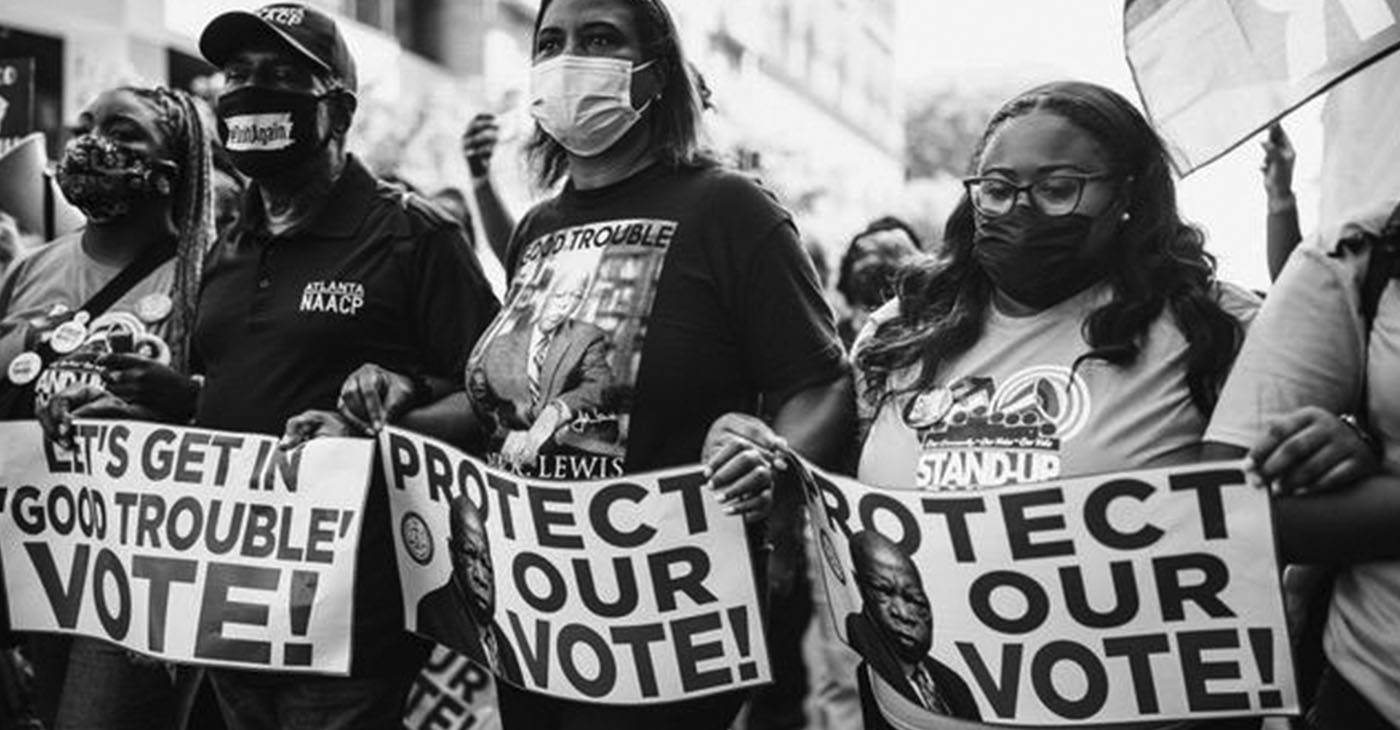
Mail-in ballot voting has been underway since the second week in May. Assembly Bill 37, signed into law by Gov. Gavin Newsom in 2021, requires the state to send vote-by-mail (VBM) ballots to every registered voter in the state. The law applies to all elections held after Jan. 1, 2022.

By Joe W. Bowers Jr., California Black Media
June 7, 2022 is Primary Election Day in California.
On the ballot are candidates for U.S. Senate, Governor, Lieutenant Governor, Secretary of State, Controller, Treasurer, Attorney General, Insurance Commissioner, State Board of Equalization, State Superintendent of Public Instruction, U.S. House of Representatives, State Senate and State Assembly, as well as candidates for local elected positions.
There are two contests for U.S. Senate on the ballot. One is for a full six-year term ending Jan. 3, 2029. The other is for the remainder of the term that Sen. Alex Padilla (D-CA) has been serving in place of Vice. President Kamala Harris that ends Jan. 3, 2023.
Mail-in ballot voting has been underway since the second week in May. Assembly Bill 37, signed into law by Gov. Gavin Newsom in 2021, requires the state to send vote-by-mail (VBM) ballots to every registered voter in the state. The law applies to all elections held after Jan. 1, 2022.
Ballots are sent 29 days before the election, which was May 9 for the primary. For the November General Election, voters will start receiving ballots October 10.
A majority of California voters live in counties that have adopted the Voter’s Choice Act (VCA) system. In 2016, Senate Bill 450 created the VCA, an election model that expands voters’ options for how, when and where they can cast their ballots in an attempt to provide more accessible voting options.

VBM ballots are provided with a postage-paid return envelope. For a ballot to count in the upcoming primary election, it must be postmarked on or before Election Day and received by June 14, 2022. It can also be dropped off in-person to a secure ballot drop box, a voting location or county elections office by 8:00 p.m. on June 7, 2022.
The VCA is an optional law. Counties elect if they want to adopt it. In 2018, five counties adopted the new law: Madera, Napa, Nevada, Sacramento and San Mateo. In 2020, nine additional counties changed their election models to the VCA: Amador, Butte, Calaveras, El Dorado, Fresno, Los Angeles, Mariposa, Orange, Santa Clara, and Tuolumne. In 2022, the number of counties that have transitioned to the VCA grew to 28 with the addition of Alameda, Kings, Marin, Merced, Riverside, San Benito, San Diego, Santa Cruz, Sonoma, Stanislaus, Ventura, and Yolo counties.
In VCA counties, early in-person voting begins as early as May 28. Voters can vote at any county vote center instead of being assigned to a neighborhood polling place. The vote centers are open four to 10 days prior to the election, including weekends. They serve as one-stop shops with accessible voting machines – venues where voters can drop off their VBM ballot, receive a replacement ballot, register to vote, and get help with voting material in multiple languages.
Unregistered voters who miss the close of registration on May 23 will be able to conditionally register to vote at any vote center and cast a provisional ballot through the end of Election Day.
When California policymakers and election officials proposed the Voter’s Choice Act most proponents applauded its benefits, including lowering election administration costs, providing greater convenience and flexibility for voters, and the potential to improve voter turnout.
Recently, California Secretary of State (SOS) Shirley Weber released a report on the implementation of VCA during the 2020 Primary and General Elections.
Key findings of the report include:
VCA counties had higher voter registration rates in the state. The 15 VCA counties accounted for about half of the state’s registered voters in both elections.
Many VCA counties experienced a higher voter turnout compared to their non-VCA counterparts. Turnout in the 2020 General Election across racial groups showed white voters had a higher overall turnout than their non-W\white counterparts. The voter turnout gap for Black voters was 5.2 points, and AAPI voters had a turnout gap of 4.3 points.
Black and AAPI voters turned out at similar rates as the VCA counties’ average, and Latino voters used in-person voting most among all races and ethnicities.
Use of vote-by-mail ballots was the primary choice of voting in the 2020 elections. More voters chose to return their ballot by drop box than by mail. Use of drop boxes decreased after the age of 45 in the Primary Election and age 35 in the General Election.
Voters in VCA counties cast a ballot in-person at a higher rate than voters in non-VCA counties in the General Election (55.1%). For the Primary Election, that number was 46.6%.
In the General Election, voters aged 46-55 voted in person most compared to all other age groups. In both the Primary and General Elections, voters aged 66+ voted in-person least.
VBM ballot rejection rates in VCA counties were similar to VBM ballot rejections statewide. Voters aged 18-25 had the highest ballot rejection rate. Ballot rejection rates decreased as voter age increased in VCA counties.
VBM ballots were rejected (69.3%) mainly due to not being received on time during the Primary Election. But General Election VBM ballots were mainly rejected due to non-matching signatures (56.09%).
Provisional ballot use decreased significantly between the Primary and General Elections.
There were no confirmed instances of voter fraud in both the Primary and General elections in 2020.
Secretary of State’s Recommendations based on the report findings:
Share best practices from counties that have high voter registration rates with counties that have lower registration rates.
Reduce ballot rejection rates through increased voter education.
Continue to work with counties to ensure drop box locations are accessible and convenient to the public.
Increase outreach and education about early in-person voting and other voting options available in VCA counties.
Increase targeted outreach efforts to engage young voters (18-25).
“We have taken away every excuse a person can possibly have as to why they won’t vote,” SOS Weber said recently. “People realize this is going to be easy and it’s comfortable.”













Activism
Oakland Post: Week of September 16 – 22, 2026
The printed Weekly Edition of the Oakland Post: Week of September 16 – 22, 2026
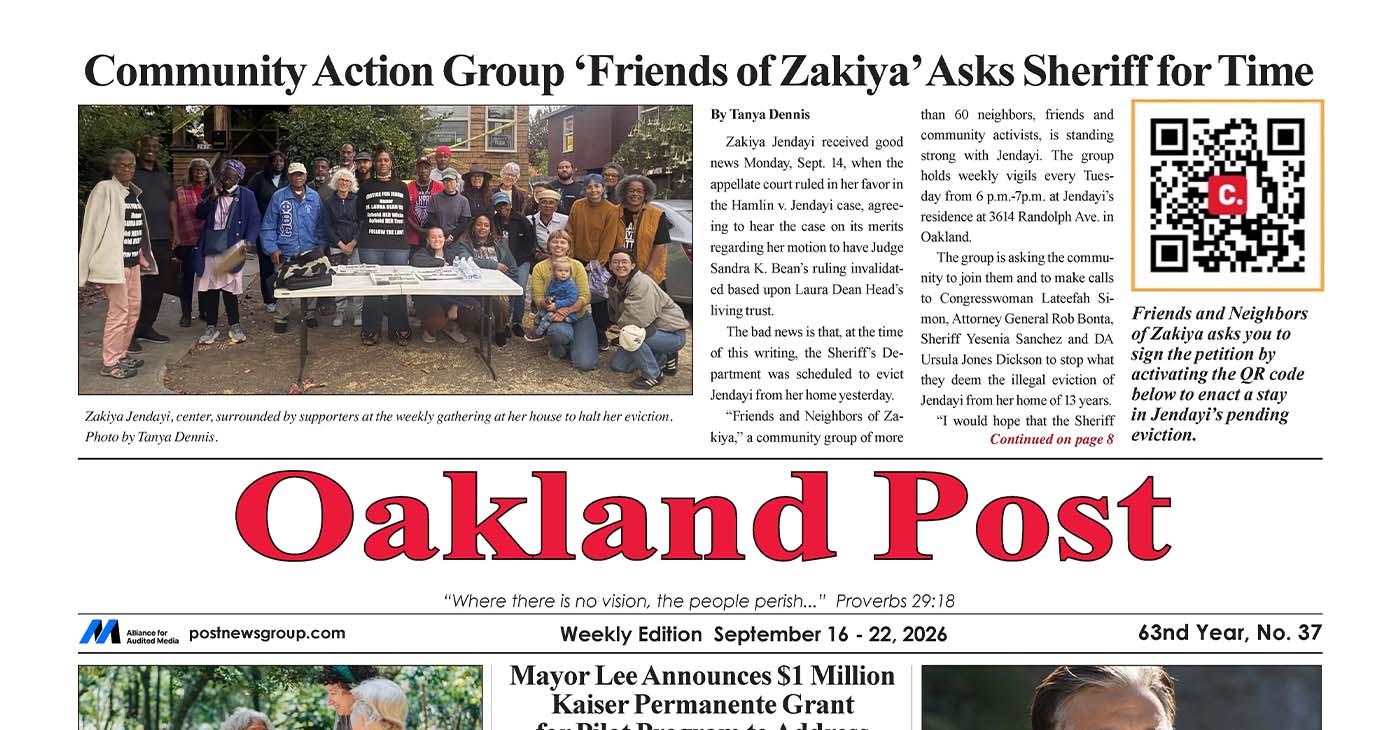
To enlarge your view of this issue, use the slider, magnifying glass icon or full page icon in the lower right corner of the browser window.
Activism
Oakland Post: Week of September 9 – 15, 2026
The printed Weekly Edition of the Oakland Post: Week of September 9 – 15, 2026

To enlarge your view of this issue, use the slider, magnifying glass icon or full page icon in the lower right corner of the browser window.
Activism
Oakland Post: Week of September 2 – 8, 2026
The printed Weekly Edition of the Oakland Post: Week of September 2 – 8, 2026
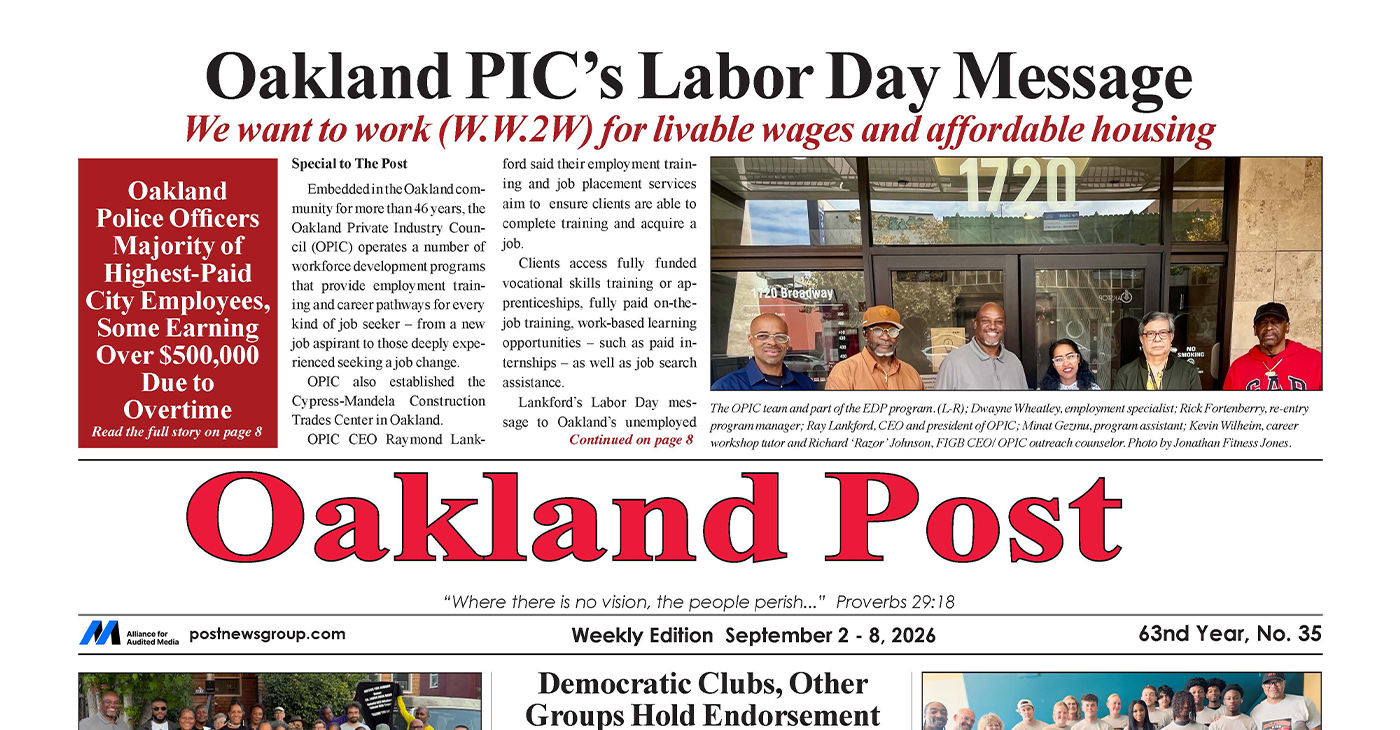
To enlarge your view of this issue, use the slider, magnifying glass icon or full page icon in the lower right corner of the browser window.



Doulas Are Helping Black California Moms Navigate Pregnancy–Even as High Mortality Rates Persist

Newsom Signs Addictive Social Media Law to Protect Kids

On Your November Ballot: Prop 38 Would Allocate $8.4 Billion to Immunology and Immunotherapy Funding

Ask California: Golden State Releases New AI Chatbot

Asm. Isaac Bryan’s Bill Banning California Police From ICE Side Jobs Reaches Newsom’s Desk

Assemblymember LaShae Sharp-Collins’s Bill Would Pause Law Enforcement’s Use of Shock Gloves Pending Study

BOOK REVIEW: ‘Laws of Solomon’ Reveals Tender Heart of Former Child Soldier

OPINION: The New American Fear – From 9-11 to AI

Passing for White, Fighting for Black America: The Courage of Walter White

Oakland People’s Arms Embargo Coalition Demands End to Military Shipments Thru Oakland

Barbara Lee Mourns Gloria Steinem, Remembers a Friendship Rooted in Equality

Event Preview: ‘Fashion v. Fascism’ – A Runway Revolution Is Coming to the Bay Area

Two Looming Threats Every Alameda County Elder Should Know About

Oakland Mayor Reads to Children at Bookout Block Party at Marcus Books Store

Tradition Comes to the Streets in 11th Annual Black-Eyed Pea Festival at the Freedom Farmers Market

Less Affluent School Districts, Including Sacramento City, Face Threat of State Takeover

ESSAY: California Can Close Its Colorectal Cancer Gap

California Hispanic Chambers of Commerce Unveils: ‘Powering the Future’ Theme for 47th Annual Statewide Convention

Four Candidates, Including Incumbent Barbara Lee, Qualify for Oakland Mayor’s Race

Oakland Post: Week of August 12 – 18, 2026

From Blueprint to Breakthrough: Tackling Affordable Housing in Oakland

Oakland Observes Black August with Block Parties, Film Showings, Workshops

COMMENTARY: Why Local School Tax Measure G1 Will Not Be on the November Ballot

Standoff for Justice: Our Homes Are Worth Fighting For

Returning to Its Roots, the Oakland Black-Eyed Pea Festival Partners with the Freedom Farmers Market Sept. 12

NPRC Scores First Advocacy Victory: David Shaw Finally Gets His Wish to ‘Go Home’

Oakland Post: Week of August 26 – September 1, 2026

Frontier Airlines’ Return to Oakland Airport Brings Flights, Jobs and Opportunity

Gubernatorial Candidate Steve Hilton Blasts California New Tire Rules; Newsom Hits Back

Chef Sharon Lee Blends Culinary Excellence, Education and Empowerment

The Conversation With Al McFarlane 6/23/26

Media Monday 6/22/26

LIVE! ASK ALMA! — TUES. 6.23.26 7PM EST

Car Buying Secrets: 4 Hidden Checks Before You Sign!

Is This 550 HP Charger Worth YOUR Money? AutoNetwork Review

Celebrating Juneteenth – Frederick Douglass on education and resistance

LIVE! — ASK ALMA! — TUES. 6.19.26 7PM EST

Hyundai Ioniq 5 Parking, Safety, and 360 View #shorts

2025 Ioniq 5 New Wiper & Powerful Performance! #shorts

Electric SUV Range: Is 259 Miles Enough? #shorts

EV Charging: How Fast Can You Charge an Electric Vehicle? #shorts

Biometric Cooling… Messaging Seats…Come on! 2025 Infiniti QX80 Autograph 4WD

Charged Up: Witness the Magic of a Fully Electric Car! #shorts

Range Rover Sport PHEV Included…: See What’s Inside This Luxury SUV! #shorts

Invisible Hood View: Perfect Parking with X-Ray Vision! #shorts
-
 Commentary4 weeks ago
Standoff for Justice: Our Homes Are Worth Fighting For
-
 Activism4 weeks ago
Oakland Post: Week of August 26 – September 1, 2026
-
 Business4 weeks ago
Frontier Airlines’ Return to Oakland Airport Brings Flights, Jobs and Opportunity
-
 Business4 weeks ago
Gubernatorial Candidate Steve Hilton Blasts California New Tire Rules; Newsom Hits Back
-
 Business4 weeks ago
Chef Sharon Lee Blends Culinary Excellence, Education and Empowerment
-

 Education4 weeks ago
Gov. Newsom’s Latest Appointees Include Sacramento Advocate for Formerly Incarcerated Students; State’s New Tech Chief
-

 Community4 weeks ago
Big City Mayors Ask for “Yes” Vote on Housing Bond Measure; Conservatives Say “No”
-

 Business4 weeks ago
Oakland Coliseum Project Opens Door for Small Businesses to Build Bigger
