
Activism
Make Mental Wellness Part of Total Health for Black Communities
The pandemic has propelled health inequity and racism into news headlines and helped spark national conversations about the health disparities that face the Black, Indigenous, and People of Color (BIPOC) communities. The impact of decisions about the treatment we receive or deserve are often driven by racism and the resulting implicit bias that individuals who have sworn to take care of their patients often harbor. And this affects our physical, mental, and emotional health and ultimately health outcomes.

By Rhonda Smith
The next phase of the COVID-19 pandemic in California has arrived. As the state begins to implement its SMARTER Plan, protecting ourselves and our communities from COVID-19 and its fast-spreading variants through vaccination can ensure better outcomes for us all.
Despite mask mandates ending, we must continue to spotlight the importance of keeping Black and African Americans healthy and encourage our community to think about being more proactive about our overall health and well-being. We can start by focusing on our whole selves—our physical, mental, and emotional health.
The pandemic has propelled health inequity and racism into news headlines and helped spark national conversations about the health disparities that face the Black, Indigenous, and People of Color (BIPOC) communities. The impact of decisions about the treatment we receive or deserve are often driven by racism and the resulting implicit bias that individuals who have sworn to take care of their patients often harbor. And this affects our physical, mental, and emotional health and ultimately health outcomes.
A reflection on our historical relationship with the medical community has certainly warranted the level of distrust of the healthcare system, and the many stories of outright racism and discrimination experienced in the past.

One example is Dr. James Marian Sims, who performed surgeries and experiments on Black women without their permission or anesthesia. Another example, which many of us are familiar with, is the Tuskegee Syphilis Study, which was administered by the U.S. Public Health Service from 1932 to 1972 to better understand syphilis.
During the four decades, hundreds of Black men in Tuskegee, Alabama, were injected with the disease without giving their consent; and even once penicillin became a common syphilis treatment, they were left untreated.
Our distrust of the healthcare system has been further shaped by present-day experiences, with many Blacks and African Americans saying they have experienced racism during a medical visit or that their physical pain or discomfort is frequently ignored.
Unfortunately, our healthcare system has often disregarded BIPOC patient needs, and systemic racism has morphed into a true public health crisis. Despite this, as Blacks and African Americans, we have persisted. Our individual and cultural resilience equips us to persevere and survive in a system built on a foundation of discriminatory design.
As part of our culture and heritage, we have relied on an oral tradition that passes on stories about how we should care for ourselves and remedies that heal our ailments. I hear many of these stories through our network and I heard them in my own family. We have relied on our own learnings; and in some instances, we have relied on our faith. And through it all, we have found ways to maintain our health and wellness.
However, we are weathered, and enduring resiliency is hard. If we are not whole, we are not healthy. If we are not healthy, we cannot be resilient.
Resilience is an element of mental health, and our whole health comprises elements of physical, mental, and emotional wellness. This means our whole health needs to be a priority, not only one dimension or another. We must invest in our individual health and wellbeing and make it a priority so that our families, community, and all of us will be healthier and live longer.
We must look to the past to inspire a better future so that we can rewrite our heath history here in California. I appreciate the state’s COVID-19 awareness campaign which has sought to address mental health concerns and other issues that impact us by partnering with African American and Black medical experts and advocates for community conversations.
These conversations have provided a platform for discussion and opportunities to educate, dispel misinformation and break stigmas.
We are not strangers to race-based adversity, and its impact on our health and wellbeing. Racism, health inequities inequity, police brutality, and residential redlining each affect public health in its own unique way. Yet we continue to persevere.
Black History Month was a time to remember our past, honor our heroes, celebrate our great legacy of achievement. The theme for the month this year was “Black Health and Wellness”, and it was meant for us to prioritize total wellness and build a healthier history for us now and for generations to come.
For more about COVID-19, including guidance on masking and testing, visit covid19.ca.gov. You should also visit covid19.ca.gov or the CDC.gov more timely, accurate information about the pandemic. To schedule an appointment for a vaccination or a booster, visit MyTurn.ca.gov, or call 1-833-422-4255.
Rhonda Smith, executive director of California Black Health Network












Activism
Oakland Post: Week of August 5 – 11, 2026
The printed Weekly Edition of the Oakland Post: Week of August 5 – 11, 2026
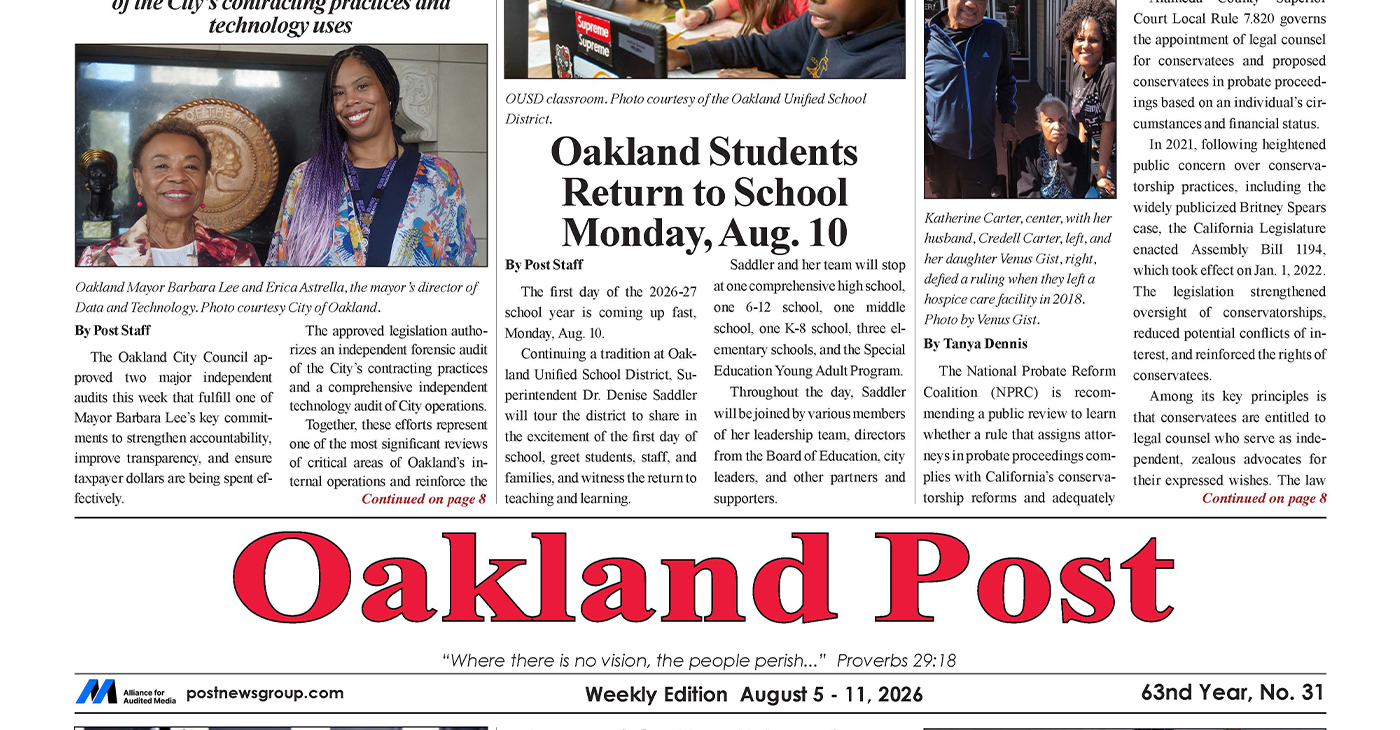
To enlarge your view of this issue, use the slider, magnifying glass icon or full page icon in the lower right corner of the browser window.
Activism
Oakland Post: Week of July 29 – August 4, 2026
The printed Weekly Edition of the Oakland Post: Week of July 29 – August 4, 2026
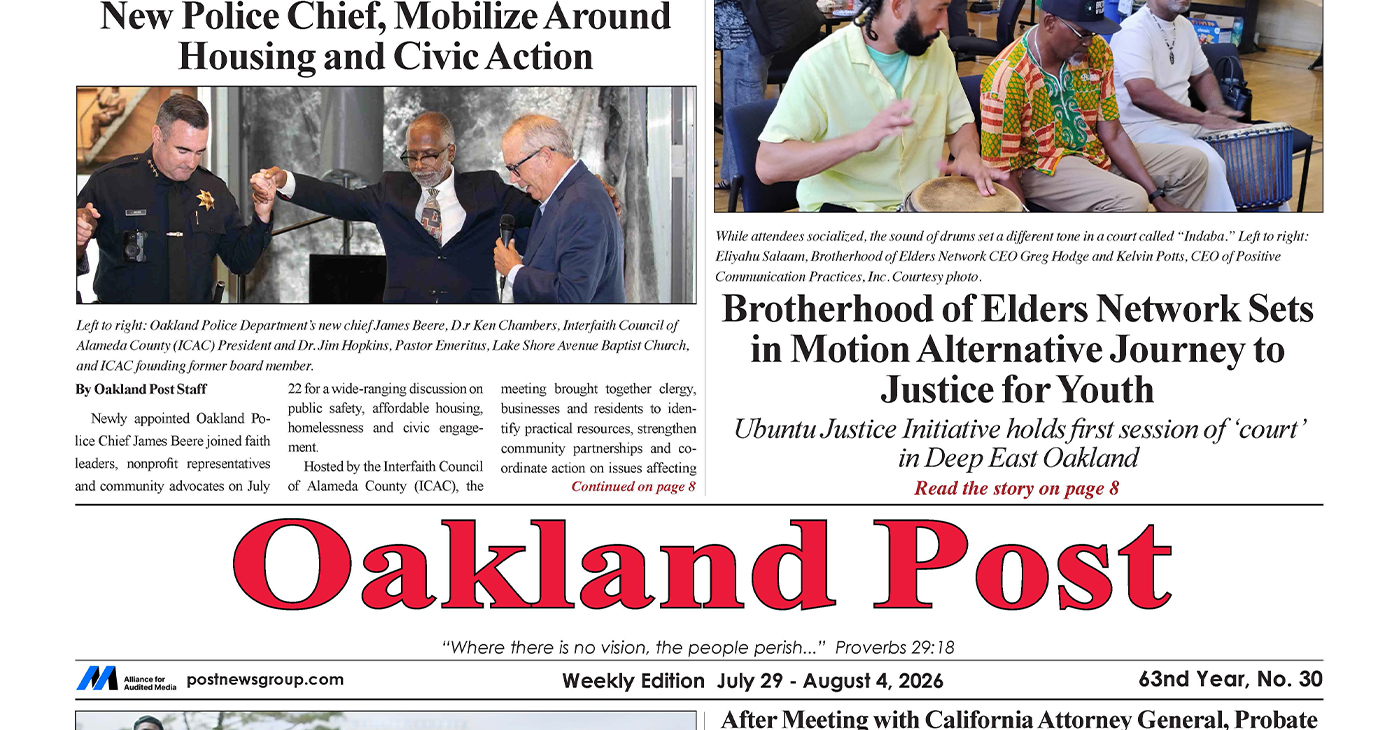
To enlarge your view of this issue, use the slider, magnifying glass icon or full page icon in the lower right corner of the browser window.
Activism
Oakland Post: Week of July 22 – 28, 2026
The printed Weekly Edition of the Oakland Post: Week of July 22 – 28, 2026

To enlarge your view of this issue, use the slider, magnifying glass icon or full page icon in the lower right corner of the browser window.
WORK FROM HOME
Home-based business with potential monthly income of $10K+ per month. A proven training system and website provided to maximize business effectiveness. Perfect job to earn side and primary income. Contact Lynne for more details: Lynne4npusa@gmail.com 800-334-0540


Car Wash Workers Cope with Lingering Impacts of ICE Raids

Misty Copeland Shapes Ballet’s Tomorrow

As Part of Your Back-to- School Checklist, Vaccinate

As Part of Your Back-to- School Checklist, Vaccinate

Congresswoman Simon Demands Investigation into Trump’s Abuse of Emergency Powers for Coal Export Terminal in West Oakland

OPINION: The Philippines Isn’t Foreign When Your Family Still Lives There

Asm. McKinnor’s Bill Banning Drones Above Outdoor Entertainment Events Awaits Senate Decision

California Sen. Padilla Joins Colleagues to Introduce Bill Imposing Term Limits on Supreme Court Justices

Department of Homeland Security Demands California Secretary of State Shirley N. Weber Scrub Voter Rolls

George Cook: The Inventor Who Made Fishing Smarter

Gov. Newsom Announces $109.6 Million in Funding for 278 Supportive Homes in Bakersfield, Contra Costa, Sacramento and Fresno

Rep. Kamlager Dove Demands Care, Justice for Man Shot by ICE

“The Power to See Threats Sooner”: Gov. Newsom, Safety Officials Showcase California’s Investments in Hi-Tech Wildfire Prevention

100 Black Wings’ Team Oakland Youth Athletes Heading to Taiwan for 2026 International Children’s Games

Oakland ‘Port Serves as a Powerful Engine for Good Jobs and Economic Development
Department of Homeland Security Demands California Secretary of State Shirley N. Weber Scrub Voter Rolls

Oakland Children’s Hospital Workers and Patients Rally for Pediatric Medical Care

New Judge Could Decide if Karmelo Anthony Gets a New Trial
“The Power to See Threats Sooner”: Gov. Newsom, Safety Officials Showcase California’s Investments in Hi-Tech Wildfire Prevention

Alpha Kappa Alpha Sorority, Inc. Celebrates New North Atlantic Regional Director

Surveillance Pricing Fight: State Senate Debates Bill Banning Retailers from Using AI to Set Prices Based on a Buyer’s Profile

Mount Zion MBC, Church of Jesus Christ of Latter-day Saints Partner to Bring 29,000 Meals to Alameda County
California Sen. Padilla Joins Colleagues to Introduce Bill Imposing Term Limits on Supreme Court Justices

Starting This Summer, California Car Buyers Can Get an Instant $3500 Off the Cost of Electric Vehicles

COMMENTARY: You Are Already Paying for the AI Boom

California Bill Would Let Abuse Victims Use Trauma as Legal Defense for Violent Crime

Fed Court to Decide Landmark First Amendment Case

Gov. Gavin Newsom Signs Law Streamlining Affordable Housing Rules

Oakland Celebrates $125 Million Coliseum Sale
Car Wash Workers Cope with Lingering Impacts of ICE Raids

The Conversation With Al McFarlane 6/23/26

Media Monday 6/22/26

LIVE! ASK ALMA! — TUES. 6.23.26 7PM EST

Car Buying Secrets: 4 Hidden Checks Before You Sign!

Is This 550 HP Charger Worth YOUR Money? AutoNetwork Review

Celebrating Juneteenth – Frederick Douglass on education and resistance

LIVE! — ASK ALMA! — TUES. 6.19.26 7PM EST

Hyundai Ioniq 5 Parking, Safety, and 360 View #shorts

2025 Ioniq 5 New Wiper & Powerful Performance! #shorts

Electric SUV Range: Is 259 Miles Enough? #shorts

EV Charging: How Fast Can You Charge an Electric Vehicle? #shorts

Biometric Cooling… Messaging Seats…Come on! 2025 Infiniti QX80 Autograph 4WD

Charged Up: Witness the Magic of a Fully Electric Car! #shorts

Range Rover Sport PHEV Included…: See What’s Inside This Luxury SUV! #shorts

Invisible Hood View: Perfect Parking with X-Ray Vision! #shorts
-
 Featured5 days ago
Department of Homeland Security Demands California Secretary of State Shirley N. Weber Scrub Voter Rolls
-
 Business3 weeks ago
Oakland Children’s Hospital Workers and Patients Rally for Pediatric Medical Care
-
 #NNPA BlackPress2 weeks ago
New Judge Could Decide if Karmelo Anthony Gets a New Trial
-
 Environment5 days ago
“The Power to See Threats Sooner”: Gov. Newsom, Safety Officials Showcase California’s Investments in Hi-Tech Wildfire Prevention
-
 Black History2 weeks ago
Alpha Kappa Alpha Sorority, Inc. Celebrates New North Atlantic Regional Director
-
 Business3 weeks ago
Surveillance Pricing Fight: State Senate Debates Bill Banning Retailers from Using AI to Set Prices Based on a Buyer’s Profile
-
 Business3 weeks ago
Mount Zion MBC, Church of Jesus Christ of Latter-day Saints Partner to Bring 29,000 Meals to Alameda County
-
 Featured5 days ago
California Sen. Padilla Joins Colleagues to Introduce Bill Imposing Term Limits on Supreme Court Justices
