
Bay Area
Chase Bank Executive Reveals Ways Bank Supports Black Community
In 2020, [JP Morgan] Chase announced its $30 billion racial equity commitment, a five-year plan that includes assisting entrepreneurs in historically underserved areas to access coaching, technical assistance and capital. Chase has also provided 15,000 loans to small businesses in diverse communities.


Honoring Black Achievement and Doubling Down on the Work to be Done During Black History Month and Beyond
February is Black History Month – an annual commemoration of the achievements of Black Americans and their remarkable impact on history. It’s a time to celebrate the cultural heritage shaped by generations of Black Americans, who for many decades have fought for equity – a fight that continues today.
Though advancements have been made, there is still so much work to be done in our communities in the pursuit of racial equity. For more on how JPMorgan Chase is honoring Black History Month, and how you can too, we sat down with Myesha Brown, Oakland Community Manager from the branch at 3005 Broadway, to discuss some impactful ways to celebrate and support the Black community, not just this month – but all year long.
Oakland Post: What type of investments is Chase making to bolster the financial health of its Black customers and communities?
Brown: Let’s first talk about Black History Month. We’re committed to driving real and sustainable change for the Black community here at Chase and around the world. We’re using this time to both reflect on the past, aswell as our commitment to build a more equitable future for all people.
From the way we do business to the policies we advocate for, our commitments are part of a continued effort to bring an enhanced equity lens to JPMorgan Chase’s businesses and how we serve all customers, clients, communities and employees.
And so, our work to support the Black community goes beyond banking. By providing growth opportunities for diverse-owned small businesses, increasing homeownership rates, providing better access to affordable housing and more, Chase is committed to helping close the racial wealth gap and driving economic inclusion. We’re also giving underbanked communities better access to the necessary resources to improve financial health.
But the work doesn’t stop there. Every day we collaborate with community partners, policymakers, customers and employees to continue improving the financial health of underrepresented communities.
Oakland Post: How is Chase helping to accelerate Black-owned businesses?
Brown: In 2020, Chase announced its $30 billion racial equity commitment, a five-year plan that includes assisting entrepreneurs in historically underserved areas to access coaching, technical assistance and capital. Chase has also provided 15,000 loans to small businesses in diverse communities.
Additionally, Chase offers a suite of helpful tools for Black and diverse-owned businesses. For example, we offer one-on-one counseling with a business banking professional, access to the Chase for Business Resource Center and membership to the JPMorgan Chase Supplier Diversity Network (SDN).
Oakland Post: What are some ways people can support the economic growth of the Black community?
Brown: Black History Month is a great reminder that, while some advancement has been made, there is room for improvement.
In February 2019, JPMorgan Chase launched Advancing Black Pathways (ABP) to strengthen the economic foundation of the Black community. ABP focuses on four key areas where there are racial and economic disparities that can create barriers to long-term financial success: careers and skills, business development, financial health and wealth creation, and community development.
These four key areas acknowledge the power and importance that entrepreneurship plays in the Black community Unfortunately, the racial wealth gap widened during the COVID-19 pandemic, with only 5% of Black Americans holding business equity — a key driver of wealth — compared to 15% of white Americans.
There are many impactful ways to support economic growth of Black Americans on local and national levels, during Black History Month and all year long. Consider these opportunities:
- Purchase a product from, or solicit the services of, a Black-owned business.
- Spread the word about your favorite Black-owned brands.
- Donate to a nonprofit that is working to advance racial equity.
- Follow a Black business on social media and engage with their posts to help build their online presence.
We know that owning a business represents the best path to the middle class. So, if we are to make meaningful progress in closing the racial wealth divide, entrepreneurship must be a key part of the equation. We can never lose sight of that dream.
Sponsored content from JPMorgan Chase & Co. To learn more about how Chase can guide your business to the right resources, please visit the following sites: Chase’s new program to empower diverse small businesses: https://www.chase.com/businessconsultant and Advancing Black Pathways: https://www.jpmorganchase.com/impact/people/advancing-black-pathways.







Activism
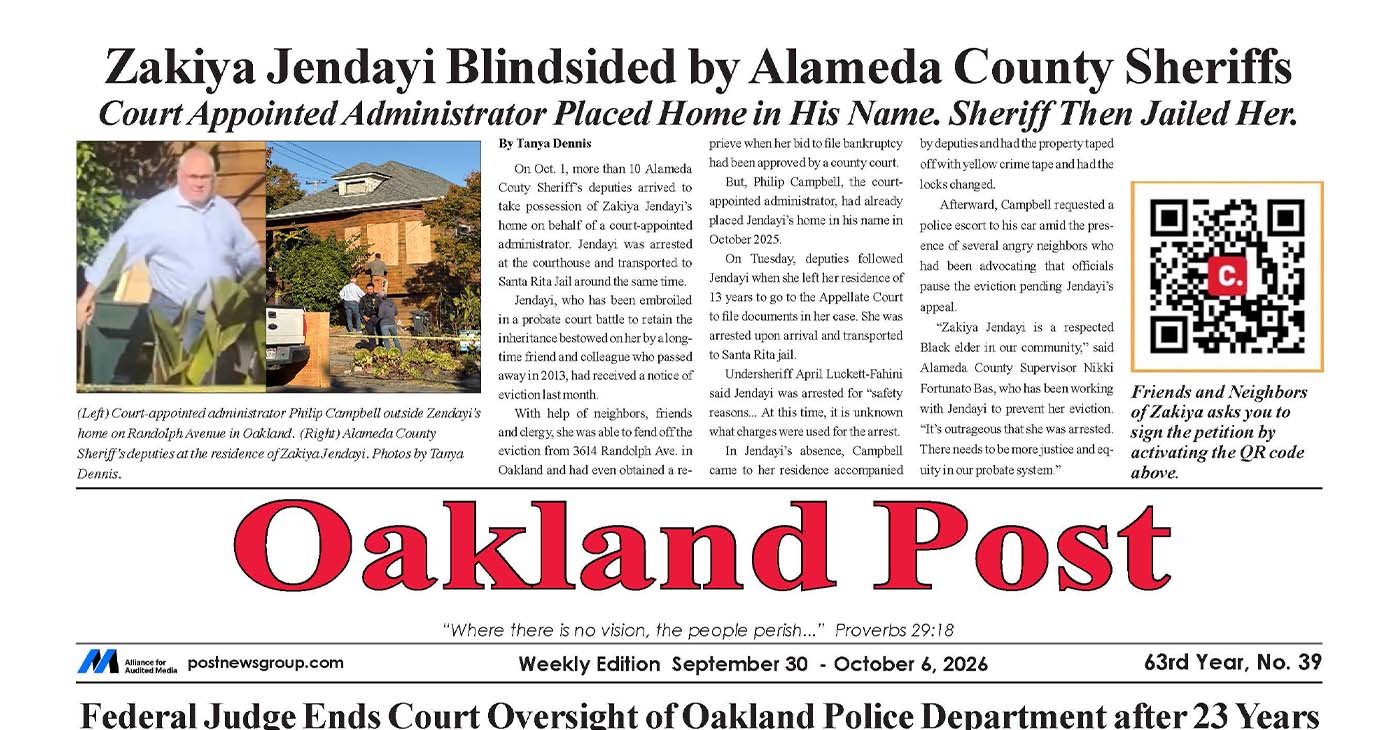
Oakland Post: Week of September 30 – October 6, 2026
The printed Weekly Edition of the Oakland Post: Week of September 30 – October 6, 2026
To enlarge your view of this issue, use the slider, magnifying glass icon or full page icon in the lower right corner of the browser window.

Activism
Oakland Post: Week of September 23 – 29, 2026
The printed Weekly Edition of the Oakland Post: Week of September 23 – 29, 2026

To enlarge your view of this issue, use the slider, magnifying glass icon or full page icon in the lower right corner of the browser window.
Activism
Oakland Post: Week of September 16 – 22, 2026
The printed Weekly Edition of the Oakland Post: Week of September 16 – 22, 2026

To enlarge your view of this issue, use the slider, magnifying glass icon or full page icon in the lower right corner of the browser window.



Listening as a Lifeline: A Doula’s Witness to Black Maternal Health

New Protections for Ticket Buyers: Gov. Newsom Signs Assemblymember Isaac Bryan’s Bill

‘We Don’t Talk Trash — We Pick Up Trash!’

Zakiya Jendayi Arrested, Locked Out of Home by Sheriff’s Deputies

Oakland Post: Week of September 30 – October 6, 2026

Asm. Corey Jackson Announces Launch of 24-Hour Childcare in His District

IN MEMORIAM: The Rev. Leon “Sonny” Clark, Longtime Orange County Pastor and Community Leader, Dies at 72

Poll: Becerra Widens His Lead Over Hilton; Californians Split on Wealth Tax

From Historic Memories to New Possibilities: Oakland Celebrates Coliseum 60

County Office of Education Says OUSD Finances Are Getting Healthier, Materially Stronger

LIVE FREE Sunday Dinner Brings Faith, Fellowship and Civic Conversation to Oakland

Remembering Chauncey Bailey as Student Journalists Face Threats to Truth-Telling

BLACspace Cooperative Invites Bay Area to Experience Oakland’s Black Cultural Ecosystem Through a BLAC Map Tour + Party

In Wake of Death on Doorstep, Williams Chapel Baptist Church Calls for Better Care, Funding for Unhoused

Oakland Centenarian Nuna McKee Honored!

Standoff for Justice: Our Homes Are Worth Fighting For

Oakland Post: Week of August 26 – September 1, 2026

Frontier Airlines’ Return to Oakland Airport Brings Flights, Jobs and Opportunity

Gubernatorial Candidate Steve Hilton Blasts California New Tire Rules; Newsom Hits Back

Chef Sharon Lee Blends Culinary Excellence, Education and Empowerment

Jackie Wright Champions Bay Area Stories, Filmmakers and Cultural Institutions

Misnamed ‘Parent’ PAC Seeks to Influence Oakland School Board Elections

Oakland Coliseum Project Opens Door for Small Businesses to Build Bigger

Big City Mayors Ask for “Yes” Vote on Housing Bond Measure; Conservatives Say “No”

Gov. Newsom’s Latest Appointees Include Sacramento Advocate for Formerly Incarcerated Students; State’s New Tech Chief

Longtime BWOPA Member Brendalyn Goodall Appointed to California Workforce Development Board

Gov. Newsom Signs Law Shielding Immigration Aid Workers From Doxing Threats

Secretary of State Shirley N. Weber Urges Californians to Vote Early as Voter ID Battle Intensifies

Oakland Post: Week of September 2 – 8, 2026

IN MEMORIAM: Dolly Parton Dead at 80 — How She Built a Legacy of Love and Earned Her Place in Black Culture

The Conversation With Al McFarlane 6/23/26

Media Monday 6/22/26

LIVE! ASK ALMA! — TUES. 6.23.26 7PM EST

Car Buying Secrets: 4 Hidden Checks Before You Sign!

Is This 550 HP Charger Worth YOUR Money? AutoNetwork Review

Celebrating Juneteenth – Frederick Douglass on education and resistance

LIVE! — ASK ALMA! — TUES. 6.19.26 7PM EST

Hyundai Ioniq 5 Parking, Safety, and 360 View #shorts

2025 Ioniq 5 New Wiper & Powerful Performance! #shorts

Electric SUV Range: Is 259 Miles Enough? #shorts

EV Charging: How Fast Can You Charge an Electric Vehicle? #shorts

Biometric Cooling… Messaging Seats…Come on! 2025 Infiniti QX80 Autograph 4WD

Charged Up: Witness the Magic of a Fully Electric Car! #shorts

Range Rover Sport PHEV Included…: See What’s Inside This Luxury SUV! #shorts

Invisible Hood View: Perfect Parking with X-Ray Vision! #shorts
-
 Community3 weeks ago
Misnamed ‘Parent’ PAC Seeks to Influence Oakland School Board Elections
-
 Activism4 weeks ago
Oakland Post: Week of September 2 – 8, 2026
-

 Activism3 weeks ago
Oakland Post: Week of September 9 – 15, 2026
-

 Community3 weeks ago
Richmond Tiny House Village Farm & Garden Set to Open Gates on Sept. 26
-

 Black History3 weeks ago
Latest Massacre in Haiti Reveals Cruelty U.S. Deportations
-

 Black History3 weeks ago
OPINION: Nolan Wells’ Death One of Several Signifying Racial Terror Lives on in U.S. South
-

 Business2 weeks ago
Mayor Lee Announces $1 Million Kaiser Permanente Grant for Pilot Program to Address Homelessness, Clean Up Public Spaces throughout Oakland
-

 Community3 weeks ago
Democratic Clubs Interview Candidates for Oakland School Board
