
#NNPA BlackPress
FILM REVIEW: New Wave of Black Films Crests at 2019 Toronto International Film Festival
NNPA NEWSWIRE — Black artists, filmmakers and films were a key part of the mix at the 2019 Toronto Film Festival. Big budget movies, small indie films, documentaries and shorts filled out the innovative programming. Check out the best of the best and the most noteworthy.

By Dwight Brown NNPA News Wire Film Critic

Nearly 500,000 film lovers flocked to the 2019 Toronto International Film Festival, screening hundreds of films from all over the world. Artistry and diversity, the hallmarks of TIFF, were on view.
Black artists, filmmakers and films were a key part of the mix. Big budget movies, small indie films, documentaries and shorts filled out the innovative programming. Check out the best of the best and the most noteworthy.
BLACK FILMS & BLACK FILMMAKERS
Atlantics (***)
An ill-fated romance in Senegal takes center stage in this visually stunning ode to passion and yearning. French actress-turned-filmmaker Mati Diop won the Cannes’ Grand Prix for co-writing this love triangle between a young woman (Mama Sané), an out-of-work construction worker (Ibrahima Traoré) she loves, and a wealthy fiancé (Babacar Sylla) she disdains. With Claire Mathon behind the camera, Dakar looks picturesque and the composition of each scene is as perfect as the lighting. Diop tells her story using lots of imagery and long scenes that test patience. The beautiful cast looks like they stepped out of Essence Magazine. Themes of class divide, spirits from beyond and girlfriends who like to party often crowd what could have been a simple love story. Still, the romance in this film prevails.
Clemency (***).
The debate over the death penalty gets a new spark with this very personal look at a humanistic warden (Alfre Woodard) who makes end-of-life experiences as compassionate as possible for those on death row. It’s as if Warden Bernadine Williams goes on cruise-control as she and her staff strap in inmates for that lethal injection. She thinks she’s fully prepared for everything. Then there’s an inevitable catastrophe that magnifies the toll her job takes on her psyche and husband (Wendell Pierce) and sobriety. Writer/director Chinonye Chukwu’s message is that executing criminals is inhumane. Slow steady drama builds and builds. Woodard creates a protagonist who is equally likeable and unapproachable. Her steely performance is complemented by supporting cast members: Aldis Hodge as the cop-killer next in line for death; Richard Schiff as the convict’s hopeful lawyer; Danielle Brooks as a person from the prisoner’s past.
Dolemite Is My Name (****)
When you need encouragement, comedian Rudy Ray Moore (Eddie Murphy) commands, “Put your weight on it.” It’s a mantra he takes to heart as he shifts his talent from struggling comic and spoken-word pioneer to novice DIY indie filmmaker. Moore’s alter-ego is Dolemite, a feisty, martial-arts-loving character he pushes to the front of his first movie. Under the guidance of director Craig Brewer (Hustle & Flow), with a hilarious bio/script by Scott Alexander and Larry Karaszewski, Eddie Murphy makes a splashing film comeback as the outrageously bold and determined artist who became an integral part of the 1970s Blaxploitation era. Never one to take no for an answer, the brash Moore gives Murphy a great opportunity to work his comic genius. And he does, along with a hilarious dream team who milks laughs: Keegan-Michael Key, Craig Robinson, Tituss Burgess, Wesley Snipes, Mike Epps, and the shameless scene stealer Luenell (I Got the Hook Up 2). Add in cameos by T.I. and Snoop Dogg and a plotline that leads to euphoria and this bit of hilarity becomes an amazing crowd-pleaser and an inspiring movie.
Harriet (***)
The responsibility for getting Harriet Tubman’s legacy as an abolitionist and the history of the Underground Railroad told right is a weight few filmmakers could carry. Director Kasi Lemmons (Eve’s Bayou) is up to the task and has a vision. Her efforts are helped by Terence Blanchard’s emotionally charged musical score, John Toll’s evocative cinematography (he makes everyone’s complexion incandescent) and Paul Tazewell’s costumes. The script, by Lemmons and Gregory Allen Howard, pulls the characters into one epic tale of inhumanity, humanity and legendary acts of bravery. Cynthia Erivo (Tony winner The Color Purple; film Widows) plays “Minty” (Tubman’s nickname) with conviction. The evildoers (Joe Alwyn, Jennifer Nettles) and saviors (Leslie Odom Jr., Janelle Monáe) are perfectly portrayed. Lemmons can be heavy on the flashbacks (black and white clips of a family breakup seem redundant), and the footage looks like a cross between an art/indie film and a Lifetime network movie. But overall, she has accomplished a difficult mission that brings the life of an extraordinary liberator into full view. Finally the film medium has produced a public record of Harriet Tubman’s heroism. Now it’s time for Tubman’s image to be on the $20 bill.
Just Mercy (***)
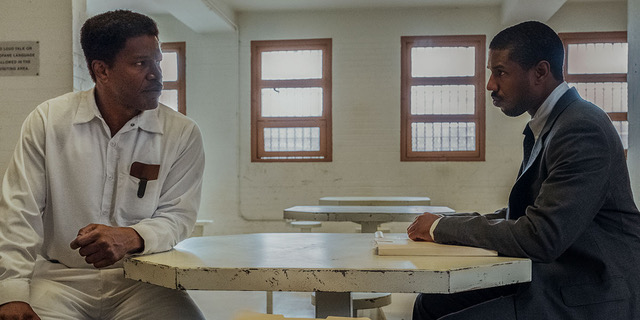
Jamie Foxx and MIchael B. Jordan in Just Mercy
A young Harvard educated lawyer, Bryan Stevenson (Michael B. Jordan), could have his pick of law firms, instead he heads to rural Alabama to set up a small law practice that seeks to reverse death row sentences for wrongfully convicted prisoners. There are many in need, but one of his primary clients is Walter McMillian (Jamie Foxx), who was convicted of killing a white woman. The film is set in 1989 and stars Jordan, but if you close your eyes and imagine a young Sidney Poitier in the lead role, you’ll get a feel for the tone of this well-intentioned but typical crime drama. Director Destin Daniel Cretton’s approach to the genre is formulaic, but gets the job done. Cretton and co-writer Andrew Lanham use the real lawyer Stevenson’s award-winning non-fiction book Just Mercy: A Story of Justice and Redemption as source material to depict poor black men being railroaded into death sentences in the south—well into the late ‘80s. Foxx gives his best performance since Ray. Jordan breaks out of his normal hero-ish mold to play a goodwill attorney, and that’s refreshing. Supporting cast of Brie Larson, Rob Morgan, Tim Blake Nelson, Rafe Spall, O’Shea Jackson Jr., and Karan Kendrick are particularly interesting to watch. A very northern and stiff lawyer learns how to acclimate to a friendlier rural southern black community and it’s a startling juxtaposition that adds depth to the proceedings
Waves (**1/2)
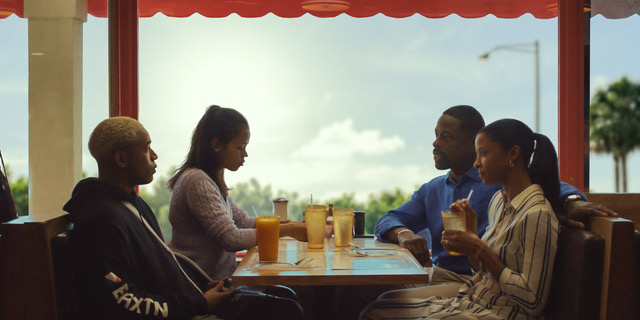
The Cast of Waves
Filmmaker Trey Edward Shults made an impressive directorial debut with the ultra-realistic family drama Krisha. This return to familial themes focuses on a wealthy black household. A dad (Sterling K. Brown) and stepmom (Renée Elise Goldsberry)—helicopter parents—pressure their teenage son (Kelvin Harrison Jr, Assassination Nation), a high-school wrestling champion, to succeed. He, however, is clandestinely living large, beset with injuries and having major girlfriend problems. His younger sister (Taylor Russel) waits in the wings for the attention she deserves. Shults’ script and direction jump-start start this teen saga with a kinetic verve reminiscent of filmmaker Harmony Korine’s wild and debauched Spring Breakers. Quick, flashy MTV-like edits (editors Isaac Hagy and Shults), a heavy-bass musical score (Trent Reznor and Atticus Ross) and an envious playlist of hip artists set the tone. The look of the film is perfect: production design by Elliott Hostetter; set decoration by Adam Willis; cinematography by Drew Daniels; and costume design by Rachel Dainer-Best. The plotline in Acts I and II leads to a clichéd stereotypical interpretation of a young black man’s life, which would be suspect coming from a black filmmaker, and is almost insulting coming from a white one. Act III takes the film in a completely different direction, which is fraught with heavy emotion that doesn’t always ring true. Something like TV’s overly touchy-feely This Is Us. In fact, watching Sterling K. Brown shed tears on screen, like he does incessantly on the TV show, is like watching a rainstorm on a tropical island. It’s an event, but it’s no surprise.
BLACK ARTISTS IN FILMS
The Goldfinch (*1/2) The novel of the same name by author Donna Tartt won the 2014 Pulitzer Prize for Fiction. This weakly developed screen adaptation will likely win a Razzie. Can’t blame the premise: A kid, Theo (Oakes Fegley), and his mom enter the Metropolitan Museum of Art. A bomb ignites. She dies. He is taken in by a friend’s wealthy mother (Nicole Kidman). Theo’s worthless father (Luke Wilson) wrestles him away, eyeing the kid’s money. A missing painting of a goldfinch—worth millions—is lost in the explosion. Who has it? Years later Theo (Ansel Elgort) can’t shake his tragic past. Director John Crowley endeared himself to audiences with his sweet, simple period film Brooklyn. In this muddled and overly complicated interpretation of the book (Peter Straughan screenwriter), a series of preposterous circumstances and an overabundance of characters stymies any plausibility. Fegley’s performance fails to make a lasting impression. The photogenic Elgort is handcuffed by a poorly written character. Veteran actor Jeffrey Wright gives the only spot-on performance, but even he can’t save a silly storyline from itself. And why cast a Canadian actor (Finn Wolfhard) and a Welsh actor (Aneurin Barnard) in a pivotal role as Theo’s “Russian” friend Boris (young and old) if they can’t master the accent? Tech credits are solid. Little else is.
Honey Boy (**) His public meltdowns were documented in the news. And now, it’s as if actor/writer Shia LaBeouf wants the masses to know that his erratic behavior is the result of an irregular childhood. Otis (Noah Jupe as the 12-year-old; Lucas Hedges at the 22-year-old), is a child actor being bullied by his ill-tempered father (LaBeouf). Life ain’t easy. Though first-time feature filmmaker Alma Ha’rel directs what’s on the page pretty well, the story, lead characters and their conflicts never gel. LaBeouf lays the bad dad persona on thick, making him appear cartoonish. Bryon Bowers (TV’s “The Chi)” plays an AA friend. Musical artist FKA Twigs portrays a neighbor in a rundown motel. Cast also includes veteran actors Clifton Collins Jr. and Laura San Giacomo. Well-intentioned project. Iffy results at best.
Hustlers (***) A group of industrious strippers bilk Wall Street men out of thousands of dollars during the money-raining days leading up to the great recession. Writer/director Lorene Scafaria (The Meddler) bases her script on a New York Magazine article that chronicles the con games run by Samantha Barbash, a scheming hostess at New York’s strip club Scores. The women swipe credit cards, charge up clothes, buy houses and set up an enterprise that is quite profitable. Sets (production design by Jane Musky), costumes (Mitchell Travers) and cinematography (Todd Banhazi) provide plenty of eye-candy. The pacing (editor Kayla Emter) is tight too. Your eyeballs will pop out of your head when 50-year-old J. Lo, as ringleader Ramona, shimmies down a stripper pole displaying the abs of a twentysomething. As she leads her robber posse on an excursion filled with peril, joy, riches and life lessons, you will be thoroughly entertained. Constance Wu, Mette Towley, Keke Palmer, Lili Reinhart and a cameo by ex-stripper Cardi B add magic as the women go from self-help, to self-employment, to self-infliction. Enjoy, and don’t forget to tip!
Knives Out (**) Who did it in this whodunit? And, who cares? Writer/director Rian Johnson (Star Wars: The Last Jedi) tries his hand at mystery writing, to little avail, and he must be an ardent Agatha Christee (Murder on the Orient Express) fan. A wealthy, elderly novelist (Christopher Plummer) dies. Suicide? Homicide? A southern sleuth (Daniel Craig) investigates. Johnson’s script is dull until the reading of the will, when family members’ greed and rivalries rage. The ensemble cast is impressive: Chris Evans, Ana de Armas, Jamie Lee Curtis, Michael Shannon, Don Johnson, Toni Collette and Lakeith Stanfield as Lieutenant Elliott. There are plot twists aplenty, but none add up to much. Craig’s Alabama accent is atrocious. Does Johnson get anything right? The novelist’s grandson (Evans) drives a sleek 1960/70s silver BMW that is a work of art.
The Report (****) Tracking down the truth regarding the CIA’s Detention and Interrogation Program and the department’s use of torture is a sobering task for Senate staffer Daniel J. Jones, (Adam Driver). Yet, under the guidance of his boss Senator Dianne Feinstein (Annette Bening), he perseveres. Years of Jones’ research unearth wrongdoing, cover-ups and lies that may never come to light. Writer/director Scott Z. Burns (The Informant!) slowly turns a very wonky, fact-based political story into a thrilling drama that pits reality against deceit and the Senate versus the United States Intelligence Community. It’s a battle of wills. Driver’s very intense performances holds viewer’s attention as a barrage of facts, figures and names rain on them in a way that only CNN could decipher. What will stay with audiences forever is that a few people fought to have the CIA’s machinations exposed. An exceptional cast also includes: Jon Hamm, Corey Stoll, Evander Duck Jr., Maura Tierney and Linda Powell (House of Cards).
Uncut Gems (****) “They say you can see the whole universe in an opal.” That makes perfect sense to Howard Ratner (Adam Sandler), a gregarious, Jewish NYC jeweler who is deep in debt to the wrong kind of people and hoping his next scheme will get him out of trouble. This time, his plan includes selling a massive opal—the size of a baseball. Brothers Benny and Josh Safdie (Good Time), New York City-based writer/directors, have an urban, guerilla style of filmmaking that mirrors Martin Scorsese’s early works. Now, with a big budget in hand, they get to use all the crayons in the box. Sandler strips away his sunny facade and plays an addicted gambler who chums it up with hip black clients (basketball player Kevin Garnett), holds it down at home with his wife (Idina Menzel), and juggles a hush-hush life with a secret lover (Julia Fox). Player! The film aptly captures the mayhem and noisy din of the Diamond District. Rarely do movies chronicle any synergy between Blacks and Jews who are both living on the same edge. Brilliant filmmaking. Sandler deserves an Oscar nod and an apology from past naysayers. Every dog has its day
OTHER FILMS OF NOTE
A Beautiful Day in the Neighborhood (**1/2)
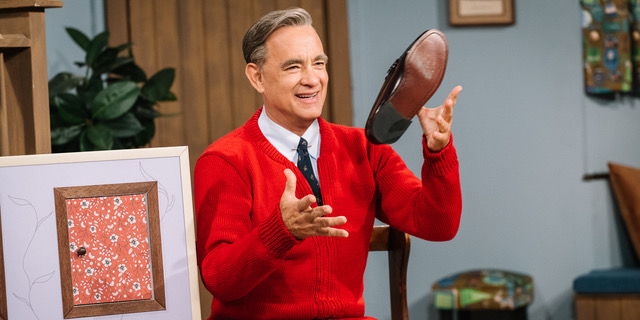
Tom Hanks stars as Mister Rogers in TriStar Pictures’ A BEAUTIFUL DAY IN THE NEIGHBORHOOD. Photo by: Lacey Terrell
Mr. Rogers was loved. Like that uncle who came over for Christmas every year and brought the best presents. Ones you didn’t know you needed ‘til you had them. If you’re expecting a charming biofilm, don’t. If you want to witness how one kind person can positively affect other people’s lives, welcome. The script by Micah Fitzerman-Blue and Noah Harpster takes its cue from a true-life story about an emotionally tarnished Esquire journalist assigned to interview Rogers. IInstead, he becomes the recipient of the cardigan-wearing TV host’s healing powers. Director Marielle Heller (Can You Ever Forgive Me?) sensitively guides the cast through this loving fable. Tom Hanks, Matthew Rhys, Chris Cooper and Wendy Makkena (TV’s Judging Amy) handle their duties well. It’s easy to get caught up in the journalist’s redemption. Not all audiences will be thrilled that they’re getting a “life-coach” movie for the holiday season (release date 11/22/19), instead of the real skinny about the TV icon’s personal life. Some may say, “Where’s the beef?”
Bad Education (****)
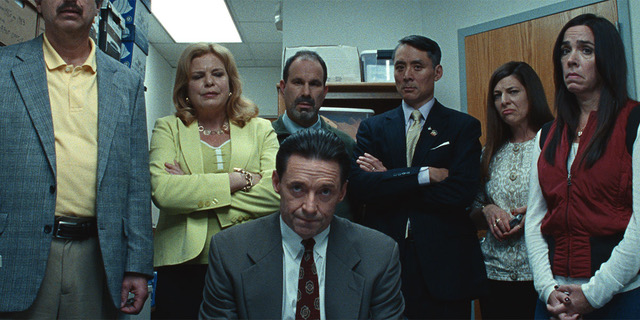
Hugh Jackman in Bad Education
Thou shalt not steal. It’s a commandment that the characters in this true-life tale of debauchery and excess don’t heed. All is going well in Long Island’s Roslyn School District, until a high school newspaper journalist (Geraldine Viswanathan) starts investigating line items on the school district budget that seem, well, fake. Contractors and companies are ghosts. Certainly Pam Gluckin (Allison Janney), who handles the budgets doesn’t see anything wrong. Nor does the easy-going school district superintendent (Hugh Jackman). As the undeterred student continues to dig, the improprieties mount. The plotline (screenwriter Mike Makowsky) unravels in bits and pieces, causing increasing astonishment. Jackman is as wicked as he can be. Janney as the lady with more relatives on the payroll than Trumps in the White House, plays her sociopathic character to a T. Director Cory Finley (Thoroughbreds) doesn’t point fingers, doesn’t pass judgement. Instead he weaves extramarital affairs, weak school boards and betrayals into a web of insanity that is as outrageous as Janney’s other mayhem vehicle, “I, Tonya.” What’s the alternate spelling of embezzlement? P-R-I-S-O-N. A total delight in the most devious way.
Blackbird (***) People deal with their last moments on earth in their own ways. Few, however, decide to throw a weekend party so family members can watch them commit suicide. That’s the premise of director Roger Michell’s (Notting Hill, My Cousin Rachel) warmhearted look at a clan who wrestles with cancer, mortality and conflict. Christian Torpe’s screenplay creates viable characters and sets their actions and reactions in motion. Mom (Susan Sarandon) is the weed-smoking matriarch, dad (Sam Neill) her life partner. Two daughters (Kate Winslet, Mia Wasikowaska) show up with their extended families along with mom’s best friend Liz (Lindsay Duncan). Jealousies, rivalries and inner turmoil brim to the surface as they confront mortality: ‘You’re here now. But tomorrow you’ll be dead,” says one daughter. Some moviegoers may wish the family was more down to earth blue-collar than whiny and rich. The wonderful ensemble acting comes under the guidance of Michell. Poignant life-affirming words by Torpe’s perceptive script endure: “The day’s go by so slowly. The years go by so fast.” Considering the gravity of the subject matter, what’s on view is surprisingly touching and disarming in the best ways.
Coming Home Again (***) The bond between a mother and her son is tested in this warm-hearted story about a young Korean American man (Justin Chon, Gook) who leaves his job and girlfriend behind to take care of his terminally ill mom (Jackie Chung, Grey’s Anatomy) in San Francisco. They connect through food and the recipes she passes on to him. Based on his own experience, director/writer Wayne Wang (Joy Luck Club) creates a very humbling and humanizing story in a low-budget, small-cast movie that is powerful. Chon’s sensitive acting plays well against Chung’s spirited portrayal. Their experience and culture are specifically Asian, but the lifecycle event is universal. Wayne’s illuminating script and restrained direction give a sense of authenticity and clarity to everything. When the camera focuses on Chon trying to putty up a crack in an old wall, it becomes a metaphor for the film’s very rich and gripping premise.
A Hidden Life (****) In this age of neo-fascism, writer/director Terence Malick (Days of Heaven) astutely reminds viewers that they can counteract evil in their own way. Austrian farmer Franz Jägerstätter (August Diehl) becomes a conscientious objector during World War II. His neighbors and town officials in his small village ostracize him, his wife Franziska (Valeri Pachner) and their three young daughters. The Nazis have a plan for him, and its bleak. Malick sets the location perfectly with wondrous shots of the Alps. Scenes of Hitler’s brutal officers committing atrocities reflect the era. The music (James Newton Howard), cinematography (Jôrg Widmer) and production design (Sebastian T. Krawinkel) are exquisite. Eerie parallels to modern times, echo again and again, as vicious leaders pray on the weak and instill fear in the masses. Franz to his spouse: “Oh my wife. What happened to our country, the land we love?” He adds: “If God gives us free will, we’re responsible for what we do.” A masterpiece of storytelling becomes a fitting tribute to those who remain principled and defiant.
Joker (**1/2) Why would a film company give a stand-alone origin project about the comic book villain The Joker to the writer/director of The Hangover series, Todd Phillips? Casting Joaquin Phoenix in the lead role, whose acting is ingeniously mercurial in the villain, is brilliant. Phillips? That’s a question mark. Arthur Fleck (Phoenix), a rent-a-clown loser who lives with his mom, is tormented by a defect that makes him laugh inappropriately and uncontrollably and is bullied by adults—and kids too. It’s no wonder the dude is angry at the world. Phoenix creates a snake of a man with few to no redeeming qualities and along the way he turns in a blistering performance that should get him a front row seat on Oscar night. Strong visuals and imaginative action scenes are absent in this crime thriller. Blame director of photography Lawrence Sher (Hangover) for the lapse in striking images. And Phillips gets no love for a dearth of cool fights and heated battles.
Judy (***1/2) No feature film could capture the entire troubled life of Judy Garland, who went from child actress (The Wizard of Oz), to deceased drug and alcohol-impaired adult in just 47-years. Smartly, director Rupert Goold and screenwriter Tom Edge pull from the stage play End of the Rainbow by Peter Quilter, which recounts the last six months of the star’s increasingly unsteady life. Credit Renée Zellweger for doing her own singing. Does she sound like Garland? No. Does she evoke her spirit? Yes—like a champ! The director, writer and actress make Garland look sociable, self-involved and weary of her superstardom all at once. Judy, knowing the burden she can be on others during her drunken episodes, proudly proclaims to her elementary-school-age son, “It’s wonderful to have a son big enough to carry his mother to the car.” The film’s only questionable element is a parallel storyline about her childhood, when she was groomed to be a pill-popper and emotionally abused by adults. Dramatic scenes, where she argues with an ex-husband at lunch or comes out drunk on stage, will make you wince. This is a solid interpretation of a life everyone knew would be cut short, while garnering millions of fans along the way. Very sweet. Quite tragic. Garland: “I still believe in it. The love you have with an audience.”
Marriage Story (****) As writer/director Noah Baumbach has matured, so has the subject of his films. His 1995 movie Kicking and Screaming reflected his 26-year-old view of life. His 2019 film Marriage Story captures the angst of a 50-year-old who has weathered a divorce. He doesn’t have to say that this story is coming from a very organic place. It’s obvious by the characters on view and the raw emotion they display. Charlie (Adam Driver in his best performance ever) is the head of a Brooklyn theater group. Nicole (Scarlett Johansson) is his wife and the troupe’s star. She’s offered a TV pilot in L.A., and that decision leads the two and their son Henry (Azhy Robertson) on a twisted road through divorce land, which turns them into adversaries with lawyers (Laura Dern for her; Ray Liotta for him.) who bully. There are screaming matches in this marital breakup parable that are as primal as the ones in Who’s Afraid of Virginia Woolf?” In 136 engaging minutes Baumbach relives every tortured moment and slight in the couple’s less than idyllic marriage. D-I-V-O-R-C-E!
The Personal History of David Copperfield (**1/2) No this is not about the magician. Think back further to 1850 and a book written by Charles Dickens: David (Dev Patel), is raised by his widowed mother and a loving housekeeper. Life changes when mom marries a wicked man. Soon after, the boy is kicked out of his house, into boarding schools, factory work and eventually to the loving home of his eccentric Aunt Betsey (Tilda Swinton). David’s refuge is his writing. Director Armando Iannucci (The Death of Stalin) uses Simon Blackwell’s script to form a storybook life that is as winsome and charming as it is boring and too British. Think British director Mike Leigh and his obscure movie Topsy Turvy, and you get the gist. Oscar nominee Patel is as magnetic as Swinton is eccentric. Iannucci’s decision to make 19th century London multicultural is very progressive. Rosalind Eleazar plays David’s love interest, and she and Patel are quite disarming in a film with little appeal other than its acting and tech credits.
The Two Popes (****) It’s surprising to watch a film about two heads of the Catholic Church, who have vehement disagreements and opposing viewpoints yet find common ground. It’s as if Anthony McCarten’s (Darkest Hour) insightful screenplay is trying to teach polarized factions how to bond. Anthony Hopkins plays Pope Benedict, the traditionalist monsignor who is stodgy and not hip to the times. Jonathan Pryce is Pope Francis, a sociable, humble innovator more concerned with the good of the people than the strict rules of the church. The film is strongest when the two actors are center stage giving their diametrically opposed opinions. It’s less interesting, but still good, when it depicts Francis’ backstory. Directed deftly by the brilliant Brazilian filmmaker Fernando Meirelles (City of God), the dignity, humanity and humor of the two characters is quite appealing. Francis: “How does an Argentinian kill himself? He climbs to the top of his ego and jumps off.” Jump Popes. Jump.
These movies and artists, fresh from Toronto, will be on a screen near you before you know it.
Visit NNPA News Wire Film Critic Dwight Brown at DwightBrownInk.com.













#NNPA BlackPress
Smooth Ride! Car Suspension & Comfort Tested #shorts
Smooth suspension meets surprisingly spacious legroom. Experience true comfort on any road!

 Watch the full video: https://youtu.be/l9Z571za5Gc
#NNPA BlackPress
61 years since Selma, Houston leaders say the bridge remains to be crossed
61 years after Selma, Houston leaders say the fight for equality continues. The issues that sparked the marches still impact Black Americans today.
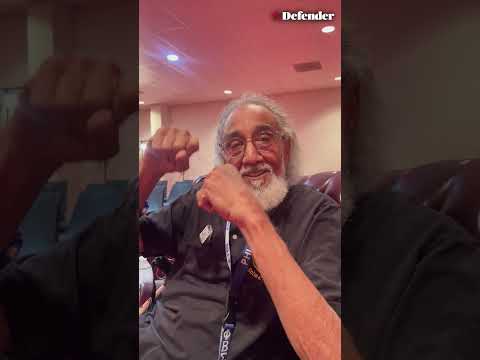
It has been 61 years since the Selma marches. But political leaders in Houston say that the issues protesters were marching for still plague the lives of Black Americans.
Visit Our Website
Read more stories by our team
https://defendernetwork.com/category/news/opinion/
Sign-up for the Top 5 newsletter
Donate/ Support Our Work
#NNPA BlackPress
Here is what you need to know about finding unique white elephant gift ideas that everyone wants to steal
The best white elephant gift ideas are funny enough to get a reaction but useful enough that people actually want to steal them. Look for gifts with a surprise factor, broad appeal, an inside joke, and just enough personality to spark some friendly competition. The wrapping paper comes off, the room goes quiet for half […]

The best white elephant gift ideas are funny enough to get a reaction but useful enough that people actually want to steal them. Look for gifts with a surprise factor, broad appeal, an inside joke, and just enough personality to spark some friendly competition.
The wrapping paper comes off, the room goes quiet for half a second, and suddenly everyone wants the same gift. That is the sweet spot. A great white elephant pick should make people laugh, lean in, and start plotting their next steal before the turn is even over.
Should a White Elephant Gift Be Funny or Useful?
A white elephant gift can be funny or useful, but the strongest choices usually give people a reason to laugh and a reason to keep the item. A practical gift with an odd design, unexpected feature, or playful theme can get a reaction without becoming something the recipient immediately wants to give away.
The right balance depends on the group. Close friends and family members may enjoy a ridiculous gag gift because they already understand one another’s sense of humor.
A workplace exchange, neighborhood party, or mixed-age gathering usually calls for something with broader appeal. In those settings, humor works better when it is built into an item people could still use afterward.
It also helps to think about how quickly the gift will make sense once it is opened. A strangely shaped kitchen tool, oversized mug, quirky desk accessory, or unexpectedly fancy everyday item can create an immediate reaction. Guests understand the joke right away, while the item still has enough practical value to attract a steal.
Pure gag gifts can be harder to pull off. Something that exists only for the punchline may get a big laugh during the reveal and then sit untouched for the rest of the game. If the goal is to bring one of the gifts everyone keeps fighting over, usefulness gives the joke staying power.
Memorable Present Ideas: Creating Inside Joke Gifts
Inside joke gifts can make a white elephant exchange feel much more personal, especially when most of the group shares the same stories. The trick is choosing a reference that people will recognize quickly instead of building the entire joke around something only two guests understand.
You can turn a memorable vacation mishap, office catchphrase, family story, or long-running group joke into the theme of the gift. A personalized comic book can work especially well when it turns familiar people or a ridiculous shared moment into part of the story.
Think carefully about who the joke involves before ordering anything permanent. The gift should make the person feel included in the fun, not singled out for the wrong reason.
Can You Bring Something You Already Own?
Holiday gift exchanges can be a good place to re-gift something you never used, especially if it is unopened and clean.
The following can all work if they still look presentable:
- A duplicate kitchen gadget
- An untouched game
- A decorative item
- A sealed gift set
- An unopened candle
- A new travel accessory
The goal is to give the item a second chance, not use the exchange as an excuse to clear out damaged or unwanted clutter.
Take a close look at the packaging before wrapping it. Faded boxes, missing pieces, visible wear, or anything that looks obviously used can make the gift feel careless.
Wrapping Budget-Friendly Gifts
Wrapping can make gifts more entertaining before anyone even knows what’s inside.
Misdirection works especially well for fun party games. Put a small gift inside a much larger box. Use packaging from an unrelated household item.
Add harmless weight so guests cannot guess what they are holding. The reveal becomes part of the joke without changing the gift itself.
You can also lean into the theme of the exchange. Bright paper, oversized bows, reusable bags, or deliberately over-the-top wrapping can make an ordinary item feel more memorable. If the gift itself is already funny, simple wrapping may work better so the surprise stays hidden until the last second.
Frequently Asked Questions
Is Picking Last an Advantage in White Elephant?
Picking last can be an advantage because you get to see almost every gift before making your move. Instead of choosing blindly from the remaining wrapped presents, you can steal something that has already caught your attention if the rules still allow it.
That advantage depends on the house rules. Some games limit how many times a gift can be stolen.
Others lock an item once it reaches a certain number of steals. If the most popular gifts are already unavailable, the final player may have fewer strong options than expected.
The first player can also get another turn at the end in some versions of the game. That rule can balance things out, since the person who started with the least information may get one final chance to steal.
How Do You Plan White Elephant for a Large Group?
For a large white elephant exchange, set a firm spending limit and establish the stealing rules in advance.
Create a clear turn order before the game begins. Drawing numbers as guests arrive can save time once everyone is ready to start.
Keep the number of steals per gift limited so the game does not drag on. It also helps to have one person track which creative holiday presents have been stolen and when they are locked, especially if dozens of people are participating.
Can You Play White Elephant Virtually?
A virtual white elephant exchange can work over a video call, with one person keeping track of the turn order and each steal. Guests can either mail physical gifts ahead of time or use digital gifts that can be delivered once the game ends.
Set the spending limit and stealing rules before everyone joins. It also helps to decide how gifts will be revealed and who is responsible for sending each one afterward so the exchange does not become confusing.
Choose a Perfect White Elephant Gift in a Snap
Look for a white elephant gift that fits some of these criteria, and everyone will be trying to grab it at your next celebration.
Do you need more gift-giving tips and tricks? Make sure you read some of our other posts.



Mayor Barbara Lee Holds Special State of the City Address in Deep East Oakland

Practitioners of African Traditional Spirituality Offer Ancestral Reverence Ritual Oct. 31

It’s Time to Lose Weight Before the Holidays

Trader Vic’s Returns to Its Oakland Roots

Oakland Coal Terminal Backed by Trump Would Be Bigger, Dirtier Than Promised, Says Report

Opponents Smear Effective African American Transit Director as Election Nears

Oakland Post: Week of October 14 – 20, 2026

OP-ED: The Black Church Writes AI’s Next Chapter

OP-ED: The Black Church Writes AI’s Next Chapter

WCCUSD Joins Statewide Organic School Food Purchasing Cooperative

Democrats, Community Groups Back Measure EE to Change How Oakland Is Governed

Four Tips to Help You Plan a Holiday “Staycation”

Veterans Housing Project Proposed for South Richmond
PRESS ROOM: Transformative Justice Coalition 2026 Voting Rights Champion Awards Reception ‘Yesterday Is Today: The Battle For Voting Rights

Mayor Lee Delivers 2026 State of the City Address: ‘Oakland Continues to Be on the Move’

Misnamed ‘Parent’ PAC Seeks to Influence Oakland School Board Elections

Oakland Post: Week of September 2 – 8, 2026

Oakland Post: Week of September 9 – 15, 2026

Poll: Becerra Widens His Lead Over Hilton; Californians Split on Wealth Tax

County Office of Education Says OUSD Finances Are Getting Healthier, Materially Stronger

Richmond Tiny House Village Farm & Garden Set to Open Gates on Sept. 26

Latest Massacre in Haiti Reveals Cruelty U.S. Deportations

Mayor Lee Announces $1 Million Kaiser Permanente Grant for Pilot Program to Address Homelessness, Clean Up Public Spaces throughout Oakland

OPINION: Nolan Wells’ Death One of Several Signifying Racial Terror Lives on in U.S. South

Listening as a Lifeline: A Doula’s Witness to Black Maternal Health

Zakiya Jendayi Arrested, Locked Out of Home by Sheriff’s Deputies

BLACspace Cooperative Invites Bay Area to Experience Oakland’s Black Cultural Ecosystem Through a BLAC Map Tour + Party

Oakland Post: Week of September 16 – 22, 2026

Democratic Clubs Interview Candidates for Oakland School Board

Oakland People’s Arms Embargo Coalition Demands End to Military Shipments Thru Oakland

The Conversation With Al McFarlane 6/23/26

Media Monday 6/22/26

LIVE! ASK ALMA! — TUES. 6.23.26 7PM EST

Car Buying Secrets: 4 Hidden Checks Before You Sign!

Is This 550 HP Charger Worth YOUR Money? AutoNetwork Review

Celebrating Juneteenth – Frederick Douglass on education and resistance

LIVE! — ASK ALMA! — TUES. 6.19.26 7PM EST

Hyundai Ioniq 5 Parking, Safety, and 360 View #shorts

2025 Ioniq 5 New Wiper & Powerful Performance! #shorts

Electric SUV Range: Is 259 Miles Enough? #shorts

EV Charging: How Fast Can You Charge an Electric Vehicle? #shorts

Biometric Cooling… Messaging Seats…Come on! 2025 Infiniti QX80 Autograph 4WD

Charged Up: Witness the Magic of a Fully Electric Car! #shorts

Range Rover Sport PHEV Included…: See What’s Inside This Luxury SUV! #shorts

Invisible Hood View: Perfect Parking with X-Ray Vision! #shorts
-
 Economy3 weeks ago
Poll: Becerra Widens His Lead Over Hilton; Californians Split on Wealth Tax
-
 Business3 weeks ago
County Office of Education Says OUSD Finances Are Getting Healthier, Materially Stronger
-
 Business4 weeks ago
Mayor Lee Announces $1 Million Kaiser Permanente Grant for Pilot Program to Address Homelessness, Clean Up Public Spaces throughout Oakland
-
 Black History2 weeks ago
Listening as a Lifeline: A Doula’s Witness to Black Maternal Health
-
 Lead Story2 weeks ago
Zakiya Jendayi Arrested, Locked Out of Home by Sheriff’s Deputies
-
 Art3 weeks ago
BLACspace Cooperative Invites Bay Area to Experience Oakland’s Black Cultural Ecosystem Through a BLAC Map Tour + Party
-
 Activism4 weeks ago
Oakland Post: Week of September 16 – 22, 2026
-
 Uncategorized4 weeks ago
Oakland People’s Arms Embargo Coalition Demands End to Military Shipments Thru Oakland
