
City Government
Commentary: Budget Showdown in Oakland


Community says Schaaf’s budget hides $45 million ‘slush fund’
Oakland Mayor Libby Schaaf could have responded to City Council President Rebecca Kaplan’s amendments to her administration’s proposed $2.3 billion city budget with diplomacy and negotiations, as many City Hall observers had expected she would.
She could have recognized that Kaplan’s budget proposals were a response to the growing frustrations of city workers and Oakland communities who are tired of standing on the sidelines of a booming economy—illustrated by a skyline full of construction cranes. Year after year, City Hall produces austerity budgets that communities say starve the needs of local residents who are desperate for stable housing, an end to homelessness, clean and well maintained streets and parks, programs for marginalized youth and wildfire safety.
Schaaf could have realized that Kaplan’s budget recommendations do no not belong to the council president alone but are backed by neighborhood and community groups as well as supporters of the “People’s Budget,” proposed by the ReFund Community-Labor Coalition, which includes city worker unions SEIU Local 1021 and IFPTE Local 21, EBASE, EBHO, Causa Justa: Just Cause, ACCE Action, the Anti Police-Terror Project, Street Level Health Project and others.
Instead of taking the path of negotiating and deliberating, Mayor Schaaf and her administration chose to come out swinging, opting for a head-on confrontation with Kaplan and the progressives on the City Council, attacking the proposals as irresponsible and vigorously defending continued austerity measures in response to community needs. Her budget directs a huge share of the city’s income into business-as-usual funding to the Oakland Police Department and the unregulated pot of money that goes to police overtime, which costs residents about $30 million a year.
On Monday, June 10, on the same day a special City Council meeting was scheduled to discuss the Schaaf Administration’s budget proposal and the proposed amendments, the mayor sent out a blast email to local residents accusing Kaplan of “deceit and political pandering” and calling Kaplan’s budget amendment proposal “one of the most dangerous proposals I’ve ever seen to threaten Oakland’s future.”
In a move that upset many city workers, Schaaf’s city administrator, Sabrina Landreth, sent an email to all city employees titled “Update on Labor Negotiations and FY 2019-21 Budget,” dated June 6, denouncing Kaplan’s proposals for relying on “fictitious revenues” that could “potentially result in layoffs of filled positions in (the) Department of Transportation, the Clerk’s Office, OPD non-sworn and possibly employees in departments across the city.”
Speaking at Monday evening’s council meeting, Landreth refused to present a summary of the mayor’s budget to the public, saying there was no need to do that because staff had presented the proposal May 7 and that answers to questions from council members and the public had been posted online. Landreth repeatedly rebuffed Kaplan’s invitation to explain the Schaaf administration’s budget proposal to the public at Monday’s council meeting.
Mobilizing in support of the People’s Budget and Kaplan’s proposals that embodied many of them, hundreds of people packed the City Council meeting, marching up the stairs to the council chambers, with drums beating.
The main floor and the gallery seating were full to capacity, and an overflow room was opened for those who could not find a seat. The city clerk announced that 117 people had signed up to speak on the budget.
A report was presented at the meeting by Kristen Schumacher, staff researcher for Local 21, which showed that for the past seven years the administration purposely undercounted revenues by an average of $45 million a year.
Many saw this as a blow to the administration’s contention that Kaplan’s proposals were based on “fictitious revenues.”
This money, not included in the budget or in the City Council’s public budget deliberations, could eventually be spent by the administration and the mayor as they saw fit.
“Property taxes have been under-projected every single year, transient occupancy taxes have been under-projected every single year, and business license taxes have come in a minimum of $3.6 million higher and a maximum of $9 million higher over each of these seven years,” Schumacher said.
“The real estate transfer tax has been under-projected every single year by a minimum of $1.7 million and as much as $28 million,” she said. “In addition to these systematic under-projections, the vast majority of city departments underspend their budgets due to hundreds of vacancies in the non-sworn personnel budget.”
Referring to the mayor’s approach to budget deliberations, Dwight McElroy, chief steward for SEIU Local 1021, who works in the city’s paving division, said, “If there is an alternative point of view that may benefit the citizens of this city—who the money really belongs to—I don’t want to see mudslinging. I don’t want to see allegations. I don’t want to read about bully tactics.”
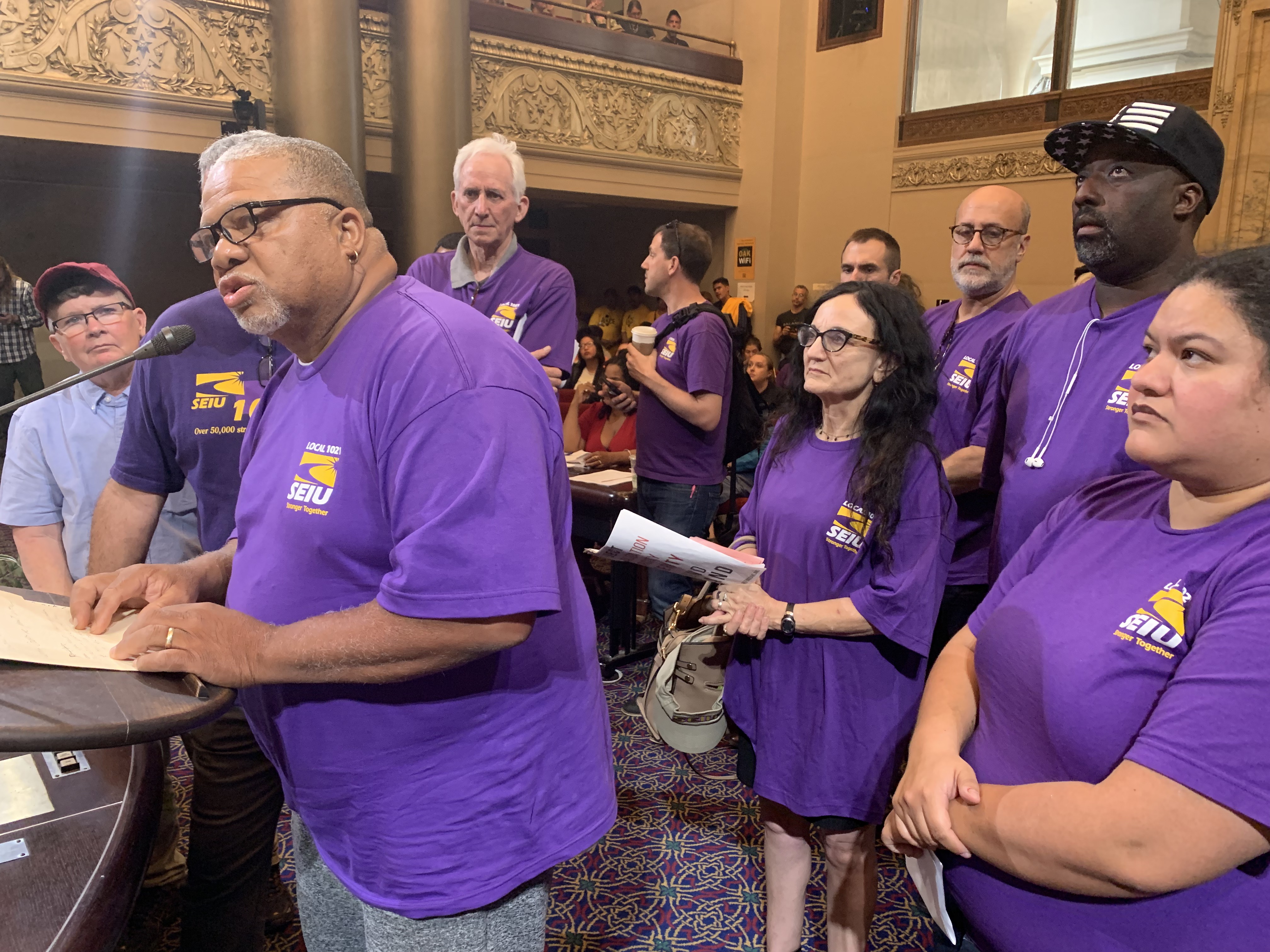
Dwight McElroy, chief steward, SEIU Local 1021, calls on the City Council to pass City Council President Rebecca Kaplan’s budget proposals. Photo by Ken Epstein.
The $45 million per year that was left out of the budget for seven years, said McElroy, “is restricted and has minimum use to benefit this city. You want to talk about fiction, the way you budget is a fiction.”
Felipe Cuevas, chapter president of SEIU 1021, a heavy equipment mechanic for the City of Oakland for 20 years, said, ”I just don’t understand the eagerness of our City Administrator Sabrina Landreth to harass our members with a threat of a layoff when we don’t even have a budget yet.
“If something like that would happen, if you were going to go by the rules, that would happen after you had a budget,” he said. “My union will be filing (unfair labor practice) charges over the harassment and intimidation by the city administration.”
Cat Brooks, executive director of the Justice Teams Network, said, “We here…in mass, united across race, class, ideology, profession as one Oakland. Rebecca Kaplan’s budget is the only budget that reflects the values of the city, that reflects the priorities of the people of this city,” she said. It is a budget that “puts Oakland on the path toward being the city that we profess to be, a city that is progressive and rooted in justice, equity and humanity.”
In her remarks, Kaplan denied that her proposal involved laying off union workers.
“There is no such proposal,” she said. “That was an inaccurate characterization, and I think that is part of why people feel there is a lack of respect going on—in terms of making statements that are untrue about the proposals.”
Explaining her understanding of budget deliberations, Kaplan said:
“Adopting a budget is one of the most important things we as a council do. It is our legal duty to deliberate and adopt a budget. And it is the administrative [duty] to ensure that it is implemented. How we allocate money and what we allocate it to is core to how we take action collectively as a council to ensure the needs of our city. This is a chance to put our goals and values into action by putting dollar amounts beside them.”
Budget proposals are scheduled to be discussed at the June 18 council meeting and again on June 24, if needed. The deadline for passing the completed budget is June 30.


Activism
Oakland Post: Week of September 23 – 29, 2026
The printed Weekly Edition of the Oakland Post: Week of September 23 – 29, 2026


To enlarge your view of this issue, use the slider, magnifying glass icon or full page icon in the lower right corner of the browser window.

Activism
Oakland Post: Week of September 16 – 22, 2026
The printed Weekly Edition of the Oakland Post: Week of September 16 – 22, 2026

To enlarge your view of this issue, use the slider, magnifying glass icon or full page icon in the lower right corner of the browser window.
Activism
Oakland Post: Week of September 9 – 15, 2026
The printed Weekly Edition of the Oakland Post: Week of September 9 – 15, 2026

To enlarge your view of this issue, use the slider, magnifying glass icon or full page icon in the lower right corner of the browser window.



Asm. Corey Jackson Announces Launch of 24-Hour Childcare in His District

IN MEMORIAM: The Rev. Leon “Sonny” Clark, Longtime Orange County Pastor and Community Leader, Dies at 72

Poll: Becerra Widens His Lead Over Hilton; Californians Split on Wealth Tax

From Historic Memories to New Possibilities: Oakland Celebrates Coliseum 60

County Office of Education Says OUSD Finances Are Getting Healthier, Materially Stronger

LIVE FREE Sunday Dinner Brings Faith, Fellowship and Civic Conversation to Oakland

Remembering Chauncey Bailey as Student Journalists Face Threats to Truth-Telling

BLACspace Cooperative Invites Bay Area to Experience Oakland’s Black Cultural Ecosystem Through a BLAC Map Tour + Party

In Wake of Death on Doorstep, Williams Chapel Baptist Church Calls for Better Care, Funding for Unhoused

Oakland Centenarian Nuna McKee Honored!

Caribbean Nations Produce Action Plan Calling for UK Reparations Over Slavery

Oakland Post: Week of September 23 – 29, 2026

Doulas Are Helping Black California Moms Navigate Pregnancy–Even as High Mortality Rates Persist

Newsom Signs Addictive Social Media Law to Protect Kids

On Your November Ballot: Prop 38 Would Allocate $8.4 Billion to Immunology and Immunotherapy Funding

Standoff for Justice: Our Homes Are Worth Fighting For

Oakland Post: Week of August 26 – September 1, 2026

Frontier Airlines’ Return to Oakland Airport Brings Flights, Jobs and Opportunity

Gubernatorial Candidate Steve Hilton Blasts California New Tire Rules; Newsom Hits Back

Chef Sharon Lee Blends Culinary Excellence, Education and Empowerment

Jackie Wright Champions Bay Area Stories, Filmmakers and Cultural Institutions

Big City Mayors Ask for “Yes” Vote on Housing Bond Measure; Conservatives Say “No”

Oakland Coliseum Project Opens Door for Small Businesses to Build Bigger

Gov. Newsom’s Latest Appointees Include Sacramento Advocate for Formerly Incarcerated Students; State’s New Tech Chief

Misnamed ‘Parent’ PAC Seeks to Influence Oakland School Board Elections

Longtime BWOPA Member Brendalyn Goodall Appointed to California Workforce Development Board

Gov. Newsom Signs Law Shielding Immigration Aid Workers From Doxing Threats

Secretary of State Shirley N. Weber Urges Californians to Vote Early as Voter ID Battle Intensifies

Oakland Post: Week of September 2 – 8, 2026

IN MEMORIAM: Dolly Parton Dead at 80 — How She Built a Legacy of Love and Earned Her Place in Black Culture

The Conversation With Al McFarlane 6/23/26

Media Monday 6/22/26

LIVE! ASK ALMA! — TUES. 6.23.26 7PM EST

Car Buying Secrets: 4 Hidden Checks Before You Sign!

Is This 550 HP Charger Worth YOUR Money? AutoNetwork Review

Celebrating Juneteenth – Frederick Douglass on education and resistance

LIVE! — ASK ALMA! — TUES. 6.19.26 7PM EST

Hyundai Ioniq 5 Parking, Safety, and 360 View #shorts

2025 Ioniq 5 New Wiper & Powerful Performance! #shorts

Electric SUV Range: Is 259 Miles Enough? #shorts

EV Charging: How Fast Can You Charge an Electric Vehicle? #shorts

Biometric Cooling… Messaging Seats…Come on! 2025 Infiniti QX80 Autograph 4WD

Charged Up: Witness the Magic of a Fully Electric Car! #shorts

Range Rover Sport PHEV Included…: See What’s Inside This Luxury SUV! #shorts

Invisible Hood View: Perfect Parking with X-Ray Vision! #shorts
-
 Community3 weeks ago
Misnamed ‘Parent’ PAC Seeks to Influence Oakland School Board Elections
-
 Activism4 weeks ago
Oakland Post: Week of September 2 – 8, 2026
-

 Community3 weeks ago
Richmond Tiny House Village Farm & Garden Set to Open Gates on Sept. 26
-

 Activism3 weeks ago
Oakland Post: Week of September 9 – 15, 2026
-

 Black History3 weeks ago
Latest Massacre in Haiti Reveals Cruelty U.S. Deportations
-

 Black History3 weeks ago
OPINION: Nolan Wells’ Death One of Several Signifying Racial Terror Lives on in U.S. South
-

 Community3 weeks ago
Democratic Clubs Interview Candidates for Oakland School Board
-

 Business2 weeks ago
Mayor Lee Announces $1 Million Kaiser Permanente Grant for Pilot Program to Address Homelessness, Clean Up Public Spaces throughout Oakland
