
Activism
William Wells Brown, Personifying the American Dream
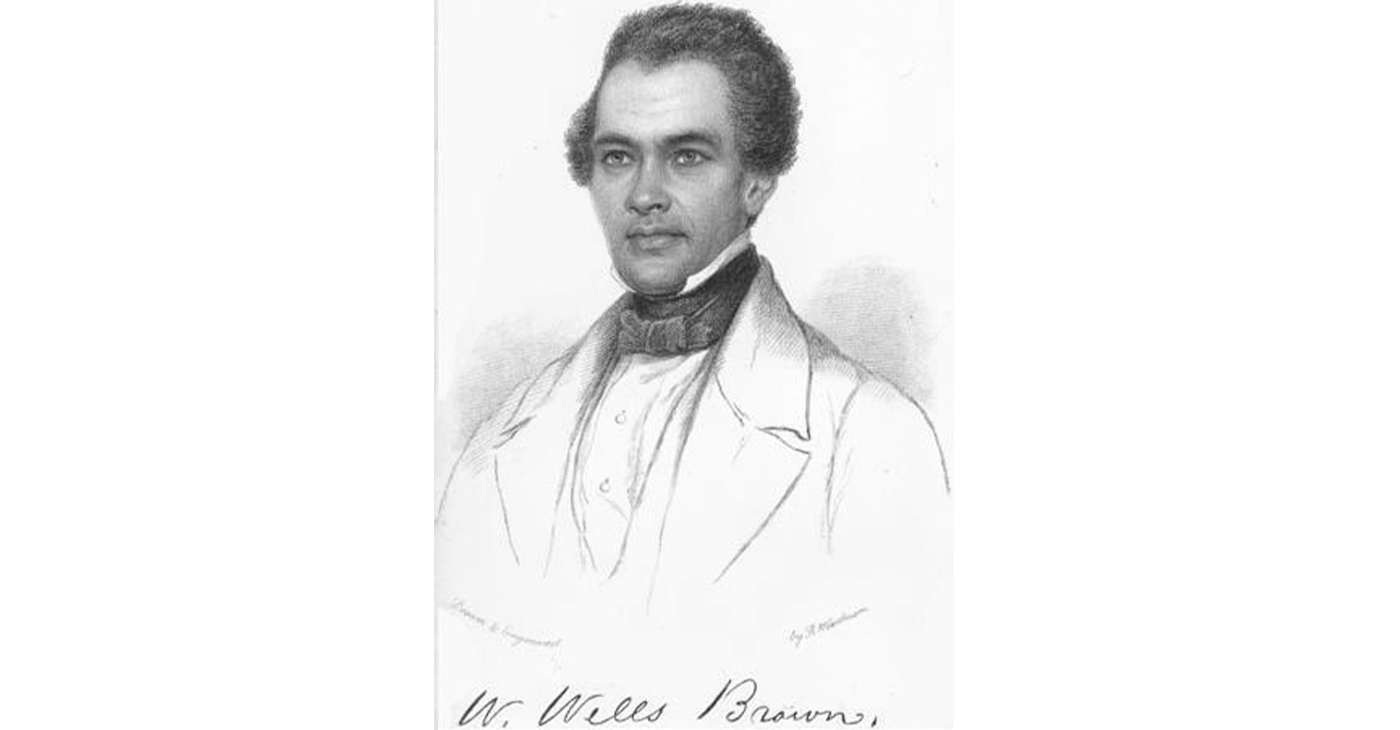
William Wells Brown personified the American dream. He’d become an internationally renowned antislavery activist and writer who resided in and traveled widely across the northern United States and the British Isles. He penned a series of remarkable books including the first Black novel, the first printed Black play, the first Black travelogue, and the first Black panorama displayed in Britain.

By Tamara Shiloh
The minstrel shows of the early 19th century are believed by some to be the roots of Black theatre. However, they were written, acted, and performed by whites for white audiences. The first known play by a Black American was James Brown’s “King Shotaway” (1823), but the first Black play published was William Wells Brown’s (ca. 1814–1884) “The Escape; or, A Leap for Freedom.”
While “Escape” was published in 1858, it was not officially produced until 1971 at Emerson College. It was one of the earliest extant pieces of African American dramatic literature.
Brown, whose mother was a slave, was born on a plantation outside Lexington, Ky. He would become a Black antislavery lecturer, a groundbreaking novelist, playwright, and historian.
According to the New Bedford Historical Society (NBHS), he is “widely considered to have been the first African American to publish works in several major literary genres, and widely acclaimed for the effectiveness of many of his writings.”
Bought and sold several times before age 20, Brown spent his childhood and much of his young adult life as a slave in St. Louis, Mo. There he was hired out to work on the Missouri River which, at that time, served as a major thoroughfare for the slave trade. This location allowed him several chances to escape. It was New Year’s Day in 1834 that he slipped away from a steamboat and finally became successful.
Brown landed in Cleveland, Ohio, where he began educating himself and reading antislavery newspapers. He later worked as a steam boatsman on Lake Erie and conductor for the Underground Railroad. On arrival at Cleveland, he’d taken shelter with Mr. and Mrs. Wells Brown, a white Quaker family and later adopted their names.
By 1843, Brown had become a regular on the Western New York Anti-Slavery Society lecturing circuit. He was also deeply committed to speaking out on women’s rights and temperance laws (laws banning the sale of spirits in less than 15-gallon quantities). It was Brown’s speaking that led many historians and scholars to provide the trajectory for his later career as a writer. By 1845, he’d published “Narrative of William W. Brown, a Fugitive Slave, Written by Himself.”
Brown personified the American dream. He’d become an internationally renowned antislavery activist and writer who resided in and traveled widely across the northern United States and the British Isles. He penned a series of remarkable books including the first Black novel, the first printed Black play, the first Black travelogue, and the first Black panorama displayed in Britain.
Focusing on his own historical works, Brown penned two histories of the Black race, a history on Blacks and whites in the South, and a rare military history of Blacks in the Civil War. He eventually settled in Boston, where he practiced medicine until his death from cancer in 1884.
Learn more about Brown’s compelling story through his classic American slave narrative: “The Narrative of William W. Brown a Fugitive Slave.”








Activism
Oakland Post: Week of April 8 – 14, 2026
The printed Weekly Edition of the Oakland Post: Week of April 8 – 14, 2026

To enlarge your view of this issue, use the slider, magnifying glass icon or full page icon in the lower right corner of the browser window.
Activism
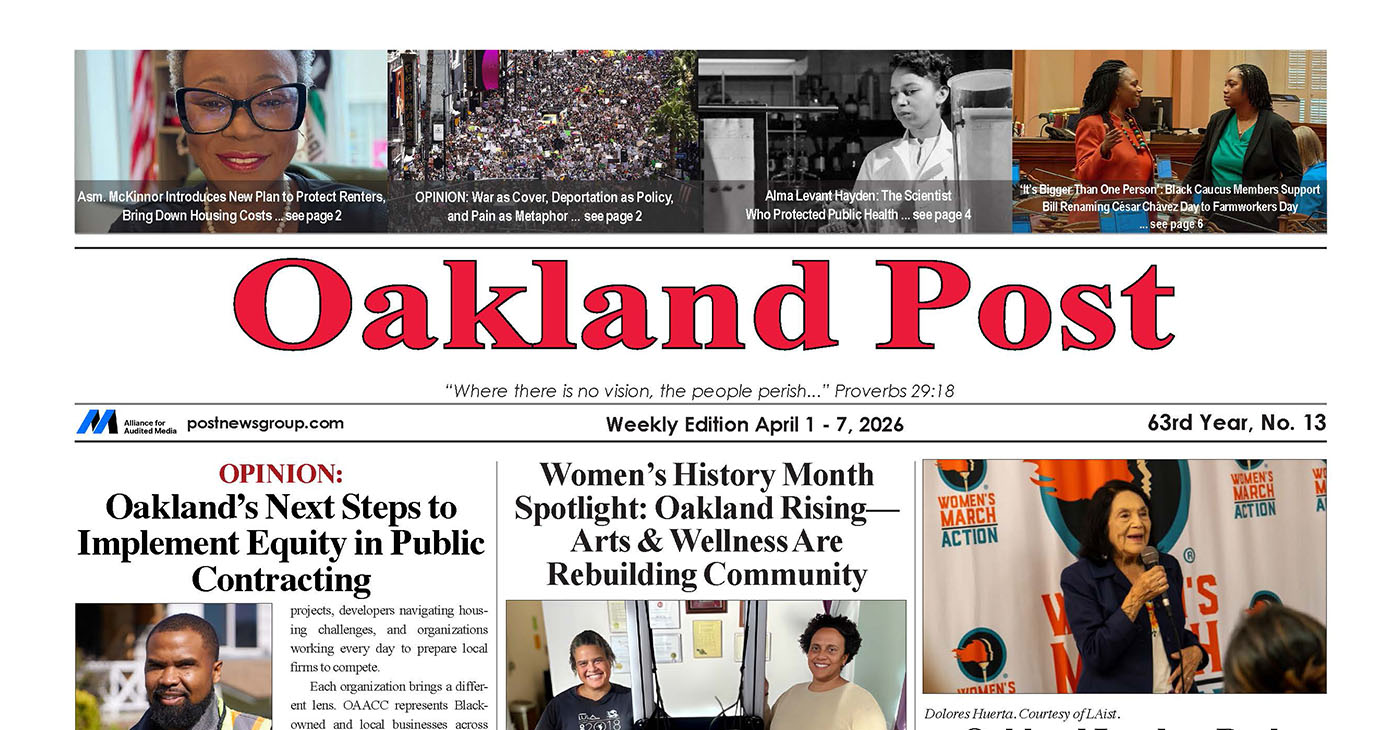
Oakland Post: Week of April 1 – 7, 2026
The printed Weekly Edition of the Oakland Post: Week of April 1 – 7, 2026
To enlarge your view of this issue, use the slider, magnifying glass icon or full page icon in the lower right corner of the browser window.
Activism
Oakland Post: Week of March 18 – 24, 2026
The printed Weekly Edition of the Oakland Post: Week of March 18 – 24, 2026

To enlarge your view of this issue, use the slider, magnifying glass icon or full page icon in the lower right corner of the browser window.

WORK FROM HOME
Home-based business with potential monthly income of $10K+ per month. A proven training system and website provided to maximize business effectiveness. Perfect job to earn side and primary income. Contact Lynne for more details: Lynne4npusa@gmail.com 800-334-0540


Oakland Post: Week of April 8 – 14, 2026

Oakland Post: Week of April 1 – 7, 2026

Black Artists in America, Installation Three Wraps at the Dixon Gallery and Gardens

Grief, Advocacy, and Education: A Counselor Reflects on Black Maternal Health

Future of Florida’s Black History Museum in Limbo

New Research Shows the Many Benefits of Early Learning

South Hampton K-8 Students Among Top 10 Finalists for Samsung’s ‘Solve for Tomorrow’ Competition

Cuba: No Negotiation with US on the President or Political System

Brooklyn Academy of Music Names Jamaican-Born Tamara McCaw as President

Trinidad & Tobego – U.S. Launches WhatsApp Channel for American Citizens in the Country

Oakland Post: Week of March 18 – 24, 2026

AI Innovation vs. Ethics and Environmental Impact

AI, Web3, and Digital Reparations

What If You Owned Your AI Agent?

Season 7, Episode 3 – January Reporter’s Roundtable 📱

Reflecting on Black History Milestones in Birmingham AL

Oakland Post: Week of February 25 – March 3, 2026

Oakland Post: Week of March 4 – 10, 2026

PRESS ROOM: NBA Hall of Fame Nominee Terry Cummings Joins 100 Black Men of DeKalb County to Launch Victory & Values Initiative
Oakland Post: Week of March 18 – 24, 2026

Trump’s MAGA Allies are Creating Executive Order Plan to Steal the 2026 Midterms

Oakland Post: Week of March 11 -17, 2026

Poll Shows Support for Policies That Help Families Afford Child Care

Financial Wellness and Mental Health: Managing Money Stress in College
New Research Shows the Many Benefits of Early Learning
Brooklyn Academy of Music Names Jamaican-Born Tamara McCaw as President

Woman’s Search for Family’s Roots Leads to Ancestor John T. Ward – A Successful Entrepreneur and Conductor on the Underground Railroad
Grief, Advocacy, and Education: A Counselor Reflects on Black Maternal Health
Future of Florida’s Black History Museum in Limbo
Black Artists in America, Installation Three Wraps at the Dixon Gallery and Gardens

Hyundai Ioniq 5 Parking, Safety, and 360 View #shorts

2025 Ioniq 5 New Wiper & Powerful Performance! #shorts

Electric SUV Range: Is 259 Miles Enough? #shorts

EV Charging: How Fast Can You Charge an Electric Vehicle? #shorts

Biometric Cooling… Messaging Seats…Come on! 2025 Infiniti QX80 Autograph 4WD

Charged Up: Witness the Magic of a Fully Electric Car! #shorts

Range Rover Sport PHEV Included…: See What’s Inside This Luxury SUV! #shorts

Invisible Hood View: Perfect Parking with X-Ray Vision! #shorts

AI Is Reshaping Black Healthcare: Promise, Peril, and the Push for Improved Results in California

ESSAY: Technology and Medicine, a Primary Care Point of View

Sanctuary Cities

The RESISTANCE – FREEDOM NOW

STATE OF THE PEOPLE: Freddie

ECONOMIC BOYCOTT DAY!!!!!

I told You So
-
 Activism3 weeks ago
Oakland Post: Week of March 18 – 24, 2026
-
 Activism4 weeks ago
Oakland Post: Week of March 11 -17, 2026
-
 Advice4 weeks ago
Financial Wellness and Mental Health: Managing Money Stress in College
-
 #NNPA BlackPress3 weeks ago
New Research Shows the Many Benefits of Early Learning
-
 #NNPA BlackPress3 weeks ago
Brooklyn Academy of Music Names Jamaican-Born Tamara McCaw as President
-
 #NNPA BlackPress3 weeks ago
Grief, Advocacy, and Education: A Counselor Reflects on Black Maternal Health
-
 #NNPA BlackPress3 weeks ago
Future of Florida’s Black History Museum in Limbo
-
 #NNPA BlackPress3 weeks ago
Black Artists in America, Installation Three Wraps at the Dixon Gallery and Gardens
