
Business
Where are the Black hemp farmers?
FLORIDA COURIER — Although hemp is legal, regulatory risks complicate the crop’s long-term outlook. Some states are positioning themselves to compete, but it’s unlikely the market can sustain hemp production in every state — unless there’s a significant increase in product demand, according to a February 2019 report from the College of Agriculture, Food and Environment at the University of Kentucky.

By April Simpson
COLUMBIA, Md. – Clarenda Stanley-Anderson will be the featured farmer of Hemp History Week, an educational campaign in June focused on a newly legal crop that’s at the center of a risky, potentially billion-dollar industry.
Stanley-Anderson is considered a pioneer in the nascent hemp agricultural community, for educating others and encouraging young farmers to bring hemp back to the U.S. agrarian landscape, according to history week organizers.
It’ll be the first time that the Hemp Industries Association annual initiative, which boasts celebrity endorsements and events across the country, will feature a non-white farmer.
Stanley-Anderson wants to expand the representation of hemp farmers, even if she’s far from the average industry insider. Black farmers are a mere 1.4 percent of the country’s 3.2 million farmers, according to the 2012 U.S. Department of Agriculture Census of Agriculture.
In North Carolina, where Stanley-Anderson and her husband own Green Heffa Farms in the town of Liberty, Black farm operators are nearly 3 percent of farmers.
While Black farmers aren’t as visible, Stanley-Anderson is part of a developing community. As growers, processors and entrepreneurs, Black professionals across the country are working to carve out a space in a trendy industry that’s projected to reach $1.9 billion in U.S. hemp-based product sales by 2022, according to the Hemp Business Journal, an online publication that tracks the industry.
‘BECOMING EXTINCT’
Individuals and organizations are in the early stages of building networks of Black farmers and processors to ensure Black agriculture professionals get their share of hemp riches. But it’s hard for everyone to take on the risk.
Black farmers have long been discriminated against by lending institutions like the USDA. And with a limited population of growers, land, resources and sometimes access to the information networks that enable farmers to move quickly, they could be left behind again with hemp.
“Black farmers are becoming extinct,” said Lamar Wilson, founder of SunJoined, a nationwide network of hemp growers and processors with farmers in Kentucky, Kansas and Colorado. “This is an opportunity to bring them back and to actually provide a profitable resource, but also a resource that can be used for so many different things.”
Not everyone is optimistic hemp is the future for the small and under-resourced farmer, unless there are regulatory efforts to ensure they can be competitive.
“Most minority farms are on the verge of survival,” said Joe Trigg, a farmer and city council member in Glasgow, Kentucky, who’s running as a Democrat for state commissioner of agriculture. “The last thing they need is something else to drag them down.”
Hemp has been touted by Democratic and Republican senators as a lifeline nationwide to farmers, many of whom are struggling under declining commodity prices. Farmers can harvest three types of hemp: fiber; grain or seed; or floral material extracted for plant resin, including cannabidiol, popularly known as CBD. Hemp’s uses span more than 25,000 products, including textiles, biofuel, ropes, cosmetics, food and beverages.
REGULATORY RISKS
Agriculture professionals say the high-value crop can be particularly well-suited to Black landowners, who typically have smaller farms and less overall sales than White farmers.
Black farmland accounts for 0.4 percent of U.S. farmland, and sales account for 0.2 percent of total U.S. agriculture sales, according to the USDA. Hemp can be cultivated in tight spaces, especially when harvested for fiber and seed, which are planted in narrow rows.
“We’re just seeing Black farmers emerge in the market,” said Bonita Money, founder of the Los Angeles-based National Diversity Inclusion and Cannabis Alliance, another group connecting hemp farmers of color.
Although hemp is legal, regulatory risks complicate the crop’s long-term outlook. Some states are positioning themselves to compete, but it’s unlikely the market can sustain hemp production in every state — unless there’s a significant increase in product demand, according to a February 2019 report from the College of Agriculture, Food and Environment at the University of Kentucky.
“Technology may dictate that production will ultimately be concentrated in relatively few states where hemp can be grown at the lowest cost of production and transported shorter distances for processing,” the report said.
GOT IN EARLY
Some states, including North Carolina and Kentucky, adopted hemp early and began growing it in research or pilot programs prior to Congress’ passage of the 2018 farm bill, which legalized hemp widely.
Before December, when President Donald Trump signed the bill, federal law treated hemp as a quasi-controlled substance because of its relation to marijuana.
Neither Kentucky nor North Carolina tracks the race of growers or processors, according to spokespeople from the states’ departments of agriculture.
With federal legalization, many states are launching hemp pilot programs, transitioning from pilot to large-scale programs, while some are choosing to keep hemp farming illegal. Regardless, competition is increasing as growing hemp becomes more accessible.
Roscoe M. Moore, Jr., a former assistant U.S. surgeon general who attended a recent hemp workshop in Columbia, Maryland, thinks that as more money enters the hemp market, there will be few minorities involved.
MARIJUANA STIGMA
He pointed to the Maryland state law that called on regulators to reflect racial, ethnic and geographic diversity among those licensed to work in the medical marijuana industry. No Black applicant was awarded a grower’s license, according to news reports, and there were no repercussions, Moore said.
“Business relationships are the gold standard for America,” said Moore, who advises several biotechnology and pharmaceutical companies. “Business is based on commerce. There’s not any excuse why we’re not involved, we just haven’t had the experience.”
But even when approached, Black farmers sometimes decline the opportunity. Trigg, the Kentucky city council member, said a state official encouraged him to participate early in Kentucky’s pilot program.
Trigg declined because of the crop’s association with marijuana and law enforcement oversight.
Even though marijuana and hemp are separate strains of cannabis, with hemp having a lower level of tetrahydrocannabinol, or THC — the main psychoactive component in the cannabis plant — farmers like Trigg worried about a stigma in being associated with the crop.
“There was still so much skepticism associated with it, and everyone was worried,” said Trigg, who plans to grow his first hemp plant this year. “You start growing marijuana on your farm and you’re Black?”
WHITE MALE COMMISSION
Stanley-Anderson, whose nickname is Farmer Cee, didn’t initially connect hemp to equity until she didn’t see herself reflected among decision makers. The North Carolina Industrial Hemp Commission, for example, whose nine members develop rules and licensing fee structures for the industry, is all male.
Eight members are White. Two are from law enforcement. None are African American.
Members, who serve as volunteers, are appointed by the governor, commissioner of agriculture and General Assembly. Their selection criteria are written into state law.
“I agree. It’s all White. It’s all male. But that’s the way it was set up,” said commission Chairman Tom Melton, also deputy director of the North Carolina Cooperative Extension Service at North Carolina State University. “Maybe the law needs to change to indicate some sort of representation. That’s beyond the scope of our commission.”
Federal law requires applicants for hemp licenses to not have had a drug felony in the past 10 years. The advocacy groups Vote Hemp, Drug Policy Alliance and others were able to get that decreased from a lifetime ban, but were unsuccessful in getting removed, said Eric Steenstra, president of Vote Hemp, in an email to Stateline.
“Our goal is to allow all farmers who want to grow hemp to do so with as limited restrictions as possible,” Steenstra wrote. Vote Hemp, based in Washington, D.C., is a national nonprofit advocacy organization that supports a free market for industrial hemp.
BACKGROUND CHECKS
For some Black farmers, the felony restriction on hemp is a lost opportunity. Blacks and Latinos are far more likely to have marijuana-related drug felonies, according to the Drug Policy Alliance.
People coming out of prison desperately need jobs, said Ashley Smith, co-founder of Black Soil: Our Better Nature, an organization that supports Black farmers, growers and producers in Kentucky.
“There has to be some compromise where we can bring folks who are in need of jobs working land that is in need of labor,” Smith said. In Kentucky, hemp laborers are subject to background checks.
Some places are trying a system to offer some restitution for the disproportionate impact of drug enforcement on Black communities.
Some California cities, for example, have adopted cannabis equity programs that provide business development, loan assistance and mentorships for minority and low-income entrepreneurs. Oakland has permits set aside for people of color.
“No one is doing that with hemp,” said Stanley-Anderson, who grew up on a farm in Alabama.
ORLANDO ADVOCACY GROUP
Jackson Garth, national director for industrial hemp for Minorities for Medical Marijuana, an advocacy group based in Orlando, has been working to get equity goals or requirements written into hemp legislation in Georgia and South Carolina. While the measures never made it into legislation, he’s encouraged South Carolina has awarded licenses to farmers of color he’s worked with.
“We’re going to have to have set-asides for Black and brown farmers, so farmers aren’t forgotten,” Garth said.
Garth’s group, known as M4MM, is in the early stages of setting up a co-op program for hemp. Garth, who’s also an executive of an industrial hemp processing company in Atlanta, is educating farmers on the crop and helping them get licenses.
“A lot of times,” Garth said, “it’s a lack of information that we’re receiving, and even when we get the information, it’s too late.”
FARMER EQUITY ACT
At least two states — Illinois and California — have enacted a Farmer Equity Act in recent years to ensure socially disadvantaged farmers and ranchers are included in food and agriculture laws.
States with programs to support minority-owned businesses, new and beginning farmers and other targeted groups, could potentially apply to commercial industrial hemp producers unless there are restrictions in place to exclude hemp production, according to the National Conference of State Legislatures.
Some critics argue that these programs can feel like a Band-Aid.
“There’s a slew of people who fall under minority,” said Kentucky farmer Charles Jones, citing White women, veterans and other farmers of color. “So, they can say they’re doing this for minorities, but the Black farmer still gets left out within this.”
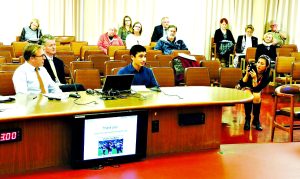
More than 100 people attended the recent daylong hemp informational event organized by Morgan State University, a historically Black university in Baltimore, Maryland. A handful of the attendees were Black. Among them, few were farmers. Instead, most were entrepreneurs or academics connected to Morgan State.
This article originally appeared in the Florida Courier.









Activism
Oakland Post: Week of March 18 – 24, 2026
The printed Weekly Edition of the Oakland Post: Week of March 18 – 24, 2026
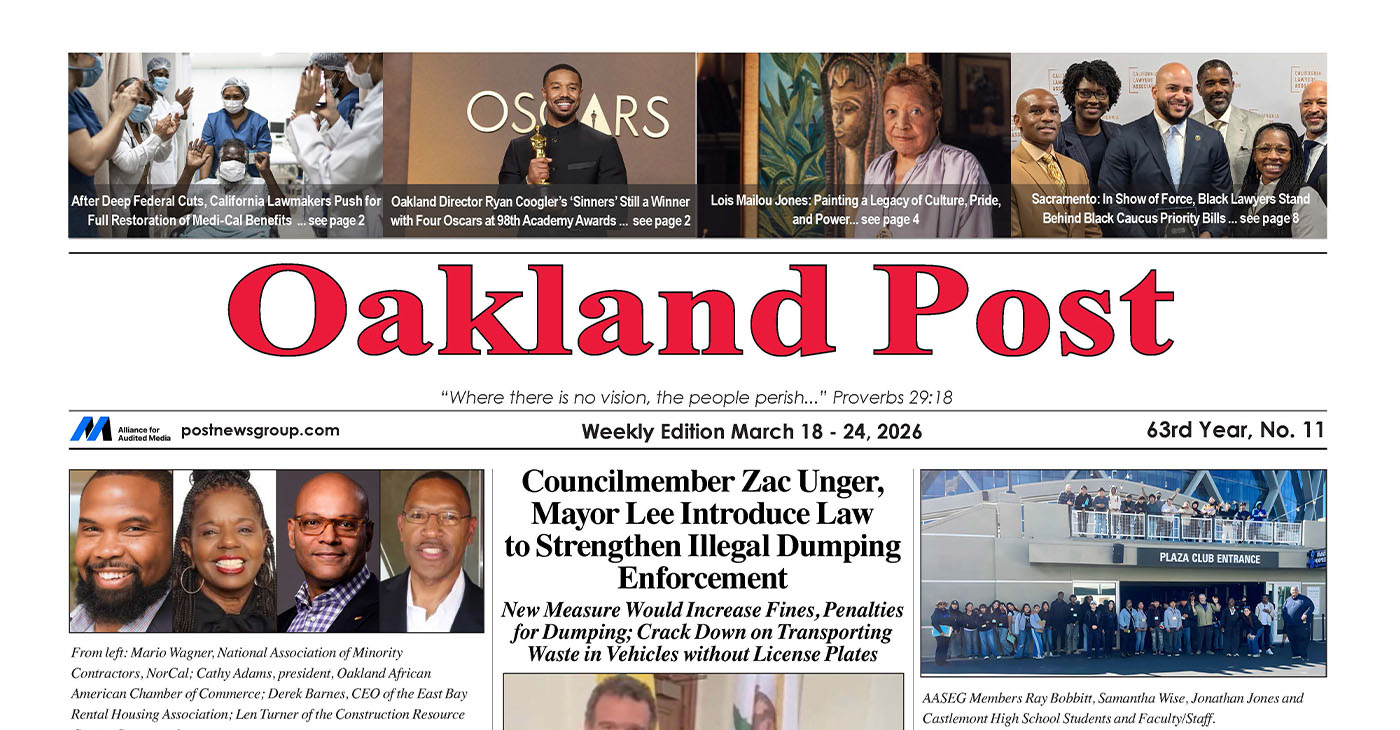
To enlarge your view of this issue, use the slider, magnifying glass icon or full page icon in the lower right corner of the browser window.
Advice
Financial Wellness and Mental Health: Managing Money Stress in College
While everyone’s financial situation is unique, several common sources of stress have the potential to strain your financial health. These include financial and economic uncertainty, existing debts, unexpected expenses, and mental or physical health changes. Financial stress may differ from situation to situation, but understanding the factors contributing to yours may help you begin to craft a plan for your unique circumstances.

Sponsored by JPMorganChase
As a college student, managing financial responsibilities can be stressful.
If you’ve found yourself staying up late thinking about your finances or just feeling anxious overall about your financial future, you’re not alone. In one survey, 78% of college students who reported financial stress had negative impacts on their mental health, and 59% considered dropping out. While finances can impact overall stress, taking steps to manage your finances can support your mental, emotional and physical well-being.
When it comes to money, the sources of stress may look different for each student, but identifying the underlying causes and setting goals accordingly may help you feel more confident about your financial future.
Consider these strategies to help improve your financial wellness and reduce stress.
Understand what causes financial stress
While everyone’s financial situation is unique, several common sources of stress have the potential to strain your financial health. These include financial and economic uncertainty, existing debts, unexpected expenses, and mental or physical health changes. Financial stress may differ from situation to situation, but understanding the factors contributing to yours may help you begin to craft a plan for your unique circumstances.
2. Determine your financial priorities
Start by reflecting on your financial priorities. For students this often includes paying for school or paying off student loans, studying abroad, saving for spring break, building an emergency fund, paying down credit card debt or buying a car. Name the milestones that are most important to you, and plan accordingly.
3. Create a plan and stick to it
While setting actionable goals starts you on the journey to better financial health, it’s essential to craft a plan to follow through. Identifying and committing to a savings plan may give you a greater sense of control over your finances, which may help reduce your stress. Creating and sticking to a budget allows you to better track where your money is going so you may spend less and save more.
4. Pay down debt
Many students have some form of debt and want to make progress toward reducing their debt obligations. One option is the debt avalanche method, which focuses on paying off your debt with the highest interest rate first, then moving on to the debt with the next-highest interest rate. Another is the debt snowball method, which builds momentum by paying off your smallest debt balance, and then working your way up to the largest amounts.
5. Build your financial resilience
Some financial stress may be inevitable, but building financial resilience may allow you to overcome obstacles more easily. The more you learn about managing your money, for instance, the more prepared you’ll feel if the unexpected happens. Growing your emergency savings also may increase resilience since you’ll be more financially prepared to cover unexpected expenses or pay your living expenses.
6. Seek help and support
Many colleges have resources to help students experiencing financial stress, like financial literacy courses or funds that provide some assistance for students in need. Talk to your admissions counselor or advisor about your concerns, and they can direct you to sources of support. Your school’s counseling center can also be a great resource for mental health assistance if you’re struggling with financial stress.
The bottom line
Financial stress can affect college students’ health and wellbeing, but it doesn’t have to derail your dreams. Setting smart financial goals and developing simple plans to achieve them may help ease your stress. Revisit and adjust your plan as needed to ensure it continues to work for you, and seek additional support on campus as needed to help keep you on track.
JPMorgan Chase Bank, N.A. Member FDIC
© 2026 JPMorgan Chase & Co.
Activism
Oakland Post: Week of March 11 -17, 2026
The printed Weekly Edition of the Oakland Post: Week of March 11 – 17, 2026
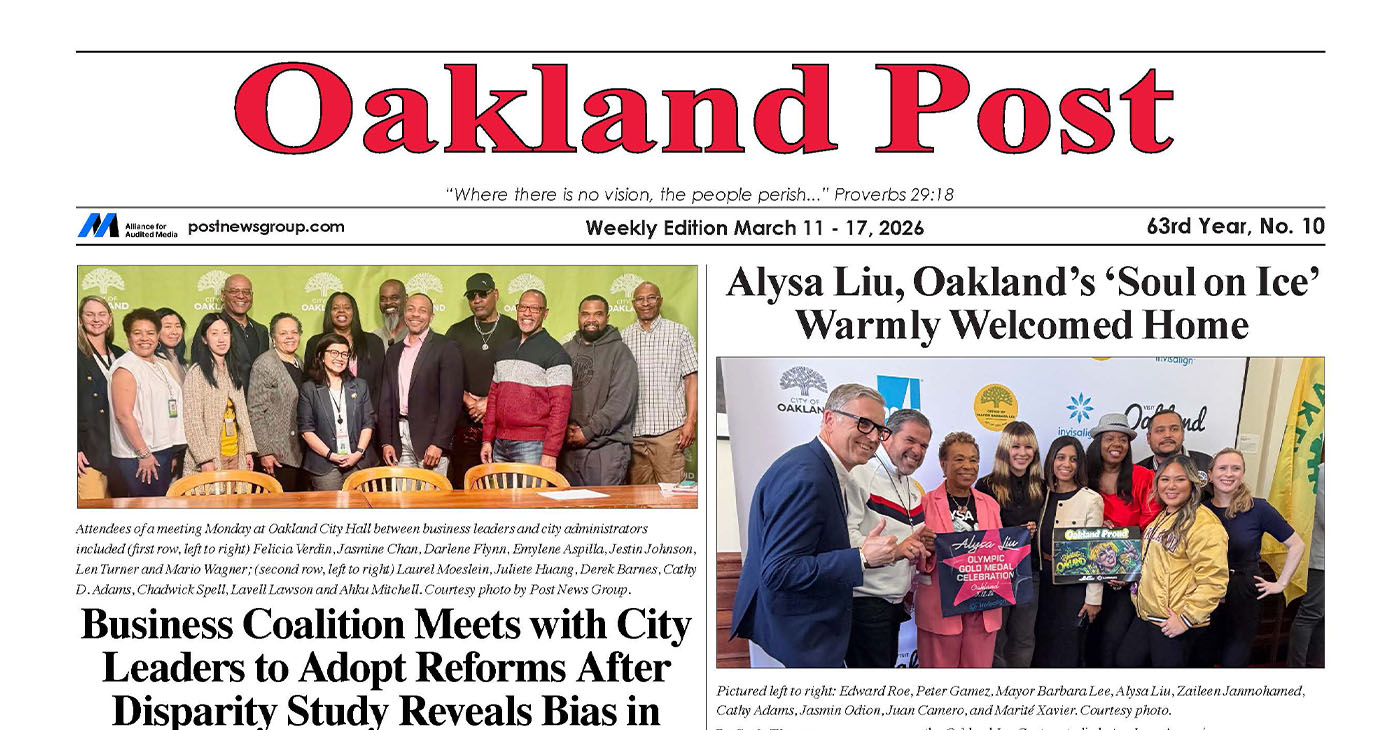
To enlarge your view of this issue, use the slider, magnifying glass icon or full page icon in the lower right corner of the browser window.

WORK FROM HOME
Home-based business with potential monthly income of $10K+ per month. A proven training system and website provided to maximize business effectiveness. Perfect job to earn side and primary income. Contact Lynne for more details: Lynne4npusa@gmail.com 800-334-0540


Black Artists in America, Installation Three Wraps at the Dixon Gallery and Gardens

Grief, Advocacy, and Education: A Counselor Reflects on Black Maternal Health

Future of Florida’s Black History Museum in Limbo

New Research Shows the Many Benefits of Early Learning

South Hampton K-8 Students Among Top 10 Finalists for Samsung’s ‘Solve for Tomorrow’ Competition

Cuba: No Negotiation with US on the President or Political System

Brooklyn Academy of Music Names Jamaican-Born Tamara McCaw as President

Trinidad & Tobego – U.S. Launches WhatsApp Channel for American Citizens in the Country

Oakland Post: Week of March 18 – 24, 2026

AI Innovation vs. Ethics and Environmental Impact

AI, Web3, and Digital Reparations

What If You Owned Your AI Agent?

Season 7, Episode 3 – January Reporter’s Roundtable 📱

Season 7, Episode 3 – January Reporter’s Roundtable

AI, Media, and Power | Part 2, Real-World Impacts and Tradeoffs

Reflecting on Black History Milestones in Birmingham AL

CITY OF SAN LEANDRO STATE OF CALIFORNIA PUBLIC WORKS DEPARTMENT ENGINEERING DIVISION NOTICE TO BIDDERS FOR ANNUAL STREET OVERLAY/REHABILITATION 2019-21 – PHASE III

Oakland Post: Week of February 18 – 24, 2026

Oakland Post: Week of February 25 – March 3, 2026

PRESS ROOM: NBA Hall of Fame Nominee Terry Cummings Joins 100 Black Men of DeKalb County to Launch Victory & Values Initiative

Trump’s MAGA Allies are Creating Executive Order Plan to Steal the 2026 Midterms

Oakland Post: Week of March 4 – 10, 2026

U.S. manufacturing rebounds – how foundry services are adapting to rising demand

Chase Oakland Community Center Hosts Alley-Oop Accelerator Building Community and Opportunity for Bay Area Entrepreneurs

Poll Shows Support for Policies That Help Families Afford Child Care

OP-ED: One Hundred Years of Black Workers Telling the Truth

Advancements in solar technology that are changing the way we power the world

Woman’s Search for Family’s Roots Leads to Ancestor John T. Ward – A Successful Entrepreneur and Conductor on the Underground Railroad

PRESS ROOM: Civil Rights TV Launches in Selma as the World’s First 24/7 Civil Rights Television Network

COMMENTARY: Women of Color Shape Our Past and Future

Hyundai Ioniq 5 Parking, Safety, and 360 View #shorts

2025 Ioniq 5 New Wiper & Powerful Performance! #shorts

Electric SUV Range: Is 259 Miles Enough? #shorts

EV Charging: How Fast Can You Charge an Electric Vehicle? #shorts

Biometric Cooling… Messaging Seats…Come on! 2025 Infiniti QX80 Autograph 4WD

Charged Up: Witness the Magic of a Fully Electric Car! #shorts

Range Rover Sport PHEV Included…: See What’s Inside This Luxury SUV! #shorts

Invisible Hood View: Perfect Parking with X-Ray Vision! #shorts

AI Is Reshaping Black Healthcare: Promise, Peril, and the Push for Improved Results in California

ESSAY: Technology and Medicine, a Primary Care Point of View

Sanctuary Cities

The RESISTANCE – FREEDOM NOW

STATE OF THE PEOPLE: Freddie

ECONOMIC BOYCOTT DAY!!!!!

I told You So
-
 Activism4 weeks ago
Oakland Post: Week of March 4 – 10, 2026
-
 #NNPA BlackPress4 weeks ago
Woman’s Search for Family’s Roots Leads to Ancestor John T. Ward – A Successful Entrepreneur and Conductor on the Underground Railroad
-
 #NNPA BlackPress4 weeks ago
COMMENTARY: Women of Color Shape Our Past and Future
-
 Activism3 weeks ago
Oakland Post: Week of March 11 -17, 2026
-

 #NNPA BlackPress4 weeks ago
OP-ED: NNPA Launches 2026 “Leadership Matters” Video Series
-

 #NNPA BlackPress4 weeks ago
Advocates Raise Alarm Over ICE Operation, MOU and Detention Risks in Baltimore County
-

 #NNPA BlackPress4 weeks ago
Pete Buttigieg to Join Mayor Randall Woodfin for Community Town Hall in Birmingham
-

 Advice3 weeks ago
Financial Wellness and Mental Health: Managing Money Stress in College
