
California Black Media
What Are Schoolteachers Thinking? Report Gives Insights
What teachers think and experience in the public education system is explored in a new report by the National Alliance for Public Charter Schools (NAPCS). The Harris Poll, a market research and consulting firm, carried out the survey of over 1,200 public schoolteachers from both charter and district schools for the report.


By Antonio Ray Harvey
California Black Media
What teachers think and experience in the public education system is explored in a new report by the National Alliance for Public Charter Schools (NAPCS).
The report, named “Listen to Your Teacher: An Analysis of Teacher Sentiment on the State of Public Education,” was authored by NAPCS’s vice president of Communications and Marketing, Debbie Veney.
The Harris Poll, a market research and consulting firm, carried out the survey of over 1,200 public schoolteachers from both charter and district schools for the report.
“I think the results of The Harris Poll raises the important point that the teacher’s voice is critical in determining the challenges we face in education, particularly in the aftermath of the pandemic,” said Leona Matthews, Senior Director of Literacy Programs for Green Dot Public Schools California.
Green Dot Public Schools is a non-profit organization whose mission is to help transform public education, so all students graduate prepared for college, leadership and life. The U.S. Department of Education has featured Green Dot as a national leader in school turnarounds.
“It makes it clear that charter schools provide the kind of small school, values driven environment that empowers teachers to meet the diverse needs of the students we serve.”

The NAPCS commissioned the survey to gain more insight into the teachers’ experiences, opinions, and motivations for entering, staying in, or leaving the profession.
The research was conducted online from May 10 to May 30, 2023.
“Next to parents, teachers are the backbone of education. It is valuable to have insight into how they feel in today’s climate and find out how we can better support their heroic work in and outside the classroom,” stated Nina Rees, president and CEO of the NAPCS. “Although we certainly have a special interest in charter schoolteachers, we care deeply about the experience of all public schoolteachers.”
Based on the study, 10 Los Angeles-based Green Dot Public Schools helped students increase proficiency rates in both math and English during the 2022-2023 year. Four schools exceeded their pre-pandemic proficiency rates.
Charter schools are publicly funded independent schools established by teachers, parents, or community groups under the terms of a charter with a local or national authority.
They are governed under a legislative contract — a charter — with the state, school district, or another entity, according to the National Center for Education Statistics (NCES), a statistical agency of the U.S. Department of Education (USDE).
In April 2020, the NCES and Institute of Education Sciences released a 71-page report that Black educators were 11% of the teachers in the country’s charter schools during the 2017-2018 academic year.
Overall, Black educators make up 11% of the teachers in city schools but only 5.5% of the teachers in suburban schools and 3.6% in rural schools. The nation’s average of Black educators in the classroom is 6.3%, according to the report.
Veney participated in a podcast focused on the study. She said that the importance of the survey was to get the 1,211 teachers to provide their perspectives (811 school district teachers and 400 charter school educators).
“This is the most important topic right now facing public education. We’re hearing all these headlines about teacher shortages, teacher resignations, and teacher dissatisfaction,” Veney said. “It really felt like we were not listening enough to what teachers were actually saying about this (or) if there was a lot of talk about teachers but not enough talk to teachers.”
The key data from the survey indicate the following trends:
Teachers Agree Families and Students Should Have Education Choice — About 4 out of 5 teachers agree that regardless of its politicized nature, public school choice is important for both families and teachers (79% of all public schoolteachers; 87% of charter schoolteachers and 78% of district schoolteachers).
Something Has to Change — Public school teachers cite student behavior and discipline issues (74%) as the top challenge they believe teachers currently face, followed by pay (65%).
There’s Something Special About the Experience of Charter Schoolteachers — Eighty percent of charter schoolteachers say they are as or more motivated than when they initially entered the profession (vs. 34% among public school teachers).
Aligning with Culture — Ninety-six percent of charter schoolteachers report feeling aligned with their current school’s culture in terms of values and beliefs about education. About 75% of district schoolteachers feel this way.
Keep Politics Out of the Classroom — Teachers say they just want to teach (94%) and report feeling like they are caught in the crossfire of a culture war (91%).
“It amplifies a needed conversation about our educational system, how we can best support teachers, and ultimately our students.” Matthews said of the report.
Charter schools historically serve proportionately more students of color and more students from low-income communities than district schools. For a stretch of 16 years (2005-06 to 2020-21 school years), charter schools have consistently had a higher portion of students of color compared to district schools, according to the National Alliance for Public Charter Schools (NAPCS).
During the 2005-2006 school year, a total of 196,851 students were enrolled in California charter schools, according to data provided by NAPCS. The movement continued each year as enrollment reached 692,783 pupils by the end of the 2020-2021 calendar year.
As of the beginning of the 2022–23 school year, more than 1,300 charter schools and seven all-charter districts are operating in California, according to the California Department of Education (CDE).
Alameda County has 80 charter schools; San Bernardino County has 52; Los Angeles County has 275; San Diego County has 124; Sacramento County has 56; and San Francisco has 16 public charter schools, according to CDE.
“I am really delighted to say that a lot of what we found is consistent and similar across both types of school settings,” said Veney, referring to the charter schools and district schools.







Activism
Oakland Post: Week of March 18 – 24, 2026
The printed Weekly Edition of the Oakland Post: Week of March 18 – 24, 2026

To enlarge your view of this issue, use the slider, magnifying glass icon or full page icon in the lower right corner of the browser window.
Activism
Oakland Post: Week of March 11 -17, 2026
The printed Weekly Edition of the Oakland Post: Week of March 11 – 17, 2026
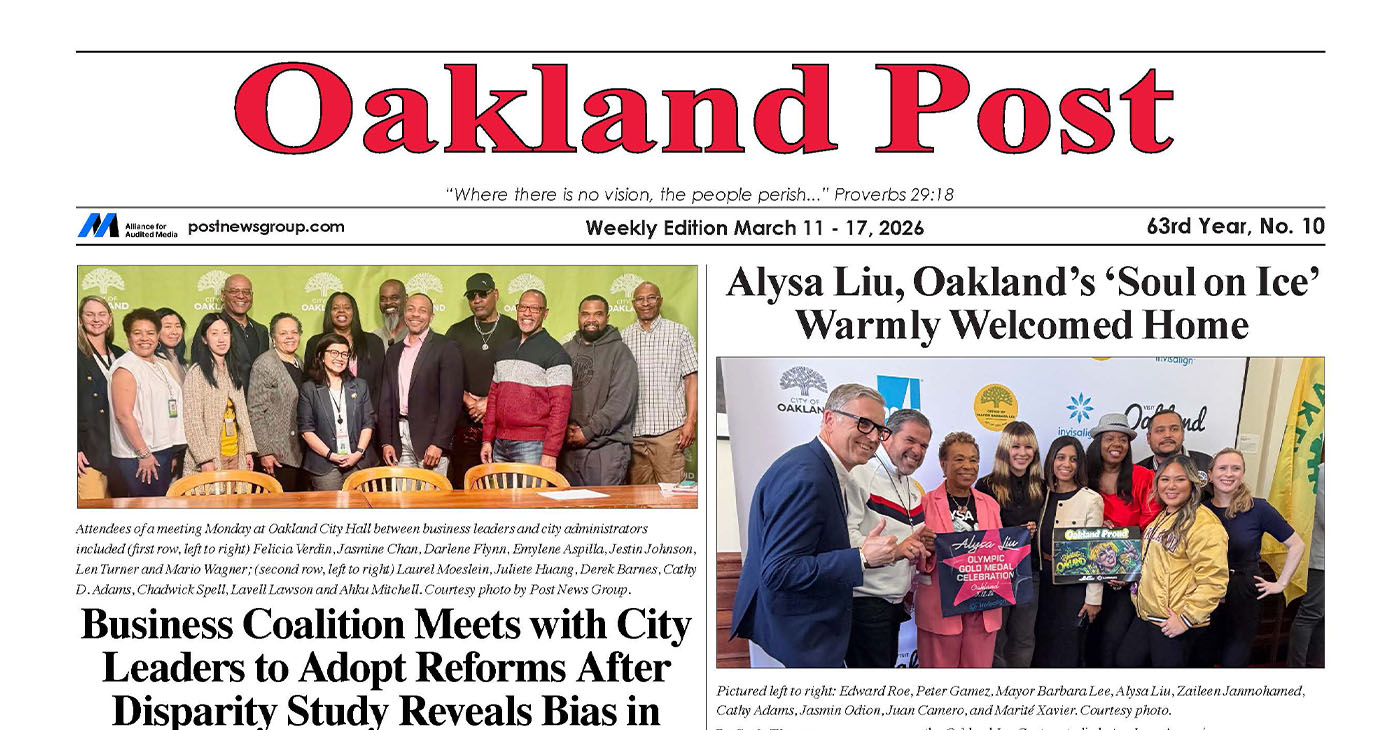
To enlarge your view of this issue, use the slider, magnifying glass icon or full page icon in the lower right corner of the browser window.
Activism
Oakland Post: Week of March 4 – 10, 2026
The printed Weekly Edition of the Oakland Post: Week of March 4 – 10, 2026

To enlarge your view of this issue, use the slider, magnifying glass icon or full page icon in the lower right corner of the browser window.


WORK FROM HOME
Home-based business with potential monthly income of $10K+ per month. A proven training system and website provided to maximize business effectiveness. Perfect job to earn side and primary income. Contact Lynne for more details: Lynne4npusa@gmail.com 800-334-0540


Black Artists in America, Installation Three Wraps at the Dixon Gallery and Gardens

Grief, Advocacy, and Education: A Counselor Reflects on Black Maternal Health

Future of Florida’s Black History Museum in Limbo

New Research Shows the Many Benefits of Early Learning

South Hampton K-8 Students Among Top 10 Finalists for Samsung’s ‘Solve for Tomorrow’ Competition

Cuba: No Negotiation with US on the President or Political System

Brooklyn Academy of Music Names Jamaican-Born Tamara McCaw as President

Trinidad & Tobego – U.S. Launches WhatsApp Channel for American Citizens in the Country

Oakland Post: Week of March 18 – 24, 2026

AI Innovation vs. Ethics and Environmental Impact

AI, Web3, and Digital Reparations

What If You Owned Your AI Agent?

Season 7, Episode 3 – January Reporter’s Roundtable 📱

Season 7, Episode 3 – January Reporter’s Roundtable

AI, Media, and Power | Part 2, Real-World Impacts and Tradeoffs

Discrimination in City Contracts

Oakland Post: Week of February 11 – 17, 2026

Reflecting on Black History Milestones in Birmingham AL

Rising Optimism Among Small And Middle Market Business Leaders Suggests Growth for California

CITY OF SAN LEANDRO STATE OF CALIFORNIA PUBLIC WORKS DEPARTMENT ENGINEERING DIVISION NOTICE TO BIDDERS FOR ANNUAL STREET OVERLAY/REHABILITATION 2019-21 – PHASE III

Oakland Post: Week of February 18 – 24, 2026

PRESS ROOM: NBA Hall of Fame Nominee Terry Cummings Joins 100 Black Men of DeKalb County to Launch Victory & Values Initiative

Oakland Post: Week of February 25 – March 3, 2026

U.S. manufacturing rebounds – how foundry services are adapting to rising demand

Trump’s MAGA Allies are Creating Executive Order Plan to Steal the 2026 Midterms

OP-ED: One Hundred Years of Black Workers Telling the Truth

Advancements in solar technology that are changing the way we power the world

Chase Oakland Community Center Hosts Alley-Oop Accelerator Building Community and Opportunity for Bay Area Entrepreneurs

PRESS ROOM: Civil Rights TV Launches in Selma as the World’s First 24/7 Civil Rights Television Network

Poll Shows Support for Policies That Help Families Afford Child Care

Hyundai Ioniq 5 Parking, Safety, and 360 View #shorts

2025 Ioniq 5 New Wiper & Powerful Performance! #shorts

Electric SUV Range: Is 259 Miles Enough? #shorts

EV Charging: How Fast Can You Charge an Electric Vehicle? #shorts

Biometric Cooling… Messaging Seats…Come on! 2025 Infiniti QX80 Autograph 4WD

Charged Up: Witness the Magic of a Fully Electric Car! #shorts

Range Rover Sport PHEV Included…: See What’s Inside This Luxury SUV! #shorts

Invisible Hood View: Perfect Parking with X-Ray Vision! #shorts

AI Is Reshaping Black Healthcare: Promise, Peril, and the Push for Improved Results in California

ESSAY: Technology and Medicine, a Primary Care Point of View

Sanctuary Cities

The RESISTANCE – FREEDOM NOW

STATE OF THE PEOPLE: Freddie

ECONOMIC BOYCOTT DAY!!!!!

I told You So
-
 #NNPA BlackPress4 weeks ago
Reflecting on Black History Milestones in Birmingham AL
-
 #NNPA BlackPress4 weeks ago
PRESS ROOM: NBA Hall of Fame Nominee Terry Cummings Joins 100 Black Men of DeKalb County to Launch Victory & Values Initiative
-
 Activism4 weeks ago
Oakland Post: Week of February 25 – March 3, 2026
-
 #NNPA BlackPress4 weeks ago
Trump’s MAGA Allies are Creating Executive Order Plan to Steal the 2026 Midterms
-
 #NNPA BlackPress4 weeks ago
OP-ED: One Hundred Years of Black Workers Telling the Truth
-
 #NNPA BlackPress4 weeks ago
Poll Shows Support for Policies That Help Families Afford Child Care
-

 Activism3 weeks ago
Oakland Post: Week of March 4 – 10, 2026
-

 #NNPA BlackPress3 weeks ago
Woman’s Search for Family’s Roots Leads to Ancestor John T. Ward – A Successful Entrepreneur and Conductor on the Underground Railroad
