
Bay Area
Voting Underway for November 8 Election
Election laws changed a few years ago requiring local elections for cities, towns, schools and special districts to be consolidated with statewide elections to increase voter turnout. That change means more races are on the general election ballot. As it does after all elections, the Elections staff will conduct an after-action report to ensure voters in the future receive their voter guides at the same time or before they receive their ballots.

Courtesy of Marin County
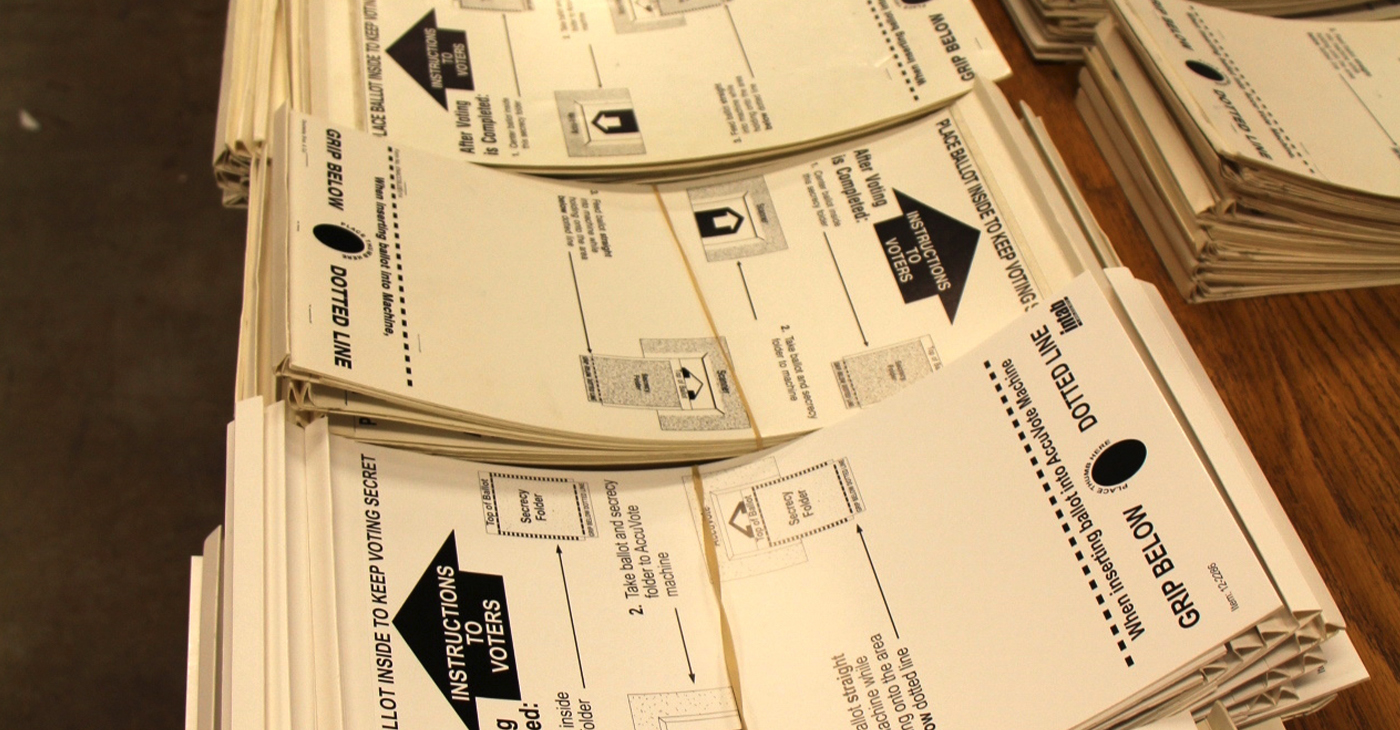
Voting for the November 8 General Election is under way in Marin County.
Ballots were mailed starting Oct. 10, and early voting started that day at the Elections Department at the Marin County Civic Center in San Rafael. Several official ballot drop boxes open around the county were available as of Oct. 11.
Registrar of Voters Lynda Roberts said the first voter guides were mailed about a week later than normal, but all were in the mail by Wednesday, Oct. 19, and accessible online through the Voter Information Portal at marinvotes.org.
“We have 87 different ballot types for this election, more than double the number we had in the November 2020 general election, and creating the voter guides took about a week longer than expected, including translation to Spanish,” Roberts said.
In some cases, ballots arrived in mailboxes before the voter guides, which prompted phone calls to the Elections Department. “For those wanting to vote right away, we were happy to send them another guide,” Roberts added. “We also let voters know about accessing the guide online.”
Election laws changed a few years ago requiring local elections for cities, towns, schools and special districts to be consolidated with statewide elections to increase voter turnout. That change means more races are on the general election ballot. As it does after all elections, the Elections staff will conduct an after-action report to ensure voters in the future receive their voter guides at the same time or before they receive their ballots.
Roberts asks voters to be aware of the recent change from Election Day polling places to multi-day vote centers. Voters are no longer assigned to one location and, when needing or wanting in-person services, voters may go to any of the 20 vote centers in Marin County.
The full list of vote centers with days and hours of operation is posted on the Elections Department website at marinvotes.org. The list is also published in the voter information guide.
Roberts also asks voters to keep these key dates in mind.
Oct. 25: Starting on this day and until 8 p.m. Election Day, eligible residents who are not registered must go to a vote center to register and vote. Check online for locations and dates and hours of operation.
Oct. 29: Four vote centers will be open in Marin this Saturday. Check online for locations and dates and hours of operation.
Nov. 1: The last day the Elections Department can mail a ballot. After this day, voters must get a ballot in person at any vote center.
Nov. 5: All 20 vote centers will be open through 8 p.m. Election Day. Check online for locations and dates and hours of operation.
Nov. 8: Election Day. All vote centers will be open from 7 a.m. to 8 p.m. Ballot return envelope must be signed and postmarked on or before this day or dropped in an official ballot drop box or at any vote center by 8 p.m. Check marinvotes.org for locations.
A voter unable to return their vote-by-mail ballot may designate someone to return it for them by filling out the short form at the top of the ballot return envelope, signature side. Those ballots must be returned within 72 hours. Voters may call the Elections Department at (415) 473-6456 if they have questions or concerns.
“I strongly encourage voters to only designate someone they know and trust,” Roberts said.
Roberts reminds voters to sign their return envelope or the Elections Department cannot process the ballot. Voters will receive a letter if their signature is missing or doesn’t compare with their voter registration form so they can fix the problem. Voters should complete and return the letter right away so the staff can process the ballot.
Follow the Elections Department on Facebook.









Activism
Oakland Post: Week of September 23 – 29, 2026
The printed Weekly Edition of the Oakland Post: Week of September 23 – 29, 2026

To enlarge your view of this issue, use the slider, magnifying glass icon or full page icon in the lower right corner of the browser window.
Activism
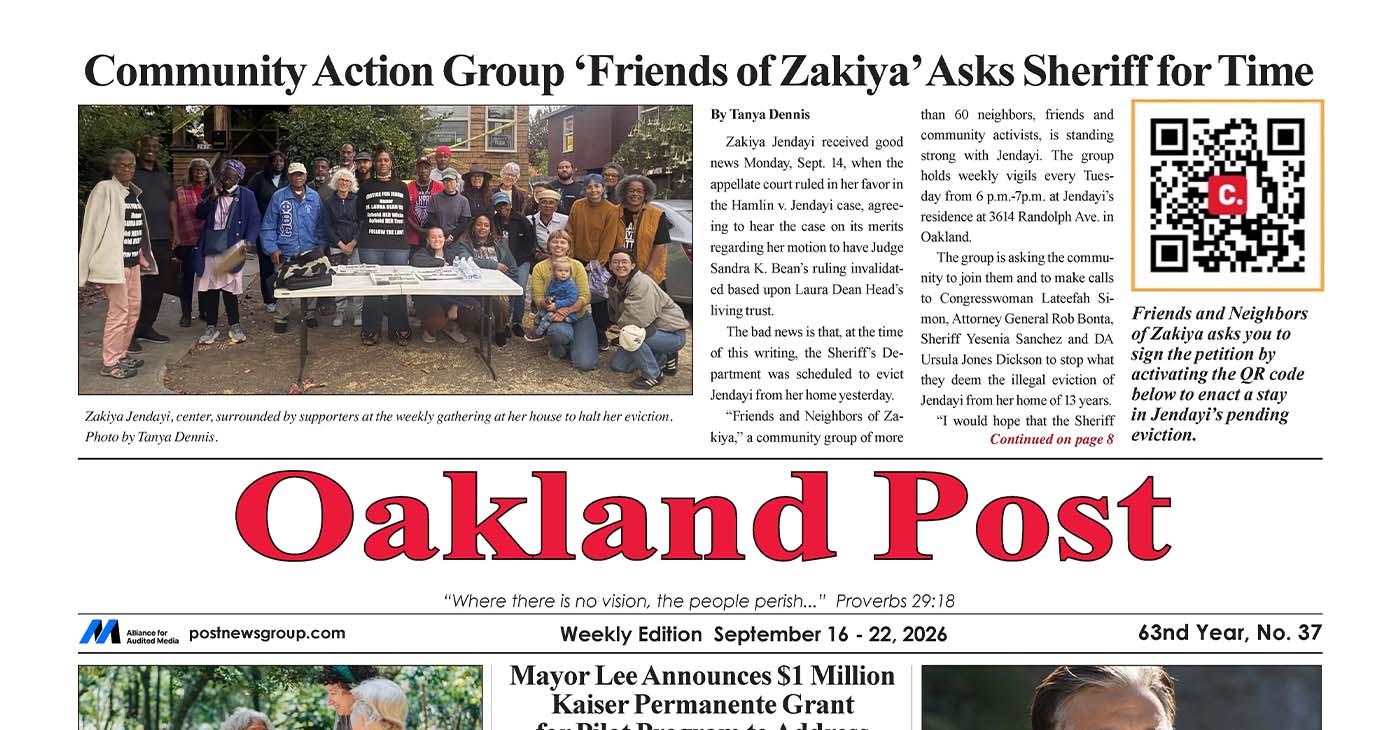
Oakland Post: Week of September 16 – 22, 2026
The printed Weekly Edition of the Oakland Post: Week of September 16 – 22, 2026
To enlarge your view of this issue, use the slider, magnifying glass icon or full page icon in the lower right corner of the browser window.
Activism
Oakland Post: Week of September 9 – 15, 2026
The printed Weekly Edition of the Oakland Post: Week of September 9 – 15, 2026

To enlarge your view of this issue, use the slider, magnifying glass icon or full page icon in the lower right corner of the browser window.



Asm. Corey Jackson Announces Launch of 24-Hour Childcare in His District

IN MEMORIAM: The Rev. Leon “Sonny” Clark, Longtime Orange County Pastor and Community Leader, Dies at 72

Poll: Becerra Widens His Lead Over Hilton; Californians Split on Wealth Tax

From Historic Memories to New Possibilities: Oakland Celebrates Coliseum 60

County Office of Education Says OUSD Finances Are Getting Healthier, Materially Stronger

LIVE FREE Sunday Dinner Brings Faith, Fellowship and Civic Conversation to Oakland

Remembering Chauncey Bailey as Student Journalists Face Threats to Truth-Telling

BLACspace Cooperative Invites Bay Area to Experience Oakland’s Black Cultural Ecosystem Through a BLAC Map Tour + Party

In Wake of Death on Doorstep, Williams Chapel Baptist Church Calls for Better Care, Funding for Unhoused

Oakland Centenarian Nuna McKee Honored!

Caribbean Nations Produce Action Plan Calling for UK Reparations Over Slavery

Oakland Post: Week of September 23 – 29, 2026

Doulas Are Helping Black California Moms Navigate Pregnancy–Even as High Mortality Rates Persist

Newsom Signs Addictive Social Media Law to Protect Kids

On Your November Ballot: Prop 38 Would Allocate $8.4 Billion to Immunology and Immunotherapy Funding

Standoff for Justice: Our Homes Are Worth Fighting For

Oakland Post: Week of August 26 – September 1, 2026

Frontier Airlines’ Return to Oakland Airport Brings Flights, Jobs and Opportunity

Gubernatorial Candidate Steve Hilton Blasts California New Tire Rules; Newsom Hits Back

Chef Sharon Lee Blends Culinary Excellence, Education and Empowerment

Jackie Wright Champions Bay Area Stories, Filmmakers and Cultural Institutions

Big City Mayors Ask for “Yes” Vote on Housing Bond Measure; Conservatives Say “No”

Oakland Coliseum Project Opens Door for Small Businesses to Build Bigger

Gov. Newsom’s Latest Appointees Include Sacramento Advocate for Formerly Incarcerated Students; State’s New Tech Chief

Misnamed ‘Parent’ PAC Seeks to Influence Oakland School Board Elections

Longtime BWOPA Member Brendalyn Goodall Appointed to California Workforce Development Board

Gov. Newsom Signs Law Shielding Immigration Aid Workers From Doxing Threats

Secretary of State Shirley N. Weber Urges Californians to Vote Early as Voter ID Battle Intensifies

From Palestine to Oakland: Seeds for Liberation Examines Shared Struggles for Freedom

IN MEMORIAM: Dolly Parton Dead at 80 — How She Built a Legacy of Love and Earned Her Place in Black Culture

The Conversation With Al McFarlane 6/23/26

Media Monday 6/22/26

LIVE! ASK ALMA! — TUES. 6.23.26 7PM EST

Car Buying Secrets: 4 Hidden Checks Before You Sign!

Is This 550 HP Charger Worth YOUR Money? AutoNetwork Review

Celebrating Juneteenth – Frederick Douglass on education and resistance

LIVE! — ASK ALMA! — TUES. 6.19.26 7PM EST

Hyundai Ioniq 5 Parking, Safety, and 360 View #shorts

2025 Ioniq 5 New Wiper & Powerful Performance! #shorts

Electric SUV Range: Is 259 Miles Enough? #shorts

EV Charging: How Fast Can You Charge an Electric Vehicle? #shorts

Biometric Cooling… Messaging Seats…Come on! 2025 Infiniti QX80 Autograph 4WD

Charged Up: Witness the Magic of a Fully Electric Car! #shorts

Range Rover Sport PHEV Included…: See What’s Inside This Luxury SUV! #shorts

Invisible Hood View: Perfect Parking with X-Ray Vision! #shorts
-
 Community2 weeks ago
Misnamed ‘Parent’ PAC Seeks to Influence Oakland School Board Elections
-

 Activism3 weeks ago
Oakland Post: Week of September 2 – 8, 2026
-

 Community2 weeks ago
Richmond Tiny House Village Farm & Garden Set to Open Gates on Sept. 26
-

 Black History2 weeks ago
Latest Massacre in Haiti Reveals Cruelty U.S. Deportations
-

 Black History2 weeks ago
OPINION: Nolan Wells’ Death One of Several Signifying Racial Terror Lives on in U.S. South
-

 Activism2 weeks ago
Oakland Post: Week of September 9 – 15, 2026
-

 Community2 weeks ago
Democratic Clubs Interview Candidates for Oakland School Board
-

 Featured2 weeks ago
‘Ready to See These Bills Become Law’: Sen. Weber’s Package of 15 Bills Advance to Gov. Newsom’s Desk
