
Politics
Video Rekindles Debate About Police Treatment of Blacks


Geneva Reed-Veal, center, hugs family members at a memorial service for her daughter Sandra Bland at Prairie View A&M University, Tuesday, July 21, 2015, in Prairie View, Texas. A newly released dashcam video documents how a routine traffic stop escalated into a shouting confrontation between a Texas state trooper and Bland, which led to her arrest. Bland was found hanging in her jail cell three days after the incident. (AP Photo/Pat Sullivan)
PAUL J. WEBER, Associated Press
WILL WEISSERT, Associated Press
AUSTIN, Texas (AP) — When Sandra Bland refused to put out her cigarette, the police officer opened her car door and tried dragging her out of the vehicle. She asked at least four times why she was being arrested and got no answer. When she told him she had epilepsy, he shouted, “Good!”

The tense dashcam video of the 28-year-old black woman getting pulled over by a white Texas state trooper for not signaling a lane change renewed the national debate Wednesday over how police treat blacks and outraged some critics of law enforcement who saw a motorist who was squarely within her rights.
Bland, who talked about police brutality on social media before her arrest, seemed to be aware of her civil liberties. And a range of experts said the officer’s orders to the 28-year-old motorist were probably lawful, even if his behavior appeared exceptionally aggressive for the circumstances.
Bland’s traffic stop drew special attention because she was found dead in her jail cell three days later, and family and supporters continue to dispute that she hanged herself with a plastic garbage bag, as authorities have concluded. The FBI is supervising a state investigation into the death.
Experts including former law enforcement officials and civil rights attorneys say the video is not a clear-cut case of an officer overstepping his authority in the face of an agitated motorist.
“Believe it or not, sometimes you can’t just look at the video and tell,” said Phillip Lyons, a former police officer and current dean of the College of Criminal Justice at Sam Houston State University in Huntsville, Texas.
The video of the traffic stop in rural Waller County drew more than 1.2 million views on YouTube, less than a day after the Department of Public Safety made the footage public.
The state trooper pulled over Bland on July 10, when she was at Prairie View A&M University, a historically black college, to interview for a job at her alma mater.
The traffic stop swiftly escalates into a shouting match after trooper Brian Encinia tells Bland she seems “irritated” and asks her to put out her cigarette. When Bland protests — “I’m in my car. Why do I have to put out my cigarette?” — Encinia orders her on the street and opens the door to drag her out when she doesn’t comply.
Simply ignoring instructions to stop smoking typically isn’t sufficient grounds for police to demand someone to get out of their car. But officers also have wide discretion to take control of a scene.
Lyons said he saw nothing that was “clearly inappropriate or unnecessary” about the request, but the legal threshold rises when an officer determines that a driver must be physically removed from a vehicle.
The justification for using force is generally supposed to be proportional to the circumstances. Bland is asked more than a dozen times to get out. As he gives those orders, Encinia becomes visibly annoyed at her refusal and eventually reaches into the car.
“We don’t observe anything that would suggest there was a legitimate law enforcement reason to get out of the car. It seems to be just an issue of asserting his authority,” said Rebecca Robertson, the legal and policy director for the American Civil Liberties Union of Texas.
But at the same time, Robertson said, if an officer instructs you to get out, “you have to get out of the car.”
Bland ultimately steps out of her car on her own after the trooper says, “I will light you up,” an apparent threat to use the stun gun he had drawn.
The speed with which Bland was threatened seems to run counter to best practices described in a 2011 Justice Department report about Tasers. The report cited a police survey in which most departments said they allow only “soft tactics,” such as pushing, against someone who refuses to comply but doesn’t physically resist.
Bland also tried recording the encounter on her phone before being told to stop, which experts say is a command police can rightfully make if it interferes with their duties.
To some experts who watched the video, it would have been in the interests of both Bland and Encinia to simply remain calm.
The director of the Department of Public Safety, Steve McCraw, has said Encinia violated internal policies of professionalism and courtesy, but he has not said the trooper acted outside the bounds of the law. Encinia has been placed on administrative leave for violating unspecified police procedures and DPS policy.
“His whole demeanor, his vocabulary, the way that he spoke to this motorist,” said Vernon Herron, a senior policy analyst with the Center for Health and Homeland Security at The University of Maryland. “I just think it added to the fact that she became combative.”
When the confrontation moves off-camera onto the sidewalk, Bland is heard screaming that the trooper is about to break her wrists as she is handcuffed. Bland was arrested for assault on a public servant. In an arrest affidavit, the trooper wrote that Bland had swung her elbows at him and kicked him in the shin.
___
Associated Press Writer Jamie Stengle in Dallas contributed to this report.
___
Follow Paul J. Weber on Twitter: www.twitter.com/pauljweber .
___
Dashcam video posted by Texas Department of Public Safety: www.youtube.com/watch?v=CaW09Ymr2BA .
Copyright 2015 The Associated Press. All rights reserved. This material may not be published, broadcast, rewritten or redistributed.











Business
OP-ED: Proposition 44 Would Put a Price on Trust
The danger in Proposition 44 is not only its 90 percent figure. It is that the meaning of “qualifying” spending will be worked out later. A clinic preparing a budget today may not know whether a navigator, health educator, transportation program, outreach worker, technology upgrade, or other patient-support service will be counted the way it expects. Yet the financial consequence of getting it wrong could be immediate.





Business
OP-ED: Proposition 40: It’s Time to Play Chess, Not Checkers
Proposition 40 would impose a one-time 5 percent tax on the wealth of Californians with more than $1 billion in assets. Most of that money would go toward health care, with the remainder supporting food assistance and education-related programs.

Activism
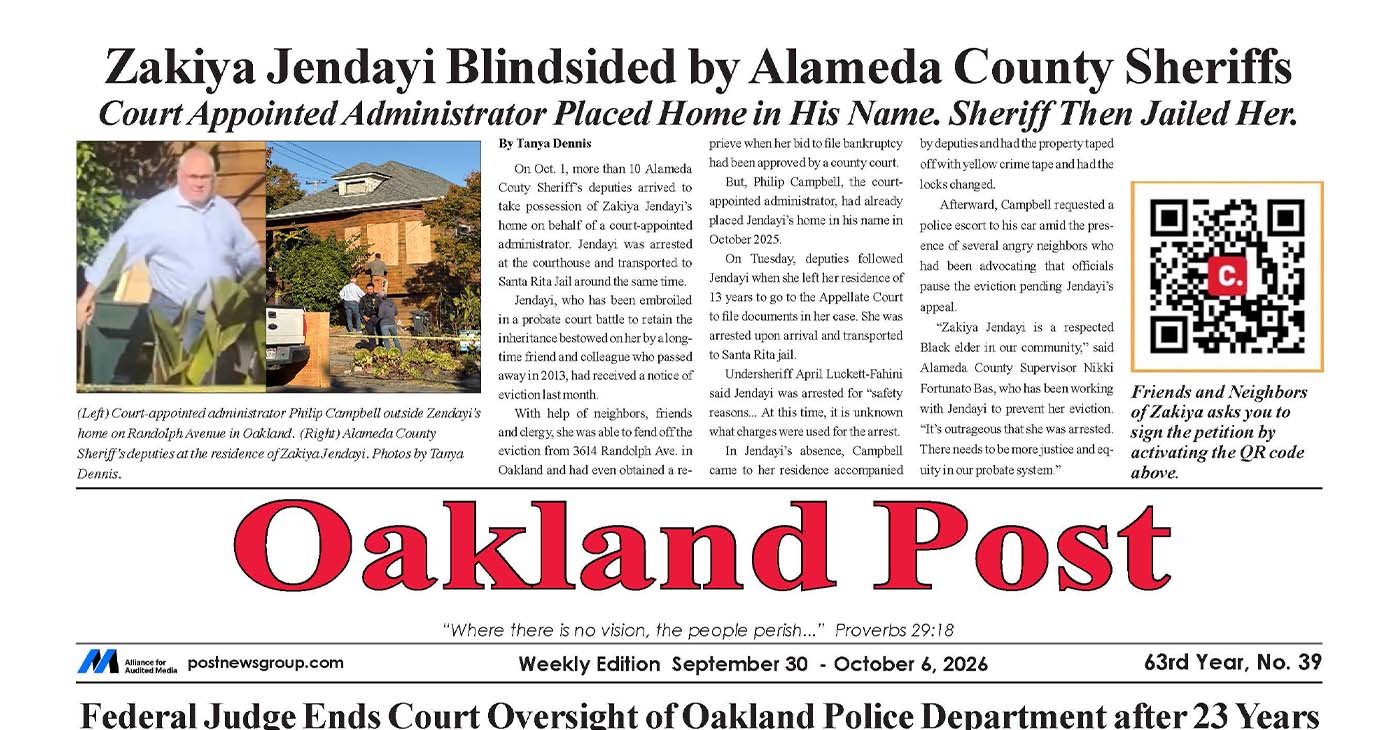
Oakland Post: Week of September 30 – October 6, 2026
The printed Weekly Edition of the Oakland Post: Week of September 30 – October 6, 2026
To enlarge your view of this issue, use the slider, magnifying glass icon or full page icon in the lower right corner of the browser window.



OP-ED: Proposition 44 Would Put a Price on Trust

OP-ED: Proposition 40: It’s Time to Play Chess, Not Checkers

Listening as a Lifeline: A Doula’s Witness to Black Maternal Health

New Protections for Ticket Buyers: Gov. Newsom Signs Assemblymember Isaac Bryan’s Bill

‘We Don’t Talk Trash — We Pick Up Trash!’

Zakiya Jendayi Arrested, Locked Out of Home by Sheriff’s Deputies

Oakland Post: Week of September 30 – October 6, 2026

Asm. Corey Jackson Announces Launch of 24-Hour Childcare in His District

IN MEMORIAM: The Rev. Leon “Sonny” Clark, Longtime Orange County Pastor and Community Leader, Dies at 72

Poll: Becerra Widens His Lead Over Hilton; Californians Split on Wealth Tax

From Historic Memories to New Possibilities: Oakland Celebrates Coliseum 60

County Office of Education Says OUSD Finances Are Getting Healthier, Materially Stronger

LIVE FREE Sunday Dinner Brings Faith, Fellowship and Civic Conversation to Oakland

Remembering Chauncey Bailey as Student Journalists Face Threats to Truth-Telling

BLACspace Cooperative Invites Bay Area to Experience Oakland’s Black Cultural Ecosystem Through a BLAC Map Tour + Party

Standoff for Justice: Our Homes Are Worth Fighting For

Oakland Post: Week of August 26 – September 1, 2026

Frontier Airlines’ Return to Oakland Airport Brings Flights, Jobs and Opportunity

Gubernatorial Candidate Steve Hilton Blasts California New Tire Rules; Newsom Hits Back

Jackie Wright Champions Bay Area Stories, Filmmakers and Cultural Institutions

Chef Sharon Lee Blends Culinary Excellence, Education and Empowerment

Misnamed ‘Parent’ PAC Seeks to Influence Oakland School Board Elections

Oakland Coliseum Project Opens Door for Small Businesses to Build Bigger

Gov. Newsom’s Latest Appointees Include Sacramento Advocate for Formerly Incarcerated Students; State’s New Tech Chief

Big City Mayors Ask for “Yes” Vote on Housing Bond Measure; Conservatives Say “No”

Longtime BWOPA Member Brendalyn Goodall Appointed to California Workforce Development Board

Oakland Post: Week of September 2 – 8, 2026

Gov. Newsom Signs Law Shielding Immigration Aid Workers From Doxing Threats

Secretary of State Shirley N. Weber Urges Californians to Vote Early as Voter ID Battle Intensifies

Oakland Post: Week of September 9 – 15, 2026

The Conversation With Al McFarlane 6/23/26

Media Monday 6/22/26

LIVE! ASK ALMA! — TUES. 6.23.26 7PM EST

Car Buying Secrets: 4 Hidden Checks Before You Sign!

Is This 550 HP Charger Worth YOUR Money? AutoNetwork Review

Celebrating Juneteenth – Frederick Douglass on education and resistance

LIVE! — ASK ALMA! — TUES. 6.19.26 7PM EST

Hyundai Ioniq 5 Parking, Safety, and 360 View #shorts

2025 Ioniq 5 New Wiper & Powerful Performance! #shorts

Electric SUV Range: Is 259 Miles Enough? #shorts

EV Charging: How Fast Can You Charge an Electric Vehicle? #shorts

Biometric Cooling… Messaging Seats…Come on! 2025 Infiniti QX80 Autograph 4WD

Charged Up: Witness the Magic of a Fully Electric Car! #shorts

Range Rover Sport PHEV Included…: See What’s Inside This Luxury SUV! #shorts

Invisible Hood View: Perfect Parking with X-Ray Vision! #shorts
-
 Community4 weeks ago
Misnamed ‘Parent’ PAC Seeks to Influence Oakland School Board Elections
-
 Activism4 weeks ago
Oakland Post: Week of September 9 – 15, 2026
-

 Community4 weeks ago
Richmond Tiny House Village Farm & Garden Set to Open Gates on Sept. 26
-

 Black History4 weeks ago
Latest Massacre in Haiti Reveals Cruelty U.S. Deportations
-

 Black History4 weeks ago
OPINION: Nolan Wells’ Death One of Several Signifying Racial Terror Lives on in U.S. South
-

 Business3 weeks ago
Mayor Lee Announces $1 Million Kaiser Permanente Grant for Pilot Program to Address Homelessness, Clean Up Public Spaces throughout Oakland
-

 Community4 weeks ago
Democratic Clubs Interview Candidates for Oakland School Board
-
 Uncategorized3 weeks ago
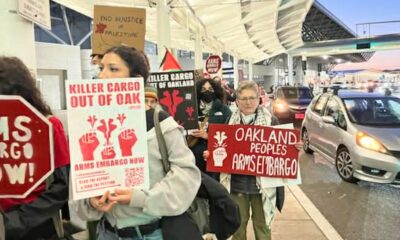
Oakland People’s Arms Embargo Coalition Demands End to Military Shipments Thru Oakland
