
Black History
The Way West: Reparations Task Force Looks at Black Migration to California
During its third meeting, California’s Task Force to Study and Develop Reparation Proposals for African Americans looked at reasons formerly enslaved Black people migrated to the Golden State — and detailed setbacks they faced after arriving.

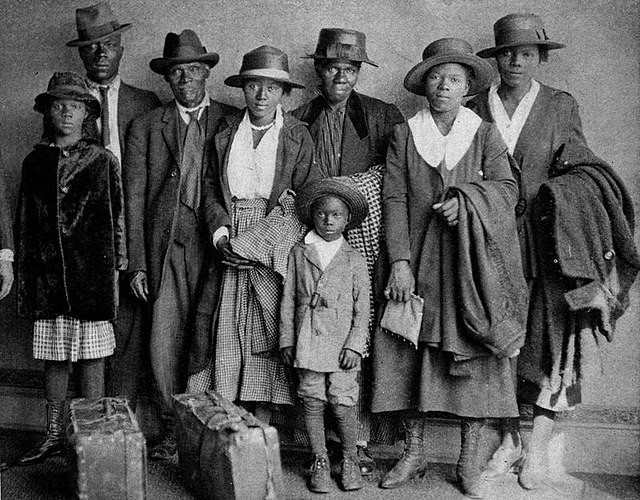
I was leaving the South
to fling myself into the unknown…
I was taking a part of the South
to transplant in alien soil,
to see if it could grow differently,
if it could drink of new and cool rains,
bend in strange winds,
respond to the warmth of other suns
and, perhaps, to bloom.
- Richard Wright, the author of Black Boy, 1945
During its third meeting, California’s Task Force to Study and Develop Reparation Proposals for African Americans looked at reasons formerly enslaved Black people migrated to the Golden State — and detailed setbacks they faced after arriving.
During the period historians dub the “Great Migration”– which lasted from the early 1900s through the 1970s – approximately 6 million Black Americans relocated from Deep South states to Northern, Midwestern, Eastern and Western states. Significant numbers ended up in California, escaping Jim Crow laws and racial violence and seeking economic opportunity.
Isabel Wilkerson, author of “The Warmth of Other Suns: The Epic Story of America’s Great Migration, “described the movement as “a redistribution of Black people.”

“It was the only time in America’s history that American citizens had to flee the land of their birth just to be recognized as the citizens that they had always been,” Wilkerson said, pointing out that no other group of Americans has been displaced under similar conditions.
After President Lincoln signed the Emancipation Proclamation, the Reconstruction era began. It was a period of prosperity as some Blacks in different places began to establish businesses and communities; contest for (and win) political office; establish schools, and more.
But it was short-lived because of white backlash, Wilkerson said.
By the early 1900s, racist white Southerners began to terrorize freed Black people with cross burnings, and racial violence — and discriminate against them by instituting Jim Crow laws.
There was a spike in lynchings, and a sharecropping system that mirrored the conditions of slavery began to take form in the 11 former slaveholding states.
Under those policies, opportunities for Blacks were almost nonexistent.
After World War World I began in Europe in 1914, there was a shortage of labor. Factories started luring Black people North to fill vacancies. By 1919, an estimated 1 million Southern Blacks had departed for the North.
By the 1930s, the Great Depression had slowed Black migration. But the revival of the exodus from the South, a period historians call the “Second Great Migration,” started around 1939.
This time around, California was a major destination.
As Black people left the South, Wilkerson said, they “followed three, beautifully predictable streams — pathways to freedom.” The first two led to Eastern and Midwestern states. The “West Coast stream,” Wilkerson told the task force, “carried people from Louisiana and Texas out to California and the entire West Coast.”
World War II created an expansion of the country’s defense industry, according to the Southern California public television network,. During this time, more jobs were available to African Americans. California cities such as Los Angeles, San Francisco and Oakland began to see an influx of Black people.
According to KCET, a Southern California public television network, the Black population in Los Angeles grew from 63,700 in the 1940s to 763,000 in 1970. The migration was largely fueled by job openings in industries manufacturing automobiles, rubber, and steel. The presence of Blacks became evident along Central Avenue between 8th and 20th streets in California’s largest city.
“(Black southerners) were recruited to the North and West to fill labor shortages in the steel mills, factories and shipyards,” Wilkerson said. “It turned out that they wanted the labor but did not want the people.”
The response to the Great Migration was “structural barriers of exclusion,” Wilkerson said. Restrictive covenants required white property owners to agree not to sell to Black people and many areas in large and mid-range cities were redlined to deny services to Blacks.
“By law and by policies, parents, grandparents or great-grandparents of almost every African American alive today (were denied) the greatest source of wealth in this country: homeownership, the American Dream itself,” Wilkerson said.
“With all the testimony I’ve heard, I don’t see how any person of conscience, character and civility could not understand that the facts have been given,” said Task Force vice-chair, the Rev. Amos Brown, pastor of Third Baptist Church in San Francisco and president of that city’s NAACP branch.
The purpose of the nine-member task force is to study and develop reparation proposals for African Americans and recommend appropriate ways to educate the Californians about the task force’s findings.
Sanctioned from 1619 to 1865, legalized slavery in the United States deprived more than 4 million Africans and their descendants of citizenship rights and economic opportunity. After it was abolished, government institutions at the federal, state, and local levels perpetuated, condoned, and often profited from practices that disadvantaged African Americans and excluded them from participation in society.
“On those sugar, rice, and tobacco fields (in the deep south) were opera singers, jazz musicians, novelists, surgeons, attorneys, professors, accountants, and legislators,” Wilkerson said. “How do we know that? Because that is what they and their children, grandchildren and now great-grandchildren have often chosen to become.”
Wilkerson first gained national attention in 1994, when she became the first Black woman to win the Pulitzer Prize for Feature Writing in 1994, while employed as Chicago Bureau Chief of The New York Times.
Wilkerson’s parents are both from Southern states, but they stayed in Wash., D.C., where she was born, after meeting at Howard University. It was her parents’ migration northward, she says, that inspired her research on an era that helped to shape the country’s current demographics.
“Slavery has lasted so long that it will not be until next year, 2022, that the United States would have been a free and independent nation for as long as slavery lasted on this soil,” she said.







Activism
Oakland Post: Week of March 18 – 24, 2026
The printed Weekly Edition of the Oakland Post: Week of March 18 – 24, 2026

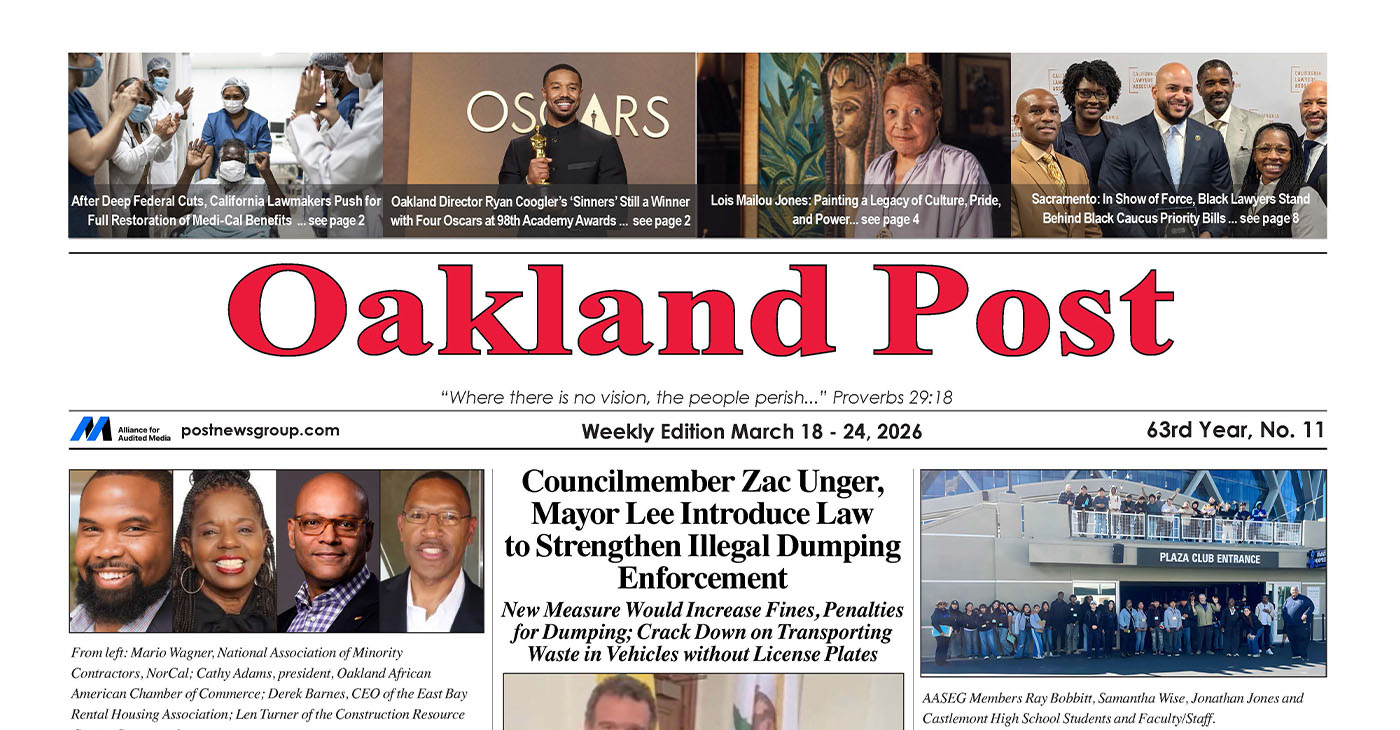
To enlarge your view of this issue, use the slider, magnifying glass icon or full page icon in the lower right corner of the browser window.

Activism
Oakland Post: Week of March 11 -17, 2026
The printed Weekly Edition of the Oakland Post: Week of March 11 – 17, 2026
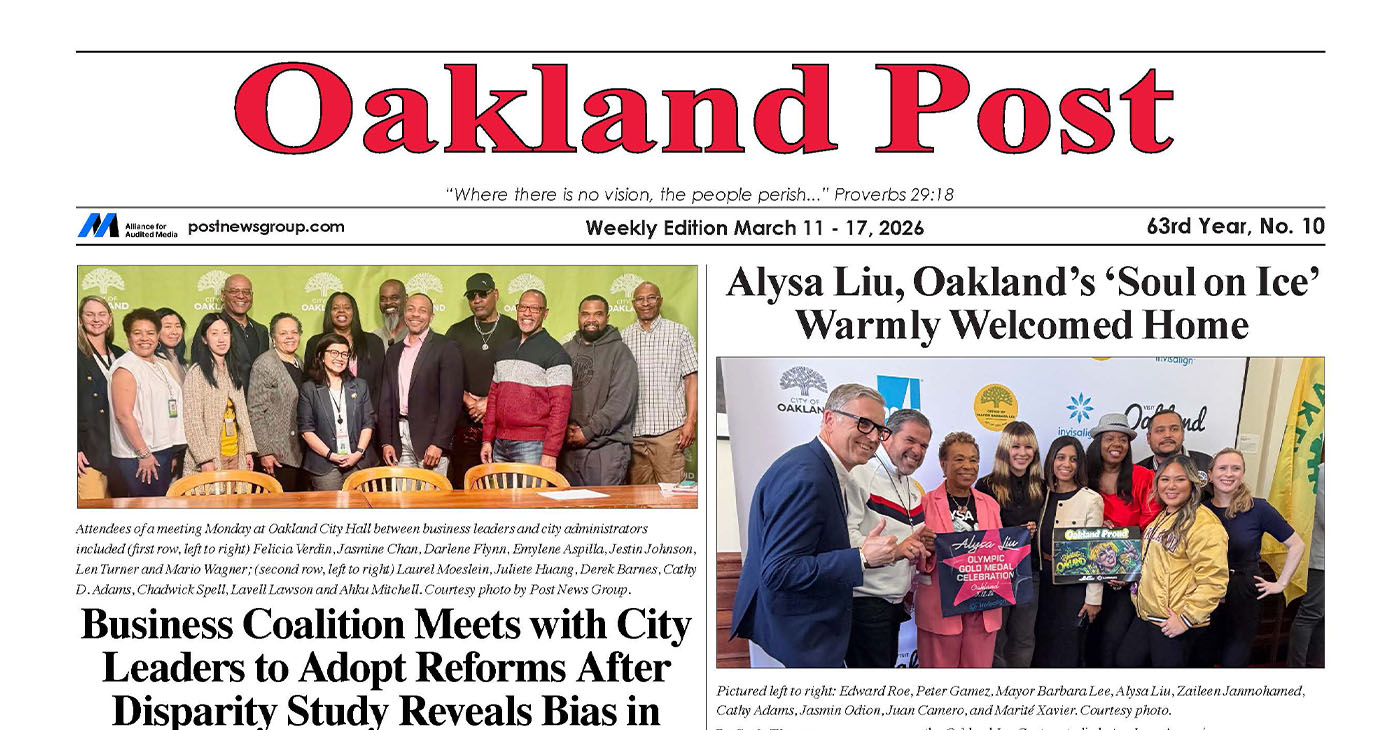
To enlarge your view of this issue, use the slider, magnifying glass icon or full page icon in the lower right corner of the browser window.
Activism
Oakland Post: Week of March 4 – 10, 2026
The printed Weekly Edition of the Oakland Post: Week of March 4 – 10, 2026

To enlarge your view of this issue, use the slider, magnifying glass icon or full page icon in the lower right corner of the browser window.


WORK FROM HOME
Home-based business with potential monthly income of $10K+ per month. A proven training system and website provided to maximize business effectiveness. Perfect job to earn side and primary income. Contact Lynne for more details: Lynne4npusa@gmail.com 800-334-0540


Black Artists in America, Installation Three Wraps at the Dixon Gallery and Gardens

Grief, Advocacy, and Education: A Counselor Reflects on Black Maternal Health

Future of Florida’s Black History Museum in Limbo

New Research Shows the Many Benefits of Early Learning

South Hampton K-8 Students Among Top 10 Finalists for Samsung’s ‘Solve for Tomorrow’ Competition

Cuba: No Negotiation with US on the President or Political System

Brooklyn Academy of Music Names Jamaican-Born Tamara McCaw as President

Trinidad & Tobego – U.S. Launches WhatsApp Channel for American Citizens in the Country

Oakland Post: Week of March 18 – 24, 2026

AI Innovation vs. Ethics and Environmental Impact

AI, Web3, and Digital Reparations

What If You Owned Your AI Agent?

Season 7, Episode 3 – January Reporter’s Roundtable 📱

Season 7, Episode 3 – January Reporter’s Roundtable

AI, Media, and Power | Part 2, Real-World Impacts and Tradeoffs

Discrimination in City Contracts

Oakland Post: Week of February 11 – 17, 2026

Reflecting on Black History Milestones in Birmingham AL

Rising Optimism Among Small And Middle Market Business Leaders Suggests Growth for California

CITY OF SAN LEANDRO STATE OF CALIFORNIA PUBLIC WORKS DEPARTMENT ENGINEERING DIVISION NOTICE TO BIDDERS FOR ANNUAL STREET OVERLAY/REHABILITATION 2019-21 – PHASE III

Oakland Post: Week of February 18 – 24, 2026

PRESS ROOM: NBA Hall of Fame Nominee Terry Cummings Joins 100 Black Men of DeKalb County to Launch Victory & Values Initiative

Oakland Post: Week of February 25 – March 3, 2026

Trump’s MAGA Allies are Creating Executive Order Plan to Steal the 2026 Midterms

U.S. manufacturing rebounds – how foundry services are adapting to rising demand

OP-ED: One Hundred Years of Black Workers Telling the Truth

Advancements in solar technology that are changing the way we power the world

Chase Oakland Community Center Hosts Alley-Oop Accelerator Building Community and Opportunity for Bay Area Entrepreneurs

Poll Shows Support for Policies That Help Families Afford Child Care

PRESS ROOM: Civil Rights TV Launches in Selma as the World’s First 24/7 Civil Rights Television Network

Hyundai Ioniq 5 Parking, Safety, and 360 View #shorts

2025 Ioniq 5 New Wiper & Powerful Performance! #shorts

Electric SUV Range: Is 259 Miles Enough? #shorts

EV Charging: How Fast Can You Charge an Electric Vehicle? #shorts

Biometric Cooling… Messaging Seats…Come on! 2025 Infiniti QX80 Autograph 4WD

Charged Up: Witness the Magic of a Fully Electric Car! #shorts

Range Rover Sport PHEV Included…: See What’s Inside This Luxury SUV! #shorts

Invisible Hood View: Perfect Parking with X-Ray Vision! #shorts

AI Is Reshaping Black Healthcare: Promise, Peril, and the Push for Improved Results in California

ESSAY: Technology and Medicine, a Primary Care Point of View

Sanctuary Cities

The RESISTANCE – FREEDOM NOW

STATE OF THE PEOPLE: Freddie

ECONOMIC BOYCOTT DAY!!!!!

I told You So
-
 #NNPA BlackPress4 weeks ago
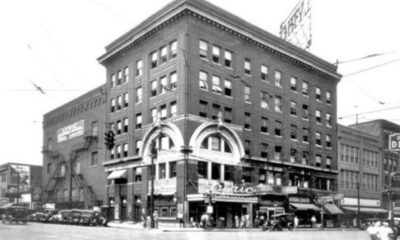
Reflecting on Black History Milestones in Birmingham AL
-
 #NNPA BlackPress4 weeks ago
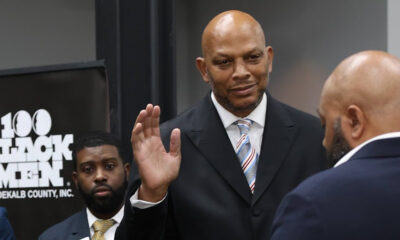
PRESS ROOM: NBA Hall of Fame Nominee Terry Cummings Joins 100 Black Men of DeKalb County to Launch Victory & Values Initiative
-
 Activism4 weeks ago
Oakland Post: Week of February 25 – March 3, 2026
-
 #NNPA BlackPress4 weeks ago
Trump’s MAGA Allies are Creating Executive Order Plan to Steal the 2026 Midterms
-
 #NNPA BlackPress4 weeks ago
Poll Shows Support for Policies That Help Families Afford Child Care
-

 Activism3 weeks ago
Oakland Post: Week of March 4 – 10, 2026
-

 #NNPA BlackPress3 weeks ago
Woman’s Search for Family’s Roots Leads to Ancestor John T. Ward – A Successful Entrepreneur and Conductor on the Underground Railroad
-

 #NNPA BlackPress3 weeks ago
OP-ED: NNPA Launches 2026 “Leadership Matters” Video Series
