
Bay Area
The Coronavirus Pandemic: Suggestions for Maintaining Health and Wellness

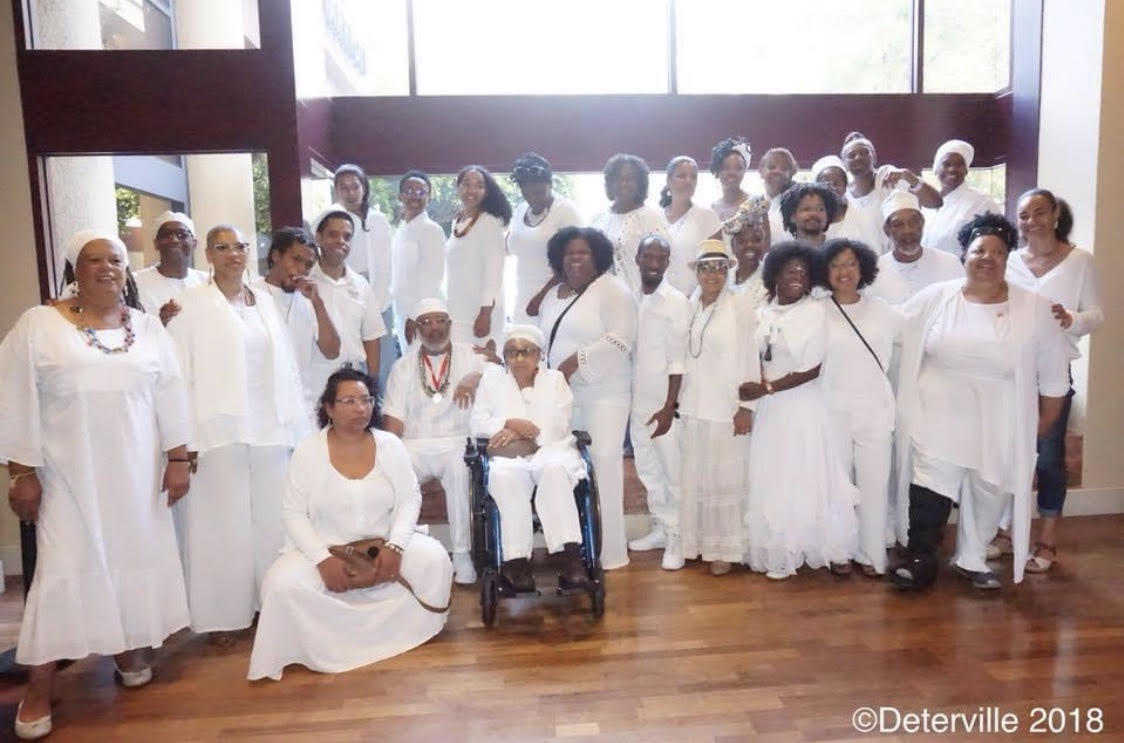
In just a short period of about 4 months, the coronavirus became a worldwide pandemic affecting almost every country on the globe. The speed with which the disease has spread and the lack of an appropriate vaccine for the virus is frightening. This virus has disrupted normal activities throughout the world.
All attention has been focused on steps to prevent/limit the spread of the virus. The community should follow the guidelines provided by public health officials to protect themselves from becoming infected, such as physical distancing, washing hands, not touching eyes/nose/mouth, etc. A challenging aspect of this virus is that people may have it, be contagious and not know it because they have no symptoms. Given that, these precautions require us to care about not spreading it to others in the community who may be particularly vulnerable. These precautions can limit the possibility of people becoming infected with the virus and halt the spread of the virus.
The coronavirus has created uncertainty and anxiety around the world. As the virus continues to spread, one effect that is apparently going unnoticed is the mental health effects that it brings. The situation is in flux and changes with almost every passing hour. Given the potential spread of the virus over the coming weeks, we can anticipate additional impacts that may produce even greater stress. Governor Newsom followed six Bay Area counties and issued a shelter in place order. Uncertainty surrounds the date this order will be lifted as the virus continues to spread in California and other parts of the country.
As healers, the health and wellbeing of society are our first priorities, and we have to do everything we can to support the community during these difficult times. While we love our family, it can become challenging to spend lots of unexpected time together during this period of rapid change and uncertainty. In our African traditional beliefs, “love” is called “Zola,” in KiKongo. “Zola” activates our self-healing capacity. During this worldwide health crisis, and all the time, we should “Zola up” on our families, each other and everyone we cherish. As community healers, we readily embrace our duty to protect our community, and to that end, we want to offer the following steps to help alleviate the anxiety, sense of helplessness, and stress that the pandemic is creating.
- With the closure of schools, parents have the added responsibility of caring for their children for the whole day. As parents, we have to create additional at-home activities for our children to keep them engaged and learning. This will be an opportunity to create activities that could excite your children’s desire to learn things that interest and inspire them. You can encourage your children by helping them with their schoolwork, reading to them, story-telling, playing games, making chores fun with rewards, etc. These activities can help to enhance the parent/child relationship and reduce the fixation on the stressful nature of the uncertainty and anxiety.
- With everyone in the house all day, we will see behaviors that we were sheltered from while we were at work or in school. It is important to tolerate these different behaviors as long as they are not harmful to others.
- Respect that everyone in the home has a voice, listen gracefully and accept that we do not all think alike. We should not correct another person’s way of thinking if it is not harmful. It is not a good idea to criticize someone at home when you have to spend weeks together.
- We must be kind and considerate to others.
- We must not bully anyone into doing what we want them to do, unless it is to save a life.
- Parents and caretakers have to create respite time for themselves and their children. Exercising, stretching, meditating, dancing, drawing, painting, listening to music, and other arts-and-craft activities can all aid in this situation.
- Pray this will be over soon and life will return to a more optimal situation.
- Please do not get caught up in the hysteria and engage in panic buying. Panic buying and hoarding only serve to make the situation worse. We do have to buy extra food to feed the children who are now at home during the day; but we have to avoid the urge to hoard extra supplies. If you don’t already do so, consider adding foods that strengthen your immune systems like carrots, cabbage, collard greens, eggs, chicken, fish as well as garlic, ginger, turmeric, fruits and blueberries.
- Be sure to wash your clothes regularly. If you go out in the public, wash your outer garments as soon as possible.
- Have a dedicated space to open and read mail. This should not be on the dining table or kitchen counter. Once the mail is read, keep bills and other information in a separate location, and discard envelopes and other junk mail in the recyclable bin. Wash your hands after handling the mail.
- We have to practice good mental health by focusing on the positives that can emerge from the crisis, like enhanced familial relations and reduced concentration on stress involved with the virus. Be sure to tell each other that you love, enjoy, and care for each other.
The community should follow the guidelines provided by public health officials to protect themselves from becoming infected, i.e., physical distancing, washing hands, not touching eyes/nose/mouth, etc.
In addition, the Ancient African principles of MAAT (truth, justice, order, harmony, balance, reciprocity, and righteousness) can assist us in maintaining a healthy mental state. Below is a list of suggested ways to apply these principles as you spend time in close quarters with your loved ones.
Truth – This is the perfect environment for rumors to spread like wildfire. Be especially mindful of this reality and diligently seek to ascertain the truth to avoid allowing reckless panic to drive your decisions.
Justice – The reality is that during times like this, we as a people will collectively be negatively impacted. Do not fall prey to participating in or encouraging behaviors that are unfair or unjust. Even if you have the power and authority. Do not be a bully. Share your power and allow others to practice having a “voice”.
Righteousness – Engage in behaviors that demonstrate acts of kindness and consideration. Do unto others as you would like them to do unto you. Practice this, even when it is not desired. Heaping loving kindness on others keeps you in a positive state. Always do the right thing.
Reciprocity – Make sure everyone has a role in helping the family during this time. Engage in activities that are mutually beneficial to everyone. Do not blast music that only you like, do not hog shared spaces or items, etc. Model volunteering to do things for others and the whole family.
Balance – This principle relates directly to the strategies noted in harmony. Balance being in your “own space” with being “together in the space”. Balance also is important as it relates to EVERYTHING the family consumes during this time, e.g. information on the virus, social media, items purchased, etc.
Harmony – As time in the shelter-in-place passes, getting along with each other can become more challenging. Schedule intentional breaks from each other. Call it mediation time, reading time, or journaling time. Do it everyday and in spaces where you are all still physically present but in your “own space”.
Order – Predictably, the current chaos that some are experiencing can be worse. Remember to stay in control of the things that you can control. Be intentional about maintaining order in your household. Examples include, creating and maintaining a schedule for eating, sleeping, and playing. Treating this like a vacation can get old quickly as the shut-in time increases.
These practices would aid us to feel at peace and sleep well as we wait out this forced shut-in together. As the reality of the virus unfolds we, The Bay Area Chapter of Black Psychologists, have to continue to do the critical work of healing our community as well as all people by assisting in reducing stress and maintaining well-being during this current crisis.
The Bay Area Chapter of the Association of Black Psychologists (ABPsi-Bay Area) is committed to providing the Post Newspaper readership with monthly discussions about critical issues in Black Mental Health. The ABPsi-Bay Area Chapter is a healing resource. We can be contacted at (bayareaabpsi@gmail.com) and readers are welcome to join us at our monthly chapter meetings, every third Saturday at the West Oakland Youth Center from 10a.m. to 12p.m when gatherings are allowed.




Activism
Oakland Post: Week of April 1 – 7, 2026
The printed Weekly Edition of the Oakland Post: Week of April 1 – 7, 2026

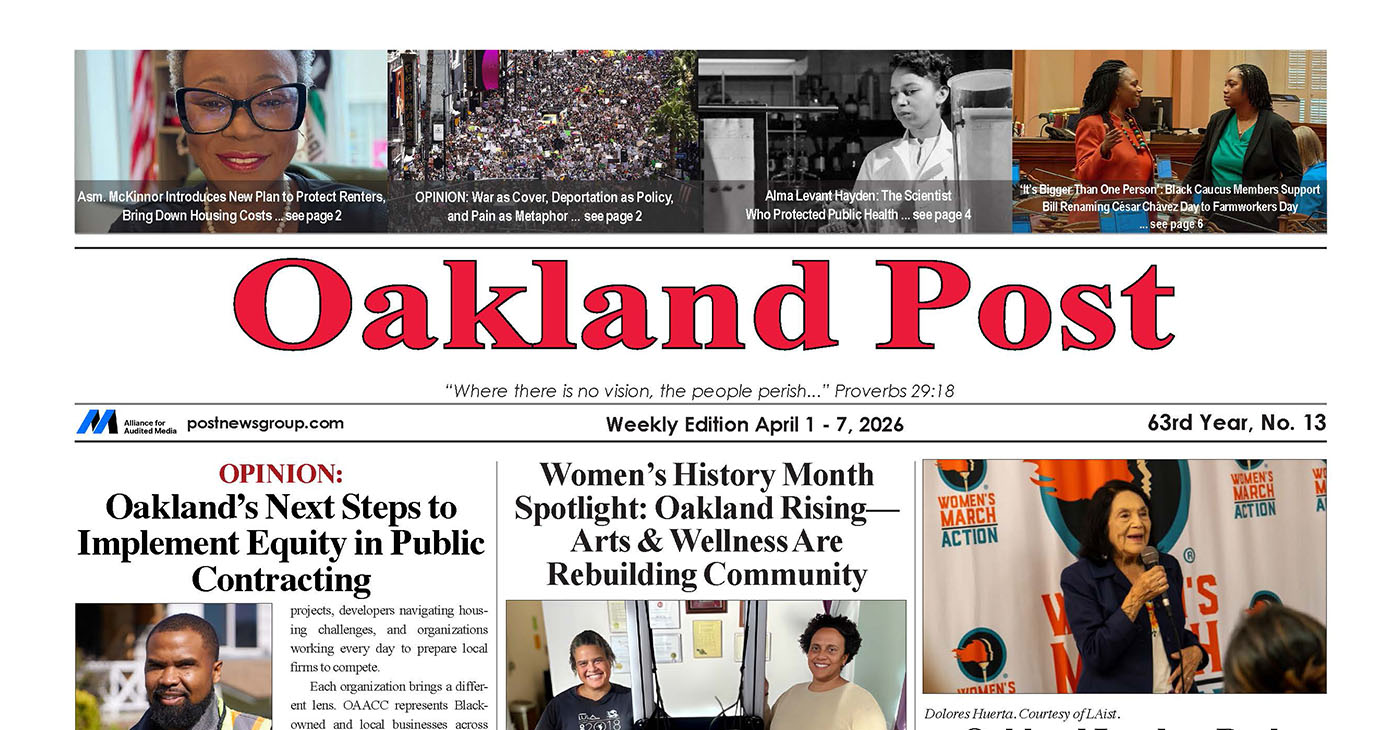
To enlarge your view of this issue, use the slider, magnifying glass icon or full page icon in the lower right corner of the browser window.

Activism
Oakland Post: Week of March 18 – 24, 2026
The printed Weekly Edition of the Oakland Post: Week of March 18 – 24, 2026

To enlarge your view of this issue, use the slider, magnifying glass icon or full page icon in the lower right corner of the browser window.
Activism
Oakland Post: Week of March 11 -17, 2026
The printed Weekly Edition of the Oakland Post: Week of March 11 – 17, 2026
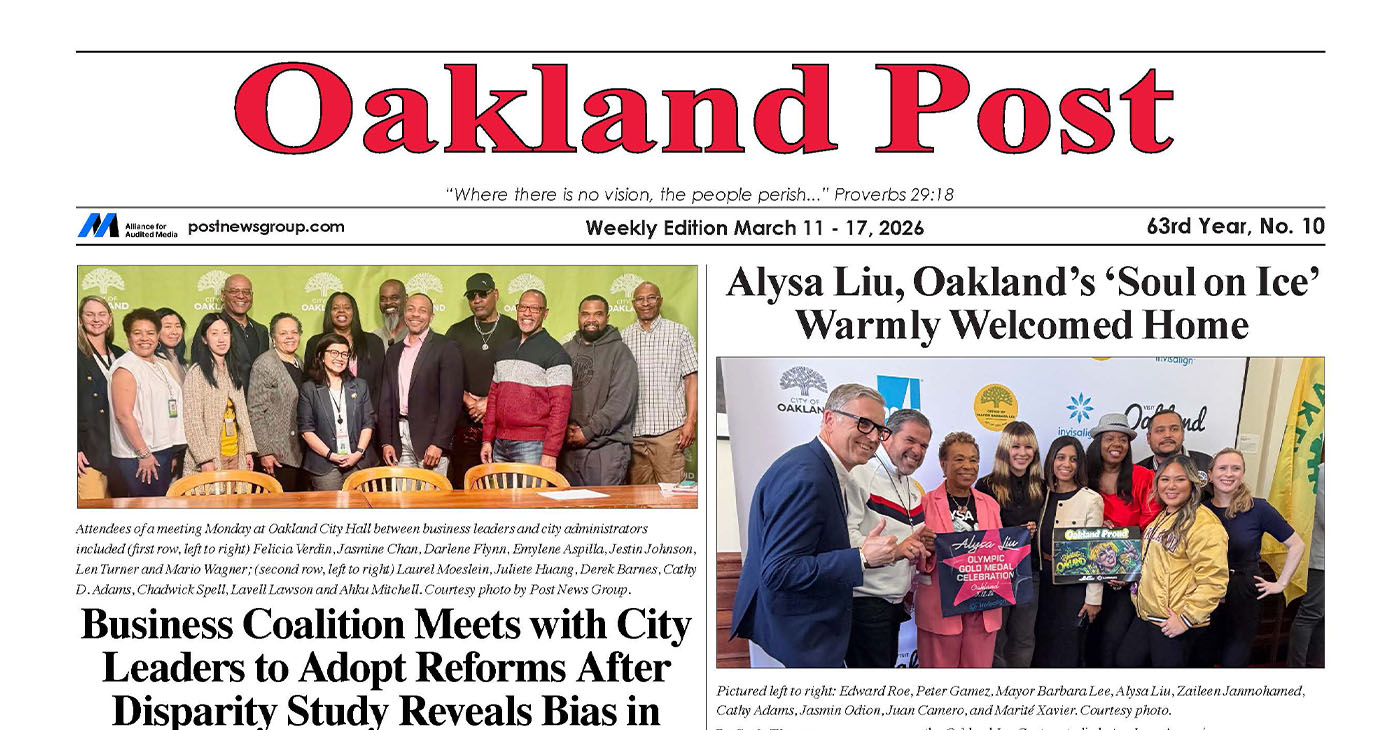
To enlarge your view of this issue, use the slider, magnifying glass icon or full page icon in the lower right corner of the browser window.


WORK FROM HOME
Home-based business with potential monthly income of $10K+ per month. A proven training system and website provided to maximize business effectiveness. Perfect job to earn side and primary income. Contact Lynne for more details: Lynne4npusa@gmail.com 800-334-0540


Oakland Post: Week of April 1 – 7, 2026

Black Artists in America, Installation Three Wraps at the Dixon Gallery and Gardens

Grief, Advocacy, and Education: A Counselor Reflects on Black Maternal Health

Future of Florida’s Black History Museum in Limbo

New Research Shows the Many Benefits of Early Learning

South Hampton K-8 Students Among Top 10 Finalists for Samsung’s ‘Solve for Tomorrow’ Competition

Cuba: No Negotiation with US on the President or Political System

Brooklyn Academy of Music Names Jamaican-Born Tamara McCaw as President

Trinidad & Tobego – U.S. Launches WhatsApp Channel for American Citizens in the Country

Oakland Post: Week of March 18 – 24, 2026

AI Innovation vs. Ethics and Environmental Impact

AI, Web3, and Digital Reparations

What If You Owned Your AI Agent?

Season 7, Episode 3 – January Reporter’s Roundtable 📱

Season 7, Episode 3 – January Reporter’s Roundtable

Reflecting on Black History Milestones in Birmingham AL

Oakland Post: Week of February 25 – March 3, 2026

PRESS ROOM: NBA Hall of Fame Nominee Terry Cummings Joins 100 Black Men of DeKalb County to Launch Victory & Values Initiative

Trump’s MAGA Allies are Creating Executive Order Plan to Steal the 2026 Midterms

Oakland Post: Week of March 4 – 10, 2026

Chase Oakland Community Center Hosts Alley-Oop Accelerator Building Community and Opportunity for Bay Area Entrepreneurs

U.S. manufacturing rebounds – how foundry services are adapting to rising demand

Poll Shows Support for Policies That Help Families Afford Child Care

OP-ED: One Hundred Years of Black Workers Telling the Truth

Advancements in solar technology that are changing the way we power the world

Oakland Post: Week of March 11 -17, 2026

Woman’s Search for Family’s Roots Leads to Ancestor John T. Ward – A Successful Entrepreneur and Conductor on the Underground Railroad
Oakland Post: Week of March 18 – 24, 2026

COMMENTARY: Women of Color Shape Our Past and Future

PRESS ROOM: Civil Rights TV Launches in Selma as the World’s First 24/7 Civil Rights Television Network

Hyundai Ioniq 5 Parking, Safety, and 360 View #shorts

2025 Ioniq 5 New Wiper & Powerful Performance! #shorts

Electric SUV Range: Is 259 Miles Enough? #shorts

EV Charging: How Fast Can You Charge an Electric Vehicle? #shorts

Biometric Cooling… Messaging Seats…Come on! 2025 Infiniti QX80 Autograph 4WD

Charged Up: Witness the Magic of a Fully Electric Car! #shorts

Range Rover Sport PHEV Included…: See What’s Inside This Luxury SUV! #shorts

Invisible Hood View: Perfect Parking with X-Ray Vision! #shorts

AI Is Reshaping Black Healthcare: Promise, Peril, and the Push for Improved Results in California

ESSAY: Technology and Medicine, a Primary Care Point of View

Sanctuary Cities

The RESISTANCE – FREEDOM NOW

STATE OF THE PEOPLE: Freddie

ECONOMIC BOYCOTT DAY!!!!!

I told You So
-
 Activism3 weeks ago
Oakland Post: Week of March 11 -17, 2026
-
 #NNPA BlackPress4 weeks ago
Woman’s Search for Family’s Roots Leads to Ancestor John T. Ward – A Successful Entrepreneur and Conductor on the Underground Railroad
-
 Activism2 weeks ago
Oakland Post: Week of March 18 – 24, 2026
-
 #NNPA BlackPress4 weeks ago
COMMENTARY: Women of Color Shape Our Past and Future
-

 Advice3 weeks ago
Financial Wellness and Mental Health: Managing Money Stress in College
-

 #NNPA BlackPress4 weeks ago
Advocates Raise Alarm Over ICE Operation, MOU and Detention Risks in Baltimore County
-

 #NNPA BlackPress4 weeks ago
Pete Buttigieg to Join Mayor Randall Woodfin for Community Town Hall in Birmingham
-
 #NNPA BlackPress2 weeks ago
Brooklyn Academy of Music Names Jamaican-Born Tamara McCaw as President
