
Activism
State Education Chief Thurmond Weighs Successes, Setbacks
Regarding commentary about his public visibility during the COVID-19 crisis, Tony Thurmond, State Superintendent of Public Instruction (SSPI)’s view is, “The way this job works, there’s a piece of it that people will never see. But I’d like to think that we have been the glue between school leaders, legislators, and the governor. In my role, we’ve had to be that glue between those entities, and that interplays on how decision-making happens.”


By Joe W. Bowers Jr. | California Black Media
When Tony Thurmond, State Superintendent of Public Instruction (SSPI) was elected in 2018, he became the second African American in the office since the 1849 California Constitution established it. Wilson Riles was California’s and the nation’s first Black SSPI. In 1970, he also was the first African American voted to hold any statewide office in California.
Recently, Thurmond spoke to California Black Media (CBM) about his experience as the state’s highest elected Education official. He says the COVID-19 pandemic has been the defining challenge of his tenure.
It affected everything — from requiring him to suddenly draft a revised strategy for supporting schools to keeping students and staff safe. He did this while taking steps to improve the overall quality of public education.
“March 13, 2020. March 13, I’ll never forget it,” Thurmond told CBM. He was in his office when he started to receive calls “asking ‘what are we going to do?’ as school districts announced that they were closing to mitigate the spread of the virus.
Responding to the COVID-19 pandemic forced Thurmond to delay action on the initiatives he identified as priorities when he entered office.
Opening schools safely and dealing with the specific systemic inequities, particularly experienced by students of color, had to be tackled first.

The California Department of Education’s (CDE) action plan included securing 2 million masks for schools and working with the governor’s office to obtain five million rapid COVID tests.
While schools were closed, the state’s education department supplied over 500 million meals to students and families. When vaccinations became available, CDE developed a campaign that encouraged staff and students to get vaccinated.
While it was up to each school district to decide how it would deal with the COVID-19 crisis, Thurmond hosted weekly meetings with all county superintendents to talk through plans for reopening schools safely.
As distance learning became necessary, inequities in access to technology were exposed. One-fifth of California students lacked the resources to continue their education from home, either due to no internet connectivity or not owning a computer at home — or both.
To find a solution to the problem, Thurmond assembled a committee he named “Closing the Digital Divide Task Force.”
“We put legislators on that committee by design. We knew that in order to get the attention of the internet providers, they need to see legislators,” Thurmond said.
As a result, the state was able to provide computers and hotspots, enhancing internet connectivity to over 400 school districts across nearly all of California’s 58 counties. According to Thurmond, “There is about $6 billion for building out broadband in this year’s state budget. The task force helped to lay the foundation for that.”
Thurmond points out that state law grants the SSPI limited authority over California’s public education policies, funding and infrastructure. But despite his restricted power, Thurmond views the SSPI role as much more than being a figurehead. As one of only eight statewide elected officials, voters have given him a prominent bully pulpit from which he can influence education policy.
“They said the office doesn’t have a lot of tools to get things done directly, but I felt very confident using my relationships with the Legislature and the governor that I could find a way to put a spotlight on big problems and find ways to influence them even though it would have to happen in an indirect way,” Thurmond said.
The governor and the Legislature determine state funding for education and set policy direction. The State Board of Education determines academic standards, curriculum, instructional materials, assessments, and accountability.
The SSPI has no legal authority over the 1,000 local school districts in the state. Each of the state’s 58 county offices of education — not the SSPI — approve school districts’ budgets and provide assistance and instruction on how they can improve their educational programs.
Thurmond’s main job is to run the day-to-day operations of the CDE, which has about 2,600 employees and enforces California’s education laws and regulations. It also administers federal and state education programs and oversees federal education grant compliance.
In addition, it performs certain administrative tasks, such as collecting and compiling statewide data on district spending and student performance.
In 2018, Thurmond decided to not to seek another Assembly term and run to be SSPI instead. That way, he could work full time on education issues. At the time, he was a two-term Assemblymember representing the 51st Assembly District in the Bay Area.
A popular politician among his constituents, Thurmond received 90% of the vote during his last Assembly election.
For Thurmond, education is the great equalizer. He says it allows children to overcome challenging circumstances and it provides paths to opportunities for all of California’s kids. He started his term as SSPI by proposing an ambitious eight-year plan to significantly boost school funding and expand early childhood education.
Beginning with his first month in office, Thurmond formed 13 transition teams with over 1,000 people. Those teams focused on his top priority: closing racial and economic achievement and opportunity gaps in a state where African American and Latino kids score below statewide standards on achievement tests.
Town halls and webinars focused on Black and Brown student achievement became the genesis for his initiative supporting funding to diversify the teacher workforce.
Now that school districts have adopted the safety protocols like masking, vaccinations, and testing necessary to stay open for in-person learning, Thurmond says he has again turned his attention to pursuing pre-pandemic initiatives.
In September, he launched a literacy goal to make sure all third-graders are able to read by 2026. He also appointed the Task Force to Improve Black Student Achievement.
Thurmond told CBM, “I feel like I’m in a place now where, like Maxine Waters says, ‘I’m reclaiming my time.’ I came to the department thinking I’d have eight years to work on third-grade literacy, and that got undercut because of the pandemic.”
Funding from the state and federal government for California’s public education is at a historic high. As a result, money is available for initiatives advocated by Thurmond like universal Pre-K and universal meals, community schools, family engagement and mental health services for students.
At his inauguration, Thurmond told the audience, “This job is the type of job where you get all the blame for what goes wrong, but you don’t have the resources to fix what needs to be fixed.”
Although at the time Thurmond was speaking generally, his observation could apply to recent criticisms leveled at him in the media about the high turnover of his senior staff.
Thurmond thinks that CDE is underfunded and insufficiently staffed to be able to handle its bureaucratic responsibilities and support the initiatives that he sees as public education priorities. He says, “I’ve taken some time to think about how to structure the organization and how to restructure it.”
Regarding commentary about his public visibility during the COVID-19 crisis, Thurmond’s view is, “The way this job works, there’s a piece of it that people will never see. But I’d like to think that we have been the glue between school leaders, legislators, and the governor. In my role, we’ve had to be that glue between those entities, and that interplays on how decision-making happens.”
Thurmond does not have a button he can push to make something happen in California public schools. But he does have a microphone to broadcast where problems are and the good news is because he has the relationships he is in a position to influence education policy for the benefit of California’s public education students.













Activism
Oakland Post: Week of August 12 – 18, 2026
The printed Weekly Edition of the Oakland Post: Week of August 12 – 18, 2026

To enlarge your view of this issue, use the slider, magnifying glass icon or full page icon in the lower right corner of the browser window.
Activism
Oakland Post: Week of August 5 – 11, 2026
The printed Weekly Edition of the Oakland Post: Week of August 5 – 11, 2026
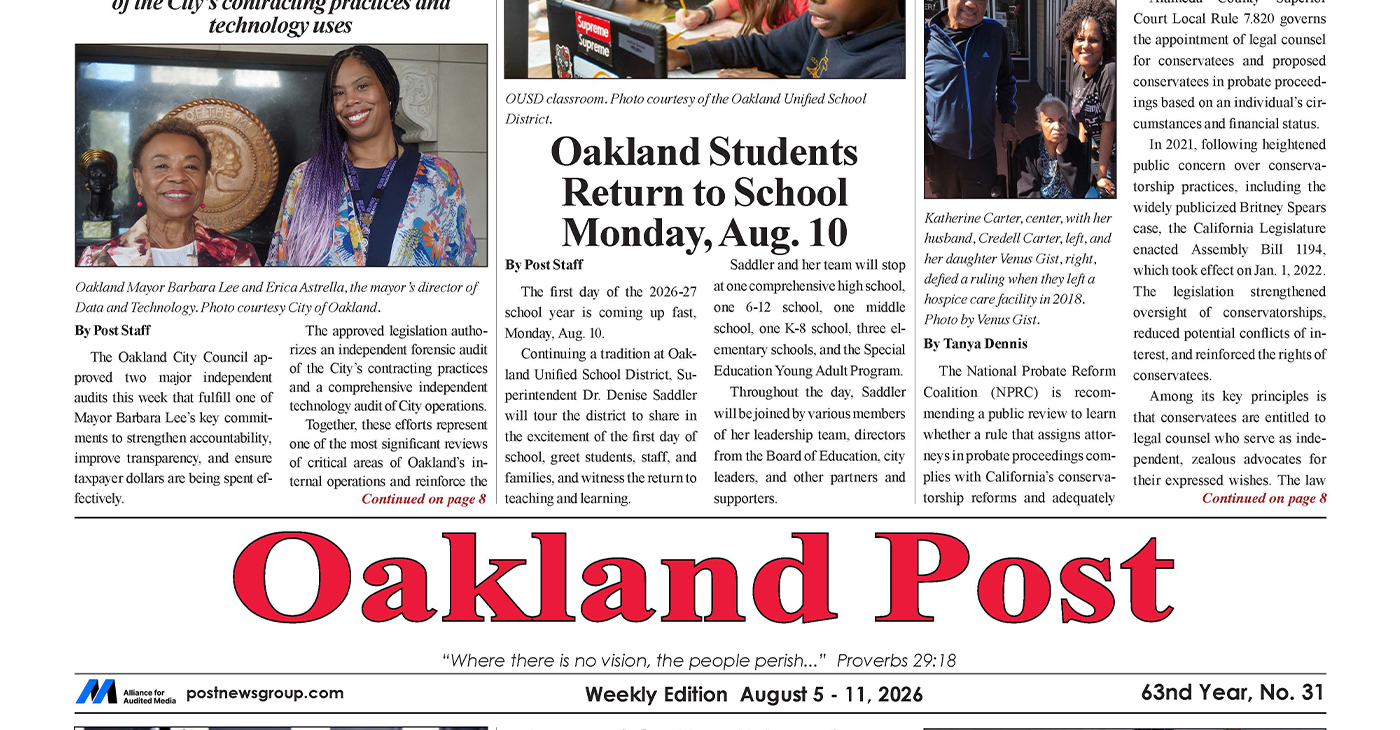
To enlarge your view of this issue, use the slider, magnifying glass icon or full page icon in the lower right corner of the browser window.
Activism
Oakland Post: Week of July 29 – August 4, 2026
The printed Weekly Edition of the Oakland Post: Week of July 29 – August 4, 2026

To enlarge your view of this issue, use the slider, magnifying glass icon or full page icon in the lower right corner of the browser window.

WORK FROM HOME
Home-based business with potential monthly income of $10K+ per month. A proven training system and website provided to maximize business effectiveness. Perfect job to earn side and primary income. Contact Lynne for more details: Lynne4npusa@gmail.com 800-334-0540


Four Candidates, Including Incumbent Barbara Lee, Qualify for Oakland Mayor’s Race

Oakland Observes Black August with Block Parties, Film Showings, Workshops

Oakland Post: Week of August 12 – 18, 2026

COMMENTARY: Why Local School Tax Measure G1 Will Not Be on the November Ballot

California Hispanic Chambers of Commerce Unveils: ‘Powering the Future’ Theme for 47th Annual Statewide Convention

Returning to Its Roots, the Oakland Black-Eyed Pea Festival Partners with the Freedom Farmers Market Sept. 12

Less Affluent School Districts, Including Sacramento City, Face Threat of State Takeover

From Blueprint to Breakthrough: Tackling Affordable Housing in Oakland

NPRC Scores First Advocacy Victory: David Shaw Finally Gets His Wish to ‘Go Home’

ESSAY: California Can Close Its Colorectal Cancer Gap

Car Wash Workers Cope with Lingering Impacts of ICE Raids

Misty Copeland Shapes Ballet’s Tomorrow

As Part of Your Back-to- School Checklist, Vaccinate

As Part of Your Back-to- School Checklist, Vaccinate

Congresswoman Simon Demands Investigation into Trump’s Abuse of Emergency Powers for Coal Export Terminal in West Oakland

Department of Homeland Security Demands California Secretary of State Shirley N. Weber Scrub Voter Rolls

Oakland Children’s Hospital Workers and Patients Rally for Pediatric Medical Care

New Judge Could Decide if Karmelo Anthony Gets a New Trial

“The Power to See Threats Sooner”: Gov. Newsom, Safety Officials Showcase California’s Investments in Hi-Tech Wildfire Prevention

Alpha Kappa Alpha Sorority, Inc. Celebrates New North Atlantic Regional Director

Surveillance Pricing Fight: State Senate Debates Bill Banning Retailers from Using AI to Set Prices Based on a Buyer’s Profile

Mount Zion MBC, Church of Jesus Christ of Latter-day Saints Partner to Bring 29,000 Meals to Alameda County

California Sen. Padilla Joins Colleagues to Introduce Bill Imposing Term Limits on Supreme Court Justices

Starting This Summer, California Car Buyers Can Get an Instant $3500 Off the Cost of Electric Vehicles
Less Affluent School Districts, Including Sacramento City, Face Threat of State Takeover

COMMENTARY: You Are Already Paying for the AI Boom

California Bill Would Let Abuse Victims Use Trauma as Legal Defense for Violent Crime
Car Wash Workers Cope with Lingering Impacts of ICE Raids

Fed Court to Decide Landmark First Amendment Case

Gov. Gavin Newsom Signs Law Streamlining Affordable Housing Rules

The Conversation With Al McFarlane 6/23/26

Media Monday 6/22/26

LIVE! ASK ALMA! — TUES. 6.23.26 7PM EST

Car Buying Secrets: 4 Hidden Checks Before You Sign!

Is This 550 HP Charger Worth YOUR Money? AutoNetwork Review

Celebrating Juneteenth – Frederick Douglass on education and resistance

LIVE! — ASK ALMA! — TUES. 6.19.26 7PM EST

Hyundai Ioniq 5 Parking, Safety, and 360 View #shorts

2025 Ioniq 5 New Wiper & Powerful Performance! #shorts

Electric SUV Range: Is 259 Miles Enough? #shorts

EV Charging: How Fast Can You Charge an Electric Vehicle? #shorts

Biometric Cooling… Messaging Seats…Come on! 2025 Infiniti QX80 Autograph 4WD

Charged Up: Witness the Magic of a Fully Electric Car! #shorts

Range Rover Sport PHEV Included…: See What’s Inside This Luxury SUV! #shorts

Invisible Hood View: Perfect Parking with X-Ray Vision! #shorts
-
 Featured1 week ago
Department of Homeland Security Demands California Secretary of State Shirley N. Weber Scrub Voter Rolls
-
 Business3 weeks ago
Oakland Children’s Hospital Workers and Patients Rally for Pediatric Medical Care
-
 #NNPA BlackPress2 weeks ago
New Judge Could Decide if Karmelo Anthony Gets a New Trial
-
 Environment1 week ago
“The Power to See Threats Sooner”: Gov. Newsom, Safety Officials Showcase California’s Investments in Hi-Tech Wildfire Prevention
-
 Black History2 weeks ago
Alpha Kappa Alpha Sorority, Inc. Celebrates New North Atlantic Regional Director
-
 Business3 weeks ago
Surveillance Pricing Fight: State Senate Debates Bill Banning Retailers from Using AI to Set Prices Based on a Buyer’s Profile
-
 Business3 weeks ago
Mount Zion MBC, Church of Jesus Christ of Latter-day Saints Partner to Bring 29,000 Meals to Alameda County
-
 Featured1 week ago
California Sen. Padilla Joins Colleagues to Introduce Bill Imposing Term Limits on Supreme Court Justices
