
City Government
Small Businesses Object to Coliseum City Development

Representatives of small businesses are complaining that city staff is on a fast track to adopt a formal plan for a massive Coliseum City development project, which has reached the final stages of approval without consulting affected companies.
The rezoning of the area for a stadium, housing and retail development on the Oakland airport side of Interstate 880 will eliminate much of Oakland’s only business park and many of its small businesses, which employ local residents, according the businessmen.
“I object to the plan, which will effectively over time destroy the business park without discussion or community input as originally promised and budgeted for when the planning process was instituted. Good paying business jobs will be sacrificed for sports, entertainment and residences without consulting the present community,” according to Robert Schwartz, long time Oakland resident and owner of Key Source international on Oakport Street in the business park.
Schwartz and others spoke Wednesday at a poorly announced Oakland Planning Commission public hearing on the plan.
City staff and a consulting team have been working on the plan for the past two years. Schwartz and others are saying they have been allowed to comment on the plan after it was designed but not to be part of the design process itself.
The Coliseum City plan, according to the City of Oakland’s website, “seeks to transform the underutilized land around the Oakland-Alameda County Coliseum and Arena into a world-class sports, entertainment and science & technology district that boasts a dynamic and active urban setting with retail, entertainment, arts, culture, live and work uses.”
The 800-plus acre site includes the present coliseum arena and the area on the west side of the freeway, where the Oakland Airport Business Park is located and extends all the way to the waterfront.
Objecting to the characterization of the business park as “underutilized land,” Schwartz said that industrial- and light-industrial use land sells for less than retail-use and residential-use land. Therefore, if zoning for industrial use is removed, the market value of the land will go up.
Existing businesses will sell out and move out of Oakland. New companies will not be able to afford to set up shop in the city.
Schwartz says he does not see the utility to the city of eliminating good jobs at long-standing local businesses in favor of creating poorly paying jobs at stadiums for “popcorn vendors.”
In a letter to the city’s department of Planning and Building, James Curtis, president of the Oakland Commerce Corporation, agreed with Schwartz.
“We object to your plan to cross the 880 freeway and intrude into our existing Port of Oakland Business Park,” he said. “That appears to use an unnecessary and detrimental encroachment on the existing businesses in the park.
“Part of the (Coliseum) Plan should include funding to improve the infrastructure and help revitalized its’ appeal for future expansion and job creation,” said Curtis.

Fred Ellis speaks for the OaklandWorks Alliance at the Planning Commissiion public hearing.
Speaking on behalf of the OaklandWorks Alliance at the Wednesday hearing, Fred Ellis read a statement backing the small business’ concerns.
“We oppose any rezoning without the opportunity for full community discussion by the affected communities,” said Ellis. “We oppose zoning changes that appear to remove East Oakland’s only business park and displace at least one of Oakland’s long standing and important businesses.”
“Few East Oakland residents are even aware that such immense and important policy changes are occurring,” Ellis continued. “The staff has provided no justification for proceeding without a participatory advisory committee of Oakland residents.”
“The planning process for East Oakland needs a restart,” he said.
Among the organizations in OaklandWorks are the West Oakland Environmental Indicators project, Black Women Organized for Political Action (BWOPA), People United for a Better Life in Oakland (PUEBLO), Oakland Black Caucus, Concerned Black Men and the John George Democratic Club.
Some people are saying that the rush to approve the project came from former Mayor Jean Quan’s administration, and there could potentially be a different approach under Mayor Libby Schaaf.
Speaking informally after the public hearing, one staff member said: “This project didn’t start with a clean slate. We heard: ‘Here are your marching orders.’”
Before it is approved, the development plan has to overcome other hurdles, the concerns of the Port of Oakland and the EBMUD, which are both impacted by the proposal. The plan must also gain the backing of the developers, who are working to put together private funding for the project.
The Planning Commission has scheduled hearings on the development plan on Feb. 4 and Feb. 9 and a vote on Feb. 18. If passed, the proposal will go to the City Council, where it could be approved in March.









Activism
Oakland Post: Week of March 18 – 24, 2026
The printed Weekly Edition of the Oakland Post: Week of March 18 – 24, 2026

To enlarge your view of this issue, use the slider, magnifying glass icon or full page icon in the lower right corner of the browser window.
Activism
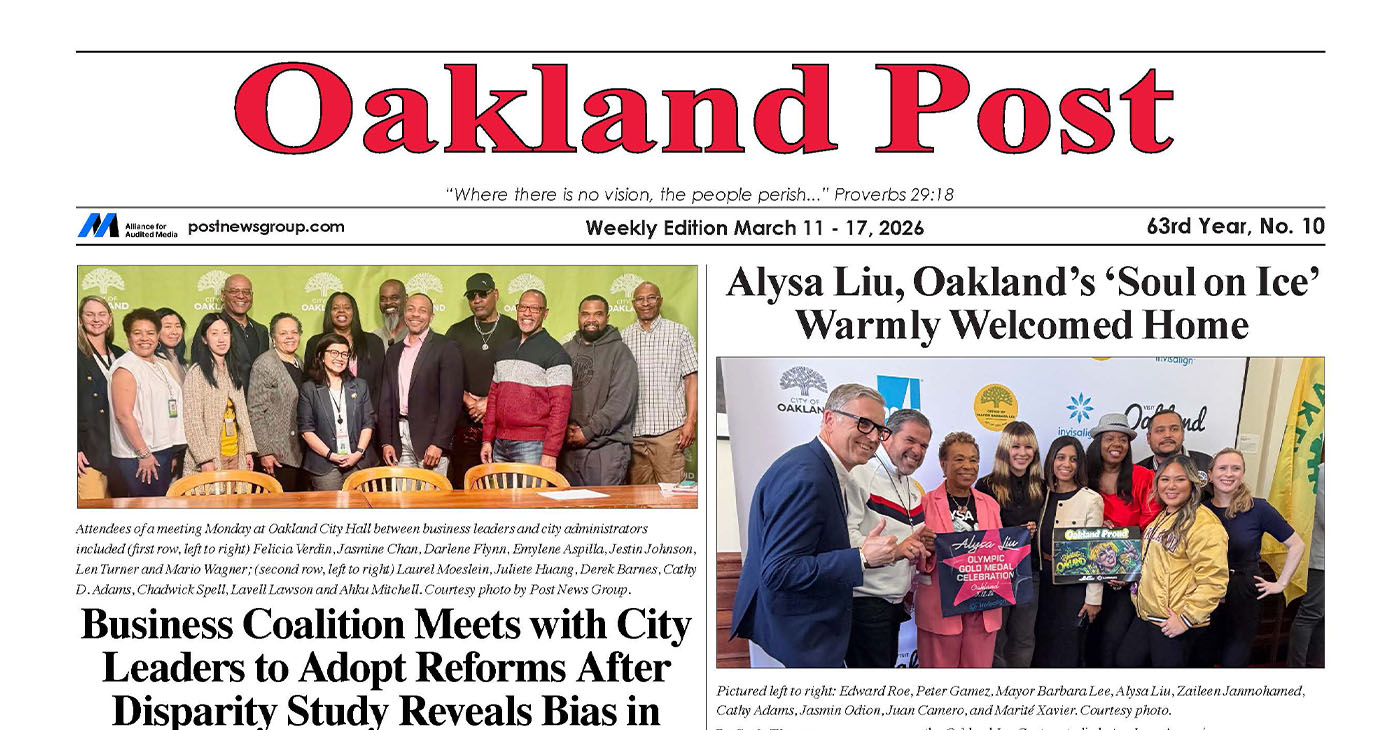
Oakland Post: Week of March 11 -17, 2026
The printed Weekly Edition of the Oakland Post: Week of March 11 – 17, 2026
To enlarge your view of this issue, use the slider, magnifying glass icon or full page icon in the lower right corner of the browser window.
Activism
Oakland Post: Week of March 4 – 10, 2026
The printed Weekly Edition of the Oakland Post: Week of March 4 – 10, 2026

To enlarge your view of this issue, use the slider, magnifying glass icon or full page icon in the lower right corner of the browser window.


WORK FROM HOME
Home-based business with potential monthly income of $10K+ per month. A proven training system and website provided to maximize business effectiveness. Perfect job to earn side and primary income. Contact Lynne for more details: Lynne4npusa@gmail.com 800-334-0540


Black Artists in America, Installation Three Wraps at the Dixon Gallery and Gardens

Grief, Advocacy, and Education: A Counselor Reflects on Black Maternal Health

Future of Florida’s Black History Museum in Limbo

New Research Shows the Many Benefits of Early Learning

South Hampton K-8 Students Among Top 10 Finalists for Samsung’s ‘Solve for Tomorrow’ Competition

Cuba: No Negotiation with US on the President or Political System

Brooklyn Academy of Music Names Jamaican-Born Tamara McCaw as President

Trinidad & Tobego – U.S. Launches WhatsApp Channel for American Citizens in the Country

Oakland Post: Week of March 18 – 24, 2026

AI Innovation vs. Ethics and Environmental Impact

AI, Web3, and Digital Reparations

What If You Owned Your AI Agent?

Season 7, Episode 3 – January Reporter’s Roundtable 📱

Season 7, Episode 3 – January Reporter’s Roundtable

AI, Media, and Power | Part 2, Real-World Impacts and Tradeoffs

Discrimination in City Contracts

Oakland Post: Week of February 11 – 17, 2026

Reflecting on Black History Milestones in Birmingham AL

Rising Optimism Among Small And Middle Market Business Leaders Suggests Growth for California

CITY OF SAN LEANDRO STATE OF CALIFORNIA PUBLIC WORKS DEPARTMENT ENGINEERING DIVISION NOTICE TO BIDDERS FOR ANNUAL STREET OVERLAY/REHABILITATION 2019-21 – PHASE III

Oakland Post: Week of February 18 – 24, 2026

PRESS ROOM: NBA Hall of Fame Nominee Terry Cummings Joins 100 Black Men of DeKalb County to Launch Victory & Values Initiative

Oakland Post: Week of February 25 – March 3, 2026

Trump’s MAGA Allies are Creating Executive Order Plan to Steal the 2026 Midterms

U.S. manufacturing rebounds – how foundry services are adapting to rising demand

OP-ED: One Hundred Years of Black Workers Telling the Truth

Advancements in solar technology that are changing the way we power the world

Chase Oakland Community Center Hosts Alley-Oop Accelerator Building Community and Opportunity for Bay Area Entrepreneurs

Poll Shows Support for Policies That Help Families Afford Child Care

PRESS ROOM: Civil Rights TV Launches in Selma as the World’s First 24/7 Civil Rights Television Network

Hyundai Ioniq 5 Parking, Safety, and 360 View #shorts

2025 Ioniq 5 New Wiper & Powerful Performance! #shorts

Electric SUV Range: Is 259 Miles Enough? #shorts

EV Charging: How Fast Can You Charge an Electric Vehicle? #shorts

Biometric Cooling… Messaging Seats…Come on! 2025 Infiniti QX80 Autograph 4WD

Charged Up: Witness the Magic of a Fully Electric Car! #shorts

Range Rover Sport PHEV Included…: See What’s Inside This Luxury SUV! #shorts

Invisible Hood View: Perfect Parking with X-Ray Vision! #shorts

AI Is Reshaping Black Healthcare: Promise, Peril, and the Push for Improved Results in California

ESSAY: Technology and Medicine, a Primary Care Point of View

Sanctuary Cities

The RESISTANCE – FREEDOM NOW

STATE OF THE PEOPLE: Freddie

ECONOMIC BOYCOTT DAY!!!!!

I told You So
-
 Activism4 weeks ago
Oakland Post: Week of February 25 – March 3, 2026
-
 #NNPA BlackPress4 weeks ago
Trump’s MAGA Allies are Creating Executive Order Plan to Steal the 2026 Midterms
-
 #NNPA BlackPress4 weeks ago
Poll Shows Support for Policies That Help Families Afford Child Care
-

 Activism3 weeks ago
Oakland Post: Week of March 4 – 10, 2026
-

 #NNPA BlackPress3 weeks ago
Woman’s Search for Family’s Roots Leads to Ancestor John T. Ward – A Successful Entrepreneur and Conductor on the Underground Railroad
-

 #NNPA BlackPress3 weeks ago
OP-ED: NNPA Launches 2026 “Leadership Matters” Video Series
-

 #NNPA BlackPress3 weeks ago
Advocates Raise Alarm Over ICE Operation, MOU and Detention Risks in Baltimore County
-

 #NNPA BlackPress3 weeks ago
COMMENTARY: Women of Color Shape Our Past and Future
