
Activism
Rev. Amos Brown Brings Wisdom, Guidance to Cal’s Reparations Task Force
“We’re about balance, inclusion, and stating the case precisely so that it doesn’t face paralysis of analysis or become just another study,” Brown said. “We have had too many studies of Black folks in the past. Now is the time to show us that we are serious about being ‘one nation under God, indivisible, with liberty and justice for all,’” said Rev. Amos C. Brown who is vice-chair and the senior member serving on the nine-member California Task Force to Study and Develop Reparation Proposals for African Americans, referencing the U.S. Pledge of Allegiance.

By Antonio Ray Harvey | California Black Media
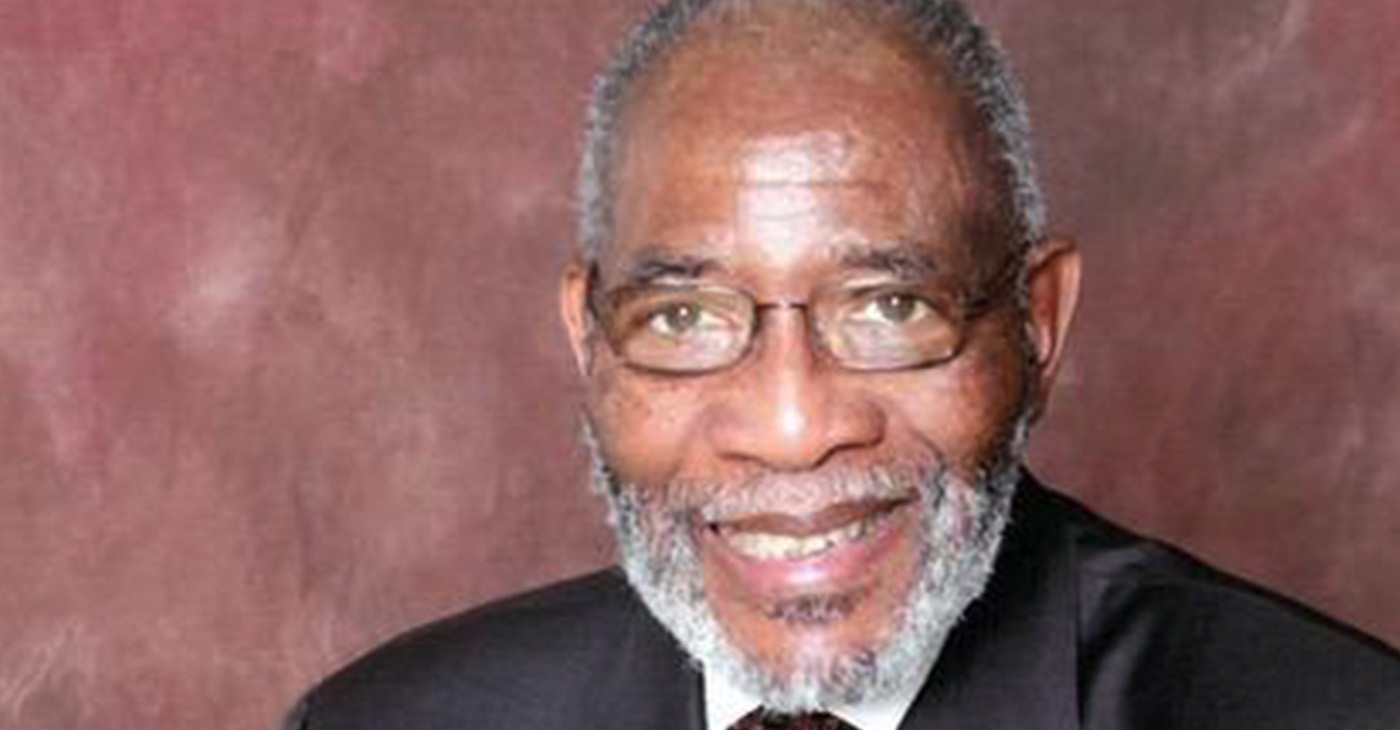
The Rev. Amos C. Brown is vice-chair and the senior member serving on the nine-member California Task Force to Study and Develop Reparation Proposals for African Americans.
Brown, 80, says he is “extremely pleased” with what the committee has accomplished after four meetings.
The task force held its fifth and final two-day meeting session of 2021 on Dec. 7 and Dec. 8. As written in Assembly Bill (AB) 3121, the group has until 2023 to present a set of recommendations to the state for consideration.
“The task force has been extremely focused and substantive. We have some of the best minds — people who know the history, psychology, and sociology of the pressure Black folks in this country have felt,” Brown told California Black Media.
The task force was created after Gov. Gavin Newsom signed AB 3121 into law in September 2020. California Secretary of State Shirley N. Weber authored the bill while she served in the State Assembly representing the 79th District in San Diego.
The law calls for the state to set up a task force to study slavery, Jim Crow segregation and other injustices African Americans have faced historically in California and across the United States.
The group will then recommend appropriate ways to educate Californians about reparations and propose ways to compensate descendants of enslaved people based on the task force’s findings.
The members of the task force come from diverse professional backgrounds. So far, the panel has heard testimony from a range of experts and witnesses, including descendants and representatives of people or families the government denied justice in the past; as well as historians, economists and academics.
“We’re about balance, inclusion, and stating the case precisely so that it doesn’t face paralysis of analysis or become just another study,” Brown said. “We have had too many studies of Black folks in the past. Now is the time to show us that we are serious about being ‘one nation under God, indivisible, with liberty and justice for all.’” Brown said, referencing the U.S. Pledge of Allegiance.
According to Brown, African Americans in his hometown of San Francisco need to overcome decades of psychological damage imposed by racism, discrimination and unfair government policies, including some urban renewal programs that hurt Black families more than they helped.
On Nov. 22, Brown joined actor Danny Glover, other local Black leaders, and members of the San Francisco Reparations Committee, to ask the city to donate the historic Fillmore Heritage Center to the African American community.
Many have referred to the Fillmore neighborhood as the “Harlem of the West” in the 1940s, Brown said. By 1945, over 30,000 Black Americans lived in the historic area.
Today, around 6% of San Francisco’s population of nearly 875,000 people are Black or mixed-race African Americans.
“San Francisco City leaders have a moral obligation to right the racist wrongs that destroyed that culture and that community and allow the Fillmore Heritage Center to live up to the full meaning of its name,” Glover said in a statement.
In 2007, the center became a venue for Jazz and Blues, reminiscent of the culture and Fillmore night clubs that attracted musical greats like Duke Ellington, Charlie Parker, Billie Holiday, and others.
Last May, the San Francisco Board of Supervisors voted unanimously to appoint a 15-member African American Reparations Advisory Committee.
“That building, that land, represents the disenfranchisement, redlining of Black folks in this town, and the redevelopment agency not being fair,” Brown said. “The Fillmore, 12 blocks, itself was the hub of Black entertainment, Black culture, Black businesses and Black life. You just can’t wipe out our history or our heritage.”
Born in Jackson, Mississippi in 1941, Brown says he was delivering JET magazine when the popular weekly published graphic photos of 14-year-old Emmett Till murdered by a racist mob in August 1955 in Money, Mississippi, a rural area known for the cultivation of cotton. Till’s lynching ignited the Civil Rights Movement.
“Emmett and I were the same age,” Brown said. “When I picked up a copy (of Jet magazine), I saw that mutilated head. It horrified me. I remember it vividly.”
At 15, Brown started the first youth council for the National Association for the Advancement of Colored People (NAACP). In 1956, Medgar Evers, a Mississippi state official for the NAACP, brought Brown, then 15, to San Francisco to attend the NAACP’s national convention where he first met Dr. Martin Luther King, Jr.
Brown later studied under King at Morehouse College in Atlanta.
In 1961, he was arrested with King at a lunch counter sit-in and joined the Freedom Riders, a group of activists who protested segregation in the South.
“In 1960, before I joined the Freedom Riders, the NAACP Youth Council actually organized the first ‘sit-down protest’ in Oklahoma City in August 1958,” Brown said. “The first sit-down movement did not start in Greensboro, North Carolina. It began in Oklahoma City, Wichita (Kansas), and Louisville (Kentucky) under the auspices of the Youth Council of the NAACP.”
Brown earned a Doctor of Divinity from United Theological Seminary in Ohio and a Master of Divinity from Crozer Theological Seminary in Pennsylvania.
Brown has been the pastor of Third Baptist Church of San Francisco since 1976. From 1996 to 2001, he served on the San Francisco Board of Supervisors. He is president of the San Francisco Branch of the NAACP and a member of the organization’s national board of directors.
Brown said he is monitoring reparation legislation and conversations across the country to see if proposals being put forward are in sync with California’s efforts.
“What I want to accomplish is: Black people being and knowing that something was done about their pain — that can be done in the state of California,” Brown said. “Things can never be perfect, but at least collectively people of conscious and good will can stand up and say, ‘this is what we must do to right this wrong.’”











Activism
Oakland Post: Week of September 16 – 22, 2026
The printed Weekly Edition of the Oakland Post: Week of September 16 – 22, 2026

To enlarge your view of this issue, use the slider, magnifying glass icon or full page icon in the lower right corner of the browser window.
Activism
Oakland Post: Week of September 9 – 15, 2026
The printed Weekly Edition of the Oakland Post: Week of September 9 – 15, 2026

To enlarge your view of this issue, use the slider, magnifying glass icon or full page icon in the lower right corner of the browser window.
Activism
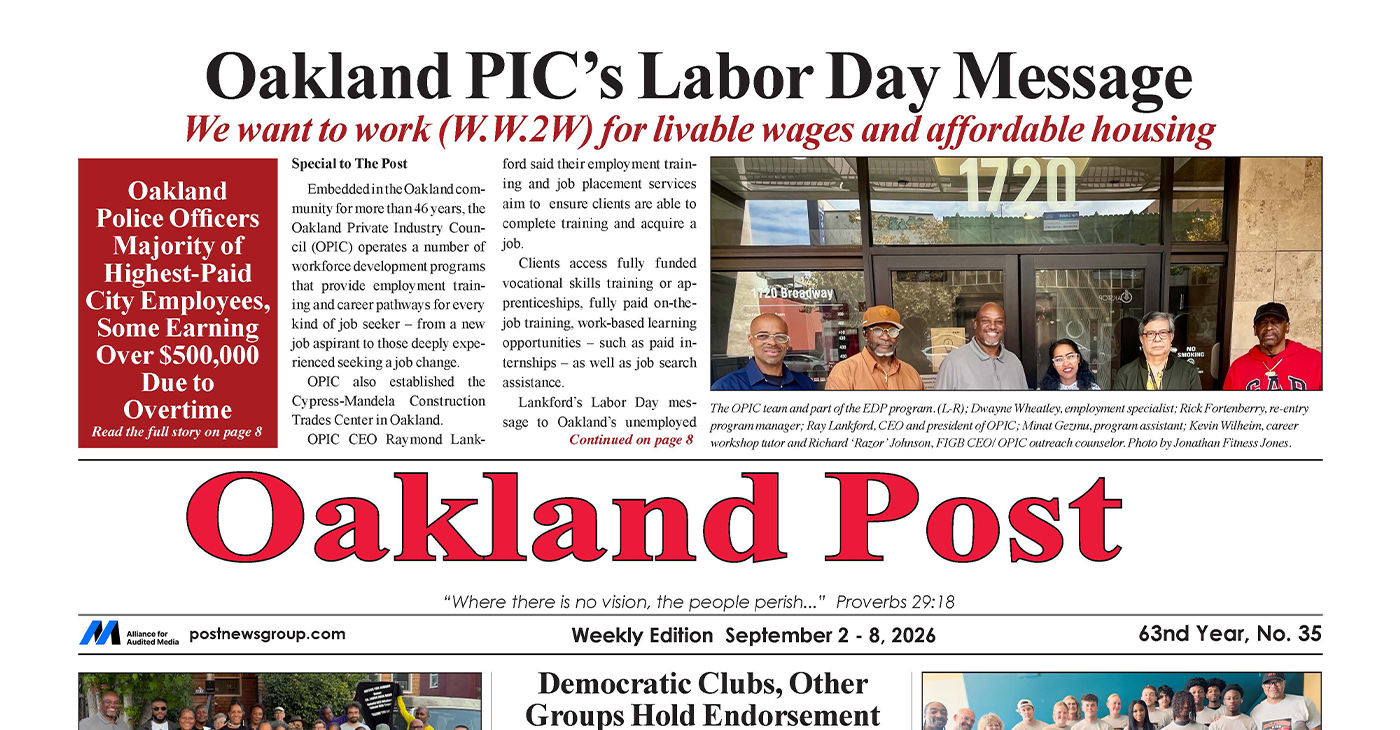
Oakland Post: Week of September 2 – 8, 2026
The printed Weekly Edition of the Oakland Post: Week of September 2 – 8, 2026
To enlarge your view of this issue, use the slider, magnifying glass icon or full page icon in the lower right corner of the browser window.


Newsom Signs Addictive Social Media Law to Protect Kids

On Your November Ballot: Prop 38 Would Allocate $8.4 Billion to Immunology and Immunotherapy Funding

Ask California: Golden State Releases New AI Chatbot

Asm. Isaac Bryan’s Bill Banning California Police From ICE Side Jobs Reaches Newsom’s Desk

Assemblymember LaShae Sharp-Collins’s Bill Would Pause Law Enforcement’s Use of Shock Gloves Pending Study

BOOK REVIEW: ‘Laws of Solomon’ Reveals Tender Heart of Former Child Soldier

OPINION: The New American Fear – From 9-11 to AI

Passing for White, Fighting for Black America: The Courage of Walter White

Oakland People’s Arms Embargo Coalition Demands End to Military Shipments Thru Oakland

Barbara Lee Mourns Gloria Steinem, Remembers a Friendship Rooted in Equality

Event Preview: ‘Fashion v. Fascism’ – A Runway Revolution Is Coming to the Bay Area

Two Looming Threats Every Alameda County Elder Should Know About

Oakland Mayor Reads to Children at Bookout Block Party at Marcus Books Store

Tradition Comes to the Streets in 11th Annual Black-Eyed Pea Festival at the Freedom Farmers Market

Attorney General Rob Bonta Continues Opposition to President Trump’s Tariff Regime

Department of Homeland Security Demands California Secretary of State Shirley N. Weber Scrub Voter Rolls

“The Power to See Threats Sooner”: Gov. Newsom, Safety Officials Showcase California’s Investments in Hi-Tech Wildfire Prevention

California Sen. Padilla Joins Colleagues to Introduce Bill Imposing Term Limits on Supreme Court Justices

Less Affluent School Districts, Including Sacramento City, Face Threat of State Takeover

Car Wash Workers Cope with Lingering Impacts of ICE Raids

ESSAY: California Can Close Its Colorectal Cancer Gap

As Part of Your Back-to- School Checklist, Vaccinate

Oakland ‘Port Serves as a Powerful Engine for Good Jobs and Economic Development

Gov. Newsom Announces $109.6 Million in Funding for 278 Supportive Homes in Bakersfield, Contra Costa, Sacramento and Fresno

California Hispanic Chambers of Commerce Unveils: ‘Powering the Future’ Theme for 47th Annual Statewide Convention

Congresswoman Simon Demands Investigation into Trump’s Abuse of Emergency Powers for Coal Export Terminal in West Oakland

Four Candidates, Including Incumbent Barbara Lee, Qualify for Oakland Mayor’s Race

Oakland Post: Week of August 12 – 18, 2026

From Blueprint to Breakthrough: Tackling Affordable Housing in Oakland

Oakland Observes Black August with Block Parties, Film Showings, Workshops

The Conversation With Al McFarlane 6/23/26

Media Monday 6/22/26

LIVE! ASK ALMA! — TUES. 6.23.26 7PM EST

Car Buying Secrets: 4 Hidden Checks Before You Sign!

Is This 550 HP Charger Worth YOUR Money? AutoNetwork Review

Celebrating Juneteenth – Frederick Douglass on education and resistance

LIVE! — ASK ALMA! — TUES. 6.19.26 7PM EST

Hyundai Ioniq 5 Parking, Safety, and 360 View #shorts

2025 Ioniq 5 New Wiper & Powerful Performance! #shorts

Electric SUV Range: Is 259 Miles Enough? #shorts

EV Charging: How Fast Can You Charge an Electric Vehicle? #shorts

Biometric Cooling… Messaging Seats…Come on! 2025 Infiniti QX80 Autograph 4WD

Charged Up: Witness the Magic of a Fully Electric Car! #shorts

Range Rover Sport PHEV Included…: See What’s Inside This Luxury SUV! #shorts

Invisible Hood View: Perfect Parking with X-Ray Vision! #shorts
-

 Commentary3 weeks ago
Standoff for Justice: Our Homes Are Worth Fighting For
-

 Activism3 weeks ago
Oakland Post: Week of August 26 – September 1, 2026
-

 Business3 weeks ago
Gubernatorial Candidate Steve Hilton Blasts California New Tire Rules; Newsom Hits Back
-

 Business3 weeks ago
Frontier Airlines’ Return to Oakland Airport Brings Flights, Jobs and Opportunity
-

 Business3 weeks ago
Chef Sharon Lee Blends Culinary Excellence, Education and Empowerment
-

 Education3 weeks ago
Gov. Newsom’s Latest Appointees Include Sacramento Advocate for Formerly Incarcerated Students; State’s New Tech Chief
-

 Business3 weeks ago
Oakland Coliseum Project Opens Door for Small Businesses to Build Bigger
-

 Community3 weeks ago
Big City Mayors Ask for “Yes” Vote on Housing Bond Measure; Conservatives Say “No”
