
News
Progress at LBNL’s Richmond Facility


Artist’s rendering of the state-of-the-art campus of Lawrence Berkeley National Laboratory’s Richmond facility.

Judith Morgan
By For Richmond Staff
With its state-of-the-art campus, bike paths leading to the Bay Trail, lecture forums and welcoming cafes, the Lawrence Berkeley National Laboratory’s Richmond development is shaping up to be a boon for the city.
And the For Richmond coalition has thrown its full support behind the project: Not only will it create jobs for residents, but it will also encourage development of other clean technologies and businesses and draw more people and revenue dollars to Richmond.
“We’re all very excited because we are expecting this significant project to draw all kinds of new businesses to Richmond, which means more jobs for residents who need them,” said Judith Morgan, President and CEO of the Richmond Chamber of Commerce and a For Richmond steering committee member.
Coalition members are thrilled to see plans for the project moving forward – despite possible delays due to federal budget cuts. At a recent community meeting at Richmond City Hall, UC Berkeley and LBNL representatives told a group of about 100 community members that project plans are in the approval process, and they described how they see the area unfolding over time.
Graham Fleming, vice chancellor of research of UC Berkeley, described the plan for Richmond as “synergistic,” with UC Berkeley, LBNL and private developers all eventually building in the West Richmond area along the coast.
“It will take decades for the full vision to be realized, but it’s good to have a big picture in mind,” said Glenn Kubiak, chief operating officer for Berkeley Lab.
That big picture is both ambitious and impressive.
“We intend this to be a premier research hub. This can only be good for the Bay Area, only be good for Richmond and is good for all of us around the world,” said Barbara Maloney, a partner with BMS Design Group, which is overseeing the design plans. “This can become a real center of research. There’s plenty of land for other research companies to establish themselves nearby.”
The campus is already taking shape on the drawing boards with building placement, parking structures, trails and protected open space all outlined for the site.
Because the area has sensitive grasslands that need to be protected, there will be 25 acres of natural open space with minimal human access. The remaining 108 acres will be developed into research facilities, educational facilities, parking, food courts and open areas.
Parking lots will be placed on the outer edges of the property, most off the main road into the site. As a result, the center of the property will remain mostly car-free but bisected by Regatta Boulevard. The area will have walkways connecting four office clusters, or “neighborhoods,” with several open areas for socializing and eating.
The first of the four campus corridors will be developed along South 47th Street, near the Bay Trail, giving the community parking and access to the trail as soon as possible. The first phase is expected to be up to 600,000 square feet and house 1,300 people.
As more employees start working out of the new development, transportation solutions will be provided, including shuttle service linking the Richmond campus to the local BART stations and UC Berkeley, and possible ferry service linking Richmond to the Bay Area.
For Willie Hicks, the For Richmond jobs chair and the president and business representative for Laborers Local 324 in Richmond, all of these new plans mean one thing: jobs, jobs and more jobs for Richmond residents in need of work.
“Projects like this are fantastic because they attract other projects and businesses that put our workforce back to work,” Hicks said.
Morgan echoed that sentiment, adding that LBNL has made a commitment to support locally-owned small businesses, meaning that local restaurants, dry cleaners and drug stores, among others, will all benefit.
“This project is a win for this community many times over,” she said.
To find out more about the project, visit http://richmondbaycampus.lbl.gov/





Activism
Oakland Post: Week of September 30 – October 6, 2026
The printed Weekly Edition of the Oakland Post: Week of September 30 – October 6, 2026
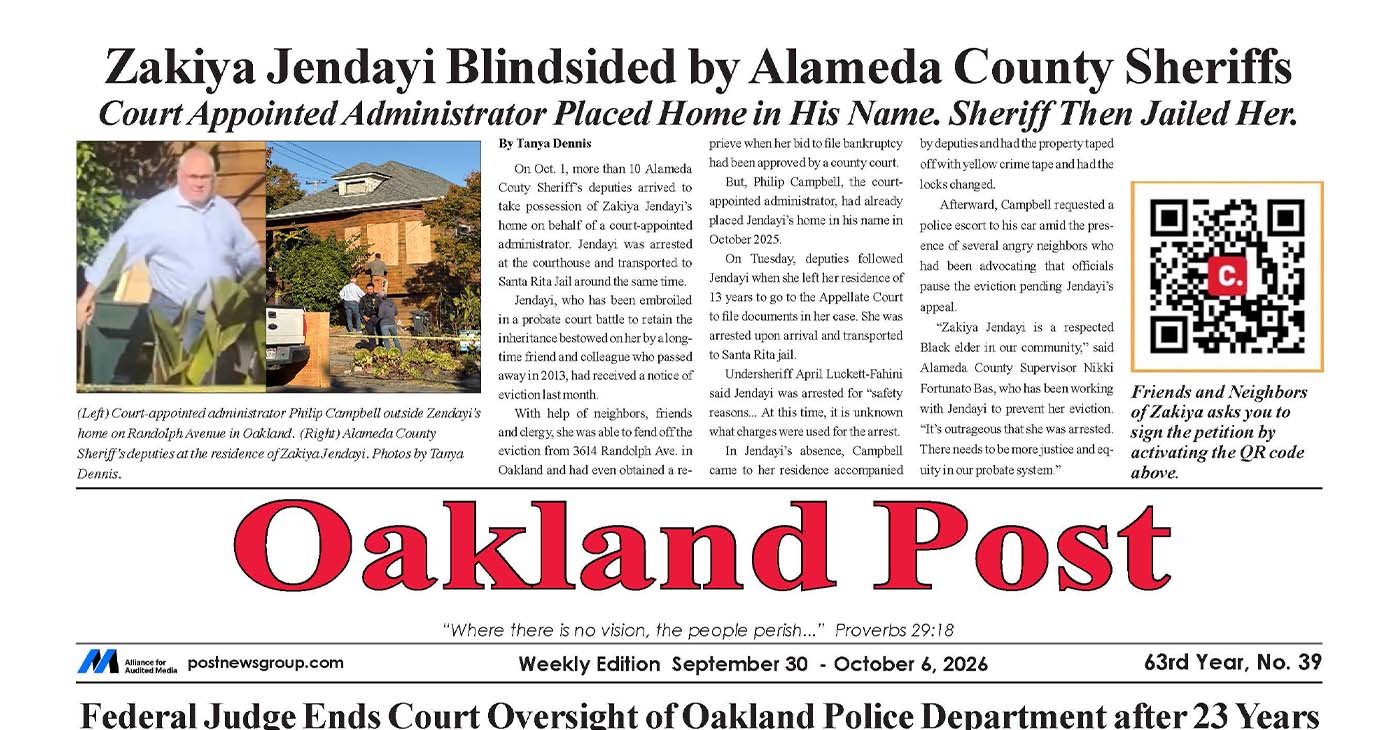
To enlarge your view of this issue, use the slider, magnifying glass icon or full page icon in the lower right corner of the browser window.
Activism
Oakland Post: Week of September 23 – 29, 2026
The printed Weekly Edition of the Oakland Post: Week of September 23 – 29, 2026

To enlarge your view of this issue, use the slider, magnifying glass icon or full page icon in the lower right corner of the browser window.
Activism
Oakland Post: Week of September 16 – 22, 2026
The printed Weekly Edition of the Oakland Post: Week of September 16 – 22, 2026

To enlarge your view of this issue, use the slider, magnifying glass icon or full page icon in the lower right corner of the browser window.



Listening as a Lifeline: A Doula’s Witness to Black Maternal Health

New Protections for Ticket Buyers: Gov. Newsom Signs Assemblymember Isaac Bryan’s Bill

‘We Don’t Talk Trash — We Pick Up Trash!’

Zakiya Jendayi Arrested, Locked Out of Home by Sheriff’s Deputies

Oakland Post: Week of September 30 – October 6, 2026

Asm. Corey Jackson Announces Launch of 24-Hour Childcare in His District

IN MEMORIAM: The Rev. Leon “Sonny” Clark, Longtime Orange County Pastor and Community Leader, Dies at 72

Poll: Becerra Widens His Lead Over Hilton; Californians Split on Wealth Tax

From Historic Memories to New Possibilities: Oakland Celebrates Coliseum 60

County Office of Education Says OUSD Finances Are Getting Healthier, Materially Stronger

LIVE FREE Sunday Dinner Brings Faith, Fellowship and Civic Conversation to Oakland

Remembering Chauncey Bailey as Student Journalists Face Threats to Truth-Telling

BLACspace Cooperative Invites Bay Area to Experience Oakland’s Black Cultural Ecosystem Through a BLAC Map Tour + Party

In Wake of Death on Doorstep, Williams Chapel Baptist Church Calls for Better Care, Funding for Unhoused

Oakland Centenarian Nuna McKee Honored!

Standoff for Justice: Our Homes Are Worth Fighting For

Oakland Post: Week of August 26 – September 1, 2026

Frontier Airlines’ Return to Oakland Airport Brings Flights, Jobs and Opportunity

Gubernatorial Candidate Steve Hilton Blasts California New Tire Rules; Newsom Hits Back

Chef Sharon Lee Blends Culinary Excellence, Education and Empowerment

Jackie Wright Champions Bay Area Stories, Filmmakers and Cultural Institutions

Oakland Coliseum Project Opens Door for Small Businesses to Build Bigger

Big City Mayors Ask for “Yes” Vote on Housing Bond Measure; Conservatives Say “No”

Misnamed ‘Parent’ PAC Seeks to Influence Oakland School Board Elections

Gov. Newsom’s Latest Appointees Include Sacramento Advocate for Formerly Incarcerated Students; State’s New Tech Chief

Longtime BWOPA Member Brendalyn Goodall Appointed to California Workforce Development Board

Gov. Newsom Signs Law Shielding Immigration Aid Workers From Doxing Threats

Secretary of State Shirley N. Weber Urges Californians to Vote Early as Voter ID Battle Intensifies

Oakland Post: Week of September 2 – 8, 2026

IN MEMORIAM: Dolly Parton Dead at 80 — How She Built a Legacy of Love and Earned Her Place in Black Culture

The Conversation With Al McFarlane 6/23/26

Media Monday 6/22/26

LIVE! ASK ALMA! — TUES. 6.23.26 7PM EST

Car Buying Secrets: 4 Hidden Checks Before You Sign!

Is This 550 HP Charger Worth YOUR Money? AutoNetwork Review

Celebrating Juneteenth – Frederick Douglass on education and resistance

LIVE! — ASK ALMA! — TUES. 6.19.26 7PM EST

Hyundai Ioniq 5 Parking, Safety, and 360 View #shorts

2025 Ioniq 5 New Wiper & Powerful Performance! #shorts

Electric SUV Range: Is 259 Miles Enough? #shorts

EV Charging: How Fast Can You Charge an Electric Vehicle? #shorts

Biometric Cooling… Messaging Seats…Come on! 2025 Infiniti QX80 Autograph 4WD

Charged Up: Witness the Magic of a Fully Electric Car! #shorts

Range Rover Sport PHEV Included…: See What’s Inside This Luxury SUV! #shorts

Invisible Hood View: Perfect Parking with X-Ray Vision! #shorts
-
 Community3 weeks ago
Misnamed ‘Parent’ PAC Seeks to Influence Oakland School Board Elections
-
 Activism4 weeks ago
Oakland Post: Week of September 2 – 8, 2026
-

 Community3 weeks ago
Richmond Tiny House Village Farm & Garden Set to Open Gates on Sept. 26
-

 Activism3 weeks ago
Oakland Post: Week of September 9 – 15, 2026
-

 Black History3 weeks ago
Latest Massacre in Haiti Reveals Cruelty U.S. Deportations
-

 Black History3 weeks ago
OPINION: Nolan Wells’ Death One of Several Signifying Racial Terror Lives on in U.S. South
-

 Community3 weeks ago
Democratic Clubs Interview Candidates for Oakland School Board
-

 Business2 weeks ago
Mayor Lee Announces $1 Million Kaiser Permanente Grant for Pilot Program to Address Homelessness, Clean Up Public Spaces throughout Oakland
