
Business
PRESS ROOM: Rep. Maxine Waters to Receive NAACP Chairman’s Award
NNPA NEWSWIRE — Leon W. Russell, Chairman of the NAACP National Board of Directors, will present Congresswoman Waters with the award at the 50th NAACP Image Awards on March 30, 2019 live at 9pm/8c on TV One.

By Stacy M. Brown, NNPA Newswire Correspondent
@StacyBrownMedia
The NAACP announced that Congresswoman Maxine Waters (D-California) will be honored with the prestigious NAACP Chairman’s Award which is bestowed in recognition of individuals who demonstrate exemplary public service and use their distinct platforms to create agents of change.
Leon W. Russell, Chairman of the NAACP National Board of Directors, will present Congresswoman Waters with the award at the 50th NAACP Image Awards on March 30, 2019 live at 9pm/8c on TV One.
“I am honored to present the Chairman’s Award to Congresswoman Waters, considered to be one of the most powerful women in American politics today and an inspiration to many,” Russell said in a news release announcing the award.
“Her 43 years of public service, first in the California State Assembly and then in the U.S. House of Representatives, have benefited countless Americans,” Russell said.
“As both a queen and a warrior, Congresswoman Waters has stood the test of time in her refusal to stand idle in the face of the relentless assaults on the humanity of African Americans and people of color. We salute her and her amazing legacy,” he said.
Past honorees of the NAACP Chairman’s Award include William Lucy, Tyler Perry, Ruby Dee, The Neville Brothers, Bono, Danny Glover, Former Vice President Al Gore and Dr. Wangari Muta Maathai, then-Senator Barack Obama, Former Surgeon General Regina Benjamin, TV One Founder and Chairman Cathy Hughes, U.S. Navy Vice Admiral Michele Howard, Brittany “Bree” Newsome, Justice League NYC, University of Missouri Concerned Student 1950 Collective, University of Mississippi NAACP College Chapter, Rev. Dr. Otis Moss III, Rev. Dr. Howard-John Wesley, Rev. Dr. Jamal Harrison Bryant, Jussie Smollett, and Dr. Charles J. Ogletree, Jr.

Throughout her many years of public service, Waters has been on the cutting edge, tackling difficult and often controversial issues, the NAACP said in the release. She has combined her strong legislative and public policy acumen and high visibility in Democratic Party activities with an unusual ability to do grassroots organizing.
Following the Los Angeles civil unrest in 1992, Congresswoman Waters faced the nation’s media and public to interpret the hopelessness and despair in cities across America.
Over the years, she has brought many government officials and policy makers to her South-Central L.A. district to appeal for more resources.
She has used her skill to shape public policy and deliver the goods: $10 billion in Section 108 loan guarantees to cities for economic and infrastructure development, housing and small business expansion; $50 million appropriation for “Youth Fair Chance” program which established an intensive job and life skills training program for unskilled, unemployed youth; expanded U.S. debt relief for Africa and other developing nations; creating a “Center for Women Veterans,” among others.
She is a co-founder of Black Women’s Forum, a nonprofit organization of over 1,200 African American women in the Los Angeles area.
In the mid-80s, she also founded Project Build, working with young people in Los Angeles housing developments on job training and placement.
As she confronts the issues such as poverty, economic development, equal justice under the law and other issues of concern to people of color, women, children, and poor people, Rep. Waters enjoys a broad cross section of support from diverse communities across the nation.
Throughout her career, Congresswoman Waters has been an advocate for international peace, justice, and human rights.
Before her election to Congress, she was a leader in the movement to end Apartheid and establish democracy in South Africa.
She opposed the 2004 Haitian coup d’etat, which overthrew the democratically-elected government of Jean-Bertrand Aristide in Haiti and defends the rights of political prisoners in Haiti’s prisons.
Waters leads congressional efforts to cancel the debts that poor countries in Africa and Latin America owe to wealthy institutions like the World Bank and free poor countries from the burden of international debts.
Expanding access to health care services is another of Congresswoman Waters’ priorities.
She spearheaded the development of the Minority AIDS Initiative in 1998 to address the alarming spread of HIV/AIDS among African Americans, Hispanics and other minorities.
Under her continuing leadership, funding for the Minority AIDS Initiative has increased from the initial appropriation of $156 million in fiscal year 1999 to approximately $400 million per year today.
Waters is also the author of legislation to expand health services for patients with diabetes, cancer and Alzheimer’s disease.
She is lauded by African American entrepreneurs for her work to expand contracting and procurement opportunities and to strengthen businesses.
Long active in the women’s movement, Rep. Waters has given encouragement and financial support to women seeking public office.
Many young people, including those in the hip-hop music community, praise her for her support and understanding of young people and their efforts at self-expression, according to the release.
“One testament to her work is the Maxine Waters Employment Preparation Center, a multimillion-dollar campus providing education and employment opportunities to residents of the Watts area,” Russell said.





Business
Sale of Coliseum to African American Developers Moves Toward Completion
The deal includes the sale of the Oakland Arena to an unidentified third-party buyer for no less than $100 million, which Bobbitt said was one of the most important aspects of the site’s future redevelopment.

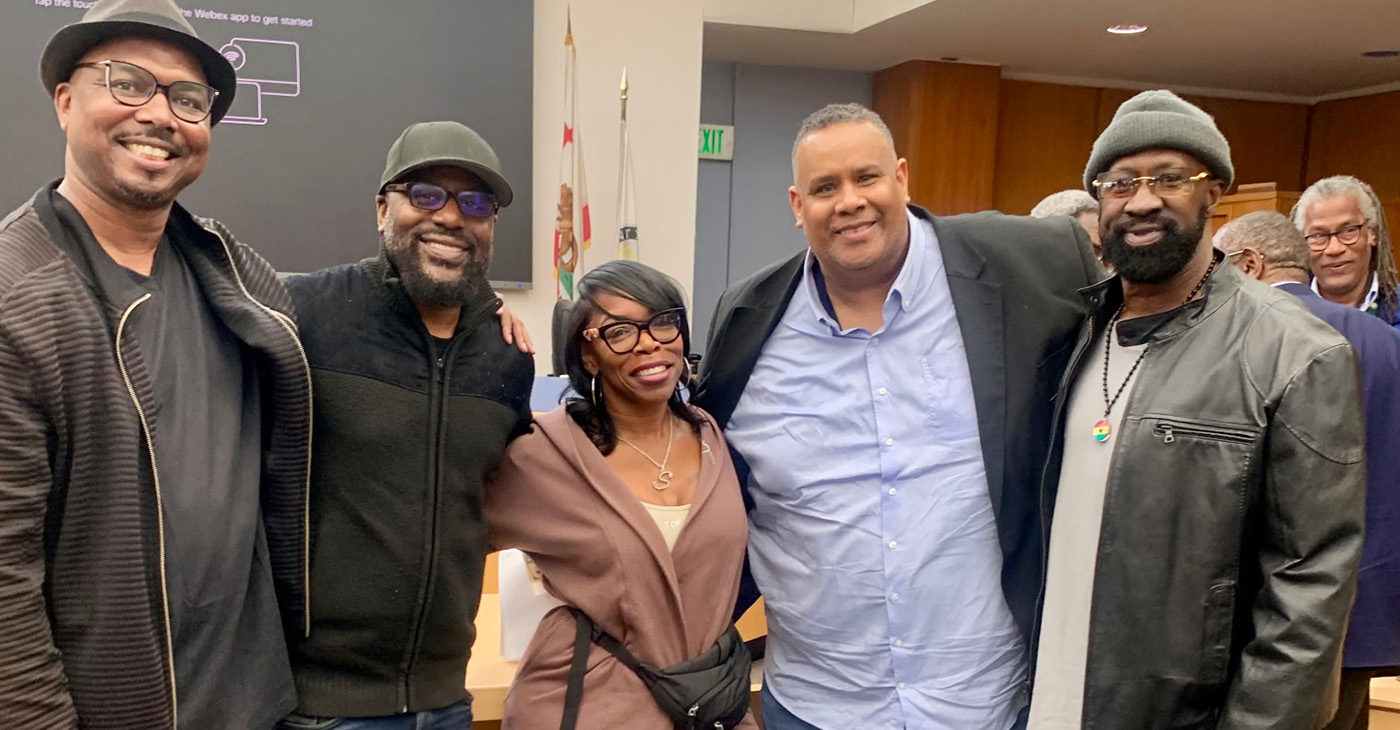
‘This is on the precipice of actually occurring,’ said Ray Bobbitt, buyers’ representative
By Post Staff
After many months of complex negotiations, the Oakland Coliseum development deal is finally nearing an agreement that will open the way for new owners – the African Americans Sports and Entertainment Group (AASEG) – to revitalize the sports complex and the Hegenberger Corridor in East Oakland.
On May 28, the Alameda County Board of Supervisors unanimously approved a non-binding agreement to dispose of the County’s portion of the complex for $115 million in a deal with AASEG, with a closing date set for June 30.
“People are seeing that this is on the precipice of actually occurring,” said Ray Bobbitt, founder of the AASEG and an East Oakland native. “People feel that this needs to happen for Oakland, for East Oakland in particular,” Bobbitt said, as reported in the East Bay Times.
The agreement would transfer ownership of the 112-acre Coliseum complex property, which was owned 50-50 by Alameda County and the City of Oakland, to Oakland Acquisition Company, which is AASEG’s real estate wing.
The County’s approval marks an important step in the sale of the property, even though concerns about environmental liability remain. Under the terms of the non-binding agreement, the county will pay $115 million to Coliseum Way Partners, the corporate entity of the Oakland Athletics that had previously purchased the county’s half of the property for $85 million.
AASEG will then pay $115 million to the County in three annual payments, with 5% annual interest paid on any outstanding balance, according to the term sheet.
AASEG already negotiated a purchase of the city’s half of the property for $125 million in 2025, awaiting the sale of the county’s half.
A strong supporter of the sale, Supervisor Nate Miley said he was not “breaking out the champagne” until the sale was final. This is not perfect, but it is good.
“It’s good because the County ends up with more money,” Miley continued. “It’s good because an African American team takes ownership of the property, and they’ve got a lot of potential in terms of what they want to do with the property.”
A remaining disagreement between Alameda County and the AASEG involves environmental concerns.
AASEG wanted a “carve-out” for environmental concerns so that it would not face liability for the release of groundwater into San Francisco Bay without a permit. Obtaining a permit could be time-consuming and expensive, requiring the need for consultants, studies, and an oversight process by the San Francisco Bay Regional Water Quality Control Board.
County supervisors unanimously supported the non-binding agreement without the carve-out, though Bobbitt said delaying or excluding the carve-out creates timing risks for the project.
“The motion is to accept the terms as presented, excluding the carve-out,” Board of Supervisors President David Haubert said. “Noting that it’s a non-binding term sheet and terms can always be discussed going forward. It’s been pointed out that that could affect the deal, timing, which we’ve been at this for nine years, but what’s a little more time?”
The deal includes the sale of the Oakland Arena to an unidentified third-party buyer for no less than $100 million, which Bobbitt said was one of the most important aspects of the site’s future redevelopment.
“The arena represents an anchor of the site,” said Babbitt. “This arena … has become a pop culture mecca, and the opportunity to enhance that and expand that is critical to the overall process.”
Speaking at the Board of Supervisors meeting, Miley explained the County’s reasoning behind some of the complex negotiations. He asked interim County Counsel Andrea Weddle:
“In layman’s term’s who’s on the hook for the environmental (cleanup)” under the current deal with the Oakland A’s?
“When the county with a former board entered in the deal with the (A’s), we took on all of the environmental obligations,” Miley said. “Since then, we’ve learned a lot more about the environmental conditions of the Coliseum.”
“If we do a deal with Coliseum Way Partners (the A’s), we remain on the hook,” she said. “If we do a deal as we’ve currently structured with OAC (AASEG), we have eliminated some or hopefully all (or) as much as we can of that liability and aligned our deal with the terms of the city.”
Bobbitt, despite his concerns, supported the nonbinding agreement. He said the public has waited nearly a decade to come to this point.
“The community support has been overwhelming,” he said. “We’ve used a lot of P-words: patience, perseverance, persistence. And we’ve just had to do it, and we understand how complex this has been.”

Activism
Oakland Post: Week of June 10 – 16, 2026
The printed Weekly Edition of the Oakland Post: Week of June 10 – 16, 2026

To enlarge your view of this issue, use the slider, magnifying glass icon or full page icon in the lower right corner of the browser window.
Art
After 10-Year Wait, Fillmore Heritage Center Reopens in San Francisco
After serving as the economic and cultural hub of the Fillmore’s historically Black community for more than a decade, the center’s closure ended what was called the “Rebirth of the Cool,” referring to the neighborhood’s role during the height of Black Jazz in the United States.
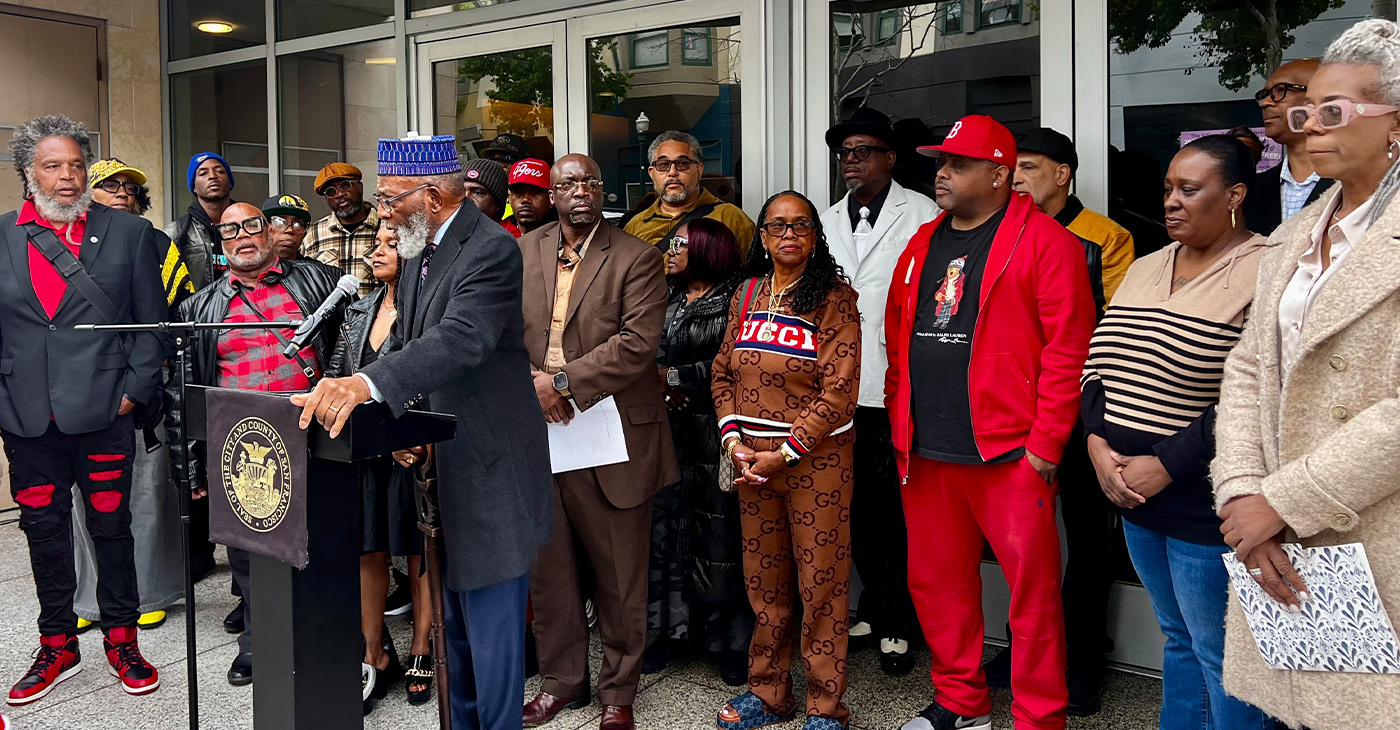
By Linda Parker Pennington, Special to The Post
Last Saturday morning, the cloudy skies cleared just as the highly anticipated ribbon-cutting ceremony began, marking the reopening of the Fillmore Heritage Center at 1330 Fillmore and Eddy.
The complex – which had once included Yoshi’s Jazz Club, the Lush Life Art Gallery, the Koret Heritage Lobby, a 54-seat microcinema, and the Black-owned 1300 On Fillmore restaurant – shuttered in 2015.
After serving as the economic and cultural hub of the Fillmore’s historically Black community for more than a decade, the center’s closure ended what was called the “Rebirth of the Cool,” referring to the neighborhood’s role during the height of Black Jazz in the United States.
San Francisco Mayor Daniel Lurie announcing the reopening of the Fillmore Heritage Center. Erika Scott, owner of Honey Art Studio, looks on with pride. Photo by Linda Parker Pennington.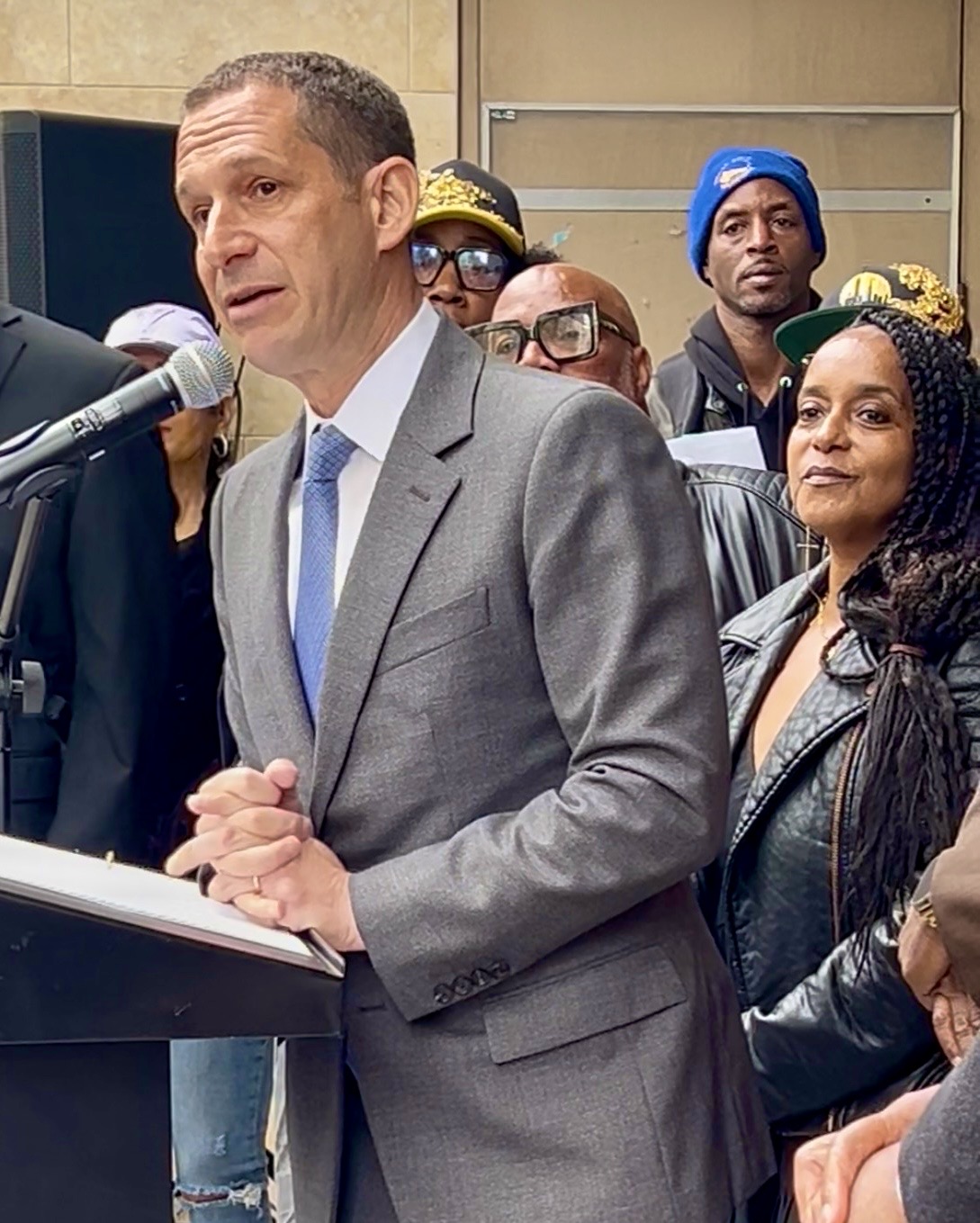
“The Fillmore is the most important neighborhood in San Francisco’s history for centering Black culture, music, business, and community, and has shaped this City and influenced the entire country,” said San Francisco Mayor Daniel Lurie to the gathering of more than 100 community leaders, business owners, and public officials. “This building reflects the deep roots of the Fillmore. Urban renewal left deep scars that are still felt today. This Center celebrates a strong Black community that continues to shape San Francisco. I am proud to join the community as we reopen the Fillmore Heritage Center.”

Although the previous stakeholders will not be returning to the center, spaces are available for nonprofit organizations and ventures, such as Fillmore native Ericka Johnson’s Honey Art Studio.
“This Center will be an economic engine and a thriving venue that shines a light on the Black-owned businesses in this neighborhood and lifts the entire district,” Lurie continued. “Our City is committed to this community for the long term.”
“We’re excited to collaborate with the City to finally reopen these doors,” said Ken Johnson, a videographer and community leader who’d been lobbying for the reopening of the center. “It’s an opportunity to showcase the entrepreneurship and creative spirit of this ‘Harlem of the West’ and the ‘Rebirth of the Cool,’ grounded in our uniquely gifted Fillmore community.”
This month, through its Office of Economic and Workforce Development, the city will begin renting the building’s noncommercial spaces for pop-up events celebrating local talent, arts, and entertainment primarily centered in the Fillmore.

WORK FROM HOME
Home-based business with potential monthly income of $10K+ per month. A proven training system and website provided to maximize business effectiveness. Perfect job to earn side and primary income. Contact Lynne for more details: Lynne4npusa@gmail.com 800-334-0540


Sale of Coliseum to African American Developers Moves Toward Completion

Celebrating Juneteenth – Frederick Douglass on education and resistance

LIVE! — ASK ALMA! — TUES. 6.19.26 7PM EST

Kansas City Launches Juneteenth Season with Parade Along 18th Street

Birmingham Launches In-Person Community Service Hub, Dynamic Website to Connect Residents to Essential Services

Saloon doors: How Black bars are reclaiming western style

Oakland Post: Week of June 10 – 16, 2026

Oakland Director Boots Dazzles Once Again in ‘I Love Boosters’

After 10-Year Wait, Fillmore Heritage Center Reopens in San Francisco

COMMENTARY: Black Music is the Sound of Black Freedom: Let Us Reclaim Both This Juneteenth

Oakland Post: Week of June 3 – 9, 2026

Study: Waiting Lists for Child Care Assistance Nearly Doubled

Venus Williams Calls a Sabalenka Exit a Tragedy

COMMENTARY: Using Art, Healing, And Community to Transform Mental Health Dialogue

Uptown Music Theatre Summer Camp Returns to Inspire the Next Generation of Performers

Book Review: Books for College-Bound Students

Against All Odds: Mary Jackson’s Journey to NASA Engineer

Q&A with Steven Bradford: Why He Wants Your Vote for California Insurance Commissioner

OPINION: The Fire of Oakland’s Justin Jones

The Marin City Flea Market Is Back

The Ladies of Delta Sigma Theta Hold Day of Advocacy at the Capitol in Sacramento

EBMUD Enshrines the Legacy of its First Black Board Member William ‘Bill’ Patterson

California Launches Free Diaper Program for Newborns Statewide

Oakland Mayor Pushes Charter Overhaul to Clarify Roles in City Government, Increase Accountability and Improve Service Delivery

Mayor Barbara Lee Declares ‘Delroy Lindo Day,’ Presents Acclaimed Actor with Key to the City

Oakland Post: Week of May 6 – 12, 2026

How Is AI Affecting California? The State Wants You to Share Your Story

Rep. Kamlager-Dove Introduces Bill to Protect Women in Custody After Reports Detailing Miscarriages and Neglect

Snoop Dogg Celebrates 10 Til’ Midnight at the Compound

OP-ED: Small Businesses Need Minnesota to Act on Pass-Through Tax Policy
Celebrating Juneteenth – Frederick Douglass on education and resistance
LIVE! — ASK ALMA! — TUES. 6.19.26 7PM EST

Hyundai Ioniq 5 Parking, Safety, and 360 View #shorts

2025 Ioniq 5 New Wiper & Powerful Performance! #shorts

Electric SUV Range: Is 259 Miles Enough? #shorts

EV Charging: How Fast Can You Charge an Electric Vehicle? #shorts

Biometric Cooling… Messaging Seats…Come on! 2025 Infiniti QX80 Autograph 4WD

Charged Up: Witness the Magic of a Fully Electric Car! #shorts

Range Rover Sport PHEV Included…: See What’s Inside This Luxury SUV! #shorts

Invisible Hood View: Perfect Parking with X-Ray Vision! #shorts

AI Is Reshaping Black Healthcare: Promise, Peril, and the Push for Improved Results in California

ESSAY: Technology and Medicine, a Primary Care Point of View

Sanctuary Cities

The RESISTANCE – FREEDOM NOW

STATE OF THE PEOPLE: Freddie
-

 #NNPA BlackPress1 week ago
5 Cleveland Police Officers Injured, Gunfire Erupts During East Side Pursuit
-
 Activism1 week ago
Oakland Post: Week of June 3 – 9, 2026
-

 #NNPA BlackPress1 week ago
2026 World Cup is Here and Atlanta is Ready For It
-
 #NNPA BlackPress1 week ago
COMMENTARY: Using Art, Healing, And Community to Transform Mental Health Dialogue
-
 Art1 week ago
After 10-Year Wait, Fillmore Heritage Center Reopens in San Francisco
-

 Activism3 weeks ago
Oakland Post: Week of May 27 – June 2, 2026
-
 #NNPA BlackPress1 week ago
Venus Williams Calls a Sabalenka Exit a Tragedy
-
 Arts and Culture1 week ago
COMMENTARY: Black Music is the Sound of Black Freedom: Let Us Reclaim Both This Juneteenth
