
Opinion
Your Pathway to High-wage Careers Begins at College of Alameda


Student in Automotive Technician Program at College of Alameda. Photo courtesy of COA.
By Tim Karas, College of Alameda President
Community colleges are a workforce engine providing opportunities for people to learn new skills, to re-train, to earn professional licenses and industry driven certificates and degrees. College of Alameda provides high quality Career Technical Education (CTE) pathways. CTE is an integral part of the community college mission.
College of Alameda provides affordable means to well-paying jobs. Courses cost $46 per unit. Numerous Financial Aid options are available to help cover the cost of college expenses and dedicated Financial Aid staff are available to assist students. Private vocational schools like those that you may have seen advertised on television offer CTE programs as well, but typically at a much higher cost. Some of these schools may charge tens of thousands of dollars in tuition.
California took a bold step in 2016 to create one million more “middle-skill” workers. At the recommendation of the California Community College Board of Governors, the Governor and Legislature approved the Strong Workforce Program, adding an investment of $200 million to spur Career Technical Education (CTE) in the nation’s largest workforce development system comprised of 114 community colleges.

In July 2017, College of Alameda earned Strong Workforce Stars’ recognition in the Advanced Transportation & Renewables sector for its Auto Body and Paint program. Students completing the Program saw their annual earnings increase by 68%.
Auto Body and Paint faculty member Bill Andrews describes the success of the Program: “We have been teaching these skills since 1970 at this College; so many people have heard of the Program from others. I have always felt we deliver a solid learning environment for our Program and focus on training students to develop the skills they need for employment in this industry. They leave the Program with the skills needed to make a living.”
Andrews noted that few places teach automotive restoration courses and Alameda is in the heart of the Bay Area. “We attract students from all over the Bay Area. I would have to say the reason that this course has much success is due to the love of the automobile! And how important it is to us. As many students, and myself, I look at cars, trucks, motorcycles as rolling art. Many owners of these vehicles want to make it their own style, want to make their car show some of their personality through customizing body panels, painting, or performance upgrades. When students learn skills on how to do this to their cars, they find out how much enjoyment and pride it brings to them.”
College of Alameda earned a second Strong Workforce Stars’ recognition in the Information and Communication Technologies (ICT)/Digital Media sector for its Computer Information Systems program, inclusive of Desktop Support Technician and Web Publishing options.
Professor Antonio Villegas attributes the success of the Web Publishing Program to its mature student population, the majority of whom are over the age of 25. Many of these students also are working students, seeking to revamp their professional skills and to gain proficiency in online publishing. Thus, these students join Alameda’s program as directed, focused, and motivated learners. Villegas asserts that Program success is also due to the way the classes are scheduled. Web Publishing classes are generally delivered in online or hybrid mediums and are only half a semester long, which makes them short-term and content-intense.
This article highlights only two of the excellent programs offered at College of Alameda. Additionally, College of Alameda’s CTE portfolio includes: Apparel Design and Merchandising, Aviation Technician, Automotive Technician, Auto Body & Paint, Diesel Mechanic, Dental Assistant, Business and Accounting, and Computer Information Systems. Many more Career Pathways are offered at the other Peralta Colleges (Berkeley City, Merritt, and Laney). Information about these programs can be found on our website: alameda.peralta.edu.
Fall classes kicked off August 21 but opportunities are still available for students to enroll.













Activism
Oakland Post: Week of September 30 – October 6, 2026
The printed Weekly Edition of the Oakland Post: Week of September 30 – October 6, 2026

To enlarge your view of this issue, use the slider, magnifying glass icon or full page icon in the lower right corner of the browser window.
Activism
Oakland Post: Week of September 23 – 29, 2026
The printed Weekly Edition of the Oakland Post: Week of September 23 – 29, 2026

To enlarge your view of this issue, use the slider, magnifying glass icon or full page icon in the lower right corner of the browser window.
Activism
Oakland Post: Week of September 16 – 22, 2026
The printed Weekly Edition of the Oakland Post: Week of September 16 – 22, 2026
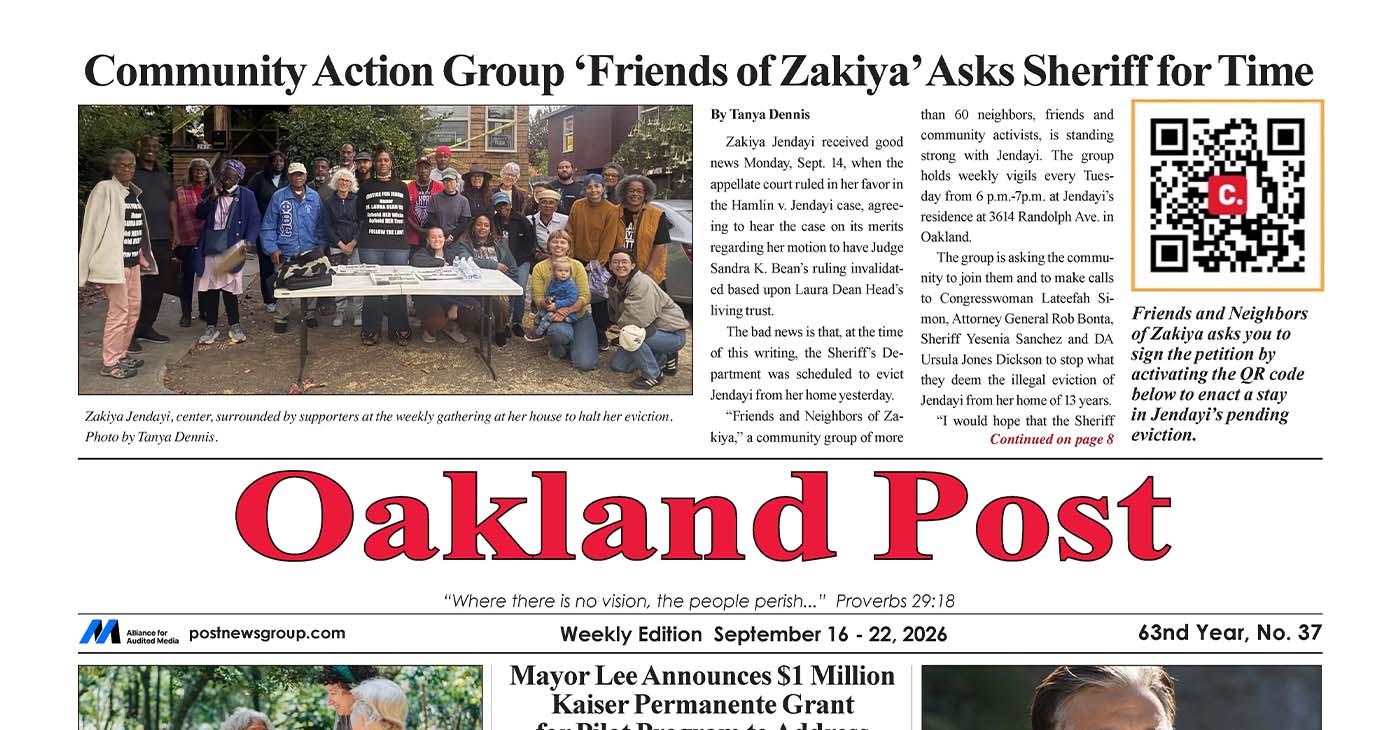
To enlarge your view of this issue, use the slider, magnifying glass icon or full page icon in the lower right corner of the browser window.



Listening as a Lifeline: A Doula’s Witness to Black Maternal Health

New Protections for Ticket Buyers: Gov. Newsom Signs Assemblymember Isaac Bryan’s Bill

‘We Don’t Talk Trash — We Pick Up Trash!’

Zakiya Jendayi Arrested, Locked Out of Home by Sheriff’s Deputies

Oakland Post: Week of September 30 – October 6, 2026

Asm. Corey Jackson Announces Launch of 24-Hour Childcare in His District

IN MEMORIAM: The Rev. Leon “Sonny” Clark, Longtime Orange County Pastor and Community Leader, Dies at 72

Poll: Becerra Widens His Lead Over Hilton; Californians Split on Wealth Tax

From Historic Memories to New Possibilities: Oakland Celebrates Coliseum 60

County Office of Education Says OUSD Finances Are Getting Healthier, Materially Stronger

LIVE FREE Sunday Dinner Brings Faith, Fellowship and Civic Conversation to Oakland

Remembering Chauncey Bailey as Student Journalists Face Threats to Truth-Telling

BLACspace Cooperative Invites Bay Area to Experience Oakland’s Black Cultural Ecosystem Through a BLAC Map Tour + Party

In Wake of Death on Doorstep, Williams Chapel Baptist Church Calls for Better Care, Funding for Unhoused

Oakland Centenarian Nuna McKee Honored!

Standoff for Justice: Our Homes Are Worth Fighting For

Oakland Post: Week of August 26 – September 1, 2026

Frontier Airlines’ Return to Oakland Airport Brings Flights, Jobs and Opportunity

Gubernatorial Candidate Steve Hilton Blasts California New Tire Rules; Newsom Hits Back

Chef Sharon Lee Blends Culinary Excellence, Education and Empowerment

Jackie Wright Champions Bay Area Stories, Filmmakers and Cultural Institutions

Big City Mayors Ask for “Yes” Vote on Housing Bond Measure; Conservatives Say “No”

Oakland Coliseum Project Opens Door for Small Businesses to Build Bigger

Misnamed ‘Parent’ PAC Seeks to Influence Oakland School Board Elections

Gov. Newsom’s Latest Appointees Include Sacramento Advocate for Formerly Incarcerated Students; State’s New Tech Chief

Longtime BWOPA Member Brendalyn Goodall Appointed to California Workforce Development Board

Gov. Newsom Signs Law Shielding Immigration Aid Workers From Doxing Threats

Secretary of State Shirley N. Weber Urges Californians to Vote Early as Voter ID Battle Intensifies

Oakland Post: Week of September 2 – 8, 2026

IN MEMORIAM: Dolly Parton Dead at 80 — How She Built a Legacy of Love and Earned Her Place in Black Culture

The Conversation With Al McFarlane 6/23/26

Media Monday 6/22/26

LIVE! ASK ALMA! — TUES. 6.23.26 7PM EST

Car Buying Secrets: 4 Hidden Checks Before You Sign!

Is This 550 HP Charger Worth YOUR Money? AutoNetwork Review

Celebrating Juneteenth – Frederick Douglass on education and resistance

LIVE! — ASK ALMA! — TUES. 6.19.26 7PM EST

Hyundai Ioniq 5 Parking, Safety, and 360 View #shorts

2025 Ioniq 5 New Wiper & Powerful Performance! #shorts

Electric SUV Range: Is 259 Miles Enough? #shorts

EV Charging: How Fast Can You Charge an Electric Vehicle? #shorts

Biometric Cooling… Messaging Seats…Come on! 2025 Infiniti QX80 Autograph 4WD

Charged Up: Witness the Magic of a Fully Electric Car! #shorts

Range Rover Sport PHEV Included…: See What’s Inside This Luxury SUV! #shorts

Invisible Hood View: Perfect Parking with X-Ray Vision! #shorts
-
 Community3 weeks ago
Misnamed ‘Parent’ PAC Seeks to Influence Oakland School Board Elections
-
 Activism4 weeks ago
Oakland Post: Week of September 2 – 8, 2026
-

 Community3 weeks ago
Richmond Tiny House Village Farm & Garden Set to Open Gates on Sept. 26
-

 Activism3 weeks ago
Oakland Post: Week of September 9 – 15, 2026
-

 Black History3 weeks ago
Latest Massacre in Haiti Reveals Cruelty U.S. Deportations
-

 Black History3 weeks ago
OPINION: Nolan Wells’ Death One of Several Signifying Racial Terror Lives on in U.S. South
-

 Community3 weeks ago
Democratic Clubs Interview Candidates for Oakland School Board
-

 Business2 weeks ago
Mayor Lee Announces $1 Million Kaiser Permanente Grant for Pilot Program to Address Homelessness, Clean Up Public Spaces throughout Oakland
