Connect with us

Activism

OPINION: What’s Really Driving the Oakland Police Department’s So-Called Staffing Crisis?

After decades of overspending on law enforcement, our nation’s police forces have now grown so large there’s simply no way they can keep themselves fully staffed. So, they’ve resorted to cannibalizing each other, poaching officers from neighboring departments. And Oakland residents are left to pay the price tag of training cadets who ultimately go on to work elsewhere, or out-of-towners whose records of conduct are difficult to unearth.

Published

on

Cat Brooks

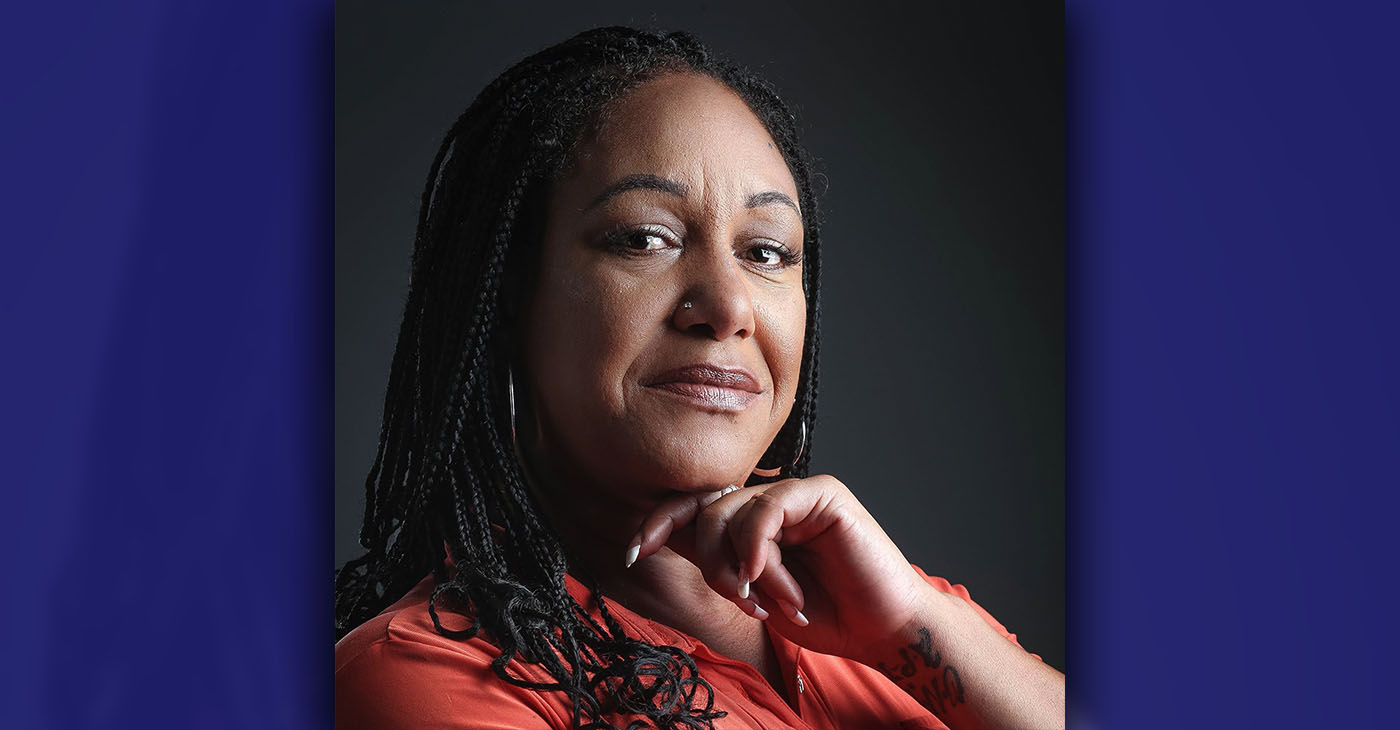
By Cat Brooks

Police forces around the country are complaining about staffing shortages. By and large, they’ve blamed the community and city leaders for not being sufficiently supportive — even though law enforcement receives the lion’s share of every city budget in the country.

We heard such disinformation recently when Oakland Police Officers Association President Barry Donelan blamed declining OPD staffing levels on “anti-police rhetoric” which is driving hard-working, dedicated Oakland police officers to leave in droves.”

While this is an obvious falsehood, it remains important to ask: why are so many cops leaving, who are they, and what is OPD spending its time on?

One major reason staffing is down is because so many cops have quit the force to escape discipline. “Heavy discipline” was among the top factors cited by departing officers in exit interviews, which OPD started conducting last fall.

What this means is that between OPD’s nonstop scandals — which range from sharing racist, sexist Instagram memes and pro-Trump insurrection posts, to teargassing kids, to overtime fraud, to murder — and Oakland’s community-led demands for accountability, the environment has become unfriendly to corrupt cops who could easily go do their dirt elsewhere without consequence. Good riddance.

Oakland’s COVID-19 vaccine mandate for city workers has also had an impact. On March 8, OPD Deputy Director Kiona Suttle revealed that 15 sworn officers will either be fired or forced to quit because of noncompliance with the mandate.

This seems to confirm the widely-held suspicion that vaccine refusal has contributed to the reduction in officer staffing in Oakland like it has everywhere else — a suspicion that grew when officer attrition spiked by 160% in October, the month the vaccine mandate took effect.

The top reason for leaving listed in exit interviews is “dissatisfaction with OPD leadership.” This shows that, despite Libby Schaaf’s gaslighting of Oaklanders with tall tales of OPD reform and the police association’s false narrative spin, OPD remains as dysfunctional as ever. Yet the City of Oakland fills their unaudited budget of almost $350 million every year.

Let’s be clear — while OPD is a terrible place to work, it is not unique in falling below its budgeted number of officers. A similar trend is happening all over the country. A national survey of nearly 200 law enforcement agencies last summer found that retirements went up by 45% and resignations went up by almost 20% in 2020-21.

After decades of overspending on law enforcement, our nation’s police forces have now grown so large there’s simply no way they can keep themselves fully staffed. So, they’ve resorted to cannibalizing each other, poaching officers from neighboring departments. And Oakland residents are left to pay the price tag of training cadets who ultimately go on to work elsewhere, or out-of-towners whose records of conduct are difficult to unearth.

Oakland will never be able to fill so many empty positions. Period. There’s just not enough people interested in working for OPD. The only solution is to scale back our police force. We’ve got to make do with fewer officers.

We can do this by ending the practice of making police be the ineffective first responders to every single social ill. They are not counselors, therapists, mental health workers, or animal welfare specialists. Sending them to do these jobs has proven not only costly but also deadly to Black and brown communities.

It won’t be a difficult shift. Right now, OPD only spends a fraction of its time on violent crime. The Anti Police-Terror Project published a report last year which found that OPD wastes significant amounts of time and money responding to nonviolent and non-criminal issues instead of focusing on violent crime.

The Department could free up the equivalent of over 60 full-time officers and save millions if it was no longer responsible for matters that don’t require an armed officer — like towing abandoned cars and catching stray dogs — as well as situations like mental health crises or interacting with unhoused neighbors.

The truth is we have too many cops, not too few. But OPD doesn’t want you to know this. That’s why they’re dragging their feet on releasing updated data about how they spend their time, which City Council demanded and is already past due.

We know what keeps us safe, and it’s not more police. It’s meeting the needs of our most vulnerable community members. That means housing, schools, jobs, mental health care, and violence prevention.

The way out of this manufactured staffing crisis is to tell OPD to do less with less — and to invest in what really keeps us safe instead.

Continue Reading
Click to comment

Leave a Reply

Your email address will not be published. Required fields are marked *

Activism

Up to the Job: How San Francisco’s PRC Is Providing Work Opportunities That Turn Into Lasting Stability

Each year, PRC serves more than 5,000 clients through a wide range of programs. These include housing navigation, legal advocacy to ensure access to health and public benefits, supportive housing, job and life-skills training, and residential treatment programs. 

Published

on

Black Leadership Council (BLC) Advocacy Day in Sacramento. BLC works to advance meaningful change through policy engagement to unlock the full potential of Black and low-income communities. Photo courtesy of PRC.

By Joe Kocurek, California Black Media

Seville Christian arrived in San Francisco in the 1990s from Kansas City, Mo., a transgender woman coming from a time and place still hostile to who she was.

San Francisco offered a deeper LGBTQ+ history and a more visible community of people like her, but even in a city known for acceptance, building a stable life from scratch was no small task.

After arriving in the city, she turned to Positive Resource Center (PRC) looking for work — and for a foothold — in a new place.

“PRC gave me my first job,” Christian said. “A simple gig — passing out magazines at the San Francisco Pride Parade.”

That first opportunity marked the beginning of a decades-long relationship with PRC, one that has seen Christian grow from client to valued employee, and eventually to policy fellow.

“Today, I’ve been with PRC for 27 years, going on 28,” she said.

Seville Christian’s decades-long relationship with PRC includes as a client, fellow and beloved employee. Photo courtesy of PRC.

Seville Christian’s decades-long relationship with PRC includes as a client, fellow and beloved employee. Photo courtesy of PRC.

Helping people access employment and build sustainable careers has been a cornerstone of PRC’s mission since its inception nearly four decades ago. In its most recent annual impact report, PRC served 443 clients through workforce development services, including career counseling, educational programs, hands-on training, and job search assistance. The average wage earned by PRC clients is $26.48 per hour — approximately 38% above San Francisco’s minimum wage.

To advance this work, organizations like PRC have benefited from funding through California’s Stop the Hate Program, which provides direct support to community-based organizations leading anti-hate initiatives.

Christian’s path was not without challenges. During some rocky years, she experienced periods of housing instability and struggled with addiction. Through PRC, she enrolled in a life-skills program that emphasized using her own lived experience as a means of helping others. The program helped set her on a path toward completing an associate’s degree and ultimately launching a career in case management.

“Today, whether someone is new to the city or has lived here their whole life, I know how to help them navigate to where they need to be,” Christian said.

Each year, PRC serves more than 5,000 clients through a wide range of programs. These include housing navigation, legal advocacy to ensure access to health and public benefits, supportive housing, job and life-skills training, and residential treatment programs.

Members of PRC’s Black Leadership Council meet with a lawmaker in Sacramento. Photo courtesy of PRC.

Members of PRC’s Black Leadership Council meet with a lawmaker in Sacramento. Photo courtesy of PRC.

While PRC was founded to serve people living with HIV, its mission has expanded over the decades to meet the needs of people with disabilities, individuals experiencing homelessness, and those facing mental health and substance use challenges.

According to PRC’s Chief of Public Policy and Public Affairs, Tasha Henneman, some of the organization’s earliest programs remain as vital today as they were at the start.

“Our emergency financial assistance program helped more than 1,200 people this year pay rent, cover medical bills, and keep the lights on,” Henneman said. “And over 1,400 people reached out for legal advocacy, resulting in more than $2.5 million in retroactive benefits unlocked.”

Beyond direct services, PRC is deeply committed to community empowerment and policy change. Programs such as the Black Leadership Council support community leaders in advocating for systemic reform, while the Black Trans Initiative focuses on addressing the unique challenges faced by Black transgender individuals.

A recent study from the Williams Institute highlighted findings that 71% of transgender homicide victims in the U.S. between 2010 and 2021 were Black and that nearly a third of the transgender homicides during that period were confirmed or suspected hate crimes.

PRC’s direct and indirect services can be a lifeline for people experiencing hate and are an example of the resources people can get connected with through the state’s CA vs Hate hotline.

PRC is now also producing a film project that centers the lived experiences of Black trans clients, including individuals like Christian.

PRC welcomed guests to their annual Open House in April, an evening dedicated to connection, reflection, and learning more about the programs and people working every day to support San Franciscans experiencing housing instability, unemployment, and behavioral health challenges. Photo courtesy of PRC.

PRC welcomed guests to their annual Open House in April, an evening dedicated to connection, reflection, and learning more about the programs and people working every day to support San Franciscans experiencing housing instability, unemployment, and behavioral health challenges. Photo courtesy of PRC.

“Our film highlights the health journeys and lived experiences of some of PRC’s Black trans clients,” Henneman said. “Our goal is to give voice, visibility, and agency to the participants — and to bring their stories, both harrowing and inspirational, to policymakers and the broader public.”

The film, expected to be released later this year, is directed by Yule Caise, with assistant director Zarina Codes, a Black transgender San Francisco resident.

Today, Christian continues her relationship with PRC as an ambassador, reflecting on a journey that began with a single job opportunity and grew into a lifelong commitment to service.

“Sometimes I’ll be riding the bus or standing in a grocery store, and someone will come up to me from a women’s shelter,” she said. “They’ll say, ‘Oh, Miss Seville, I just want to thank you. You really helped me with what I was dealing with.’”

She paused, smiling.

“And in those moments,” Christian said, “I think to myself, “Well!.”

A single word that sums up pride in a journey to find the best in herself.

Get Support After Hate:

California vs Hate is a non-emergency, multilingual hotline and online portal offering confidential support for hate crimes and incidents. Victims and witnesses can get help anonymously by calling 833-8-NO-HATE (833-866-4283), Monday to Friday, 9 a.m.–6 p.m. PT, or online at any time. Anonymous. Confidential. No Police. No ICE.

This story was produced in partnership with CA vs Hate. Join them for the first-ever CA Civil Rights Summit on May 11, 2026. More information at www.cavshate.org/summit.

Continue Reading

Activism

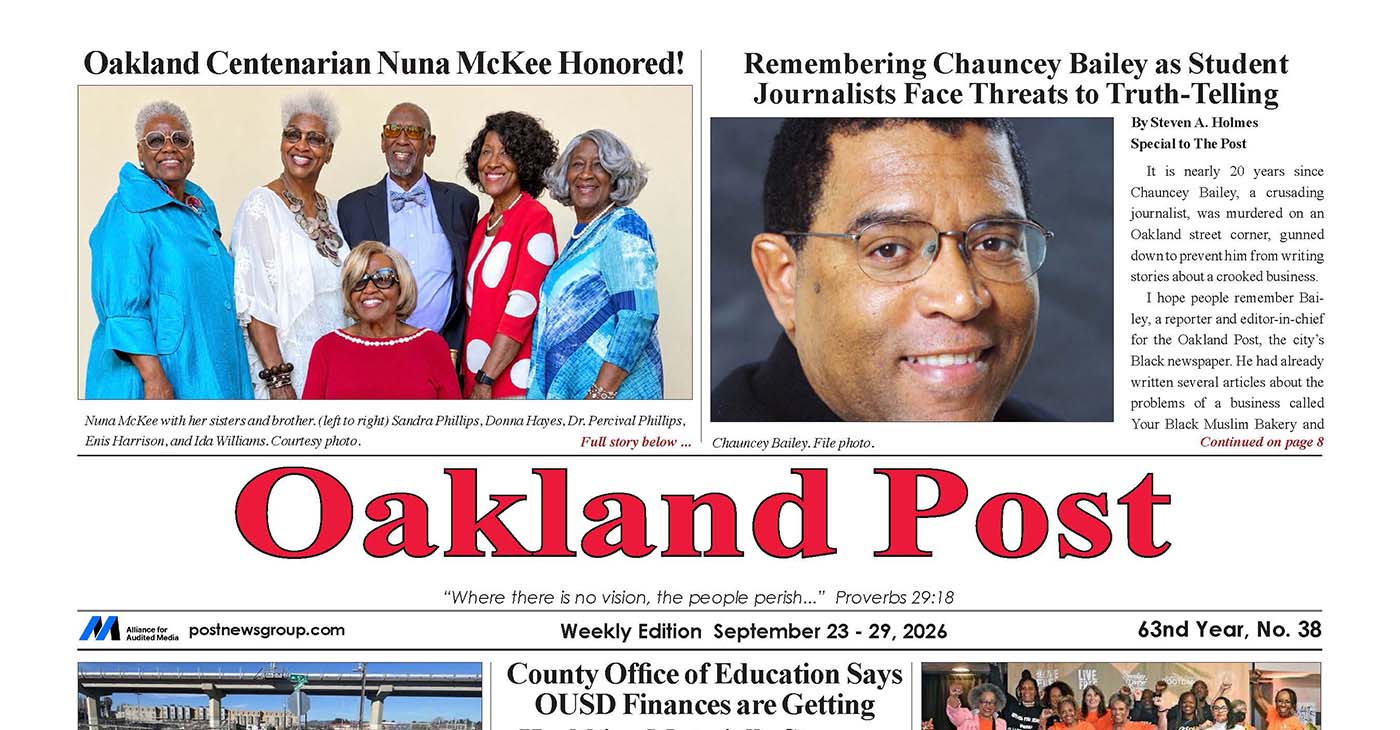
Oakland Post: Week of April 22 – 28, 2026

The printed Weekly Edition of the Oakland Post: Week of April 22 – 28, 2026

Published

on

To enlarge your view of this issue, use the slider, magnifying glass icon or full page icon in the lower right corner of the browser window.
Continue Reading

Activism

Up to the Job: How San Francisco’s PRC Is Providing Work Opportunities That Turn Into Lasting Stability

Each year, PRC serves more than 5,000 clients through a wide range of programs. These include housing navigation, legal advocacy to ensure access to health and public benefits, supportive housing, job and life-skills training, and residential treatment programs. 

Published

on

Black Leadership Council (BLC) Advocacy Day in Sacramento. BLC works to advance meaningful change through policy engagement to unlock the full potential of Black and low-income communities. Photo courtesy PRC.

Joe Kocurek | California Black Media  

 Seville Christian arrived in San Francisco in the 1990s from Kansas City, Mo., a transgender woman coming from a time and place still hostile to who she was. 

 San Francisco offered a deeper LGBTQ+ history and a more visible community of people like her, but even in a city known for acceptance, building a stable life from scratch was no small task. 

 After arriving in the city, she turned to Positive Resource Center (PRC) looking for work — and for a foothold — in a new place. 

 “PRC gave me my first job,” Christian said. “A simple gig — passing out magazines at the San Francisco Pride Parade.” 

 That first opportunity marked the beginning of a decades-long relationship with PRC, one that has seen Christian grow from client to valued employee, and eventually to policy fellow. 

 “Today, I’ve been with PRC for 27 years, going on 28,” she said. 

Helping people access employment and build sustainable careers has been a cornerstone of PRC’s mission since its inception nearly four decades ago. In its most recent annual impact report, PRC served 443 clients through workforce development services, including career counseling, educational programs, hands-on training, and job search assistance. The average wage earned by PRC clients is $26.48 per hour — approximately 38% above San Francisco’s minimum wage. 

To advance this work, organizations like PRC have benefited from funding through California’s Stop the Hate Program, which provides direct support to community-based organizations leading anti-hate initiatives. 

Christian’s path was not without challenges. During some rocky years, she experienced periods of housing instability and struggled with addiction. Through PRC, she enrolled in a life-skills program that emphasized using her own lived experience as a means of helping others. The program helped set her on a path toward completing an associate’s degree and ultimately launching a career in case management. 

“Today, whether someone is new to the city or has lived here their whole life, I know how to help them navigate to where they need to be,” Christian said. 

PRC welcomed guests to their annual Open House in April, an evening dedicated to connection, reflection, and learning more about the programs and people working every day to support San Franciscans experiencing housing instability, unemployment, and behavioral health challenges.

PRC welcomed guests to their annual Open House in April, an evening dedicated to connection, reflection, and learning more about the programs and people working every day to support San Franciscans experiencing housing instability, unemployment, and behavioral health challenges.

Each year, PRC serves more than 5,000 clients through a wide range of programs. These include housing navigation, legal advocacy to ensure access to health and public benefits, supportive housing, job and life-skills training, and residential treatment programs. 

While PRC was founded to serve people living with HIV, its mission has expanded over the decades to meet the needs of people with disabilities, individuals experiencing homelessness, and those facing mental health and substance use challenges.  

According to PRC’s Chief of Public Policy and Public Affairs, Tasha Henneman, some of the organization’s earliest programs remain as vital today as they were at the start. 

“Our emergency financial assistance program helped more than 1,200 people this year pay rent, cover medical bills, and keep the lights on,” Henneman said. “And over 1,400 people reached out for legal advocacy, resulting in more than $2.5 million in retroactive benefits unlocked.” 

Beyond direct services, PRC is deeply committed to community empowerment and policy change. Programs such as the Black Leadership Council support community leaders in advocating for systemic reform, while the Black Trans Initiative focuses on addressing the unique challenges faced by Black transgender individuals. 

 A recent study from the Williams Institute highlighted findings that 71% of transgender homicide victims in the U.S. between 2010 and 2021 were Black and that nearly a third of the transgender homicides during that period were confirmed or suspected hate crimes.  

PRC’s direct and indirect services can be a lifeline for people experiencing hate and are an example of the resources people can get connected with through the state’s CA vs Hate hotline.  

PRC is now also producing a film project that centers the lived experiences of Black trans clients, including individuals like Christian.

 “Our film highlights the health journeys and lived experiences of some of PRC’s Black trans clients,” Henneman said. “Our goal is to give voice, visibility, and agency to the participants — and to bring their stories, both harrowing and inspirational, to policymakers and the broader public.” 

The film, expected to be released later this year, is directed by Yule Caise, with assistant director Zarina Codes, a Black transgender San Francisco resident. 

 Today, Christian continues her relationship with PRC as an ambassador, reflecting on a journey that began with a single job opportunity and grew into a lifelong commitment to service. 

“Sometimes I’ll be riding the bus or standing in a grocery store, and someone will come up to me from a women’s shelter,” she said. “They’ll say, ‘Oh, Miss Seville, I just want to thank you. You really helped me with what I was dealing with.’” 

She paused, smiling. 

“And in those moments,” Christian said, “I think to myself, “Well!.” 

A single word that sums up pride in a journey to find the best in herself.  

 Get Support After Hate:

California vs Hate is a non-emergency, multilingual hotline and online portal offering confidential support for hate crimes and incidents. Victims and witnesses can get help anonymously by calling 833-8-NO-HATE (833-866-4283), Monday to Friday, 9 a.m.–6 p.m. PT, or online at any time. Anonymous. Confidential. No Police. No ICE.This story was produced in partnership with CA vs Hate. Join them for the first-ever CA Civil Rights Summit on May 11, 2026. More information at www.cavshate.org/summit.

Continue Reading

Subscribe to receive news and updates from the Oakland Post

* indicates required

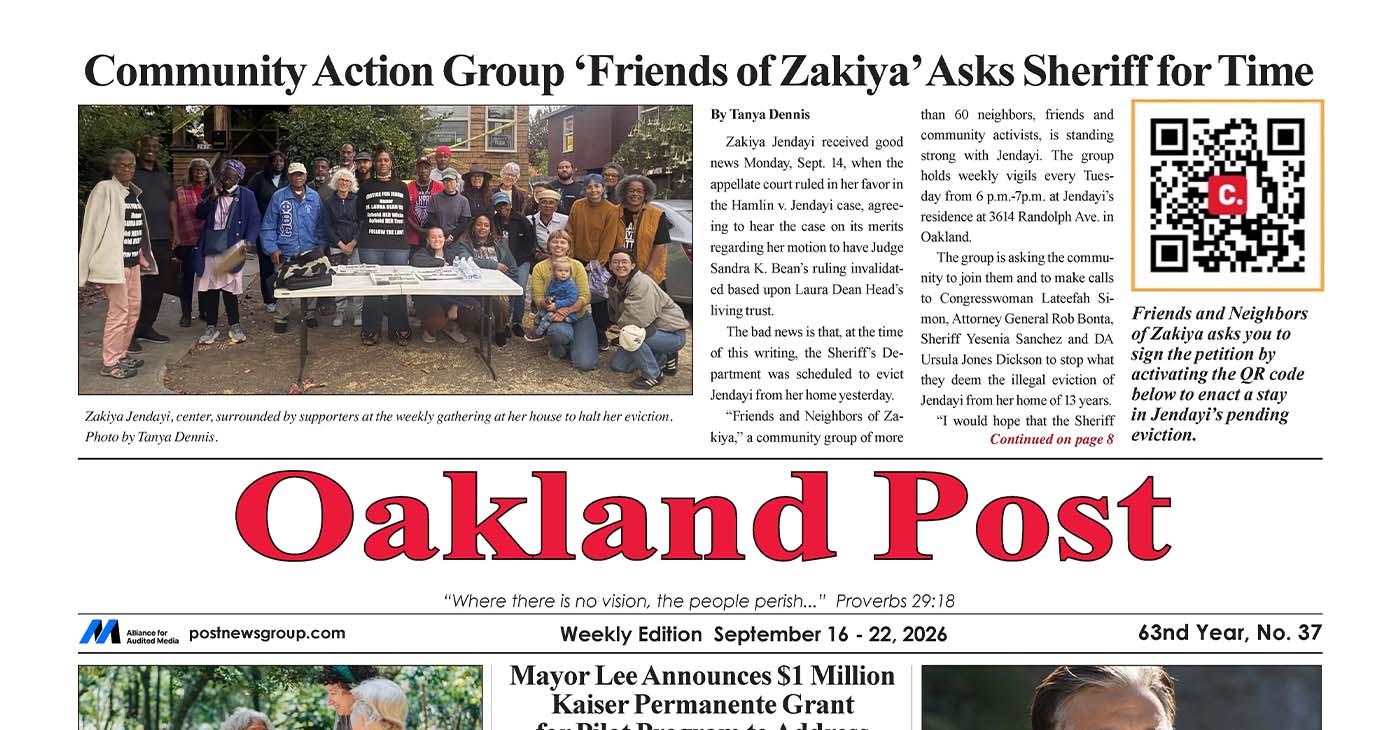
CHECK OUT THE LATEST ISSUE OF THE OAKLAND POST

ADVERTISEMENT

WORK FROM HOME

Home-based business with potential monthly income of $10K+ per month. A proven training system and website provided to maximize business effectiveness. Perfect job to earn side and primary income. Contact Lynne for more details: Lynne4npusa@gmail.com 800-334-0540

Facebook

#NNPA BlackPress3 days ago

State of Preschool Yearbook Provides an Annual Snapshot of State-Funded Preschool 

#NNPA BlackPress4 days ago

Which features on the 2026 Volkswagen Golf GTI Autobahn are actually worth having?

#NNPA BlackPress4 days ago

Panoramic Roof & Rear Seats: The Ultimate EV Comfort! #shorts

#NNPA BlackPress4 days ago

Does the 2026 Volkswagen Golf GTI Autobahn actually fit your lifestyle?

#NNPA BlackPress4 days ago

Subaru EV Blends Modern Design with Unmatched Confidence & Power! #shorts

#NNPA BlackPress4 days ago

Subaru Uncharted EV: Confidence, Control, and Daily Usability for You! #shorts

#NNPA BlackPress4 days ago

VW GTI Under the Hood: Turbocharged Engine & DSG #shorts

#NNPA BlackPress4 days ago

2026 Mazda CX‑90 PHEV Premium Plus — Luxury SUV or Overpriced Plug‑In? | Walkaround Review

#NNPA BlackPress4 days ago

Why Time Is the Most Expensive Part of Car Buying | The Color of Our Money Is Green Ep5

#NNPA BlackPress4 days ago

2026 Subaru Unchartered GT: Future of Driving is HERE! #shorts

#NNPA BlackPress4 days ago

Golf GTI Digital Cockpit Pro & HUD: Your Ultimate Driving Experience #shorts

Black Leadership Council (BLC) Advocacy Day in Sacramento. BLC works to advance meaningful change through policy engagement to unlock the full potential of Black and low-income communities. Photo courtesy of PRC.
Activism4 days ago

Up to the Job: How San Francisco’s PRC Is Providing Work Opportunities That Turn Into Lasting Stability

Activism5 days ago

Oakland Post: Week of April 22 – 28, 2026

Black Leadership Council (BLC) Advocacy Day in Sacramento. BLC works to advance meaningful change through policy engagement to unlock the full potential of Black and low-income communities. Photo courtesy PRC.
Activism1 week ago

Up to the Job: How San Francisco’s PRC Is Providing Work Opportunities That Turn Into Lasting Stability

At D. Monaghan’s on the Hill, a resolution declaring April 9 ‘100 Black Men of the Bay Area Day’ was witnessed by (l.-r.) 100 Black Men leaders Maurice Harold, Marco T. Lindsey, Danny Lee Williams, Oakland Mayor Barbara Lee, Oakland City Council President Kevin Jenkins, Port of Oakland Commissioner Derek Mohammad, and Oakland Councilmember Janani Ramachandran. Photo by Carla Thomas.
Activism2 weeks ago

Mayor Barbara Lee Proclaims April 9 as ‘100 Black Men of the Bay Area Day’

Trending

Copyright ©2021 Post News Group, Inc. All Rights Reserved.