
Opinion
Opinion: Pastores Apoyan Terminal de Carbón en Oakland por el Trabajo y el Desarrollo Económico

Un nuevo grupo de pastores locales hizo una poderosa aparición ante el consejo de la ciudad de Oakland el martes por la noche, 8 de diciembre, para hablar a favor de un proyecto marítimo que traerá empleos tan esperados y el desarrollo económico a un número de comunidades locales.
El Consejo de Empoderamiento Económico Ecuménico está compuesto por un grupo de 14 pastores de todo Oakland, y sobre todo el oeste de Oakland, que se han unido en una forma organizada para perseguir formas que permitan potenciar y sostener nuestras comunidades locales.
La atención se centrará en el empleo y la capacitación laboral, salud pública y seguridad, desarrollo de la juventud, educación, vivienda y desarrollo económico.
El tema siendo considerado por el Consejo de la Ciudad de Oakland es si se permitirá una empresa de propiedad afroamericana local para avanzar sin más retrasos en la construcción de un terminal marítima de múltiples zonas de carga en la antigua base militar de Oakland.
Aunque la terminal se encargará del transporte de numerosos productos a granel como alimento para el ganado, granos agrícolas, mineral de hierro, sodio y cenizas, el Ayuntamiento está revisando testimonios y conclusiones para determinar si hay, de hecho, un riesgo para la salud y la seguridad asociada con el transporte de carbón, que es una de las otras materias primas que será transportada a través de esta terminal.
El grupo de pastores, habiendose reunió con Jerry Bridges, el CEO afroamericano de Terminal Logistics Solutions, la empresa que va a construir, poseer y operar la terminal, expresó al Ayuntamiento su apoyo para el proyecto y su confianza en los compromisos adquiridos por el operador para mitigar todos los problemas ambientales locales planteadas por los opositores.
“El diseño innovador de este proyecto y el compromiso de TLS para aceptar sólo coches cubiertos de ferrocarril y para mover, almacenar y trasegar productos utilizando estado de la tecnología y la innovación, son convincentes y proporcionan el tipo de garantía que necesitábamos para, con la conciencia tranquila, apoyar este proyecto”, afirmó el obispo Joseph Simmons of Greater St. Paul Baptist Church, presidente de la EEEC.
Según el obispo Bob Jackson, pastor de la Iglesia del Evangelio Completo Hechos expresó en su declaración ante el Consejo de la Ciudad, “Estamos muy preocupados por el retraso por parte del Ayuntamiento para formular su determinación en este proyecto, ya que se traduce a la demora en traer empleos necesarios e importantes beneficios económicos a algunas de nuestras comunidades en Oakland que más lo necesitan”.
Los pastores estaban de acuerdo unidos junto con los contratistas minoritarios y más de 50 miembros de la iglesia que también asistieron a la reunión del Consejo y se comprometieron a volver cuando este asunto está programada para su examen por el Consejo en febrero.
El grupo de pastores concluyó su presentación al proporcionar a los miembros del Ayuntamiento una copia de la carta adjunta que se envió antes a la alcaldesa Libby Schaaf en apoyo de este proyecto y que expresa la intención del EEEC liderando el camino también en una serie de otras cuestiones de empoderamiento de la comunidad que están llegando a producir, ya que se ve que muchos de nuestros barrios y las comunidades locales en Oakland cambian tan rápidamente.
Los miembros de la EEEC incluyen a:
Obispo Joseph Simmons, presidente de la Gran St. Paul Iglesia Bautista; Rev. Michael Wallace, vicepresidente Mt. Sion de la Iglesia Bautista Misionera; Dr. Kevin D. Barnes Sr., Secretario Tesorero abisinio Iglesia Bautista Misionera;
Dr. Gerald Agee, Centro Amistad Cristiana; Rev. James E. Bobo Sr., Gran Galilea COGIC; Obispo Keith Lee Clark, Iglesia Word Assembly; Dr. E. N. Crawford, Alabanzas de Sión Iglesia Bautista Misionera,
Dr. Russell A. Duley, Kaleo Comunidad Cristiana; Obispo Bob Jackson, Hechos Iglesia del Evangelio Completo; Rev. Anthony Jenkins, Sr.Taylor Memorial United Methodist Church; Dr. Gregory B. Payton, Gran San Juan Bautista Iglesia Misionera;
Rev. Brondon Reems, Iglesia de la Comunidad Centro de la Esperanza; Obispo Dr. Samuel Robinson, Iglesia del Dios vivo; Obispo C. Carl Smith, Iglesia de Oakland Nuevo Nacimiento.









Activism
Oakland Post: Week of September 9 – 15, 2026
The printed Weekly Edition of the Oakland Post: Week of September 9 – 15, 2026

To enlarge your view of this issue, use the slider, magnifying glass icon or full page icon in the lower right corner of the browser window.
Activism
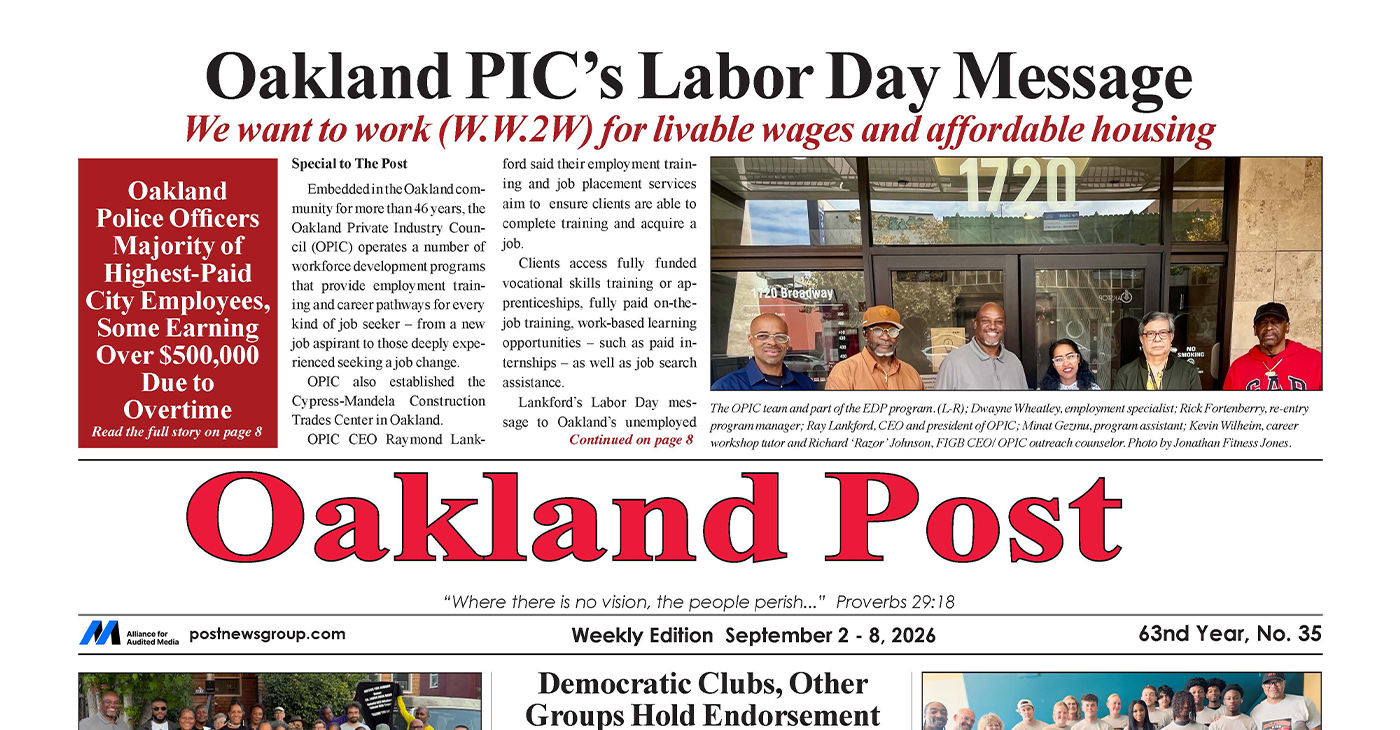
Oakland Post: Week of September 2 – 8, 2026
The printed Weekly Edition of the Oakland Post: Week of September 2 – 8, 2026
To enlarge your view of this issue, use the slider, magnifying glass icon or full page icon in the lower right corner of the browser window.
Activism
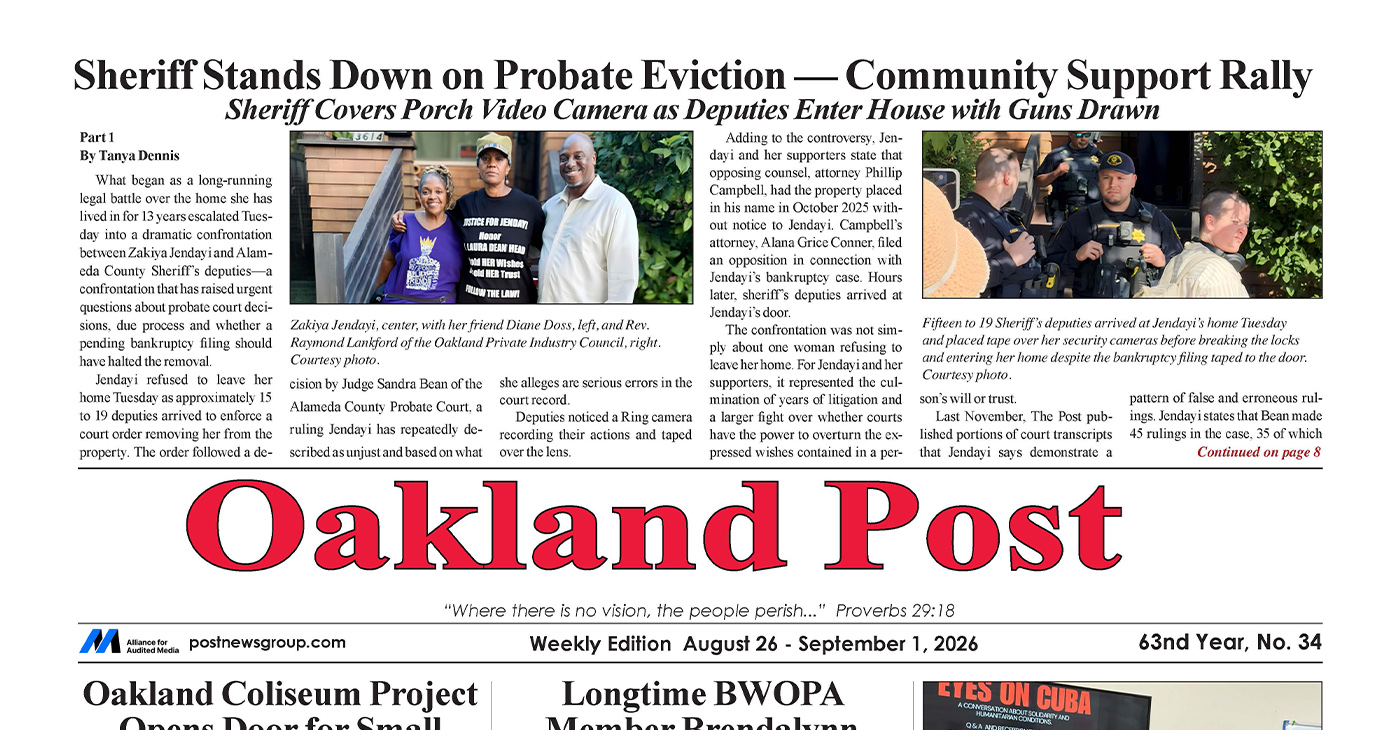
Oakland Post: Week of August 26 – September 1, 2026
The printed Weekly Edition of the Oakland Post: Week of August 26 – September 1, 2026
To enlarge your view of this issue, use the slider, magnifying glass icon or full page icon in the lower right corner of the browser window.



Port of Oakland, Army Corps Sign Historic Harbor Design Agreement

Democratic Clubs Interview Candidates for Oakland School Board

Nuna Phillips-McKee Celebrates 100 Years: ‘A Century of Faith, Family and God’s Amazing Grace!’

D.A. Ursula Jones Dickson: Terminix to Pay $3.15 Million Over Illegal Disposal of Pesticides, Customer Records

REPORT: Community Level Policy Is Impacting Homelessness and Drug Abuse in California
OPINION: AI Needs to Know Who Is the Boss
Goldi-Locs and Two (or Three) Bears in the Forest in California Hills

Election Watch 2026: 85% of Eligible Voters in California Are Registered

Don’t Let scammers Crash Your School Year

BOOK REVIEW — Curved Air: A Biography of Sickle Cell Anemia and the Quest to Cure the First Molecular Disease

California’s Legal Cannabis Market Hits $8 Billion as State Touts Progress on Fighting Drugs, Crime

Blacks and Latinos Clash Over LA’s Barrio Run; Mayor Karen Bass Calls for Dialogue Across Racial, Neighborhood Lines

Asm. Smallwood-Cuevas’s Bill Repealing ‘Racist’ CalWORKs ‘Man-in-the-House’ Rule Clears Legislature

Asm. Smallwood-Cuevas’s Bill Repealing ‘Racist’ CalWORKs ‘Man-in-the-House’ Rule Clears Legislature

‘Ready to See These Bills Become Law’: Sen. Weber’s Package of 15 Bills Advance to Gov. Newsom’s Desk

Department of Homeland Security Demands California Secretary of State Shirley N. Weber Scrub Voter Rolls

New Judge Could Decide if Karmelo Anthony Gets a New Trial

“The Power to See Threats Sooner”: Gov. Newsom, Safety Officials Showcase California’s Investments in Hi-Tech Wildfire Prevention

Alpha Kappa Alpha Sorority, Inc. Celebrates New North Atlantic Regional Director

California Sen. Padilla Joins Colleagues to Introduce Bill Imposing Term Limits on Supreme Court Justices

Less Affluent School Districts, Including Sacramento City, Face Threat of State Takeover

Car Wash Workers Cope with Lingering Impacts of ICE Raids

Oakland Post: Week of July 29 – August 4, 2026

How Oakland’s Courtsmith is Scaling its Business and Local Impact

ESSAY: California Can Close Its Colorectal Cancer Gap

Oakland Post: Week of August 5 – 11, 2026

As Part of Your Back-to- School Checklist, Vaccinate

Oakland ‘Port Serves as a Powerful Engine for Good Jobs and Economic Development

Gov. Newsom Signs New Affordable Housing Legislation

Gov. Newsom Announces $109.6 Million in Funding for 278 Supportive Homes in Bakersfield, Contra Costa, Sacramento and Fresno

The Conversation With Al McFarlane 6/23/26

Media Monday 6/22/26

LIVE! ASK ALMA! — TUES. 6.23.26 7PM EST

Car Buying Secrets: 4 Hidden Checks Before You Sign!

Is This 550 HP Charger Worth YOUR Money? AutoNetwork Review

Celebrating Juneteenth – Frederick Douglass on education and resistance

LIVE! — ASK ALMA! — TUES. 6.19.26 7PM EST

Hyundai Ioniq 5 Parking, Safety, and 360 View #shorts

2025 Ioniq 5 New Wiper & Powerful Performance! #shorts

Electric SUV Range: Is 259 Miles Enough? #shorts

EV Charging: How Fast Can You Charge an Electric Vehicle? #shorts

Biometric Cooling… Messaging Seats…Come on! 2025 Infiniti QX80 Autograph 4WD

Charged Up: Witness the Magic of a Fully Electric Car! #shorts

Range Rover Sport PHEV Included…: See What’s Inside This Luxury SUV! #shorts

Invisible Hood View: Perfect Parking with X-Ray Vision! #shorts
-

 Community4 weeks ago
Four Candidates, Including Incumbent Barbara Lee, Qualify for Oakland Mayor’s Race
-

 Activism4 weeks ago
Oakland Post: Week of August 12 – 18, 2026
-
 Black History4 weeks ago
Oakland Observes Black August with Block Parties, Film Showings, Workshops
-

 Commentary4 weeks ago
COMMENTARY: Why Local School Tax Measure G1 Will Not Be on the November Ballot
-

 Commentary2 weeks ago
Standoff for Justice: Our Homes Are Worth Fighting For
-

 Business2 weeks ago
Gubernatorial Candidate Steve Hilton Blasts California New Tire Rules; Newsom Hits Back
-

 Activism2 weeks ago
Oakland Post: Week of August 26 – September 1, 2026
-

 Education2 weeks ago
Gov. Newsom’s Latest Appointees Include Sacramento Advocate for Formerly Incarcerated Students; State’s New Tech Chief
