
Opinion
Opinion: Housing Affordability Crisis Requires Bold Action


By Assemblymember Rob Bonta
In times of crisis, all options must be on the table.
Many parts of California are suffering from a rental housing affordability crisis. According to a January 2017 Public Policy Institute of California report, our state has six of the nation’s 11 most expensive large metropolitan rental markets. People renting in the Bay Area and Los Angeles are feeling this crisis most acutely.
Another report by the Department of Housing and Community Development showed 84 percent of rental households are now considered “burdened,” meaning these individuals and families are being forced to spend 30 to 50 percent or more of their income on rent.
How can we provide our California tenants with the protections needed to ensure a roof over their heads during this crisis?
One proposal I have put forward for consideration, along with my colleagues Assemblymembers Richard Bloom (D-Santa Monica) and David Chiu (D-San Francisco), is the repeal of the Costa Hawkins Act.
Passed in 1995, Costa Hawkins imposes blanket, statewide prohibitions that prevent cities from protecting tenants in three main areas.
First, Costa Hawkins permanently exempts new construction from any local rent control. New construction is defined as a structure built after 1995. The impact of this law is magnified each year.
It means that years from now, in 2045 or 2095, for example, a 50-year-old building or a hundred-year-old building, originally built in 1995, will remain exempt from rent control under the theory that the building is still considered “new!”
Second, Costa Hawkins prevents local communities from ever extending rent control tenant protections to single family homes or condominiums. In our current housing crisis, California tenants living in these critical forms of housing are suffering too.
Third, and finally, the law imposes a statewide bar on “vacancy control”– or rent control that continues in a unit after a previous tenant has moved out and a new tenant has moved in.
This guarantees that landlords of rent-controlled units have the unfettered ability to hike their rents up, often by hundreds of dollars, to market rates whenever a tenant moves out. The odd logic here is that a community’s need for affordable housing is somehow diminished because a single tenant moves out of an apartment.
This provision of the law has had damaging results. In the years since Costa Hawkins took effect, the affordability of 77 percent of these rent-controlled units has been lost thereby reducing the inventory of affordable units and stripping away protections from countless tenants.
The repeal of Costa Hawkins would remove these three absolute, statewide prohibitions, and, in their place, insert local control.
Because they are closest to it, our local leaders know best the full gravity and destructive impact of our current affordability crisis. Families are being displaced and pushed out. People cannot afford to live in the communities where they grew up.
Workers are having to drive greater distances to their jobs because they can’t afford to live where they work, thus increasing traffic congestion and air pollution and further damaging our already-fragile environment.
Our local leaders see these tragedies play out every day in their communities. And they should be armed with the ability to address them.
Repeal of Costa Hawking would not mean that every local community would subsequently impose or expand rent control laws.
But rather than barring the consideration of tenant protections in these three areas during this time of crisis, it would place an important tool back in the hands of local government leaders.
For those cities that really need it, rent control can be an appropriate and effective tool to protect tenants.
This effort clearly will not be easy. But when 84 percent of renters are struggling, this is an “all hands on deck” moment in which we must act– and act boldly. Repealing Costa Hawkins must be on the table.

Rob Bonta is the assistant majority leader of the California State Assembly representing the cities of Oakland, Alameda and San Leandro.













Arts and Culture
COMMENTARY: Black Music is the Sound of Black Freedom: Let Us Reclaim Both This Juneteenth
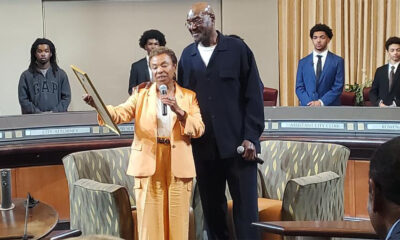
Black Music Month started when Black Music Association members Ed Wright, Kenny Gamble and his wife, journalist and radio host Dyanna Williams were able to persuade President Jimmy Carter to establish the observation on June 7, 1979.

By Wanda Ravernell
Black Music Month and Juneteenth are inextricably linked – Black music is the sound of our freedom.
From the plaintive moans of the enslaved Africans’ ‘sorrow songs,’ to the fields of Civil War battle where Black soldiers picked up abandoned bugles, to the upright piano played in juke joints on Saturday night and churches come Sunday morning, our ancestors’ innovation in the face of want, fear, degradation, and hopelessness has yielded genres of music imitated ’round the world.
Black Music Month started when Black Music Association members Ed Wright, Kenny Gamble and his wife, journalist and radio host Dyanna Williams were able to persuade President Jimmy Carter to establish the observation on June 7, 1979.
In 2000, Congress made it official. In 2009, Pres. Barack Obama changed the name to African American Music Heritage Month and in 2023, Pres. Joe Biden changed it back to Black Music Month, two years after he declared Juneteenth a national holiday, the result of a movement led by Opal Lee.
Our ancestors battle for freedom over these last 400 years and the music that allowed them expression of their humanity deserved to be honored.
But we may be losing sight of the value of their sacrifices.
‘Sing a Song Full of the Faith That the Dark past Has Taught Us…’
Along with the long-known exploitation of Black musicians whose recordings were stolen by record companies, the commercialization of Juneteenth feels like another kind of theft.
I had never heard of Juneteenth until I moved to the Bay Area from my hometown of Philadelphia. I didn’t know it was one of many freedom festivals celebrated by descendants of enslaved people in the United States.
Emancipation Day was Jan. 1 in Pennsylvania, April 16 in Wash., D.C., May 20 in Florida, and Aug. 8 in Kentucky. But Juneteenth, June 19, has the most renown, known in Texas as the ‘colored peoples’ Fourth of July.’
It was marked by parades, beauty pageants, rodeos, backyard barbecues and church picnics.
Yes, church.
The formerly enslaved began the day praying in thanks for their freedom just as they had prayed for Jubilee – the day of freedom – when they had chains on their feet and hands. They ‘testified’ about their past suffering and how they had managed to overcome.
And they sang.
Although, we will not hold it this year, Omnira Institute’s Juneteenth Ritual of Remembrance recalled this part of Juneteenth with prayers in the languages of the African captives. In the middle of the ceremony, a soloist would lead us in singing “Many Thousand Gone” while we took turns reciting portions of the Emancipation Proclamation, the news of freedom that took more than two years to reach Texas – two months after the Civil War ended.
“Many Thousand Gone” was famously recorded by Black luminary Paul Robeson in 1947:
“No more auction block for me,
No more, no more
No more auction black for me
Many thousand gone.”
Other verses refer to the ‘pint of salt’ and the ‘driver’s lash,’ the realities of enslavement that they had survived.
‘Sing a Song Full of the Hope That the Present has Brought Us’
All of the genres of African American music have at their root songs like that, the essence being, as Stevie Wonder, wrote, “the joy inside our pain.” So Black music is not just music. It is our story, our history, our very strength.
During the Civil Rights Movement, which peaked 100 years after slavery ended, the people testified that it was the freedom songs – based on spirituals – that gave them the heart to march, face attack dogs, fire hoses, beatings, and shootouts with vigilantes.
The music reminded them that power was in the people. That music, our music, can do so again. We don’t have to accept the commodification of the products of our culture.
The power of those songs is showing a resurgence across the South as we battle again for the right to self-determination through the ballot box.
Those songs are the voices of our ancestors, voices forged in their blood, their sweat, their tears, joy and, above all, faith. Those songs, those prayers live in our blood and our very breath.
This Juneteenth, let us reclaim those holy voices expressed in Black music for ourselves. It is our birthright. It can neither be bought nor sold. No more. Never again.
Wanda Ravernell is the executive director of Omnira Institute, sponsor for 18 years of the Juneteenth Ritual of Remembrance and Oakland’s 11th Annual Black-Eyed Pea Festival, which will take place on Sept. 12.
Activism
Oakland Post: Week of June 3 – 9, 2026
The printed Weekly Edition of the Oakland Post: Week of June 3 – 9, 2026

To enlarge your view of this issue, use the slider, magnifying glass icon or full page icon in the lower right corner of the browser window.
Activism
Oakland Post: Week of May 27 – June 2, 2026
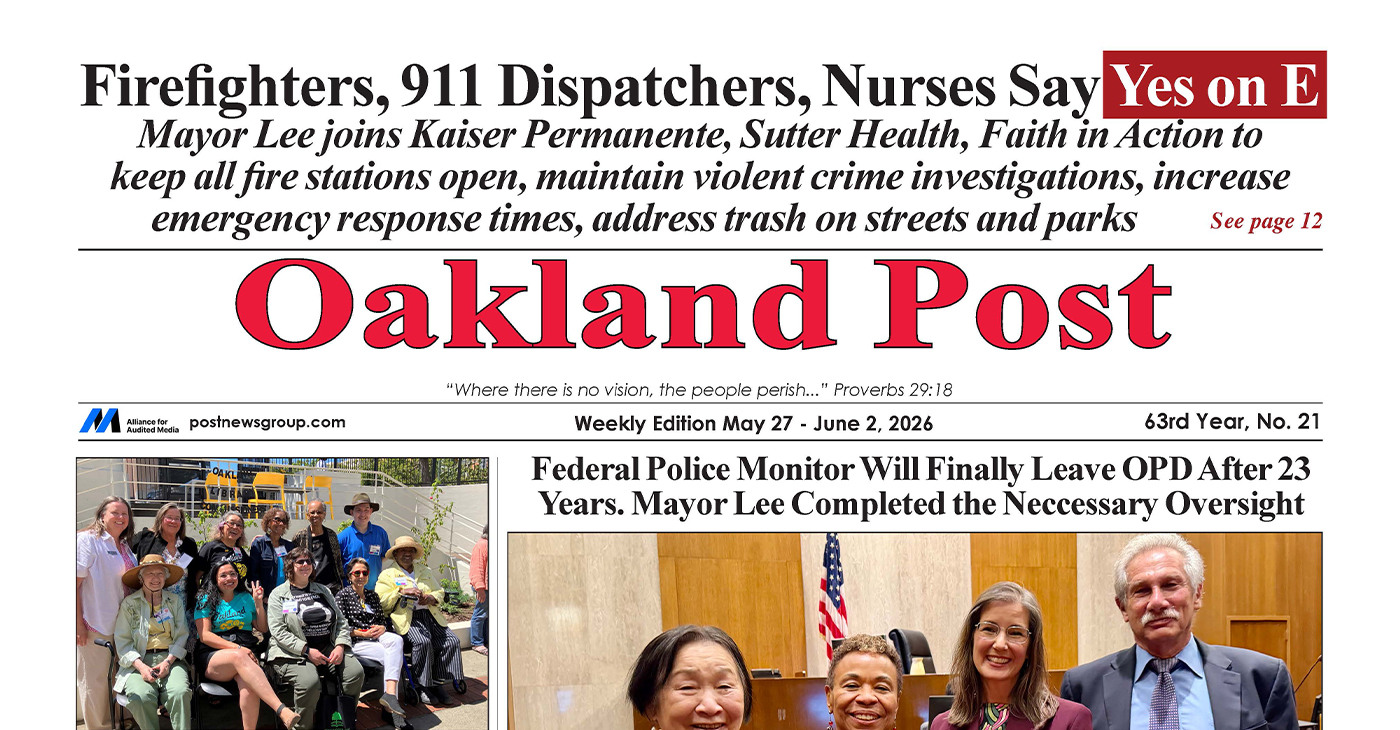
The printed Weekly Edition of the Oakland Post: Week of May 27 – June 2, 2026
To enlarge your view of this issue, use the slider, magnifying glass icon or full page icon in the lower right corner of the browser window.

WORK FROM HOME
Home-based business with potential monthly income of $10K+ per month. A proven training system and website provided to maximize business effectiveness. Perfect job to earn side and primary income. Contact Lynne for more details: Lynne4npusa@gmail.com 800-334-0540


COMMENTARY: Black Music is the Sound of Black Freedom: Let Us Reclaim Both This Juneteenth

Oakland Post: Week of June 3 – 9, 2026

Study: Waiting Lists for Child Care Assistance Nearly Doubled

Venus Williams Calls a Sabalenka Exit a Tragedy

COMMENTARY: Using Art, Healing, And Community to Transform Mental Health Dialogue

Uptown Music Theatre Summer Camp Returns to Inspire the Next Generation of Performers

5 Cleveland Police Officers Injured, Gunfire Erupts During East Side Pursuit

15-YEAR-OLD COLUMBUS GIRL DIES, Community Mourns as Authorities Urge Water Safety Awareness

Let’s Talk Karmelo Anthony!

2026 World Cup is Here and Atlanta is Ready For It

COMMENTARY: What Andrew Young Reminded Me About Baltimore

COMMENTARY: When Politics Intersects with Professional Sports

K4: Crucial Driving Advice BEFORE You Buy! #shorts
The Conversation with Al McFarlane – MINNESOTANS ORGANIZING FOR CHANGE
Negotiate Car Add-Ons: Don’t Get Ripped Off! #shorts

Book Review: Books for College-Bound Students

Against All Odds: Mary Jackson’s Journey to NASA Engineer

Q&A with Steven Bradford: Why He Wants Your Vote for California Insurance Commissioner

Up to the Job: How San Francisco’s PRC Is Providing Work Opportunities That Turn Into Lasting Stability

OPINION: The Fire of Oakland’s Justin Jones

The Marin City Flea Market Is Back

California Launches Free Diaper Program for Newborns Statewide

EBMUD Enshrines the Legacy of its First Black Board Member William ‘Bill’ Patterson

The Ladies of Delta Sigma Theta Hold Day of Advocacy at the Capitol in Sacramento

OP-ED: Small Businesses Need Minnesota to Act on Pass-Through Tax Policy

Oakland Post: Week of May 6 – 12, 2026

Snoop Dogg Celebrates 10 Til’ Midnight at the Compound

2026 Lucid Air Grand Touring Review — Is This $136K EV Sedan Worth It?

Oakland Mayor Pushes Charter Overhaul to Clarify Roles in City Government, Increase Accountability and Improve Service Delivery

Marin City Public Housing Residents Demand a Voice in County’s Renovation Plans

Hyundai Ioniq 5 Parking, Safety, and 360 View #shorts

2025 Ioniq 5 New Wiper & Powerful Performance! #shorts

Electric SUV Range: Is 259 Miles Enough? #shorts

EV Charging: How Fast Can You Charge an Electric Vehicle? #shorts

Biometric Cooling… Messaging Seats…Come on! 2025 Infiniti QX80 Autograph 4WD

Charged Up: Witness the Magic of a Fully Electric Car! #shorts

Range Rover Sport PHEV Included…: See What’s Inside This Luxury SUV! #shorts

Invisible Hood View: Perfect Parking with X-Ray Vision! #shorts

AI Is Reshaping Black Healthcare: Promise, Peril, and the Push for Improved Results in California

ESSAY: Technology and Medicine, a Primary Care Point of View

Sanctuary Cities

The RESISTANCE – FREEDOM NOW

STATE OF THE PEOPLE: Freddie

ECONOMIC BOYCOTT DAY!!!!!

I told You So
-
 Advice3 weeks ago
Book Review: Books for College-Bound Students
-
 Arts and Culture4 weeks ago
Against All Odds: Mary Jackson’s Journey to NASA Engineer
-
 Bay Area3 weeks ago
Q&A with Steven Bradford: Why He Wants Your Vote for California Insurance Commissioner
-
 Activism3 weeks ago
OPINION: The Fire of Oakland’s Justin Jones
-
 Alameda County4 weeks ago
The Marin City Flea Market Is Back
-
 Activism3 weeks ago
California Launches Free Diaper Program for Newborns Statewide
-
 Activism3 weeks ago
The Ladies of Delta Sigma Theta Hold Day of Advocacy at the Capitol in Sacramento
-
 Activism4 weeks ago
EBMUD Enshrines the Legacy of its First Black Board Member William ‘Bill’ Patterson
