
Economics
OP-ED: Shrinking middle class squeezes African Americans, Latinos

They teach our children, drive our buses, clean our streets and deliver our mail. They staff the government and make it run. Their public-sector jobs are at the heart of the middle class, particularly for African-Americans and Latinos. And they are in steep decline.
One of five African-American adults works in government employment. This is a higher percentage than either white Americans or Latinos. It isn’t surprising. Freed of segregation, African-Americans came into our cities just as manufacturing jobs — the traditional pathway to the middle class — were headed abroad. Government employment offered secure jobs, decent pay and benefits, a chance to buy a home and lift your family.
Women also flocked to public service jobs, which offered greater professional and managerial opportunities.
But in 2008 when the economy collapsed, state budgets were savaged. Tax revenues plummeted; spending needs soared. Deep cutbacks in regular programs followed. No one will be surprised to learn that African Americans lost jobs at a higher rate than whites, often because of seniority.
Now, in the sixth year of the recovery, the economy has inched back, unemployment is down. But employment in the public sector hasn’t bounced back. The new jobs being created pay less and offer less security than the jobs that were lost.
And this has devastating effects on the African-American middle class, the very people who have worked hard, played by the rules, and sought to get ahead.
The Economic Policy Institute estimates that since 2007, there are 1.8 million missing jobs in the public sector. Moreover, across the country, conservative Republican governors have assaulted unions and sought to curb collective bargaining, erase teacher tenure, and dramatically cut pensions and other benefits.
The loss of jobs and cutback on wages exacerbated the housing collapse. We’ve learned that banks and other predators targeted black neighborhoods like Prince Georges County in Maryland.
They marketed shoddy mortgages, leaving those with good credit paying higher rates than they could have and those with no credit betting it all on the assumption that housing prices would never fall.
Many report on the decline of the middle class, which has fallen backward over the last decade in both median income and wealth. More than 8 of 10 Americans, according to a Pew Poll, now report that it is harder to maintain their standard of living than it was 10 years ago.
And African-Americans and Latinos got hit the hardest. The race gap has widened, not narrowed, in this century. The New York Times reports that 50 percent of African-Americans now are low-income households, along with 43 percent of Latinos — a category that has been growing since 2000.
In Illinois, the nonprofit Corporation for Enterprise Development reports that more than one in three households suffers a “persistent state of financial insecurity.” Again, African-Americans, Latinos and single women with children fare worse.
Numbers like this numb. We know the reality. But we seem in denial. When Baltimore blows up, the spotlight is put on the police and their practices, as it should be.
But police forces across the country are ordered to keep order in communities racked with unemployment, homelessness, drugs, guns, collapsing schools, impoverished families and crushed hopes. The best-trained, more empathetic police officers in the country would have a hard time fulfilling that mission.
This country cannot stay in denial. We have to have a bold plan to rebuild high poverty neighborhoods from Chicago’s South Side to Appalachia’s valleys. Across the country we have work to do — from rebuilding 100-year-old water systems to creating the rapid transit that will connect people to jobs to moving to clean energy — and we have an entire generation of young people desperate for work.
We have corporations stashing trillions abroad to avoid paying their fair share of taxes. Billionaire hedge fund operators pay a lower tax rate than their secretaries. We need rebuild America and put people to work. The cost of losing another generation to despair will be far greater than the cost of investing in them on the front side of life.











Activism
Oakland Post: Week of September 23 – 29, 2026
The printed Weekly Edition of the Oakland Post: Week of September 23 – 29, 2026
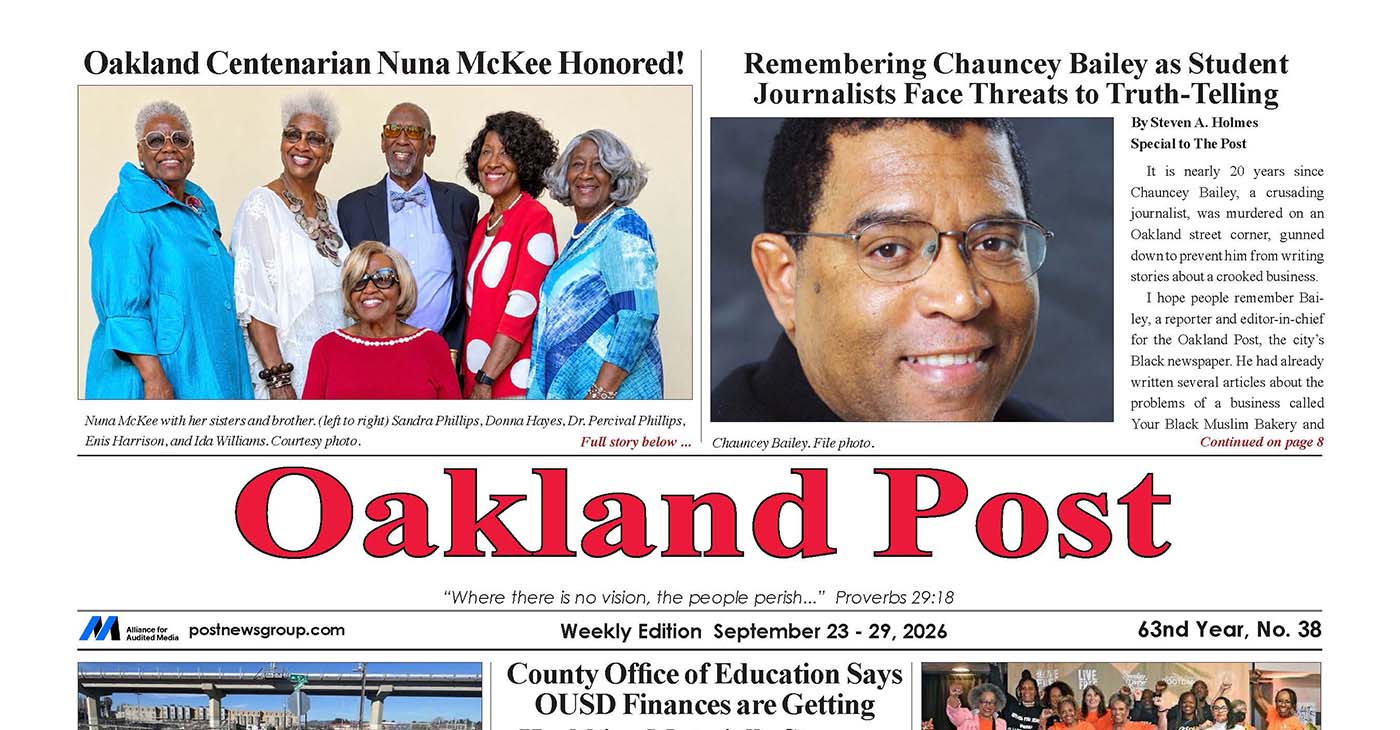
To enlarge your view of this issue, use the slider, magnifying glass icon or full page icon in the lower right corner of the browser window.
Activism
Oakland Post: Week of September 16 – 22, 2026
The printed Weekly Edition of the Oakland Post: Week of September 16 – 22, 2026

To enlarge your view of this issue, use the slider, magnifying glass icon or full page icon in the lower right corner of the browser window.
Activism
Oakland Post: Week of September 9 – 15, 2026
The printed Weekly Edition of the Oakland Post: Week of September 9 – 15, 2026

To enlarge your view of this issue, use the slider, magnifying glass icon or full page icon in the lower right corner of the browser window.



Asm. Corey Jackson Announces Launch of 24-Hour Childcare in His District

IN MEMORIAM: The Rev. Leon “Sonny” Clark, Longtime Orange County Pastor and Community Leader, Dies at 72

Poll: Becerra Widens His Lead Over Hilton; Californians Split on Wealth Tax

From Historic Memories to New Possibilities: Oakland Celebrates Coliseum 60

County Office of Education Says OUSD Finances Are Getting Healthier, Materially Stronger

LIVE FREE Sunday Dinner Brings Faith, Fellowship and Civic Conversation to Oakland

Remembering Chauncey Bailey as Student Journalists Face Threats to Truth-Telling

BLACspace Cooperative Invites Bay Area to Experience Oakland’s Black Cultural Ecosystem Through a BLAC Map Tour + Party

In Wake of Death on Doorstep, Williams Chapel Baptist Church Calls for Better Care, Funding for Unhoused

Oakland Centenarian Nuna McKee Honored!

Caribbean Nations Produce Action Plan Calling for UK Reparations Over Slavery

Oakland Post: Week of September 23 – 29, 2026

Doulas Are Helping Black California Moms Navigate Pregnancy–Even as High Mortality Rates Persist

Newsom Signs Addictive Social Media Law to Protect Kids

On Your November Ballot: Prop 38 Would Allocate $8.4 Billion to Immunology and Immunotherapy Funding

Standoff for Justice: Our Homes Are Worth Fighting For

Oakland Post: Week of August 26 – September 1, 2026

Frontier Airlines’ Return to Oakland Airport Brings Flights, Jobs and Opportunity

Gubernatorial Candidate Steve Hilton Blasts California New Tire Rules; Newsom Hits Back

Chef Sharon Lee Blends Culinary Excellence, Education and Empowerment

Jackie Wright Champions Bay Area Stories, Filmmakers and Cultural Institutions

Big City Mayors Ask for “Yes” Vote on Housing Bond Measure; Conservatives Say “No”

Oakland Coliseum Project Opens Door for Small Businesses to Build Bigger

Gov. Newsom’s Latest Appointees Include Sacramento Advocate for Formerly Incarcerated Students; State’s New Tech Chief

Misnamed ‘Parent’ PAC Seeks to Influence Oakland School Board Elections

Longtime BWOPA Member Brendalyn Goodall Appointed to California Workforce Development Board

Gov. Newsom Signs Law Shielding Immigration Aid Workers From Doxing Threats

Secretary of State Shirley N. Weber Urges Californians to Vote Early as Voter ID Battle Intensifies

From Palestine to Oakland: Seeds for Liberation Examines Shared Struggles for Freedom

IN MEMORIAM: Dolly Parton Dead at 80 — How She Built a Legacy of Love and Earned Her Place in Black Culture

The Conversation With Al McFarlane 6/23/26

Media Monday 6/22/26

LIVE! ASK ALMA! — TUES. 6.23.26 7PM EST

Car Buying Secrets: 4 Hidden Checks Before You Sign!

Is This 550 HP Charger Worth YOUR Money? AutoNetwork Review

Celebrating Juneteenth – Frederick Douglass on education and resistance

LIVE! — ASK ALMA! — TUES. 6.19.26 7PM EST

Hyundai Ioniq 5 Parking, Safety, and 360 View #shorts

2025 Ioniq 5 New Wiper & Powerful Performance! #shorts

Electric SUV Range: Is 259 Miles Enough? #shorts

EV Charging: How Fast Can You Charge an Electric Vehicle? #shorts

Biometric Cooling… Messaging Seats…Come on! 2025 Infiniti QX80 Autograph 4WD

Charged Up: Witness the Magic of a Fully Electric Car! #shorts

Range Rover Sport PHEV Included…: See What’s Inside This Luxury SUV! #shorts

Invisible Hood View: Perfect Parking with X-Ray Vision! #shorts
-
 Community2 weeks ago
Misnamed ‘Parent’ PAC Seeks to Influence Oakland School Board Elections
-

 Activism3 weeks ago
Oakland Post: Week of September 2 – 8, 2026
-

 Community2 weeks ago
Richmond Tiny House Village Farm & Garden Set to Open Gates on Sept. 26
-

 Activism3 weeks ago
Oakland Post: Week of September 9 – 15, 2026
-

 Black History2 weeks ago
Latest Massacre in Haiti Reveals Cruelty U.S. Deportations
-

 Black History2 weeks ago
OPINION: Nolan Wells’ Death One of Several Signifying Racial Terror Lives on in U.S. South
-

 Community2 weeks ago
Democratic Clubs Interview Candidates for Oakland School Board
-
 Featured2 weeks ago
‘Ready to See These Bills Become Law’: Sen. Weber’s Package of 15 Bills Advance to Gov. Newsom’s Desk
