
City Government
OP-ED: Don’t Stop Window Smashing by Targeting Peaceful Demonstrators

By Rebecca Kaplan
In recent years, we have suffered from the cyclical epidemic of responding to problems by aiming at the wrong targets.
Some people, expressing (or pretending to express) anger about police misconduct, have broken windows and vandalized Oakland businesses. Being angry about police misconduct is legitimate, but the target — local Oakland businesses — is the wrong place to put that anger.
Many people have responded by pointing out that “having your windows smashed is not as bad as being killed,” but that does not solve the problem that the people whose windows are being smashed are not the people who did the killing.
Smashing windows and causing economic hardship to Oakland businesses and workers does nothing to stop the nationwide crisis involving the shooting of unarmed Black men.
The vandalism undermines efforts to build real solutions, diverting effort and public attention away from the need to end these wrongful deaths, and causing the public to associate the movement with the destruction of property of those who have done nothing wrong.
But just as window smashing misses the target, so too has the Oakland city administrations’ response to it — repeatedly — over the years. Those who engage in vandalism have often gotten away with it, while peaceful demonstrators are surrounded and arrested.
The window smashing is illegal and destructive, and it is important to hold people who do it accountable. However, mass arrests of nonviolent protesters who had nothing to do with the window smashing is missing the target — just like the window smashing itself.
This is not a question of having enforcement versus no enforcement; it’s a question of enforcement against the people who committed the harm versus enforcement targeted against those who did not commit the harm.
Because police resources are stretched thin, focusing efforts on strategies that don’t improve public safety means that other important work isn’t happening — such as catching illegal gun dealers, armed robbers, and the window-smashers.
Regardless of whether someone believes it is appropriate to devote substantial police resources to move demonstrators from streets to sidewalks, (and whether or not it turns out to be legal, which we do not yet know), surely we can all realize that it does not target the vandals who got away with their acts of destruction.
The people being cited and arrested are not believed to have engaged in vandalism — and meanwhile, those who committed the vandalism are not being held accountable.
To effectively respond to and redress the vandalism, we should directly target, and hold accountable the people who have engaged in acts of vandalism.
Therefore, I am asking that Oakland specifically:
- Make a real effort to identify and hold accountable those who have engaged in vandalism.
For those who did not get caught, continue efforts after-the-fact to identify and find them. Collect and review video and photo footage and work to find the identity of the vandals.
Ask the public for help in identifying people in photos. Initiate significant litigation against those who engaged in vandalism and destruction to seek payment for the harm they caused, including compensating the businesses for their impact, and requiring a commitment that they refrain from such acts in the future.
- Help the businesses that were harmed, including with tenant improvement and façade improvement funds.
Make city funds available, in a timely way, to support needed repairs, including allowing funds to be used for strengthening measures to make businesses less vulnerable in the future. (Such as helping install metal roll-down doors and unbreakable windows).
Those who vandalize Oakland businesses not only create blight in our community, but they also endanger the jobs of working people who rely on their jobs at these businesses to feed their families and put roofs over their heads. Those who vandalize Oakland businesses are not only creating harm to our business owners, but also are putting the economic security of working people and our broader community at risk.
Rebecca Kaplan is vice mayor of Oakland. This column was originally published in the East Bay Express.












Activism
Oakland Post: Week of September 23 – 29, 2026
The printed Weekly Edition of the Oakland Post: Week of September 23 – 29, 2026
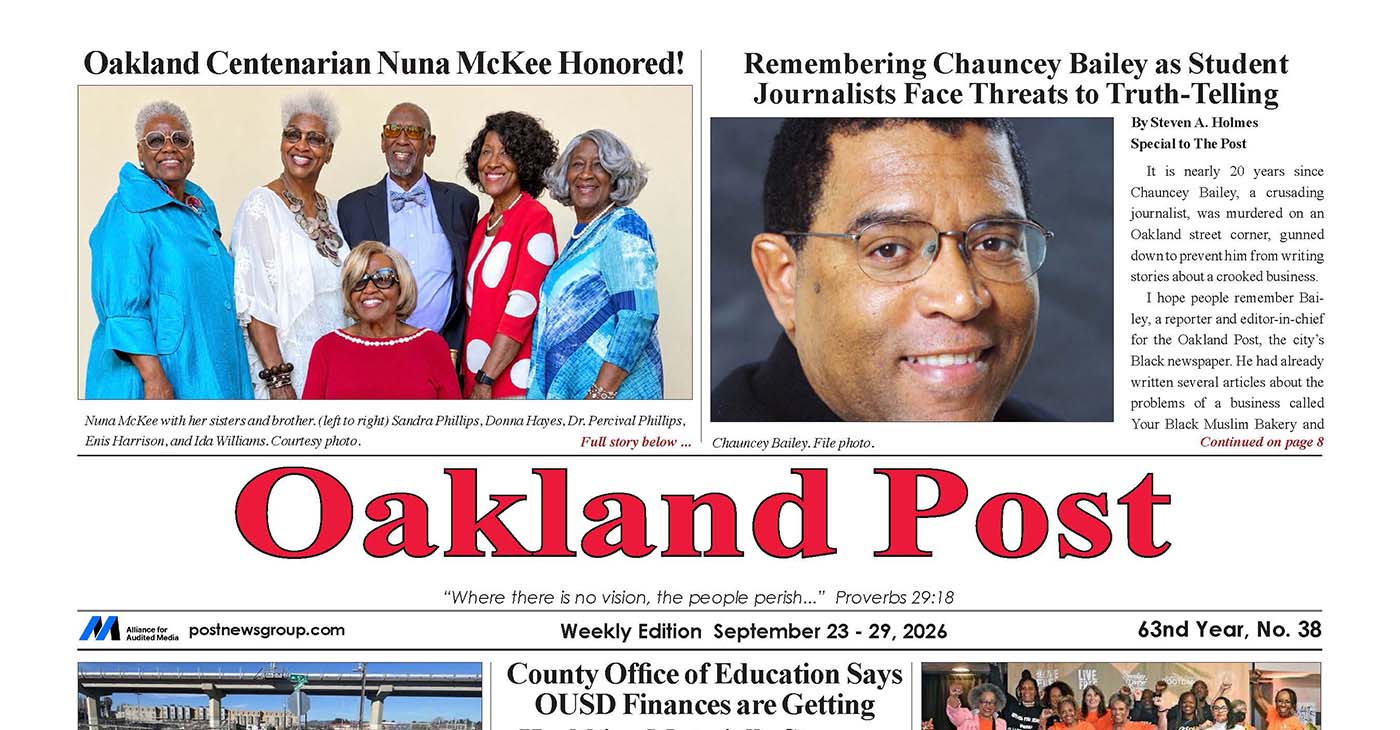
To enlarge your view of this issue, use the slider, magnifying glass icon or full page icon in the lower right corner of the browser window.
Activism
Oakland Post: Week of September 16 – 22, 2026
The printed Weekly Edition of the Oakland Post: Week of September 16 – 22, 2026
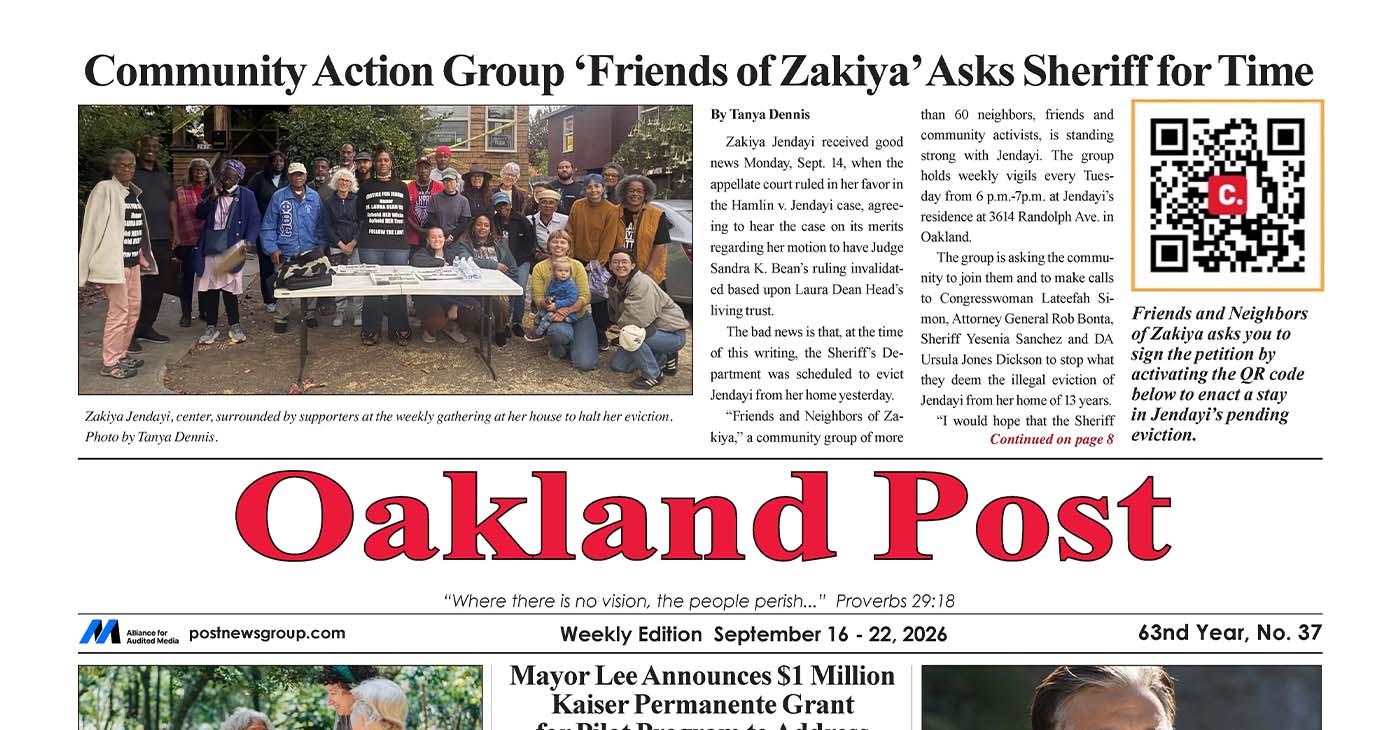
To enlarge your view of this issue, use the slider, magnifying glass icon or full page icon in the lower right corner of the browser window.
Activism
Oakland Post: Week of September 9 – 15, 2026
The printed Weekly Edition of the Oakland Post: Week of September 9 – 15, 2026

To enlarge your view of this issue, use the slider, magnifying glass icon or full page icon in the lower right corner of the browser window.



Asm. Corey Jackson Announces Launch of 24-Hour Childcare in His District

IN MEMORIAM: The Rev. Leon “Sonny” Clark, Longtime Orange County Pastor and Community Leader, Dies at 72

Poll: Becerra Widens His Lead Over Hilton; Californians Split on Wealth Tax

From Historic Memories to New Possibilities: Oakland Celebrates Coliseum 60

County Office of Education Says OUSD Finances Are Getting Healthier, Materially Stronger

LIVE FREE Sunday Dinner Brings Faith, Fellowship and Civic Conversation to Oakland

Remembering Chauncey Bailey as Student Journalists Face Threats to Truth-Telling

BLACspace Cooperative Invites Bay Area to Experience Oakland’s Black Cultural Ecosystem Through a BLAC Map Tour + Party

In Wake of Death on Doorstep, Williams Chapel Baptist Church Calls for Better Care, Funding for Unhoused

Oakland Centenarian Nuna McKee Honored!

Caribbean Nations Produce Action Plan Calling for UK Reparations Over Slavery

Oakland Post: Week of September 23 – 29, 2026

Doulas Are Helping Black California Moms Navigate Pregnancy–Even as High Mortality Rates Persist

Newsom Signs Addictive Social Media Law to Protect Kids

On Your November Ballot: Prop 38 Would Allocate $8.4 Billion to Immunology and Immunotherapy Funding

Standoff for Justice: Our Homes Are Worth Fighting For

Oakland Post: Week of August 26 – September 1, 2026

Frontier Airlines’ Return to Oakland Airport Brings Flights, Jobs and Opportunity

Gubernatorial Candidate Steve Hilton Blasts California New Tire Rules; Newsom Hits Back

Chef Sharon Lee Blends Culinary Excellence, Education and Empowerment

Jackie Wright Champions Bay Area Stories, Filmmakers and Cultural Institutions

Big City Mayors Ask for “Yes” Vote on Housing Bond Measure; Conservatives Say “No”

Oakland Coliseum Project Opens Door for Small Businesses to Build Bigger

Gov. Newsom’s Latest Appointees Include Sacramento Advocate for Formerly Incarcerated Students; State’s New Tech Chief

Misnamed ‘Parent’ PAC Seeks to Influence Oakland School Board Elections

Longtime BWOPA Member Brendalyn Goodall Appointed to California Workforce Development Board

Gov. Newsom Signs Law Shielding Immigration Aid Workers From Doxing Threats

Secretary of State Shirley N. Weber Urges Californians to Vote Early as Voter ID Battle Intensifies

From Palestine to Oakland: Seeds for Liberation Examines Shared Struggles for Freedom

IN MEMORIAM: Dolly Parton Dead at 80 — How She Built a Legacy of Love and Earned Her Place in Black Culture

The Conversation With Al McFarlane 6/23/26

Media Monday 6/22/26

LIVE! ASK ALMA! — TUES. 6.23.26 7PM EST

Car Buying Secrets: 4 Hidden Checks Before You Sign!

Is This 550 HP Charger Worth YOUR Money? AutoNetwork Review

Celebrating Juneteenth – Frederick Douglass on education and resistance

LIVE! — ASK ALMA! — TUES. 6.19.26 7PM EST

Hyundai Ioniq 5 Parking, Safety, and 360 View #shorts

2025 Ioniq 5 New Wiper & Powerful Performance! #shorts

Electric SUV Range: Is 259 Miles Enough? #shorts

EV Charging: How Fast Can You Charge an Electric Vehicle? #shorts

Biometric Cooling… Messaging Seats…Come on! 2025 Infiniti QX80 Autograph 4WD

Charged Up: Witness the Magic of a Fully Electric Car! #shorts

Range Rover Sport PHEV Included…: See What’s Inside This Luxury SUV! #shorts

Invisible Hood View: Perfect Parking with X-Ray Vision! #shorts
-
 Community3 weeks ago
Misnamed ‘Parent’ PAC Seeks to Influence Oakland School Board Elections
-

 Activism3 weeks ago
Oakland Post: Week of September 2 – 8, 2026
-

 Community3 weeks ago
Richmond Tiny House Village Farm & Garden Set to Open Gates on Sept. 26
-

 Activism3 weeks ago
Oakland Post: Week of September 9 – 15, 2026
-

 Black History3 weeks ago
Latest Massacre in Haiti Reveals Cruelty U.S. Deportations
-

 Black History3 weeks ago
OPINION: Nolan Wells’ Death One of Several Signifying Racial Terror Lives on in U.S. South
-

 Community3 weeks ago
Democratic Clubs Interview Candidates for Oakland School Board
-

 Featured3 weeks ago
‘Ready to See These Bills Become Law’: Sen. Weber’s Package of 15 Bills Advance to Gov. Newsom’s Desk
