
Opinion
Op-Ed: Oakland Achieves School Progress Report Misses the Mark

By Jan Malvin and Joel Moskowitz
Confusing the public may well be the major achievement of the fourth annual Oakland Achieves Public Education Progress Report prepared by Urban Strategies Council.
This report, deemed “primarily an update on the academic outcomes for the 2014-15 school year,” offers no trends data for Oakland Unified School District-run schools.
Rather, it is the first report in the series to feature student-level data from charter schools.
Without explaining the omission of trends data for district-run schools, the report appears crafted to tell a story that compares charter schools with district-run schools.
Commenting on Oakland Achieves, the Executive Director of GO Public Schools states, “The data is at a high level to spark collaborative learning, not to pit school types against each other and draw tentative conclusions.”
Yet, this report manufactures unfair competition between the charter and district-run school sectors, relying on incomplete or biased data.
For example, out-of-district students enrolled in OUSD-authorized charter schools ranged from 0-56 percent in 2015-16 (average = 14 percent).
How fair would it be to judge performance of a sports team that recruits exclusively from within the city against one that recruits from the whole Bay Area?
Urban Strategies announced, “One important finding revealed that while charter schools did poorly in ELA testing for 3rd-5th graders, by middle school, math testing of 7th & 8th grades were much better than for district schools—a flip in performance.”

Claiming such a “flip in performance” by comparing data from two different cohorts of students at a single point in time, one set of data from English (ELA) and the other from math, is absurd.
If this observation were valid, a more plausible interpretation is that many high achieving students in district-run elementary schools transfer to charters or private schools for middle and high school.
Much higher standards—matched comparison groups, measurement of each indicator at least twice—apply before one can make causal statements about school effects on student performance.
If these standards cannot be met by design, analysts must employ statistical controls for all pre-existing differences that may affect the outcomes.
Since Oakland Achieves failed to address pre-existing student differences, conclusions about charter vs. district-run schools are indefensible.
It is essential to understand the school-site practices and other factors that underlie different outcomes.
This report does not acknowledge this shortcoming and so misleads the reader with false comparisons between types of schools.
Many factors may account for student outcomes, but Oakland Achieves addresses none of these.
For example, selective enrollment and pushout practices, described by the ACLU in Unequal Access, its recent report on charter school enrollment practices, can influence indicators of student progress (see: www.aclusocal.org/unequal-access/).
Oakland Achieves does not consider the impact on student outcomes of teacher turnover and experience; instructional practices; curriculum; parental involvement, education, and occupation; and details about vulnerable subgroups.
For example, are special education students in charter schools less diverse than special education students in district-run schools?
A final shortcoming of Oakland Achieves is that a considerable amount of data was missing for charter schools. Although the report notes the omission, it does not spell out the implications.
Missing data, especially if not random, biases comparisons with district-run schools because charter results do not reflect the entire charter school population.
Despite public claims to the contrary, Oakland Achieves has not demonstrated that charter schools do a better (or worse) job than district-run schools on any of the indicators presented.
The outcomes are different because, from the start, the students are different.
Jan Malvin, Ph.D., is a retired University of California researcher; Joel Moskowitz, Ph.D., is in the School of Public Health, UC Berkeley.













Activism
Oakland Post: Week of September 9 – 15, 2026
The printed Weekly Edition of the Oakland Post: Week of September 9 – 15, 2026

To enlarge your view of this issue, use the slider, magnifying glass icon or full page icon in the lower right corner of the browser window.
Activism
Oakland Post: Week of September 2 – 8, 2026
The printed Weekly Edition of the Oakland Post: Week of September 2 – 8, 2026
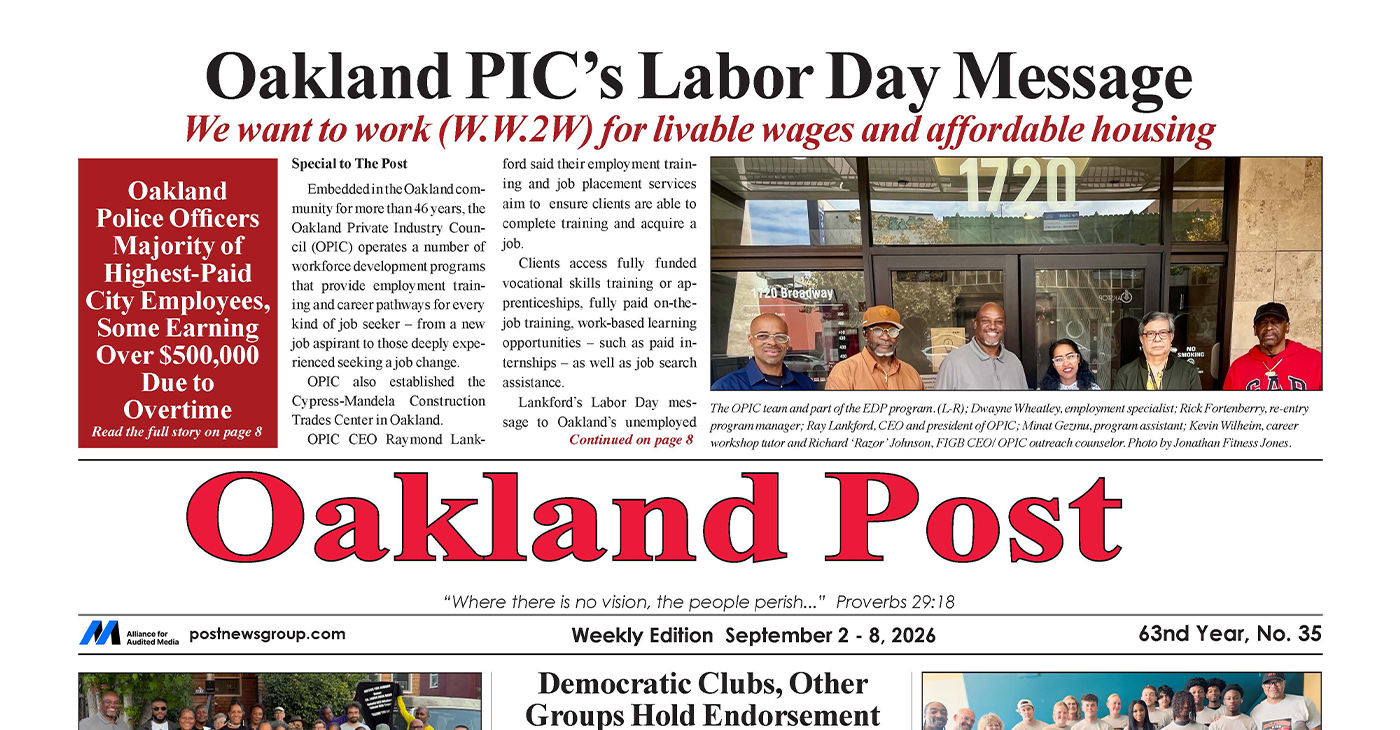
To enlarge your view of this issue, use the slider, magnifying glass icon or full page icon in the lower right corner of the browser window.
Activism
Oakland Post: Week of August 26 – September 1, 2026
The printed Weekly Edition of the Oakland Post: Week of August 26 – September 1, 2026

To enlarge your view of this issue, use the slider, magnifying glass icon or full page icon in the lower right corner of the browser window.



Port of Oakland, Army Corps Sign Historic Harbor Design Agreement

Democratic Clubs Interview Candidates for Oakland School Board

Nuna Phillips-McKee Celebrates 100 Years: ‘A Century of Faith, Family and God’s Amazing Grace!’

D.A. Ursula Jones Dickson: Terminix to Pay $3.15 Million Over Illegal Disposal of Pesticides, Customer Records

REPORT: Community Level Policy Is Impacting Homelessness and Drug Abuse in California
OPINION: AI Needs to Know Who Is the Boss
Goldi-Locs and Two (or Three) Bears in the Forest in California Hills

Election Watch 2026: 85% of Eligible Voters in California Are Registered

Don’t Let scammers Crash Your School Year

BOOK REVIEW — Curved Air: A Biography of Sickle Cell Anemia and the Quest to Cure the First Molecular Disease

California’s Legal Cannabis Market Hits $8 Billion as State Touts Progress on Fighting Drugs, Crime

Blacks and Latinos Clash Over LA’s Barrio Run; Mayor Karen Bass Calls for Dialogue Across Racial, Neighborhood Lines

Asm. Smallwood-Cuevas’s Bill Repealing ‘Racist’ CalWORKs ‘Man-in-the-House’ Rule Clears Legislature

Asm. Smallwood-Cuevas’s Bill Repealing ‘Racist’ CalWORKs ‘Man-in-the-House’ Rule Clears Legislature

‘Ready to See These Bills Become Law’: Sen. Weber’s Package of 15 Bills Advance to Gov. Newsom’s Desk

Department of Homeland Security Demands California Secretary of State Shirley N. Weber Scrub Voter Rolls

New Judge Could Decide if Karmelo Anthony Gets a New Trial

“The Power to See Threats Sooner”: Gov. Newsom, Safety Officials Showcase California’s Investments in Hi-Tech Wildfire Prevention

Alpha Kappa Alpha Sorority, Inc. Celebrates New North Atlantic Regional Director

California Sen. Padilla Joins Colleagues to Introduce Bill Imposing Term Limits on Supreme Court Justices

Less Affluent School Districts, Including Sacramento City, Face Threat of State Takeover

Car Wash Workers Cope with Lingering Impacts of ICE Raids

Oakland Post: Week of July 29 – August 4, 2026

How Oakland’s Courtsmith is Scaling its Business and Local Impact

ESSAY: California Can Close Its Colorectal Cancer Gap

Oakland Post: Week of August 5 – 11, 2026

As Part of Your Back-to- School Checklist, Vaccinate

Oakland ‘Port Serves as a Powerful Engine for Good Jobs and Economic Development

Gov. Newsom Signs New Affordable Housing Legislation

Gov. Newsom Announces $109.6 Million in Funding for 278 Supportive Homes in Bakersfield, Contra Costa, Sacramento and Fresno

The Conversation With Al McFarlane 6/23/26

Media Monday 6/22/26

LIVE! ASK ALMA! — TUES. 6.23.26 7PM EST

Car Buying Secrets: 4 Hidden Checks Before You Sign!

Is This 550 HP Charger Worth YOUR Money? AutoNetwork Review

Celebrating Juneteenth – Frederick Douglass on education and resistance

LIVE! — ASK ALMA! — TUES. 6.19.26 7PM EST

Hyundai Ioniq 5 Parking, Safety, and 360 View #shorts

2025 Ioniq 5 New Wiper & Powerful Performance! #shorts

Electric SUV Range: Is 259 Miles Enough? #shorts

EV Charging: How Fast Can You Charge an Electric Vehicle? #shorts

Biometric Cooling… Messaging Seats…Come on! 2025 Infiniti QX80 Autograph 4WD

Charged Up: Witness the Magic of a Fully Electric Car! #shorts

Range Rover Sport PHEV Included…: See What’s Inside This Luxury SUV! #shorts

Invisible Hood View: Perfect Parking with X-Ray Vision! #shorts
-

 Business4 weeks ago
California Hispanic Chambers of Commerce Unveils: ‘Powering the Future’ Theme for 47th Annual Statewide Convention
-

 Community4 weeks ago
Four Candidates, Including Incumbent Barbara Lee, Qualify for Oakland Mayor’s Race
-

 Activism4 weeks ago
Oakland Post: Week of August 12 – 18, 2026
-

 Black History4 weeks ago
Oakland Observes Black August with Block Parties, Film Showings, Workshops
-

 Commentary4 weeks ago
COMMENTARY: Why Local School Tax Measure G1 Will Not Be on the November Ballot
-

 Commentary2 weeks ago
Standoff for Justice: Our Homes Are Worth Fighting For
-

 Business2 weeks ago
Gubernatorial Candidate Steve Hilton Blasts California New Tire Rules; Newsom Hits Back
-

 Activism2 weeks ago
Oakland Post: Week of August 26 – September 1, 2026
