
City Government
OP-ED: Mayor, City Council Should Heed Residents’ Call for a Department of Race and Equity

By Ise Lyfe
Auditioning. That’s what comes to mind when I think about the dynamic in the media and tone of local and federal governments as it relates to police brutality and holding law enforcement accountable for the perpetual murder of Black men.
Black men and women are on a constant and relentless audition for their humanity in America. After a Black man is murdered by a police officer, a peculiar thing begins to unfold and the auditioning begins.
First, the officer(s) is swept off into ambiguity, their names and histories all hidden and protected. This seems to be the pre-production to the audition and then, the real show begins.
Then, the life of the victim previous to his death at the hands of the officer(s) is put on trial, or audition. For example: “Was he in a gang?” “Was their marijuana in his system?” ”Did he graduate from high school?” “Has he ever been to prison?“
All of these questions are emitted from news media and they reflect the thinking of a large share of Americans. These questions are all offsets of the real question and feeling Americans subconsciously have when they learn of an unarmed Black man or woman being murdered:

“Is this person human enough for me to care about them being murdered by the police?”
Phase two of the audition comes along when the victim’s family is shuffled in front of cameras as they weep and try to compose themselves to talk about the murder of their loved one to a nation that is listening to them as long as a game isn’t on or Mayweather isn’t fighting…This nation stares into TV and computer screens and casually assesses the family, and in this part of the audition, America is deciding if the family of the deceased is a family that we should care about or is it safe to assume they bred a thug that was a loser and probably got what he had coming.
More questions are triggered as the family emerges:
“Why was he walking on that part of the road?” “Why was he standing in front of that store?”
Then comes the final phase of the audition…How Black communities and their allies respond to the injustice is scrutinized for the final part of the audition:
“Is their rage valid?” “Should they be blocking traffic as they protest?” “Should they be protesting at all?”
Jesse Jackson (who is so irrelevant to Black youth that if you showed a room full of Black kids a picture of Jesse and Billy D. Williams, they wouldn’t know the difference) said their rioting is uncalled for – is he right?
Black people who have been living in this country for four centuries and have been legal citizens here for a century and a half still can’t get a benefit of the doubt on their humanity!
Furthermore, their right to speak out against their oppression is ridiculed by America and largely perceived as an annoyance, sans the ratings and advertising dollars network news coverage rakes in from it all.
Residents and community organizations in Oakland, CA are asking their city government for an institutional solution to the disparities the city is plagued with. These disparities range from policing and safety to education and access to healthy foods.
The proposed solution is a city funded Department of Race and Equity.
The notion and plan was first authored by newly reelected City Councilmember Desley Brooks, who this past November was selected by Oakland voters to her 4th term as the leader of East Oakland’s District 6.
As she started her 13th year in office at the beginning of 2015, Black America was holding up a new slogan for the newest phase of humanity auditioning, Black Life Matters. They needed to remind America of that, you see…
Councilmember Brooks marched with protestors and was in agreeance with the provocative and peaceful protest against the slaying of Mike Brown and Kevin Garner. These peaceful protest shutdown Bay Area Rapid Transit for hours and brought media attention to a community demand for justice.
From her appointed office, she took on the challenges of racial injustice by laying the groundwork for a department of race and equity, which would be unprecedented in Oakland, both one of the nations most diverse and inequity riddled cities. Marketing ploys and PR driven travel articles about Oakland are criminally omissive about what the city really reflects.
Right now, an African-American child from East Oakland can expect to live 15 years less than a white child living only a few miles away.
That’s roughly equivalent to the difference between Iceland and Iraq. In 2006 Samoans had the highest arrest rate of any racial ethnic group in Oakland and Laotians in Oakland suffer from disproportionately high arrest rates.
Less than half of Latino and African-American male students graduate from high school.
“We all have our roles to play, and as elected officials we have to go a step beyond listening to our constituents and be imaginative and useful with the resources available to us,” said Desley Brooks. “The city government cannot and should not be spectators to the community’s call to end inequity. We should be partners and allies in this process. I’ve been a politician for sometime and one thing is for sure – if the city doesn’t put money behind it, it is all just lip service. This is why I’m asking our city to offer money and an institutional framework to end inequity in Oakland, rather than make empty promises and hold stale redundant meetings.“
Though Brooks initiated this call for a department of race and equity, she is far from a lone ranger in the cause. In just two months the campaign for the department has gotten over 31 major endorsements including but not limited to the NAACP, the Director of Alameda County Transit, Alameda County Central Labor Council, Asian Pacific Environmental Network , East Bay Asian Youth Center ,Communities For A Better Environment, Ella Baker Center for Human Rights, and Causa Justa. Also, petitions both physical and online have tallied several hundred endorsements from residents across the city saying that this is something they want. Oakland residents even started a Facebook page dedicated to this effort.
You would think all of this support and outcry would move Oakland’s mayor, Libby Schaaf, and the other city council members to join the effort to bring this office into fruition, but it hasn’t. In fact, none of the other city council members elected by Oakland voters have endorsed or even acknowledged officially what so many Oaklanders in their districts are asking for. Councilmember Brooks has asked for a mere $500,000 from the City’s 2 year 1 BILLION DOLLAR budget to open the department. That is only 0.05% of the budget. The rest of the city officials seem to be balking at it or treating it like some radical notion. Meanwhile Mayor Schaaf is allocating $194,000,000 to the Oakland Police Department and the city spends $10,000,000 a year to subsidize the Oracle Arena, home of the Golden State Warriors.
Neither Councilmember Rebecca Kaplan nor Councilmember Noel Gallo were available when contacted for this article.
On April 22nd while holding a Twitter forum about the budget she will be submitting on April 30, 2015, Mayor Schaaf’s response to her constituents asking her to include a department of race and equity in the city budget was, to me (and others), insensitive and displaying of how out of touch even the mayor might be about equity:
“We love to cut ribbons but I would ALSO love to see us improve the structures and services we already have.”
Unfortunately, Mayor Schaaf seems to be unaware that Oakland has no structures or services within its body that address racial equity for her to improve…
Oaklanders living under putrid inequity conditions are not asking for a “ribbon to be cut”, their asking for the boot of police brutality and the noose of institutional racism to be cut from their necks.
Insiders have revealed that Mayor Schaaf, under pressure from residents who support the call for a department of race and equity, has included $100,000 to spread across 2 years to pay a “Race and Equity Consultant” to build an “Equity map” in Oakland. One, taking $100,000 out of a $1,000,000,000 for racial equity in Oakland is offensive and appalling. Two, by law, a consultant or contractor could not be managed or held accountable by the city. This is antithetical to what community members are asking for. Basically, this offering from the mayor outsources the responsibility of making Oakland equitable.
In researching all of this I thought I’d make a call to one of the bright minds and city actions that inspired Councilmember Brooks to call for a department of race and equity in Oakland.
I spoke with Donte James, Esq., Director of Portland, OR’s Office of Equity and Human Rights, to get a feel for what his office has accomplished and what it has done for Portland. To put race in context in the state of Oregon: When Oregon was granted statehood in 1859, it was the only state in the Union admitted with a constitution that forbade black people from living, working, or owning property there. It was illegal for black people even to move to the state until 1926.
“This department has only been in existence for a little over 3 years,” said James, “but in that time we’ve changed hiring policies, we’ve band the box so that people who have been formerly incarcerated do not have to check a mark on job applications that they’ve been convicted of a crime, and we facilitate a complete budget equity tool for every department in our city to be sure that resource allocation is guided by an ethic of equity. I’m really proud of the racial equity strategic plan our office has developed here. It essentially is a living document for every city department that unfolds over a 5-year period of time. This is the tool that helps to make sure that hiring, purchasing, contracting, outreach, and a sleuth of other important quality of life markers in Portland are equitable.”
He added, “We also work with the police bureau so that the interview and hiring of police is more character oriented and not just questions about a potential officers training or strategy index.”
Because of the push back or non-responsiveness Oakland residents are getting from their mayor and council members, I asked James if there was any initial push back on starting the office in Portland:
“Oh, absolutely – the main push back being around the funding of it. We were getting financial push back but we were only asking for about 1% of the entire city budget- 1.5 million of 300 million. Some people said that focusing on race creates more problems than it fixes. These of course were unfounded ideas. And you know, I really have to give a lot of credit to our mayor, Mayor Charlie Hales. He’s always addressed the inequities in Portland and stood behind our office unapologetically and that is necessary. I report directly to him and that’s what this is all about, accountability and structure,” James said.
(For added context, I want to note that Portland’s Mayor is a 59 year-old White man)
I was blown away listening to Mr. James, followed by even further disappointment and confusion in Oakland’s elected officials.
I’m from East Oakland’s Brookfield neighborhood. Unfortunately, if you grew up where I did, you’re not just from Oakland – you survive Oakland. We do not get to live in Oakland, we are surviving there. You survive the racially inequitable Oakland Unified School District, you survive your neighborhood with no grocery store, you survive skyrocketing rents and the new trampling inhabitants, and of course (if you’re lucky) you survive contact with over zealous and undertrained police officers.
There are two Oakland’s in Oakland, no matter how many trendy coffee and apparel shops you see popping up. What will define the new mayor is her willingness and performance to end the last twenty-year side stepping of racial issues in the city. She could start with an errata to her budget that provides in a tangible way the development of a Department of Race and Equity in Oakland.
In the meantime while we are all waiting, people of various backgrounds in the city are waking up and getting ready for their next humanity audition.
Ise Lyfe (HBO Def Poetry, Huffington Post, New York Times) is an award winning conceptual artist, justice advocate, author, and actor. Additionally, he’s one of the leading Spoken Word artists in America with a broad fan base stemming from appearances on several commercial market platforms and his social and political commentary.










Activism
Oakland Post: Week of September 30 – October 6, 2026
The printed Weekly Edition of the Oakland Post: Week of September 30 – October 6, 2026
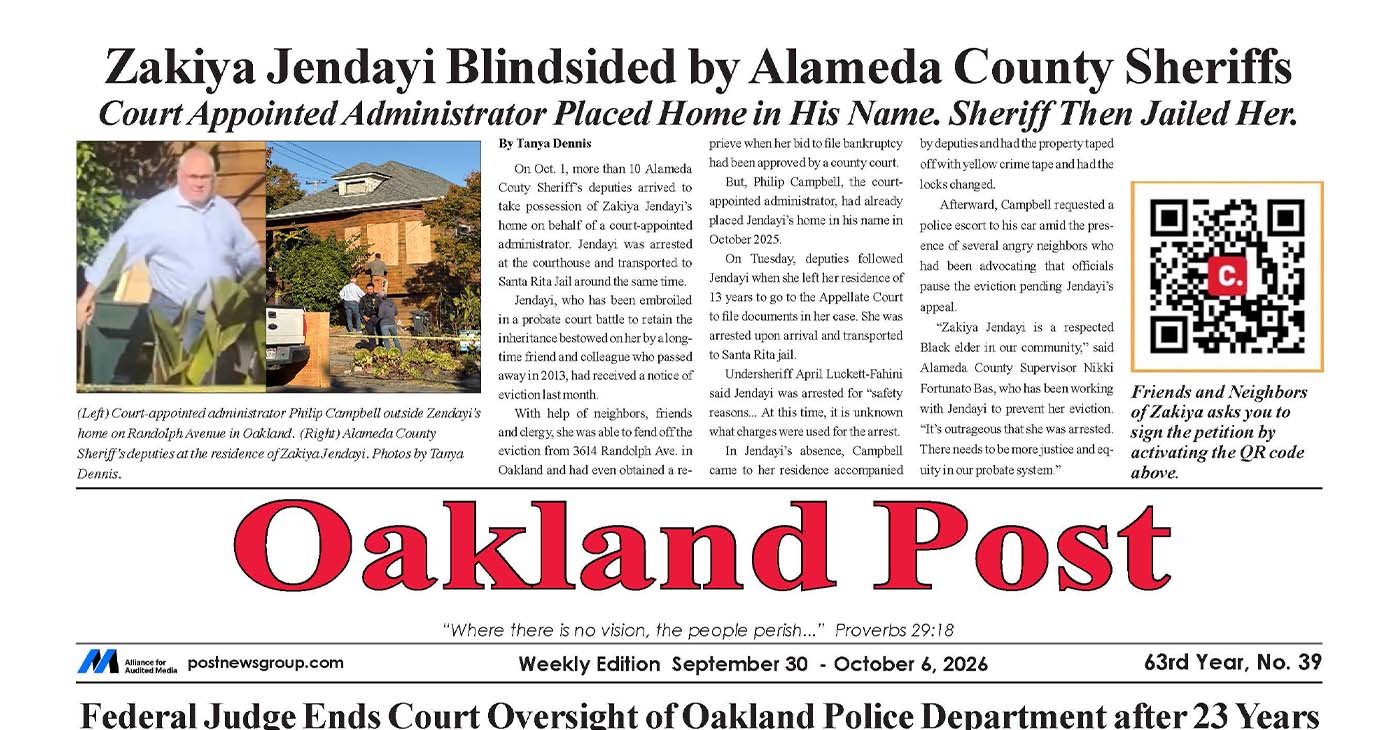
To enlarge your view of this issue, use the slider, magnifying glass icon or full page icon in the lower right corner of the browser window.

Activism
Oakland Post: Week of September 23 – 29, 2026
The printed Weekly Edition of the Oakland Post: Week of September 23 – 29, 2026

To enlarge your view of this issue, use the slider, magnifying glass icon or full page icon in the lower right corner of the browser window.
Activism
Oakland Post: Week of September 16 – 22, 2026
The printed Weekly Edition of the Oakland Post: Week of September 16 – 22, 2026

To enlarge your view of this issue, use the slider, magnifying glass icon or full page icon in the lower right corner of the browser window.



OP-ED: Proposition 44 Would Put a Price on Trust

OP-ED: Proposition 40: It’s Time to Play Chess, Not Checkers

Listening as a Lifeline: A Doula’s Witness to Black Maternal Health

New Protections for Ticket Buyers: Gov. Newsom Signs Assemblymember Isaac Bryan’s Bill

‘We Don’t Talk Trash — We Pick Up Trash!’

Zakiya Jendayi Arrested, Locked Out of Home by Sheriff’s Deputies

Oakland Post: Week of September 30 – October 6, 2026

Asm. Corey Jackson Announces Launch of 24-Hour Childcare in His District

IN MEMORIAM: The Rev. Leon “Sonny” Clark, Longtime Orange County Pastor and Community Leader, Dies at 72

Poll: Becerra Widens His Lead Over Hilton; Californians Split on Wealth Tax

From Historic Memories to New Possibilities: Oakland Celebrates Coliseum 60

County Office of Education Says OUSD Finances Are Getting Healthier, Materially Stronger

LIVE FREE Sunday Dinner Brings Faith, Fellowship and Civic Conversation to Oakland

Remembering Chauncey Bailey as Student Journalists Face Threats to Truth-Telling

BLACspace Cooperative Invites Bay Area to Experience Oakland’s Black Cultural Ecosystem Through a BLAC Map Tour + Party

Standoff for Justice: Our Homes Are Worth Fighting For

Oakland Post: Week of August 26 – September 1, 2026

Frontier Airlines’ Return to Oakland Airport Brings Flights, Jobs and Opportunity

Gubernatorial Candidate Steve Hilton Blasts California New Tire Rules; Newsom Hits Back

Chef Sharon Lee Blends Culinary Excellence, Education and Empowerment

Jackie Wright Champions Bay Area Stories, Filmmakers and Cultural Institutions

Misnamed ‘Parent’ PAC Seeks to Influence Oakland School Board Elections

Oakland Coliseum Project Opens Door for Small Businesses to Build Bigger

Gov. Newsom’s Latest Appointees Include Sacramento Advocate for Formerly Incarcerated Students; State’s New Tech Chief

Big City Mayors Ask for “Yes” Vote on Housing Bond Measure; Conservatives Say “No”

Longtime BWOPA Member Brendalyn Goodall Appointed to California Workforce Development Board

Oakland Post: Week of September 2 – 8, 2026

Gov. Newsom Signs Law Shielding Immigration Aid Workers From Doxing Threats

Secretary of State Shirley N. Weber Urges Californians to Vote Early as Voter ID Battle Intensifies

IN MEMORIAM: Dolly Parton Dead at 80 — How She Built a Legacy of Love and Earned Her Place in Black Culture

The Conversation With Al McFarlane 6/23/26

Media Monday 6/22/26

LIVE! ASK ALMA! — TUES. 6.23.26 7PM EST

Car Buying Secrets: 4 Hidden Checks Before You Sign!

Is This 550 HP Charger Worth YOUR Money? AutoNetwork Review

Celebrating Juneteenth – Frederick Douglass on education and resistance

LIVE! — ASK ALMA! — TUES. 6.19.26 7PM EST

Hyundai Ioniq 5 Parking, Safety, and 360 View #shorts

2025 Ioniq 5 New Wiper & Powerful Performance! #shorts

Electric SUV Range: Is 259 Miles Enough? #shorts

EV Charging: How Fast Can You Charge an Electric Vehicle? #shorts

Biometric Cooling… Messaging Seats…Come on! 2025 Infiniti QX80 Autograph 4WD

Charged Up: Witness the Magic of a Fully Electric Car! #shorts

Range Rover Sport PHEV Included…: See What’s Inside This Luxury SUV! #shorts

Invisible Hood View: Perfect Parking with X-Ray Vision! #shorts
-
 Community4 weeks ago
Misnamed ‘Parent’ PAC Seeks to Influence Oakland School Board Elections
-

 Activism4 weeks ago
Oakland Post: Week of September 9 – 15, 2026
-

 Community4 weeks ago
Richmond Tiny House Village Farm & Garden Set to Open Gates on Sept. 26
-

 Black History4 weeks ago
Latest Massacre in Haiti Reveals Cruelty U.S. Deportations
-

 Black History4 weeks ago
OPINION: Nolan Wells’ Death One of Several Signifying Racial Terror Lives on in U.S. South
-

 Business2 weeks ago
Mayor Lee Announces $1 Million Kaiser Permanente Grant for Pilot Program to Address Homelessness, Clean Up Public Spaces throughout Oakland
-

 Community4 weeks ago
Democratic Clubs Interview Candidates for Oakland School Board
-

 Uncategorized2 weeks ago
Oakland People’s Arms Embargo Coalition Demands End to Military Shipments Thru Oakland
