
Crime
Obama Bans Some Military-style Equipment Provided to Police

By Associated Press
In a surprise announcement coming nine months after police in riot gear dispelled racially charged protests, President Barack Obama is banning the federal government from providing some military-style equipment to local departments and putting stricter controls on other weapons and gear distributed to law enforcement.
The announcement comes after the White House suggested last year that Obama would maintain programs that provide the type of military-style equipment used to respond to demonstrators last summer in Ferguson, Missouri, because of their broader contribution to public safety. But an interagency group found “substantial risk of misusing or overusing” items like tracked armored vehicles, high-powered firearms and camouflage could undermine trust in police.
With scrutiny on police only increasing in the ensuing months after a series of highly publicized deaths of black suspects nationwide, Obama also is unveiling the final report of a task force he created to help build confidence between police and minority communities in particular. The announcements come as Obama is visiting Camden, New Jersey, one of the country’s most violent and poorest cities.
Obama plans to visit Camden police headquarters before heading to a community center to meet with youth and law enforcement and give a speech. “I’ll highlight steps all cities can take to maintain trust between the brave law enforcement officers who put their lives on the line, and the communities they’re sworn to serve and protect,” Obama said in his weekly address out Saturday.

In previewing the president’s trip, the White House said that effective immediately, the federal government will no longer fund or provide armored vehicles that run on a tracked system instead of wheels, weaponized aircraft or vehicles, firearms or ammunition of .50-caliber or higher, grenade launchers, bayonets or camouflage uniforms. The federal government also is exploring ways to recall prohibited equipment already distributed.
In addition, a longer list of equipment the federal government provides will come under tighter control, including wheeled armored vehicles like Humvees, manned aircraft, drones, specialized firearms, explosives, battering rams and riot batons, helmets and shields. Starting in October, police will have to get approval from their city council, mayor or some other local governing body to obtain it, provide a persuasive explanation of why it is needed and have more training and data collection on the use of the equipment.
The issue of police militarization rose to prominence last year after a white police officer in Ferguson fatally shot unarmed black 18-year-old Michael Brown, sparking protests.
Critics questioned why police in full body armor with armored trucks responded to dispel demonstrators, and Obama seemed to sympathize when ordering a review of the programs that provide the equipment.
“There is a big difference between our military and our local law enforcement and we don’t want those lines blurred,” Obama last in August.
But he did not announce a ban in December with the publication of the review, which showed five federal agencies spent $18 billion on programs that provided equipment including 92,442 small arms, 44,275 night-vision devices, 5,235 Humvees, 617 mine-resistant vehicles and 616 aircraft.
At the time, the White House defended the programs as proving to be useful in many cases, such as the response to the Boston Marathon bombing. Instead of repealing the programs, Obama issued an executive order that required federal agencies that run the programs to consult with law enforcement and civil rights and civil liberties organizations to recommend changes that make sure they are accountable and transparent.
That working group said in a report out Monday that it developed the list of newly banned equipment because “the substantial risk of misusing or overusing these items, which are seen as militaristic in nature, could significantly undermine community trust and may encourage tactics and behaviors that are inconsistent with the premise of civilian law enforcement.”
The separate report from the 21st Century Policing task force has a long list of recommendations to improve trust in police, including encouraging more transparency about interactions with the public. The White House said 21 police agencies nationwide, including Camden and nearby Philadelphia, have agreed to start putting out never-before released data on citizen interactions like use of force, stops, citations and officer-involved shootings.
The administration also is launching an online toolkit to encourage the use of body cameras to record police interactions. And the Justice Department is giving $163 million in grants to incentivize police departments to adopt the report’s recommendations.





Activism
Oakland Post: Week of February 25 – March 3, 2026
The printed Weekly Edition of the Oakland Post: Week of – February 25 – March 3, 2026

To enlarge your view of this issue, use the slider, magnifying glass icon or full page icon in the lower right corner of the browser window.
Activism
Oakland Post: Week of February 18 – 24, 2026
The printed Weekly Edition of the Oakland Post: Week of – February 18 – 24, 2026
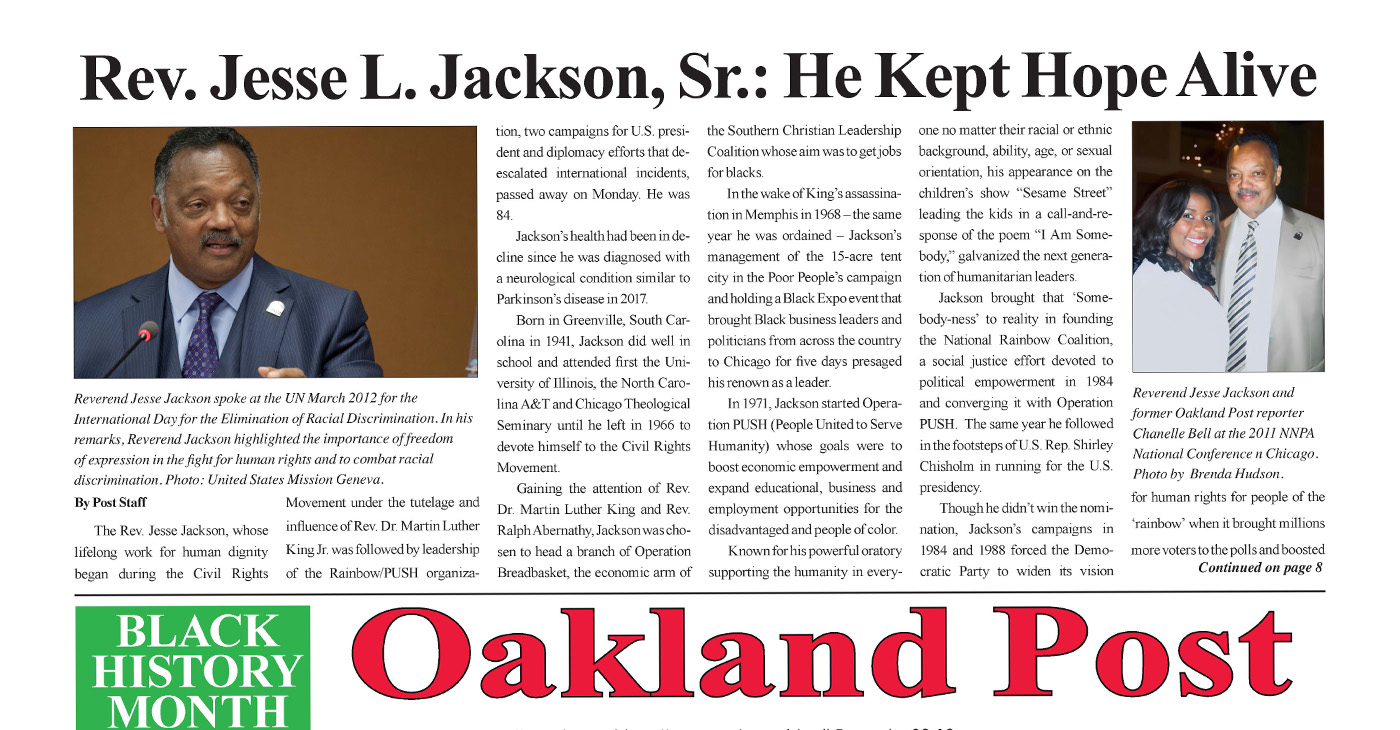
To enlarge your view of this issue, use the slider, magnifying glass icon or full page icon in the lower right corner of the browser window.

Activism
Oakland Post: Week of February 11 – 17, 2026
The printed Weekly Edition of the Oakland Post: Week of – February 11 – 17, 2026

To enlarge your view of this issue, use the slider, magnifying glass icon or full page icon in the lower right corner of the browser window.

WORK FROM HOME
Home-based business with potential monthly income of $10K+ per month. A proven training system and website provided to maximize business effectiveness. Perfect job to earn side and primary income. Contact Lynne for more details: Lynne4npusa@gmail.com 800-334-0540


Poll Shows Support for Policies That Help Families Afford Child Care

Oakland Post: Week of February 25 – March 3, 2026

Trump’s MAGA Allies are Creating Executive Order Plan to Steal the 2026 Midterms

PRESS ROOM: NBA Hall of Fame Nominee Terry Cummings Joins 100 Black Men of DeKalb County to Launch Victory & Values Initiative

Reflecting on Black History Milestones in Birmingham AL

OP-ED: One Hundred Years of Black Workers Telling the Truth

PRESS ROOM: Civil Rights TV Launches in Selma as the World’s First 24/7 Civil Rights Television Network

Advancements in solar technology that are changing the way we power the world

U.S. manufacturing rebounds – how foundry services are adapting to rising demand

Why has blood testing become so popular in today’s world?

Ghana Mourns a Son of the African World

OP-ED: Trump’s Policies Hurt Black America—and Everyone Else

OP-ED: Meta Deleted Me. I Still Don’t Know Why. And neither will you.

More than a Mission: Paying It Forward for the Future of Education

Avoid Eviction This Season: Landlord Checklist for Stable Tenancies

Life Expectancy in Marin City, a Black Community, Is 15-17 Years Less than the Rest of Marin County

Oakland Post: Week of January 28, 2025 – February 3, 2026

Community Celebrates Turner Group Construction Company as Collins Drive Becomes Turner Group Drive

California Launches Study on Mileage Tax to Potentially Replace Gas Tax as Republicans Push Back

Discrimination in City Contracts

Oakland Post: Week of January 21 – 27, 2026

Book Review: Books on Black History and Black Life for Kids

COMMENTARY: The Biases We Don’t See — Preventing AI-Driven Inequality in Health Care

Post Newspaper Invites NNPA to Join Nationwide Probate Reform Initiative

Medi-Cal Cares for You and Your Baby Every Step of the Way

Black History Events in the East Bay

Art of the African Diaspora Celebrates Legacy and Community at Richmond Art Center

COMMENTARY: The National Protest Must Be Accompanied with Our Votes

After Don Lemon’s Arrest, Black Officials Raise Concerns About Independent Black Media

New Bill, the RIDER Safety Act, Would Support Transit Ambassadors and Safety on Public Transit

Hyundai Ioniq 5 Parking, Safety, and 360 View #shorts

2025 Ioniq 5 New Wiper & Powerful Performance! #shorts

Electric SUV Range: Is 259 Miles Enough? #shorts

EV Charging: How Fast Can You Charge an Electric Vehicle? #shorts

Biometric Cooling… Messaging Seats…Come on! 2025 Infiniti QX80 Autograph 4WD

Charged Up: Witness the Magic of a Fully Electric Car! #shorts

Range Rover Sport PHEV Included…: See What’s Inside This Luxury SUV! #shorts

Invisible Hood View: Perfect Parking with X-Ray Vision! #shorts

AI Is Reshaping Black Healthcare: Promise, Peril, and the Push for Improved Results in California

ESSAY: Technology and Medicine, a Primary Care Point of View

Sanctuary Cities

The RESISTANCE – FREEDOM NOW

STATE OF THE PEOPLE: Freddie

ECONOMIC BOYCOTT DAY!!!!!

I told You So
-
 Activism3 weeks ago
Community Celebrates Turner Group Construction Company as Collins Drive Becomes Turner Group Drive
-
 Business3 weeks ago
California Launches Study on Mileage Tax to Potentially Replace Gas Tax as Republicans Push Back
-
 Activism3 weeks ago
Discrimination in City Contracts
-
 Arts and Culture3 weeks ago
Book Review: Books on Black History and Black Life for Kids
-
 Activism3 weeks ago
COMMENTARY: The Biases We Don’t See — Preventing AI-Driven Inequality in Health Care
-
 Activism3 weeks ago
Post Newspaper Invites NNPA to Join Nationwide Probate Reform Initiative
-
 Alameda County3 weeks ago
Black History Events in the East Bay
-
 Activism3 weeks ago
Art of the African Diaspora Celebrates Legacy and Community at Richmond Art Center
