
Bay Area
Oakland Program Distributes $500 to Families of Color
The assistance, which targets low-income families of color in the 426,000-population city, will last 18 months. Mayor Schaaf detailed that the money comes with “no-strings attached,” and recipients can use it as they please. “We have designed this demonstration project to add to the body of evidence and to begin this relentless campaign to adopt a guaranteed income federally,” Mayor Schaaf told the local ABC News station.

In the middle of a worldwide awakening to the centuries-old racism and oppression suffered by Black people, some African Americans finally see tangible assistance – even if the help isn’t characterized as reparations.
Oakland, Calif., Mayor Libby Schaaf announced that the city would begin a guaranteed income project that would provide $500 per month to Black and Indigenous families.
The assistance, which targets low-income families of color in the 426,000-population city, will last 18 months.
Mayor Schaaf detailed that the money comes with “no-strings attached,” and recipients can use it as they please.
“We have designed this demonstration project to add to the body of evidence and to begin this relentless campaign to adopt a guaranteed income federally,” Mayor Schaaf told the local ABC News station.
The station reported that, for the project, the Oakland Resilient Families program has so far raised $6.75 million from private donors, including Blue Meridian Partners, a national philanthropy group.
The programs require residents have at least one child under 18 and income at or below 50 percent of the area median income – about $59,000 per year for a family of three.
Half the spots are reserved for people who earn below 138 percent of the federal poverty level or about $30,000 per year for a family of three, ABC reported. Participants are randomly selected from a pool of applicants who meet the eligibility requirements.
The report noted that Oakland’s project is significant because it is one of the most outstanding efforts in the U.S. so far, targeting up to 600 families. And it is the first program to limit participation strictly to Black, Indigenous, and people of color communities.
Oakland, where 24 percent of the residents are Black, is among a growing list of municipalities providing financial payments to people of color – or reparations.
Evanston, Illinois, a city where 18 percent of its more than 74,500 residents are Black, approved the Local Reparations Restorative Housing Program, which provides up to $25,000 for housing down payments or home repairs to African Americans.
The bill, authored by California Assemblywoman Shirley Weber, establishes a nine-person task force that will study the impact of the slave trade on Black people.
It does not commit to any specific payment, but the task force will make recommendations to legislators about what kind of compensation should be provided, who should receive it, and what form it would take.
“After watching [the presidential] debate, this signing can’t come too soon,” Newsom declared during a videoconference with lawmakers and other stakeholders, including the rapper Ice Cube, who championed the bill.
“As a nation, we can only truly thrive when every one of us has the opportunity to thrive. Our painful history of slavery has evolved into structural racism and bias built into and permeating throughout our democratic and economic institutions,” the governor stated.
“Hundreds of years of Black blood spilled that fills the cup we drink from today,” said Councilman Keith Young, one of two African American members of the City Council that voted 7-0 in favor of reparations.
“It is simply not enough to remove statutes. Black people in this country are dealing with systemic issues,” Young declared.
Asheville’s resolution doesn’t include monetary payments to African Americans but promises investments in areas where Black people face disparities.
Earlier this year, Congress debated H.R. 40, a bill that doesn’t place a specific monetary value on reparations but focuses on investigating and presenting the facts and truth about the unprecedented centuries of brutal enslavement of African people, racial healing, and transformation.
The commission’s mission includes identifying the role of federal and state governments in supporting the institution of slavery, forms of discrimination in public and private sectors against freed slaves and their descendants, and lingering adverse effects of slavery on living African Americans and society.
Congresswoman Jackson Lee, who sits on numerous House committees, including the Judiciary, Budget, and Homeland Security, has made the reparations legislation her top priority during the 117th Congress.
“I think if people begin to associate this legislation with what happened to the descendants of enslaved Africans as a human rights violation, the sordid past that violated the human rights of all of us who are descendants of enslaved Africans, I think that we can find common ground to pass this legislation,” Congresswoman Jackson Lee pronounced.
The project in Oakland targets groups with the city’s most significant wealth disparities.
According to CNN and per the Oakland Equality Index, the median income for White households in Oakland to be nearly three times that of Black homes.
“The poverty we all witness today is not a personal failure. It is a systems failure,” Schaaf remarked. “Guaranteed income is one of the most promising tools for systems change, racial equity, and economic mobility we’ve seen in decades.”
Two years ago, 100 residents in Stockton, California, began receiving unconditional $500 payments, CNN reported. Other initiatives in Newark, New Jersey, and Atlanta, Georgia, were launched as recently as 2020.
Former Stockton Mayor, Michael Tubbs, is the founder of Mayors for a Guaranteed Income, a network of advocating mayors founded in 2020.
Oakland Mayor Schaaf is also a founding member of the network.
“One of my hopes in testing out a guaranteed income is that other cities would follow suit, and I’m thrilled that Oakland is among the first,” Tubbs told CNN.
“By focusing on BIPOC residents, the Oakland Resilient Families program will provide critical financial support to those hardest hit by systemic inequities, including the pandemic’s disproportionate toll on communities of color.”





Activism
Oakland Post: Week of March 11 -17, 2026
The printed Weekly Edition of the Oakland Post: Week of March 11 – 17, 2026

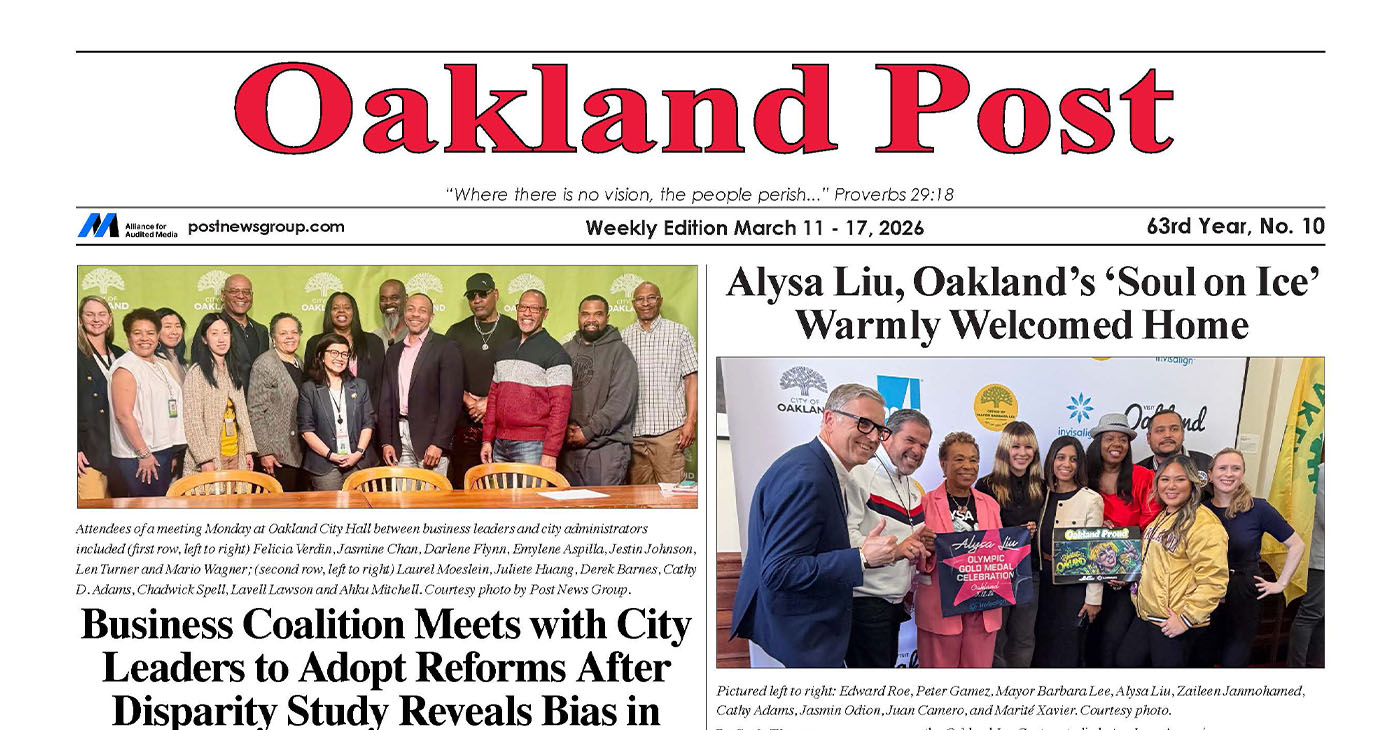
To enlarge your view of this issue, use the slider, magnifying glass icon or full page icon in the lower right corner of the browser window.

Activism
Oakland Post: Week of March 4 – 10, 2026
The printed Weekly Edition of the Oakland Post: Week of March 4 – 10, 2026

To enlarge your view of this issue, use the slider, magnifying glass icon or full page icon in the lower right corner of the browser window.
Activism
Oakland Post: Week of February 25 – March 3, 2026
The printed Weekly Edition of the Oakland Post: Week of – February 25 – March 3, 2026

To enlarge your view of this issue, use the slider, magnifying glass icon or full page icon in the lower right corner of the browser window.

WORK FROM HOME
Home-based business with potential monthly income of $10K+ per month. A proven training system and website provided to maximize business effectiveness. Perfect job to earn side and primary income. Contact Lynne for more details: Lynne4npusa@gmail.com 800-334-0540


Financial Wellness and Mental Health: Managing Money Stress in College

Oakland Post: Week of March 11 -17, 2026

Women & Wealth: Tips for Navigating Your Lifelong Financial Journey

COMMENTARY: Women of Color Shape Our Past and Future

Woman’s Search for Family’s Roots Leads to Ancestor John T. Ward – A Successful Entrepreneur and Conductor on the Underground Railroad

Advocates Raise Alarm Over ICE Operation, MOU and Detention Risks in Baltimore County

Pete Buttigieg to Join Mayor Randall Woodfin for Community Town Hall in Birmingham

WATCH: Week One – NNPA’s “Leadership Matters” Video Series

Oakland Post: Week of March 4 – 10, 2026

OP-ED: NNPA Launches 2026 “Leadership Matters” Video Series

PRESS ROOM: PMG and Cranbrook Horizons-Upward Bound Launch Journey Fellowship Cohort 2

Los Angeles Summit Brings Together Leaders to Tackle Poverty and Affordability

Civil Rights TV Launches 24/7 Network Focused on Black History, Education and Equity

REVIEW: The Ultimate Hot Girl Summer Getaway: Sunseeker Resort Florida

COMMENTARY: How You Stop a Prescription Medicine is as Important as How You Start

Book Review: Books on Black History and Black Life for Kids

Community Celebrates Turner Group Construction Company as Collins Drive Becomes Turner Group Drive

Discrimination in City Contracts

California Launches Study on Mileage Tax to Potentially Replace Gas Tax as Republicans Push Back

COMMENTARY: The Biases We Don’t See — Preventing AI-Driven Inequality in Health Care

Black History Events in the East Bay

Post Newspaper Invites NNPA to Join Nationwide Probate Reform Initiative

Art of the African Diaspora Celebrates Legacy and Community at Richmond Art Center

New Bill, the RIDER Safety Act, Would Support Transit Ambassadors and Safety on Public Transit

COMMENTARY: The National Protest Must Be Accompanied with Our Votes

Oakland Post: Week of February 4 – 10, 2026

Oakland Post: Week of February 11 – 17, 2026

Dorothy Lee Bolden: Uniting Domestic Workers

After Don Lemon’s Arrest, Black Officials Raise Concerns About Independent Black Media

Reflecting on Black History Milestones in Birmingham AL

Hyundai Ioniq 5 Parking, Safety, and 360 View #shorts

2025 Ioniq 5 New Wiper & Powerful Performance! #shorts

Electric SUV Range: Is 259 Miles Enough? #shorts

EV Charging: How Fast Can You Charge an Electric Vehicle? #shorts

Biometric Cooling… Messaging Seats…Come on! 2025 Infiniti QX80 Autograph 4WD

Charged Up: Witness the Magic of a Fully Electric Car! #shorts

Range Rover Sport PHEV Included…: See What’s Inside This Luxury SUV! #shorts

Invisible Hood View: Perfect Parking with X-Ray Vision! #shorts

AI Is Reshaping Black Healthcare: Promise, Peril, and the Push for Improved Results in California

ESSAY: Technology and Medicine, a Primary Care Point of View

Sanctuary Cities

The RESISTANCE – FREEDOM NOW

STATE OF THE PEOPLE: Freddie

ECONOMIC BOYCOTT DAY!!!!!

I told You So

-
 #NNPA BlackPress3 weeks ago
Reflecting on Black History Milestones in Birmingham AL
-

 #NNPA BlackPress3 weeks ago
PRESS ROOM: NBA Hall of Fame Nominee Terry Cummings Joins 100 Black Men of DeKalb County to Launch Victory & Values Initiative
-

 #NNPA BlackPress4 weeks ago
U.S. manufacturing rebounds – how foundry services are adapting to rising demand
-

 #NNPA BlackPress4 weeks ago
OP-ED: One Hundred Years of Black Workers Telling the Truth
-

 Activism3 weeks ago
Oakland Post: Week of February 25 – March 3, 2026
-

 #NNPA BlackPress4 weeks ago
Advancements in solar technology that are changing the way we power the world
-

 #NNPA BlackPress3 weeks ago
Trump’s MAGA Allies are Creating Executive Order Plan to Steal the 2026 Midterms
-

 #NNPA BlackPress4 weeks ago
PRESS ROOM: Civil Rights TV Launches in Selma as the World’s First 24/7 Civil Rights Television Network
