
Activism
Oakland Group Seeks to Aid Pregnant Residents After Encampment Closure
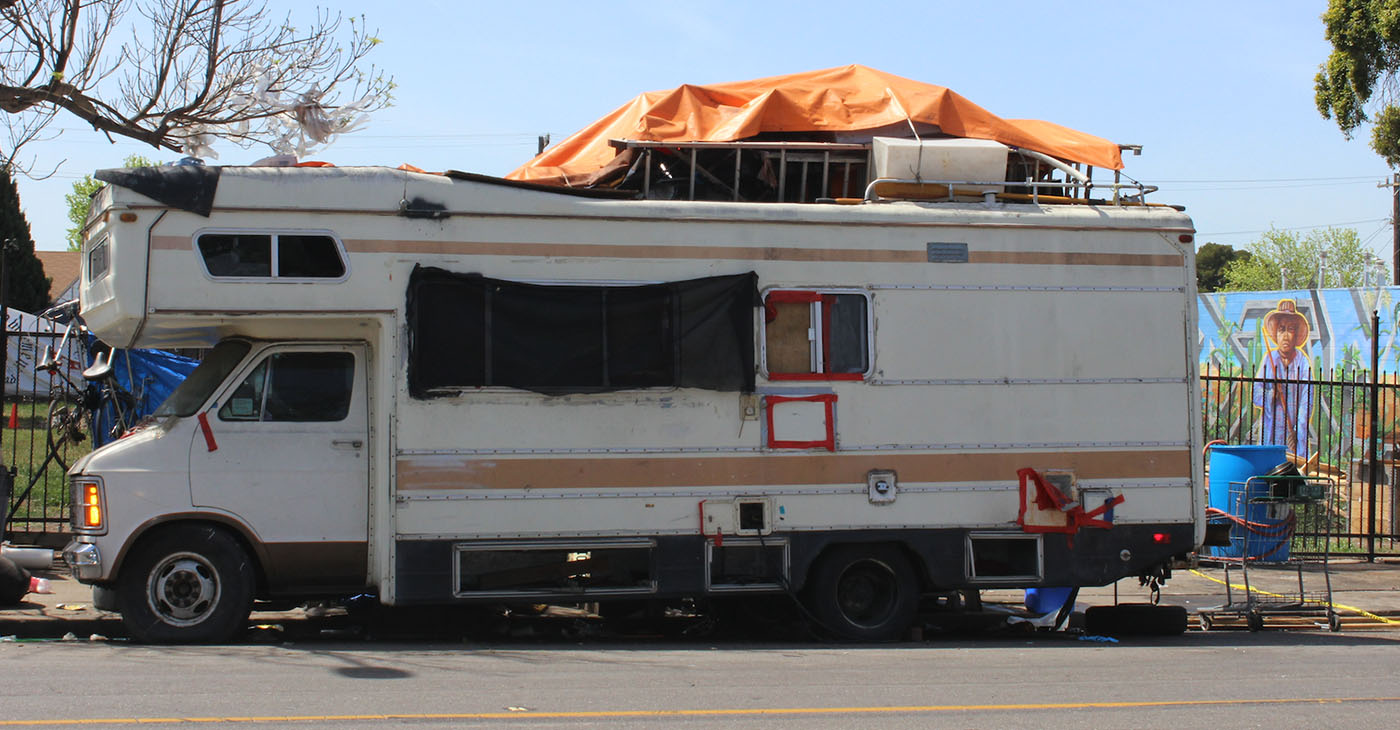
According to residents and advocates present during the closure of the encampment on April 7, city public works staff and Oakland Police Department officers arrived around 9 a.m., asked residents to leave, and did not offer alternative shelter options. OPD confirmed one officer and two public service technicians were present. In the days before the closure, about 20 residents had lived in the area, mostly in RVs and trailers. The city posted pink signs informing residents of the closure several days before it occurred. While most residents left the encampment, a few remained.

By Zack Haber

A recent closure of a homeless encampment near the intersection of MacArthur Boulevard and 106th Avenue has prompted Homies Empowerment, an East Oakland-based grassroots organization, to call attention to and organize for improving the living conditions of two displaced pregnant women that lived in the encampment.
“We’re looking for a house to rent for them now,” said Rev. Harry Louis Williams II, an activist, author, and hip-hop artist who works as a Care Manager with Homies Empowerment. “Our long-term goal for these women is to get them into an affordable place to live. We don’t want their children to be like baby Jesus in the manger.”
After the closure, Homies Empowerment put the two women up in a hotel room. They want help from the community to house them and are encouraging those who have the means to offer aid to contact the organization.
“Sometimes people say things are bad, and they wish they could do something,” said Williams. “Well, this is a way to do something. This is urgent and we’re not sitting around and waiting for a grant.”
According to residents and advocates present during the closure of the encampment on April 7, city public works staff and Oakland Police Department officers arrived around 9 a.m., asked residents to leave, and did not offer alternative shelter options. OPD confirmed one officer and two public service technicians were present. In the days before the closure, about 20 residents had lived in the area, mostly in RVs and trailers. The city posted pink signs informing residents of the closure several days before it occurred. While most residents left the encampment, a few remained.
Two of those who remained were Teela Hardy and Tanya Andrade. Hardy had been working as a receptionist for a law firm but became homeless after she was laid off. Andrade said she was let go from her service industry job soon after she became pregnant. While she says she technically has access to her former home, it’s uninhabitable.
“I can’t stand my house because it’s full of mold,” said Andrade. “Living there is unsafe because I’m pregnant, and I have asthma.”
Both Hardy and Andrade are about seven months pregnant and had lived in RVs that no longer run but still provided them with shelter. In the days leading up to the closure, it was difficult to move their inoperable RVs and they did not expect the city to follow through with the eviction.
“They gave us a warning,” said Hardy. “But they’ve given us warnings before and not gone through with their word.”
According to Hardy, the City of Oakland had posted signs three separate times this year telling residents they planned to close the encampment on specific dates, but those dates came and passed without any closure enforcement. The Oakland Post emailed Oakland’s director of communications multiple times over three days seeking comments on this story. But the city ultimately did not provide comments before this story’s deadline.
Hardy and Andrade were able to keep their RVs after friends helped tow them to another location, but the women said they lost other possessions during the closure. For Hardy, the most important thing she lost was her car she had been using to do odd jobs and run errands, including getting to doctor’s appointments. According to Hardy, it was impounded because, although she had been trying to get it registered, she hadn’t yet been able to do so.
“It’s just hard,” Hardy said. “They didn’t give me a bus pass or anything, and I know I’m not going to be able to do the things I need to do in the amount of time I need to do them now that I don’t have a car.”
According to Williams of Homies Empowerment, the organization became aware of the closure because they have recently started renting land from the city that sits at 10451 MacArthur Blvd., which is next to where the encampment had been. Hardy said the organization had allowed her to use the land for her dogs to play and that she and Andrade, in turn, had helped to clean up the parcel. Homies Empowerment plans to use the land to set up a small community farm.
A statement on Homies Empowerment’s website says the organization “works alongside our community towards a world absent of whiteness, capitalism, and heteropatriarchy.” The organization started about 12 years ago to help quell gang violence and also address the city’s gang injunctions, which Homies Empowerment saw as harmful. They started a program called Loaves and Fishes during the pandemic, which is still in operation, that feeds East Oakland residents in need of food, including people experiencing homelessness. Williams says the organization offers “solidarity not charity.”
“We shared with the people in the encampment,” Williams said. “They became family. They were welcomed to eat with us.” The encampment closure “shocked and dismayed” members of Homies Empowerment and left them “disheartened.”
Hardy and Andrade said they suspected the city enforced the closure due to the encampment becoming messy. They also said the city provided no toilets, rarely offered trash pickup services, and that sometimes housed private citizens and businesses would dump trash in their encampment instead of disposing of their trash properly.
Williams feels the city is doing “all kinds of things to displace people,” while “people just want to live.” While the city slowed down closures of homeless encampments immediately following the initial COVID-19 outbreak in 2020, by 2021 encampment closures returned with over four occurring per month between January and August of that year. In 2022, several closures have been occurring per week.
Recently, Council Member Noel Gallo proposed an ordinance to the city’s public works committee that would explicitly ban RVs and trailers from streets that are 40 feet wide or narrower. The committee is scheduled to consider the ordinance on May 24. If the ordinance is put to vote and approved by the City Council as it is currently written, it would ban people from living in RVs on about 79% of Oakland’s streets.
“I love Oakland,” said Williams. “But I think Oakland could do more to show loving care to people who are experiencing these problems. If the leadership of the city could come work with us, we could avoid homelessness.”
Homies Empowerment currently sees Oakland’s community as the best avenue to help Hardy and Andrade.
“I am hopeful,” said Williams. “There’s a lot of fire in Oakland’s belly from just regular working people who are saying we want to feed and house people. I think enough people just need to come together and change will come.”








To enlarge your view of this issue, use the slider, magnifying glass icon or full page icon in the lower right corner of the browser window.

To enlarge your view of this issue, use the slider, magnifying glass icon or full page icon in the lower right corner of the browser window.
Activism
Oakland Post: Week of September 30 – October 6, 2026
The printed Weekly Edition of the Oakland Post: Week of September 30 – October 6, 2026

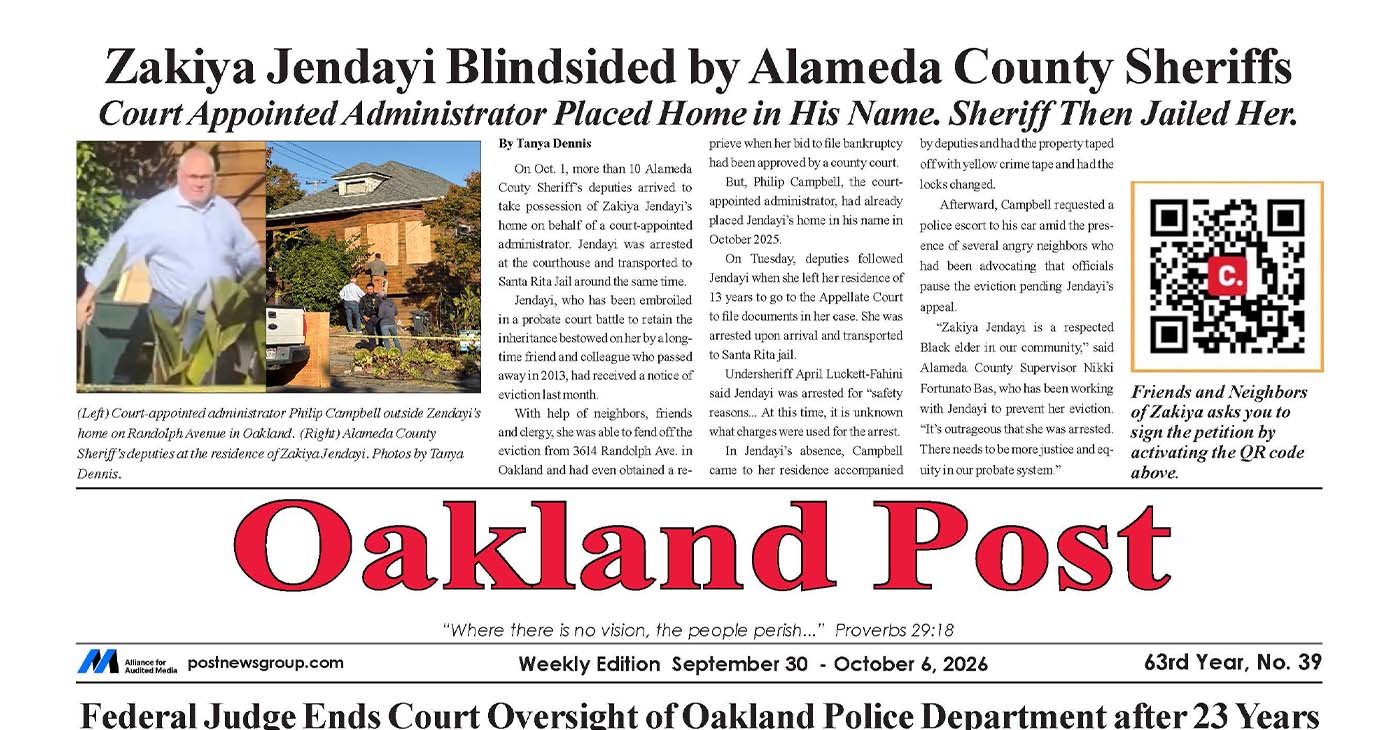
To enlarge your view of this issue, use the slider, magnifying glass icon or full page icon in the lower right corner of the browser window.


Mayor Barbara Lee Holds Special State of the City Address in Deep East Oakland

Practitioners of African Traditional Spirituality Offer Ancestral Reverence Ritual Oct. 31

It’s Time to Lose Weight Before the Holidays

Trader Vic’s Returns to Its Oakland Roots

Oakland Coal Terminal Backed by Trump Would Be Bigger, Dirtier Than Promised, Says Report

Opponents Smear Effective African American Transit Director as Election Nears

Oakland Post: Week of October 14 – 20, 2026

OP-ED: The Black Church Writes AI’s Next Chapter

OP-ED: The Black Church Writes AI’s Next Chapter

WCCUSD Joins Statewide Organic School Food Purchasing Cooperative

Democrats, Community Groups Back Measure EE to Change How Oakland Is Governed

Four Tips to Help You Plan a Holiday “Staycation”

Veterans Housing Project Proposed for South Richmond
PRESS ROOM: Transformative Justice Coalition 2026 Voting Rights Champion Awards Reception ‘Yesterday Is Today: The Battle For Voting Rights

Mayor Lee Delivers 2026 State of the City Address: ‘Oakland Continues to Be on the Move’

Misnamed ‘Parent’ PAC Seeks to Influence Oakland School Board Elections

Poll: Becerra Widens His Lead Over Hilton; Californians Split on Wealth Tax

Listening as a Lifeline: A Doula’s Witness to Black Maternal Health

Oakland Post: Week of September 9 – 15, 2026

County Office of Education Says OUSD Finances Are Getting Healthier, Materially Stronger

Richmond Tiny House Village Farm & Garden Set to Open Gates on Sept. 26

Mayor Lee Announces $1 Million Kaiser Permanente Grant for Pilot Program to Address Homelessness, Clean Up Public Spaces throughout Oakland

Latest Massacre in Haiti Reveals Cruelty U.S. Deportations

Zakiya Jendayi Arrested, Locked Out of Home by Sheriff’s Deputies

OPINION: Nolan Wells’ Death One of Several Signifying Racial Terror Lives on in U.S. South

Doulas Are Helping Black California Moms Navigate Pregnancy–Even as High Mortality Rates Persist

BLACspace Cooperative Invites Bay Area to Experience Oakland’s Black Cultural Ecosystem Through a BLAC Map Tour + Party

Oakland Post: Week of September 16 – 22, 2026

Democratic Clubs Interview Candidates for Oakland School Board

Oakland People’s Arms Embargo Coalition Demands End to Military Shipments Thru Oakland

The Conversation With Al McFarlane 6/23/26

Media Monday 6/22/26

LIVE! ASK ALMA! — TUES. 6.23.26 7PM EST

Car Buying Secrets: 4 Hidden Checks Before You Sign!

Is This 550 HP Charger Worth YOUR Money? AutoNetwork Review

Celebrating Juneteenth – Frederick Douglass on education and resistance

LIVE! — ASK ALMA! — TUES. 6.19.26 7PM EST

Hyundai Ioniq 5 Parking, Safety, and 360 View #shorts

2025 Ioniq 5 New Wiper & Powerful Performance! #shorts

Electric SUV Range: Is 259 Miles Enough? #shorts

EV Charging: How Fast Can You Charge an Electric Vehicle? #shorts

Biometric Cooling… Messaging Seats…Come on! 2025 Infiniti QX80 Autograph 4WD

Charged Up: Witness the Magic of a Fully Electric Car! #shorts

Range Rover Sport PHEV Included…: See What’s Inside This Luxury SUV! #shorts

Invisible Hood View: Perfect Parking with X-Ray Vision! #shorts
-
 Economy4 weeks ago
Poll: Becerra Widens His Lead Over Hilton; Californians Split on Wealth Tax
-
 Black History3 weeks ago
Listening as a Lifeline: A Doula’s Witness to Black Maternal Health
-
 Business4 weeks ago
County Office of Education Says OUSD Finances Are Getting Healthier, Materially Stronger
-
 Lead Story3 weeks ago
Zakiya Jendayi Arrested, Locked Out of Home by Sheriff’s Deputies
-
 Black History4 weeks ago
Doulas Are Helping Black California Moms Navigate Pregnancy–Even as High Mortality Rates Persist
-
 Art4 weeks ago
BLACspace Cooperative Invites Bay Area to Experience Oakland’s Black Cultural Ecosystem Through a BLAC Map Tour + Party
-

 Business4 weeks ago
From Historic Memories to New Possibilities: Oakland Celebrates Coliseum 60
-

 Community4 weeks ago
Asm. Corey Jackson Announces Launch of 24-Hour Childcare in His District
