
Technology
News Guide: Net Neutrality and What it Could Mean to You


In this Oct. 8, 2014 file photo, Federal Communications Commission (FCC) Chairman Tom Wheeler speaks during new conference in Washington. Internet service providers, including those selling wireless connections, would be prohibited from slowing down or speeding up web traffic, under rules proposed Wednesday by a top U.S. regulator that would subject the broadband industry to unprecedented regulation. (AP Photo/Jose Luis Magana, File)
ANNE FLAHERTY, Associated Press
WASHINGTON (AP) — A top U.S. regulator just announced he wants more power to oversee Internet service, much in the same way that the government already regulates phone service and other public utilities. The goal is to prevent Internet service providers like AT&T, Verizon, Comcast, Sprint and T-Mobile from blocking or slowing down Web traffic, or striking deals with companies that provide content like Amazon, Google or Netflix to move their data faster than others.
What does this mean for the average person? Probably nothing right away. One of the big providers will likely take the matter to a federal court and ask the judge to suspend enforcement of the rules until the case is decided.
But this latest decision by Tom Wheeler, chairman of the Federal Communications Commission, opens up a new chapter in Internet history. Equal access to content has been deemed a right of the American public. And depending upon how it’s done, that could mean more taxes.
A look at the issue and why you should care:
___
NET NEUTRALITY
The idea of net neutrality is that websites or videos load at about the same speed. This means you won’t choose to watch “Downton Abbey” on Amazon Prime instead of “Orange is the New Black” on Netflix because Amazon has struck some backdoor deal with your service provider to load its data faster. And when you’re shopping online and comparing prices, images of Eddie Bauer jackets won’t load faster than those on the LL Bean site. As you can imagine, this kind of disparity matters greatly in the world of online commerce and entertainment.
___
WHY NOW
It’s true the Internet has flourished under very little regulation. It’s also true that this exponential growth can be attributed in part to the Internet’s open architecture. Under the threat of regulation and because of market demand, service providers for many years agreed not to pick winners and losers among Web traffic.
What’s changed recently is that Netflix, YouTube and other on-demand video services have become wildly popular, including as an alternative to expensive cable packages. They can hog much of a provider’s bandwidth at any given time. Internet service providers say they have invested heavily to improve their infrastructure to handle the heavy traffic. Isn’t it only fair to charge Netflix and others a “toll” to move their data?
Netflix objects and has compared these toll fees to holding data for ransom.
___
THE PLAN
Chairman Wheeler wants to subject all Internet service, including wireless, to Title II of the 1934 Communications Act. This is the same law that governs phone service and gives the FCC broad authority to ensure everyone has access.
Wheeler says he won’t apply several pieces of the law, including price controls. Industry contends that once Title II is applied, it’s only a matter of time before Internet service becomes bogged down in red tape.
The FCC’s five-member commission is planning to vote on the plan on Feb. 26, and it’s likely the proposal will be approved along party lines. But because of legal challenges, it’s possible the issue won’t be resolved for several more years, even well into the next president’s first term.
___
CONGRESS
Lawmakers could try to resolve the uncertainty, but Congress rarely is that pragmatic. Lawmakers tend to take on issues that fire up their base or bring their states money, and an in-the-weeds compromise on telecommunications law would be a lot of work with little immediate payoff.
So far, Republicans have pitched an idea that would enforce basic open Internet rules but could strip the FCC of its ability to help local municipalities build their own broadband. It’s a nonstarter for President Barack Obama and congressional Democrats who say poor and rural areas have been left behind in the deployment of high-speed Internet.
Assuming Wheeler’s proposal satisfies consumer advocacy groups, Democrats would have little incentive to revisit the issue. While Republicans have the votes to push through their own anti-regulation legislation without Democratic support, Obama would veto it.
___
CONSUMERS
Most Internet providers, except Sprint, have warned that the legal uncertainty would chill future investments. Wheeler has shrugged off these suggestions, citing $300 billion in investment by the wireless industry in the past two decades.
As for taxes, the Progressive Policy Institute estimated that treating the Internet like phone service would trigger taxes and fees up to $15 billion a year, including $67 for each wired service and $72 for wireless in state and local taxes.
But that report, widely quoted by industry lobbyists, did not take into account the Internet Tax Freedom Act, which prohibits state and local governments from imposing new taxes on Internet access, or the FCC’s ability to shield consumers against some state and local taxes by claiming the Internet is an “interstate” service.
Copyright 2015 The Associated Press. All rights reserved. This material may not be published, broadcast, rewritten or redistributed.






Business
AG Bonta Announces Action on Cryptocurrency, Sextortion Fraud – Increasingly Targeting Gen-Z
California Attorney General Rob Bonta is warning residents about a surge in cryptocurrency fraud and online sextortion schemes that increasingly target Gen Z through social media platforms. With internet-based scams costing Americans nearly $21 billion in 2023, Bonta highlighted how artificial intelligence and deepfakes allow criminals to impersonate loved ones and promote fraudulent investment groups. The Attorney General’s Office has already shut down over 100 fraudulent websites and is now utilizing new legislative tools to recover assets for victims. Read more.


California Attorney General Rob Bonta warned residents about rising cryptocurrency fraud and online sextortion scams, urging Californians to recognize warning signs and protect themselves as scammers increasingly target younger people through social media.
Speaking at a news conference on Oct. 19, Bonta said Americans lost $20.9 billion to internet-based scams in 2025, including $11.4 billion to cryptocurrency scams. He said artificial intelligence, deepfakes, and malicious smart contracts have made fraud easier to carry out and more difficult to detect and prevent.
While older Californians remain targets, Bonta said his office has seen a sharp rise in reports of Gen Z consumers being targeted on platforms such as Twitch, TikTok, and Instagram.
One growing scheme involves so-called rug-pull scams, in which fraudsters promote low-priced stocks or volatile cryptocurrencies through online investment groups and streaming communities. After generating interest and driving up prices, scammers sell their holdings, causing values to collapse and leaving investors with losses.
Bonta also warned about sextortion, in which scammers trick or coerce victims into sharing explicit images before threatening to distribute them to friends and family unless they pay. He advised victims not to give in to demands, saying scammers often do not release the images when victims refuse to pay. Instead, he recommended ignoring and blocking the perpetrators.

Another scheme, known as recovery fraud, targets people who have already lost money to cryptocurrency scams. Fraudsters impersonate blockchain recovery specialists or law enforcement officials and demand additional payments while promising to recover stolen assets.
Bonta urged Californians to be skeptical of promises of large returns on small investments, fake cryptocurrencies resembling established ones, and celebrity endorsements that may have been generated using artificial intelligence. He also warned that scammers can use AI to impersonate loved ones through manipulated video and audio.
“Never use a crypto ATM,” Bonta said, emphasizing that transactions can be difficult to trace and reverse and that the machines lack adequate consumer protections.
His office has shut down more than 100 fraudulent websites over the past two years that collectively scammed victims out of at least $8.3 million, he said.
Bonta also highlighted Senate Bill 1208, which he said was recently signed into law. The measure allows law enforcement to petition a court to return seized cryptocurrency to victims, including when alleged perpetrators are outside U.S. jurisdiction.
Residents who have fallen victim to scams can report them to the California Department of Justice at oag.ca.gov/report.
Bonta also urged victims not to feel embarrassed, stressing that scammers are responsible for the harm they cause.

Black History
OP-ED: The Black Church Writes AI’s Next Chapter
BLACKPRESSUSA NEWSWIRE — I implore my fellow faith leaders to use these tools. Start now and use them with wisdom. We count on each and every one of you to make sure our communities help write the next chapter of this story. This rapid change is not as unfamiliar as it may sound. My first understanding of AI came from using a calculator for the first time in grade school. We did not call it AI, but it was a tool that helped me work through mathematical equations hours more efficiently.

For generations, the Black church has stood strong in our communities through every historical change this country has experienced. During the civil rights movement and in recent times, faith leaders have helped uplift Black sanctuaries to register voters, keep food pantries open for people in need, and sit with families in hospital rooms in their most desperate moments. When our people faced new trials, they could always look to our faith leaders and the church to lean in to help us be included in these transformative changes.
Artificial intelligence is the latest revolutionary change to impact our society, and much like other transformations before us, underserved communities often get left behind.
I was recently featured in a report entitled “Faith, Community & AI” and it found that people send ChatGPT more than 70 million messages a week about religion. Nearly 22 million involve studying sacred texts, and 16 million ask about religious practices and holy days. Our members make up part of those numbers. They bring questions of faith to these tools every day.
Pastors have noticed, and according to a September 2025 Lifeway Research survey of 1,003 Protestant pastors, 42 percent said they use or experiment with AI in ministry. I count myself among them.

I write my sermons by hand, through prayer and study. When I finish a draft, I ask ChatGPT this question: “Where might this sermon become unclear or difficult to follow for someone early in their walk of faith?” It shows me gaps in my preparation, like where I incorrectly assumed everyone would know the context of who the Pharisees were. Then, change comes from my own pen, not the robot. The tool helps me reach the person in the back pew while the message still comes from me.
If I could have my wish, our whole community would take a similar posture. We must use these tools, understand them, and most importantly be present to help shape them if we want to be included in the coming change.
I implore my fellow faith leaders to use these tools. Start now and use them with wisdom. We count on each and every one of you to make sure our communities help write the next chapter of this story. This rapid change is not as unfamiliar as it may sound. My first understanding of AI came from using a calculator for the first time in grade school. We did not call it AI, but it was a tool that helped me work through mathematical equations hours more efficiently.
It starts with training; there is no involvement without understanding. Free AI trainings have begun in our churches and community centers across the nation. Every faith leader should sign up and, when possible, encourage members of your congregations to join you. By learning how to use AI, we can better understand what it can do, make up our own minds about its impact, and have a say in how it shapes our communities.”
Next, we must be at the tables where the builders of these tools make decisions. Presence is the first step toward understanding, and that gap is only bridged through a coordinated effort. How can any tool serve a community well if that community is not part of the conversation? Our traditions, needs, and concerns must be accounted for, and Black faith leaders are already making that happen. OpenAI’s recent Faith report states plainly that AI should never become an arbiter of religious truth. I fully intend to hold the company to its word, and the most effective way I can do that is from inside.
I will close with this––we must diligently protect what only the church can give. A believer in Seoul, Korea quoted in the report warned, “if you pour every struggle into a private chat, your pastor and your friends may never learn you need help.” A chatbot will not sit with a grieving family or pray with you at two in the morning. As we adopt this technology, it is up to us to ensure it keeps people connected to each other and to their church.
Rev. Dr. Adolphus Lacey is senior pastor of Bethany Baptist Church in Brooklyn, New York.
Black History
OP-ED: The Black Church Writes AI’s Next Chapter
BLACKPRESSUSA NEWSWIRE — I implore my fellow faith leaders to use these tools. Start now and use them with wisdom. We count on each and every one of you to make sure our communities help write the next chapter of this story. This rapid change is not as unfamiliar as it may sound. My first understanding of AI came from using a calculator for the first time in grade school. We did not call it AI, but it was a tool that helped me work through mathematical equations hours more efficiently.

For generations, the Black church has stood strong in our communities through every historical change this country has experienced. During the civil rights movement and in recent times, faith leaders have helped uplift Black sanctuaries to register voters, keep food pantries open for people in need, and sit with families in hospital rooms in their most desperate moments. When our people faced new trials, they could always look to our faith leaders and the church to lean in to help us be included in these transformative changes.
Artificial intelligence is the latest revolutionary change to impact our society, and much like other transformations before us, underserved communities often get left behind.
I was recently featured in a report entitled “Faith, Community & AI” and it found that people send ChatGPT more than 70 million messages a week about religion. Nearly 22 million involve studying sacred texts, and 16 million ask about religious practices and holy days. Our members make up part of those numbers. They bring questions of faith to these tools every day.
Pastors have noticed, and according to a September 2025 Lifeway Research survey of 1,003 Protestant pastors, 42 percent said they use or experiment with AI in ministry. I count myself among them.
I write my sermons by hand, through prayer and study. When I finish a draft, I ask ChatGPT this question: “Where might this sermon become unclear or difficult to follow for someone early in their walk of faith?” It shows me gaps in my preparation, like where I incorrectly assumed everyone would know the context of who the Pharisees were. Then, change comes from my own pen, not the robot. The tool helps me reach the person in the back pew while the message still comes from me.
If I could have my wish, our whole community would take a similar posture. We must use these tools, understand them, and most importantly be present to help shape them if we want to be included in the coming change.
I implore my fellow faith leaders to use these tools. Start now and use them with wisdom. We count on each and every one of you to make sure our communities help write the next chapter of this story. This rapid change is not as unfamiliar as it may sound. My first understanding of AI came from using a calculator for the first time in grade school. We did not call it AI, but it was a tool that helped me work through mathematical equations hours more efficiently.
It starts with training; there is no involvement without understanding. Free AI trainings have begun in our churches and community centers across the nation. Every faith leader should sign up and, when possible, encourage members of your congregations to join you. By learning how to use AI, we can better understand what it can do, make up our own minds about its impact, and have a say in how it shapes our communities.”
Next, we must be at the tables where the builders of these tools make decisions. Presence is the first step toward understanding, and that gap is only bridged through a coordinated effort. How can any tool serve a community well if that community is not part of the conversation? Our traditions, needs, and concerns must be accounted for, and Black faith leaders are already making that happen. OpenAI’s recent Faith report states plainly that AI should never become an arbiter of religious truth. I fully intend to hold the company to its word, and the most effective way I can do that is from inside.
I will close with this––we must diligently protect what only the church can give. A believer in Seoul, Korea quoted in the report warned, “if you pour every struggle into a private chat, your pastor and your friends may never learn you need help.” A chatbot will not sit with a grieving family or pray with you at two in the morning. As we adopt this technology, it is up to us to ensure it keeps people connected to each other and to their church.
Rev. Dr. Adolphus Lacey is senior pastor of Bethany Baptist Church in Brooklyn, New York.


How the Sandwich Generation Can Help Protect Aging Parents’ Finances

As Progressive Democrats Celebrate ‘Blue Tsunami,’ Oakland Counts Victories

Golden State Valkyries Become Bay Area Legends Winning WNBA Championship on Halloween Night

IN MEMORIAM: Marcia Ann Gillespie, Editor of Essence and Ms. Magazines, Dies at 82

U.S. Rep. John Garamendi Honors local ‘Women of the Year’ at Annual Awards Ceremony

Richmond Neighbors Put Pantry Power on the Map

Oakland Latino Chamber of Commerce Hosts Statewide Convention, Generating $3 Million in Economic Impact

HISTORY MADE: Keisha Lance Bottoms Becomes First Black Woman Elected Governor in American History

HISTORY MADE: Keisha Lance Bottoms Becomes First Black Woman Elected Governor in American History

Five Hospitals Said No! Who Will Help Annette Henry Recover?

Oakland NAACP, BWOPA Speak Out Against Alleged Harassment of Black Women Political Leaders

COMMENTARY: Oakland’s Black Students Have Gained Ground: We Shouldn’t Stop Now

From Backyard Grilling to Jack London Square: Jamale Carlyle’s Chicken Wing Success Story

SEIU Local 1000 and State of California Will Continue to Negotiate New Labor Contract

OPINION: We Can Restore Checks and Balances on Trump

COMMENTARY: Valarie Bachelor and Jennifer Brouhard are Excellent School Board Members and Deserve to Be Reelected

Listening as a Lifeline: A Doula’s Witness to Black Maternal Health

Poll: Becerra Widens His Lead Over Hilton; Californians Split on Wealth Tax

Zakiya Jendayi Arrested, Locked Out of Home by Sheriff’s Deputies
HISTORY MADE: Keisha Lance Bottoms Becomes First Black Woman Elected Governor in American History

County Office of Education Says OUSD Finances Are Getting Healthier, Materially Stronger

From Historic Memories to New Possibilities: Oakland Celebrates Coliseum 60

OUSD Receives State Review of District Finances; Outlines Progress Since January

BLACspace Cooperative Invites Bay Area to Experience Oakland’s Black Cultural Ecosystem Through a BLAC Map Tour + Party

Oakland Post: Week of September 23 – 29, 2026

It’s Time to Lose Weight Before the Holidays
SEIU Local 1000 and State of California Will Continue to Negotiate New Labor Contract

Democrats, Community Groups Back Measure EE to Change How Oakland Is Governed

Oakland Post: Week of September 30 – October 6, 2026

Mayor Barbara Lee Holds Special State of the City Address in Deep East Oakland

The Conversation With Al McFarlane 6/23/26

Media Monday 6/22/26

LIVE! ASK ALMA! — TUES. 6.23.26 7PM EST

Car Buying Secrets: 4 Hidden Checks Before You Sign!

Is This 550 HP Charger Worth YOUR Money? AutoNetwork Review

Celebrating Juneteenth – Frederick Douglass on education and resistance

LIVE! — ASK ALMA! — TUES. 6.19.26 7PM EST

Hyundai Ioniq 5 Parking, Safety, and 360 View #shorts

2025 Ioniq 5 New Wiper & Powerful Performance! #shorts

Electric SUV Range: Is 259 Miles Enough? #shorts

EV Charging: How Fast Can You Charge an Electric Vehicle? #shorts

Biometric Cooling… Messaging Seats…Come on! 2025 Infiniti QX80 Autograph 4WD

Charged Up: Witness the Magic of a Fully Electric Car! #shorts

Range Rover Sport PHEV Included…: See What’s Inside This Luxury SUV! #shorts

Invisible Hood View: Perfect Parking with X-Ray Vision! #shorts
-
 Commentary1 week ago
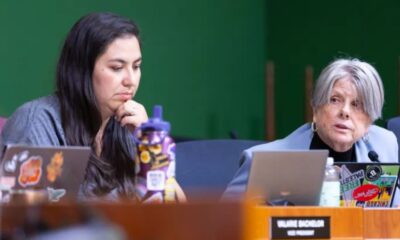
COMMENTARY: Valarie Bachelor and Jennifer Brouhard are Excellent School Board Members and Deserve to Be Reelected
-
 Black History5 days ago
HISTORY MADE: Keisha Lance Bottoms Becomes First Black Woman Elected Governor in American History
-
 Education1 week ago
OUSD Receives State Review of District Finances; Outlines Progress Since January
-
 Community3 weeks ago
It’s Time to Lose Weight Before the Holidays
-
 Business1 week ago
SEIU Local 1000 and State of California Will Continue to Negotiate New Labor Contract
-
 Community4 weeks ago
Democrats, Community Groups Back Measure EE to Change How Oakland Is Governed
-
 Community3 weeks ago
Mayor Barbara Lee Holds Special State of the City Address in Deep East Oakland
-

 Business1 week ago
COMMENTARY: Your California Living Trust Could Be Next: When Evidence Isn’t Enough
