
Activism
Michael Jordan’s Big GIVE

 Friday, June 12, the basketball icon Michael Jordan and his Jordan Brand committed $100 million
over the next 10 years to organizations assisting Black people with social justice and greater
access to education.
A joint statement with Nike read, “The Jordan Brand is us, the Black community. Until the
ingrained racism that allows our country’s institutions to fail is completely eradicated, we will
remain committed to protecting and improving the lives of Black people.” Nike, also committed
to donating $40 million over four years to support Black communities.
When Jordan committed $100 million last week, many Black community voices responded, “It’s
about time,” expressing a sentiment, according to NBC’s TV series GIVE Executive
Producer/Creator Gary Reeves, “is a misconceived sentiment based on lack of research.”
The Black community may have developed that sentiment based upon Kareem Abdul-Jabbar
criticizing Jordan in 2015 for choosing “commerce over conscience” or in 1990 failing to support
a democratic nominee attempting to unseat conservative Senator Jesse Helms, who opposed
federal integration policy, when Jordan stated, “Republicans buy shoes too.”
Sentiment began to shift in 2016 after Jordan donated 5 million for the National Museum of
African American History and Culture in DC and 2 million that same year to two social justice
organizations. However many still felt Jordan had an elitist mentality.
“Most of the giving Michael has done has gone un-celebrated,” says Reeves, “In 1987 I
approached Michael to produce his story about being cut in high school. I saw the story as an
inspirational message for those youth that encounter rejection as they pursue their dream. The
inspirational story was titled ‘Michael Jordan’s Playground’.”
“If he had quit we wouldn’t know him today. His message to so many people was the importance
to push through adversity if you love something and the importance of passion. It’s easy to be
discouraged if you like something, but if you love what you do, you push through to achieve
your dream.”
“Although I didn’t have the resume at the time to produce, he embraced my passion for
delivering an important message using his setback as an inspiration.”
In 1984, Al Attles appointed Reeves as the Golden State Warriors spiritual advisor, working
under Will Herzfeld, of the Oakland, Lutheran Church. Reeves served the organization for
thirteen years, addressing the spiritual and emotional interests of the players. During this tenure,
his services expanded throughout the NBA.
“The graciousness Jordan extended to me had far-reaching results, the perfect example of the
‘butterfly effect’ which inspired a greater potential for social impact.”
Jordan’s give encouraged Reeves ability to create socially inspiring content utilizing sports to
teach life lessons in Oakland, Berkeley and the Greater Bay Area. Reeves touched the lives of
Jason Kidd, Brian Shaw, Gary Payton, Greg Foster, Antonio Davis, Levi Middlebrooks, and
others via free basketball camps, that were supported by the Coors Family and later Coors
Brewing Company.
“Because it was beer, we couldn’t promote the brand because minors were involved so we called
the program ‘21 means 21.’ Ivan Burwell, who was introduced to me by Phyllis Coors, served as
my internal mentor/advocate who was the director of community relations for Coors Brewing
Company in Denver Colorado.”
“I was the person that bridged the gap between celebrities and corporate America with
community partner’s like East Oakland Development Center, Alameda Foster Care services,
HIV/AIDS work with Magic Johnson, and the AIDS Healthcare Foundation where we were able
to build medical centers in San Francisco and Oakland.”
Reeves has rallied celebrity support for a number of community service providers and public
schools in the West Contra Costa School District.
“We provided field trips and a series of concert/assemblies with Robin Thicke, EnVogue,
Mindless Behavior, El Debarge, and Genuine with Blair Underwood and Mario Lopez as hosts.
The concerts were fundraisers that provided positive rewards for kids that did acts of kindness at
schools from James Logan High School in Union City, to El Cerrito High School, Kennedy and
Richmond Pal.”
This was a result of Michael Jordan’s big give. He allowed his support to breathe life into local
under-the-radar programs, and has done this multiple times with multiple individuals, that never
gained public attention.
Moving forward, in 2017 Reeves created the GIVE show that launched on NBC. GIVE provides
a platform for local service providers a seat at the table with national and internationally known
philanthropists. GIVE won the Emmy in 2018 and Tully Award for family programming.
GIVE serves as a platform for philanthropists and donors such as Michael Bloomberg, Michael
Eisner, Ford Company Fund, Paul Newman’s Own, Unite4Good, and the Tisch Family who own
the Mets.
“These philanthropists would never have had a seat at the table if not for GIVE. Blair
Underwood and Jenna Bush, former President Bush’s daughter serve as hosts.”
After two seasons with NBC, Reeves renegotiated his contract and is now moving to Oprah’s
OWN-Network stating it’s a better business model regarding philanthropy.
Michael contributed 100 million dollars, but Reeves serves as an example of how Michael’s
giving has impacted medical centers, and inner-city programs nationwide for many others like
Reeves.
Reeves says, “Don’t be quick to judge, perceptions of Jordan are misaligned, and contributions
throughout his life misunderstood. His service to underserved communities has impacted beyond
his celebrity. He’s impacted social services, social justice, and social inequality his entire career.”







Activism
Oakland Post: Week of September 30 – October 6, 2026
The printed Weekly Edition of the Oakland Post: Week of September 30 – October 6, 2026

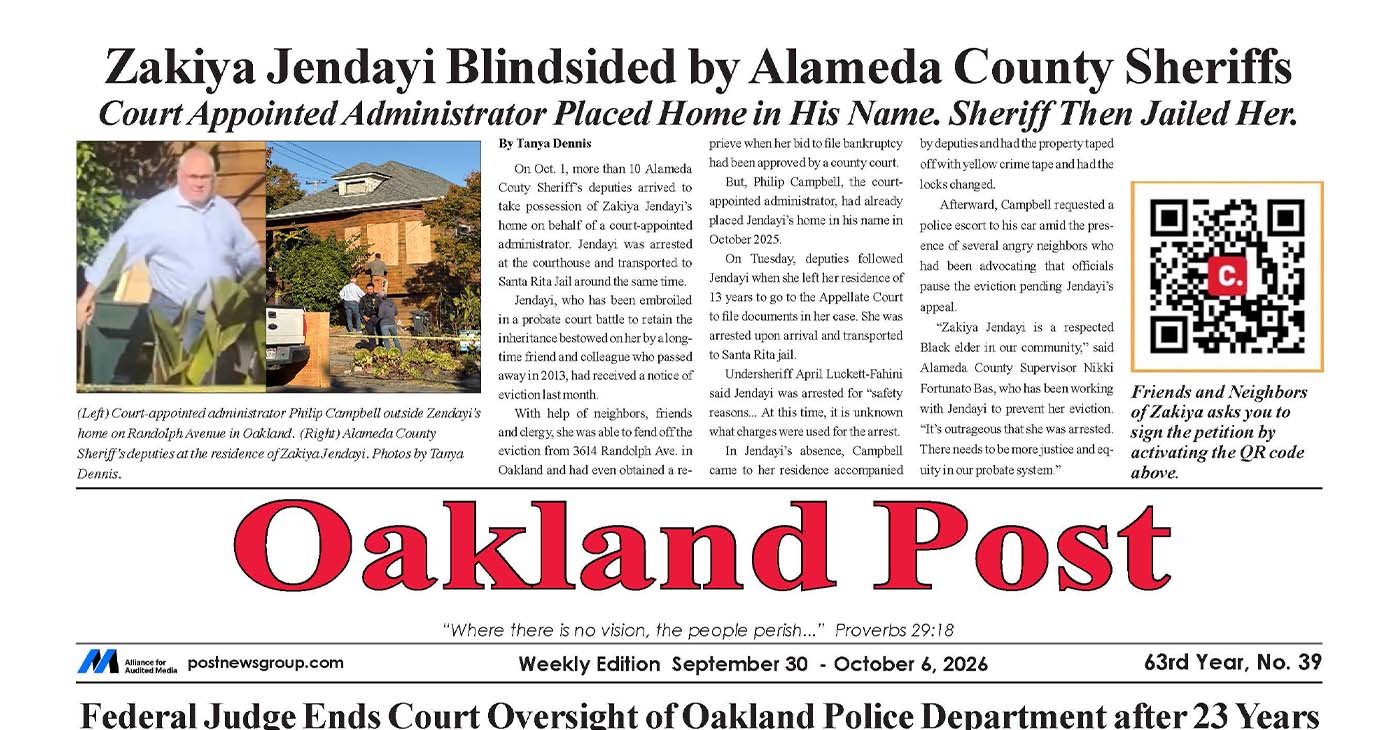
To enlarge your view of this issue, use the slider, magnifying glass icon or full page icon in the lower right corner of the browser window.


Activism
Oakland Post: Week of September 23 – 29, 2026
The printed Weekly Edition of the Oakland Post: Week of September 23 – 29, 2026

To enlarge your view of this issue, use the slider, magnifying glass icon or full page icon in the lower right corner of the browser window.
Activism
Oakland Post: Week of September 16 – 22, 2026
The printed Weekly Edition of the Oakland Post: Week of September 16 – 22, 2026
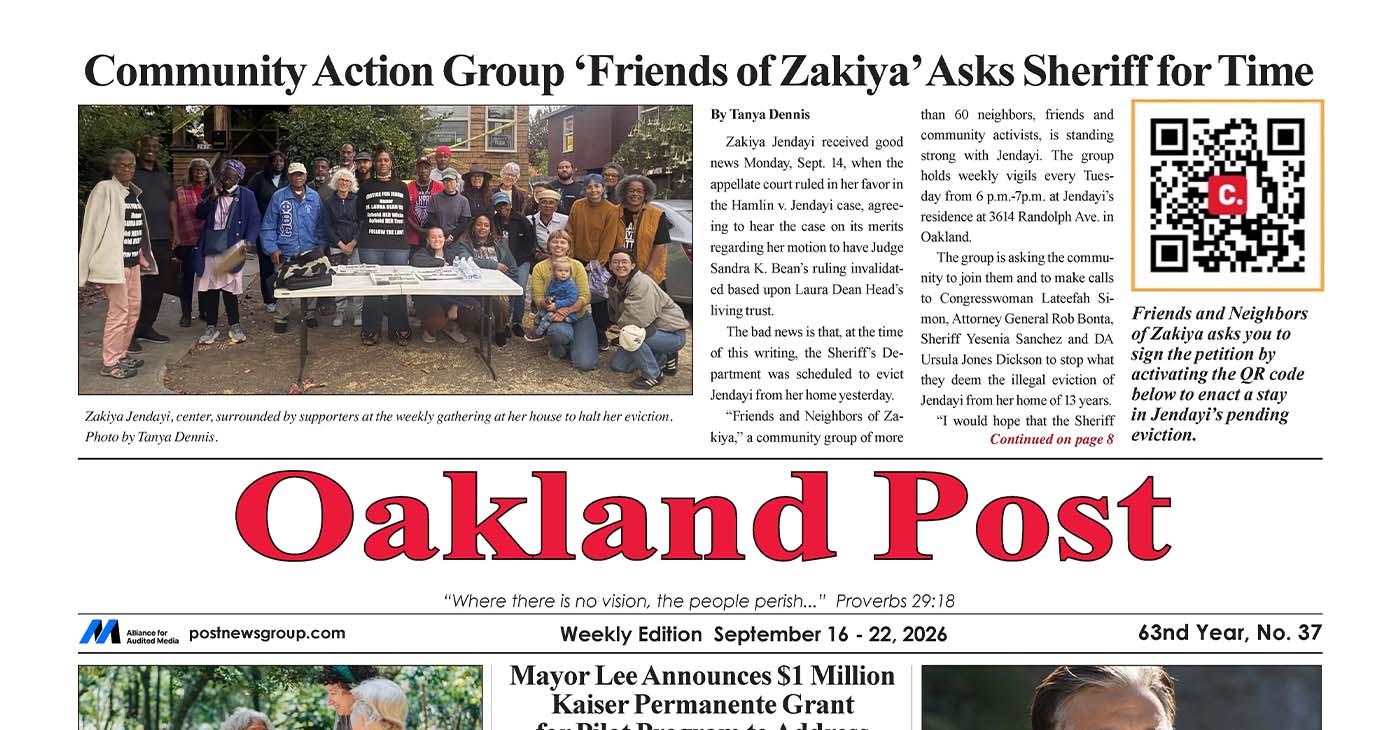
To enlarge your view of this issue, use the slider, magnifying glass icon or full page icon in the lower right corner of the browser window.


OP-ED: Proposition 44 Would Put a Price on Trust

OP-ED: Proposition 40: It’s Time to Play Chess, Not Checkers

Listening as a Lifeline: A Doula’s Witness to Black Maternal Health

New Protections for Ticket Buyers: Gov. Newsom Signs Assemblymember Isaac Bryan’s Bill

‘We Don’t Talk Trash — We Pick Up Trash!’

Zakiya Jendayi Arrested, Locked Out of Home by Sheriff’s Deputies

Oakland Post: Week of September 30 – October 6, 2026

Asm. Corey Jackson Announces Launch of 24-Hour Childcare in His District

IN MEMORIAM: The Rev. Leon “Sonny” Clark, Longtime Orange County Pastor and Community Leader, Dies at 72

Poll: Becerra Widens His Lead Over Hilton; Californians Split on Wealth Tax

From Historic Memories to New Possibilities: Oakland Celebrates Coliseum 60

County Office of Education Says OUSD Finances Are Getting Healthier, Materially Stronger

LIVE FREE Sunday Dinner Brings Faith, Fellowship and Civic Conversation to Oakland

Remembering Chauncey Bailey as Student Journalists Face Threats to Truth-Telling

BLACspace Cooperative Invites Bay Area to Experience Oakland’s Black Cultural Ecosystem Through a BLAC Map Tour + Party

Standoff for Justice: Our Homes Are Worth Fighting For

Oakland Post: Week of August 26 – September 1, 2026

Frontier Airlines’ Return to Oakland Airport Brings Flights, Jobs and Opportunity

Gubernatorial Candidate Steve Hilton Blasts California New Tire Rules; Newsom Hits Back

Chef Sharon Lee Blends Culinary Excellence, Education and Empowerment

Jackie Wright Champions Bay Area Stories, Filmmakers and Cultural Institutions

Misnamed ‘Parent’ PAC Seeks to Influence Oakland School Board Elections

Oakland Coliseum Project Opens Door for Small Businesses to Build Bigger

Gov. Newsom’s Latest Appointees Include Sacramento Advocate for Formerly Incarcerated Students; State’s New Tech Chief

Big City Mayors Ask for “Yes” Vote on Housing Bond Measure; Conservatives Say “No”

Longtime BWOPA Member Brendalyn Goodall Appointed to California Workforce Development Board

Oakland Post: Week of September 2 – 8, 2026

Gov. Newsom Signs Law Shielding Immigration Aid Workers From Doxing Threats

Secretary of State Shirley N. Weber Urges Californians to Vote Early as Voter ID Battle Intensifies

IN MEMORIAM: Dolly Parton Dead at 80 — How She Built a Legacy of Love and Earned Her Place in Black Culture

The Conversation With Al McFarlane 6/23/26

Media Monday 6/22/26

LIVE! ASK ALMA! — TUES. 6.23.26 7PM EST

Car Buying Secrets: 4 Hidden Checks Before You Sign!

Is This 550 HP Charger Worth YOUR Money? AutoNetwork Review

Celebrating Juneteenth – Frederick Douglass on education and resistance

LIVE! — ASK ALMA! — TUES. 6.19.26 7PM EST

Hyundai Ioniq 5 Parking, Safety, and 360 View #shorts

2025 Ioniq 5 New Wiper & Powerful Performance! #shorts

Electric SUV Range: Is 259 Miles Enough? #shorts

EV Charging: How Fast Can You Charge an Electric Vehicle? #shorts

Biometric Cooling… Messaging Seats…Come on! 2025 Infiniti QX80 Autograph 4WD

Charged Up: Witness the Magic of a Fully Electric Car! #shorts

Range Rover Sport PHEV Included…: See What’s Inside This Luxury SUV! #shorts

Invisible Hood View: Perfect Parking with X-Ray Vision! #shorts
-
 Community4 weeks ago
Misnamed ‘Parent’ PAC Seeks to Influence Oakland School Board Elections
-

 Activism4 weeks ago
Oakland Post: Week of September 9 – 15, 2026
-

 Community4 weeks ago
Richmond Tiny House Village Farm & Garden Set to Open Gates on Sept. 26
-

 Black History4 weeks ago
Latest Massacre in Haiti Reveals Cruelty U.S. Deportations
-

 Black History4 weeks ago
OPINION: Nolan Wells’ Death One of Several Signifying Racial Terror Lives on in U.S. South
-

 Business3 weeks ago
Mayor Lee Announces $1 Million Kaiser Permanente Grant for Pilot Program to Address Homelessness, Clean Up Public Spaces throughout Oakland
-

 Community4 weeks ago
Democratic Clubs Interview Candidates for Oakland School Board
-
 Uncategorized2 weeks ago
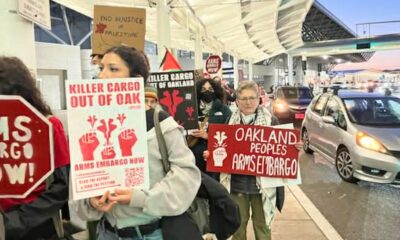
Oakland People’s Arms Embargo Coalition Demands End to Military Shipments Thru Oakland

1 Comment