
Business
Media Heads Rule Ranks of Best-Paid CEOs


This photo shows six of the ten highest-paid CEOs in 2014, according to a study carried out by executive compensation data firm Equilar and The Associated Press. Top row, from left: David Zaslav, Discovery Communications; Les Moonves, CBS; and Philippe Dauman, Viacom. Bottom row, from left: Robert Iger, Walt Disney; Brian Roberts, Comcast; and Jeffrey Bewkes, Time Warner. (AP Photo)
STEVE ROTHWELL, AP Business Writers
RYAN NAKASHIMA, AP Business Writers
NEW YORK (AP) — They’re not Hollywood stars, they’re not TV personalities and they don’t play in a rock band, but their pay packages are in the same league.
Six of the 10 highest-paid CEOs last year worked in the media industry, according to a study carried out by executive compensation data firm Equilar and The Associated Press.
The best-paid chief executive of a large American company was David Zaslav, head of Discovery Communications, the pay-TV channel operator that is home to “Shark Week.” His total compensation more than quadrupled to $156.1 million in 2014 after he extended his contract.

Les Moonves, of CBS, held on to second place in the rankings, despite a drop in pay from a year earlier. His pay package totaled $54.4 million.
The remaining four CEOs, from entertainment giants Viacom, Walt Disney, Comcast and Time Warner, have ranked among the nation’s highest-paid executives for at least four years, according to the Equilar/AP pay study.
One reason for the high level of pay in the industry is that its CEOs are dealing with well-paid individuals.
“The talent, the actors and directors and writers, they’re being paid a lot of money,” said Steven Kaplan, a professor of finance at the University of Chicago Booth School of Business. “In industries where the talent makes a lot of money, the CEO makes a lot of money as well.”
Pay packages for CEOs overall grew for the fifth straight year in 2014, driven by a rising stock market that pushed up the value of executive stock awards. Median compensation for the heads of Standard & Poor’s 500 companies rose to a record $10.6 million, up from $10.5 million the year before, according to the Equilar/AP pay study.
Peer pressure is another factor driving up executive compensation. The board members responsible for setting CEO pay typically consider what the heads of similar companies are making. If pay for one goes up, it will likely go up for others.
For the chieftains of media, there are also other factors boosting pay.
Several work at companies where a few major shareholders control the vote.
The media magnate Sumner Redstone controls almost 80 percent of the voting stock at CBS and Viacom. Because of his large holdings, Redstone can easily override the concerns of other investors about the level of CEO pay. Discovery’s voting stock is heavily influenced by the brothers Si and Donald Newhouse and John Malone, another influential investor in the media industry.
At Comcast, which owns NBC and Universal Studios, CEO and Chairman Brian Roberts controls a third of his company’s voting stock. That means he has substantial influence on the pay that he is awarded.
Comcast had no comment when contacted by the AP for this story.
All of the media executives have tried, with varying degrees of success, to maximize the value of their company’s entertainment brands online and on mobile devices.
For example, Moonves at CBS launched the series “Under the Dome” — based on the Stephen King novel — both on the network and on the Amazon Prime streaming service. Besides reaching online customers, the move helped offset production costs. The company, whose shows also include “NCIS” and “The Good Wife,” has attracted 100,000 customers to “CBS All Access,” an online subscription platform that costs $6 a month. Time Warner, under CEO Jeffrey Bewkes, launched HBO Now, which streams shows to computers, tablets and smartphones for $15 a month.
At Disney, CEO Bob Iger has bolstered revenues through canny acquisitions.
The purchase of Marvel in 2009 is reaping dividends with blockbuster superhero movies. “Avengers: Age of Ultron,” pulled in almost $190 million in its opening weekend, making it the second-biggest U.S. movie opening ever. Disney’s purchase of LucasFilms in 2012 means it also owns the highly lucrative “Star Wars” franchise, with the next installment scheduled for release in December.
Disney spokesman David Jefferson said in an email that Iger’s pay award “reflected the company’s outstanding financial performance,” and cited its record earnings. He also said that during Iger’s tenure Disney has returned more than $51 billion to stockholders through share buybacks and dividends.
Media stocks have climbed strongly the past five years. An index of media companies in the S&P 500 index has risen 194 percent compared with a gain of 94 percent for the broader S&P 500.
Discovery’s stock price has climbed almost fivefold since it started trading as a public company in September 2008.
Zaslav, who has led Discovery since 2007, saw his compensation rise last year after he negotiated a new contract that will keep him at the company until 2019. Last year’s pay package included $145 million in stock and options awards, $6 million in cash bonuses, $3 million in base salary, and $1.9 million in perks.
The company has pushed its channels overseas where pay TV penetration is growing faster than in the U.S. Last year, Discovery also grabbed a controlling stake in Eurosport International, making a bet on live sports. The move into European sports has set the stage for renewed growth overseas.
Zaslav has done a terrific job, said Chris Marangi, portfolio manager at GAMCO Investors Inc., which holds more than $150 million in Discovery stock.
The CEO has returned cash to shareholders and increased viewership largely through company-owned reality TV shows like “Say Yes to the Dress” and “Deadliest Catch.”
“He’s a dynamic leader at the helm of a company in a very fast-changing industry,” Marangi said.
Even though Discovery’s stock has slumped over the last 18 months, it is still up 244 percent since Zaslav took the helm in 2007. That compares with a gain of 46 percent for the S&P 500 over the same time.
Discovery declined to comment for this story when contacted by the AP.
The pay package of Viacom CEO Philippe Dauman’s reflects “solid financial results, execution on key operational goals and a return of $3.9 billion to stockholders through stock buybacks and dividends,” company spokesman Jeremy Zweig said in an email.
Top executives are getting paid more because much of their compensation comes from bonuses linked to their company’s financial and stock performance. Only a small part of their pay comes from their base salary.
Structuring pay this way is intended to align the executives’ interests to that of the company and to encourage long-term strategies.
Because corporate earnings have grown consistently, with a near six-year expansion of the economy, executives have met or beaten their earnings targets generally.
Earnings-per-share for the average S&P 500 company rose 7.7 percent in 2014, according to data from S&P Capital IQ. Revenue-per-share climbed 4 percent.
“There should be a strong link between pay and performance. The markets were up in 2014 so it makes sense that (compensation) was going in the same direction,” said Bess Joffe, managing director of corporate governance at TIAA-CREF, an asset management company. “We would also expect, in a downturn, for the compensation numbers to fall.”
The gap between pay for CEOs and that of the average worker narrowed slightly last year, because average wages crept up more than CEO pay did.
A chief executive made about 205 times the average worker’s wage, compared with 257 times the year before, according to AP calculations using earnings statistics from The Labor Department. That gap was still much wider than six years before, during the recession, when executives earned 181 times the average worker’s pay.
The notion that every CEO is a visionary in the mold of Steve Jobs, who led Apple, or Bill Gates, who co-founded Microsoft, is challenged by some.
“There are superstar CEOs that definitely are the driving force of the company, but while they are out there, they are rare,” said Charles Elson, a corporate governance expert at the University of Delaware.
Elson says that boards should look at overall levels of pay within their own company, rather than benchmarking pay against CEOs working in the same industry. He also says companies are paying too much to retain their chief executives when there is little evidence they’ll move to competitors.
For the annual CEO pay study, Equilar assessed data from 338 companies that filed proxy statements with regulators between Jan. 1 and April 30, 2015. To calculate a CEO’s pay package, Equilar and the AP looked at salary, stock and option awards, perks and bonuses.
The study only includes chief executives who have been at the helm of their company for at least two years. Because of these criteria, there are some notable omissions from the list.
Among other findings:
— The industry with the biggest pay increase was basic materials, which includes oil, mining and chemical companies. Median pay at these companies rose by 15 percent last year. Exxon Mobil CEO Rex Tillerson was the highest paid, making $28.4 million last year.
— Female CEOs again had a median pay package worth more than their male counterparts. Last year, women chief executives earned $15.9 million compared with the median salary for male CEOs of $10.4 million. The number of female CEOs included in the study rose to 17 from 12 in the previous year. Yahoo CEO Marissa Mayer was the highest paid, earning $42.1 million, which placed her fifth among CEOs in the survey.
— Richard Hayne, the CEO and co-founder of Urban Outfitters, received the biggest pay bump. His compensation soared 682 percent to $535,636. Most of the increase came from his performance cash bonus, which jumped to $500,000 from $35,000 a year earlier. Hayne returned to lead the company in 2012 after an absence of five years.
___
Nakashima reported from Los Angeles.
Follow Steve Rothwell on Twitter @SteveRothwellAP
Follow Ryan Nakashima on Twitter @rnakashi
___
Online:
http://www.equilar.com/
Copyright 2015 The Associated Press. All rights reserved. This material may not be published, broadcast, rewritten or redistributed.


Activism
Oakland Post: Week of April 8 – 14, 2026
The printed Weekly Edition of the Oakland Post: Week of April 8 – 14, 2026

To enlarge your view of this issue, use the slider, magnifying glass icon or full page icon in the lower right corner of the browser window.
Activism
Oakland Post: Week of April 1 – 7, 2026
The printed Weekly Edition of the Oakland Post: Week of April 1 – 7, 2026
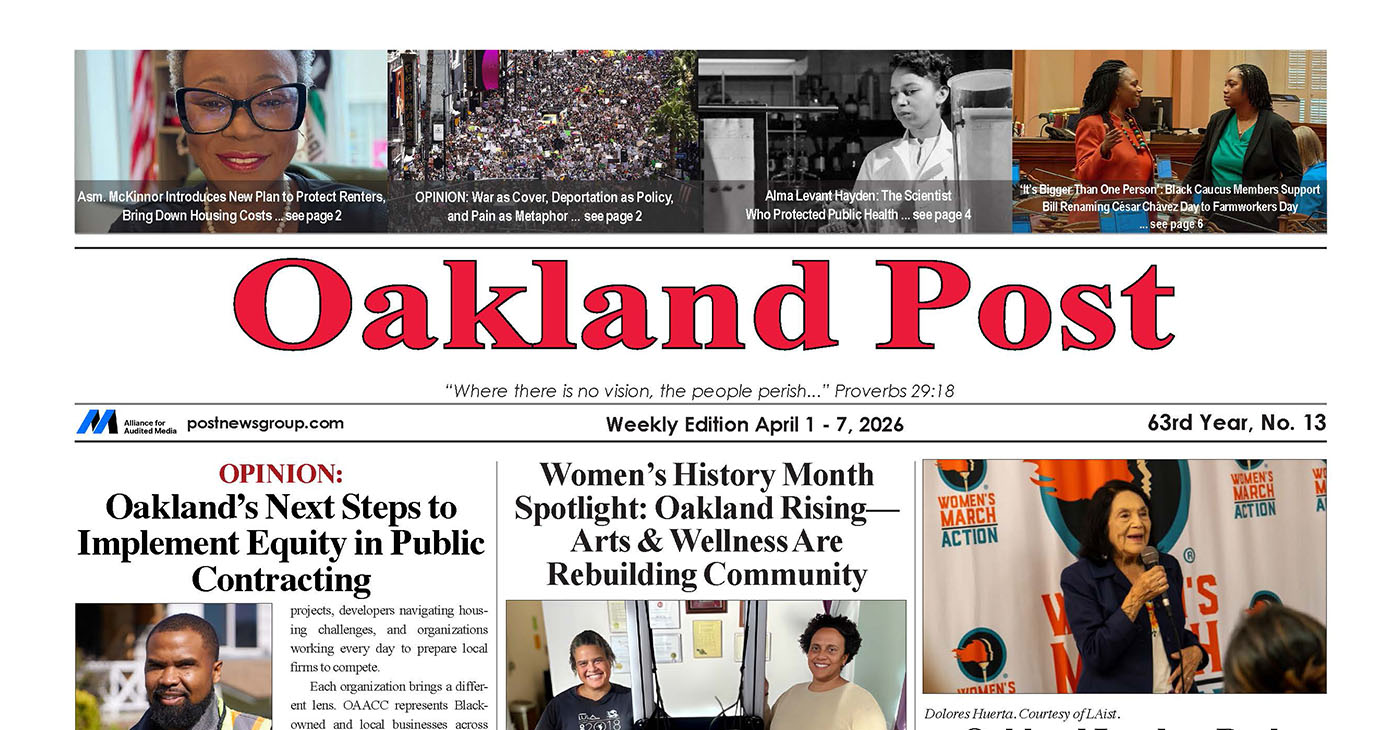
To enlarge your view of this issue, use the slider, magnifying glass icon or full page icon in the lower right corner of the browser window.
Activism
Oakland Post: Week of March 18 – 24, 2026
The printed Weekly Edition of the Oakland Post: Week of March 18 – 24, 2026
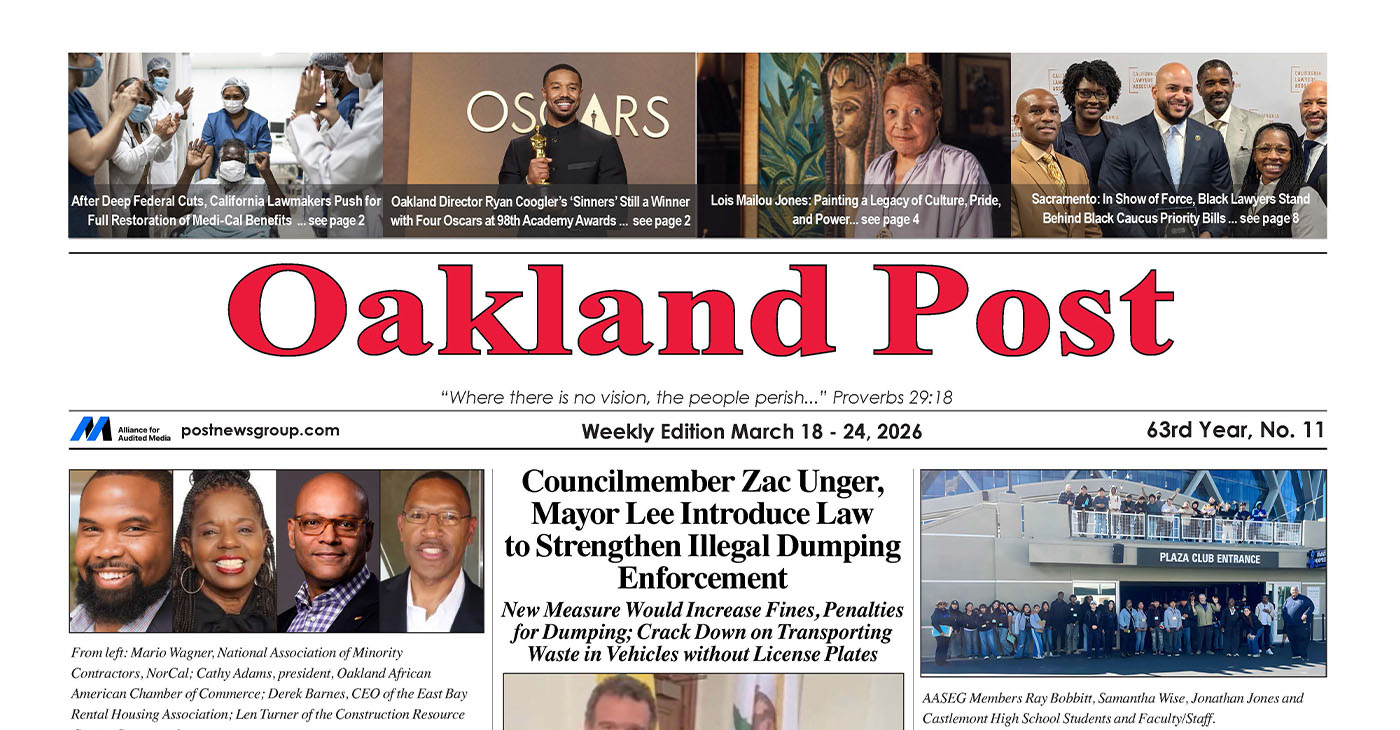
To enlarge your view of this issue, use the slider, magnifying glass icon or full page icon in the lower right corner of the browser window.


WORK FROM HOME
Home-based business with potential monthly income of $10K+ per month. A proven training system and website provided to maximize business effectiveness. Perfect job to earn side and primary income. Contact Lynne for more details: Lynne4npusa@gmail.com 800-334-0540


Oakland Post: Week of April 8 – 14, 2026

Oakland Post: Week of April 1 – 7, 2026

Black Artists in America, Installation Three Wraps at the Dixon Gallery and Gardens

Grief, Advocacy, and Education: A Counselor Reflects on Black Maternal Health

Future of Florida’s Black History Museum in Limbo

New Research Shows the Many Benefits of Early Learning

South Hampton K-8 Students Among Top 10 Finalists for Samsung’s ‘Solve for Tomorrow’ Competition

Cuba: No Negotiation with US on the President or Political System

Brooklyn Academy of Music Names Jamaican-Born Tamara McCaw as President

Trinidad & Tobego – U.S. Launches WhatsApp Channel for American Citizens in the Country

Oakland Post: Week of March 18 – 24, 2026

AI Innovation vs. Ethics and Environmental Impact

AI, Web3, and Digital Reparations

What If You Owned Your AI Agent?

Season 7, Episode 3 – January Reporter’s Roundtable 📱

Reflecting on Black History Milestones in Birmingham AL

Oakland Post: Week of February 25 – March 3, 2026

Oakland Post: Week of March 4 – 10, 2026

PRESS ROOM: NBA Hall of Fame Nominee Terry Cummings Joins 100 Black Men of DeKalb County to Launch Victory & Values Initiative

Trump’s MAGA Allies are Creating Executive Order Plan to Steal the 2026 Midterms

U.S. manufacturing rebounds – how foundry services are adapting to rising demand

Poll Shows Support for Policies That Help Families Afford Child Care

Oakland Post: Week of March 11 -17, 2026
Oakland Post: Week of March 18 – 24, 2026

OP-ED: One Hundred Years of Black Workers Telling the Truth

Advancements in solar technology that are changing the way we power the world

Financial Wellness and Mental Health: Managing Money Stress in College

Woman’s Search for Family’s Roots Leads to Ancestor John T. Ward – A Successful Entrepreneur and Conductor on the Underground Railroad

COMMENTARY: Women of Color Shape Our Past and Future

PRESS ROOM: Civil Rights TV Launches in Selma as the World’s First 24/7 Civil Rights Television Network

Hyundai Ioniq 5 Parking, Safety, and 360 View #shorts

2025 Ioniq 5 New Wiper & Powerful Performance! #shorts

Electric SUV Range: Is 259 Miles Enough? #shorts

EV Charging: How Fast Can You Charge an Electric Vehicle? #shorts

Biometric Cooling… Messaging Seats…Come on! 2025 Infiniti QX80 Autograph 4WD

Charged Up: Witness the Magic of a Fully Electric Car! #shorts

Range Rover Sport PHEV Included…: See What’s Inside This Luxury SUV! #shorts

Invisible Hood View: Perfect Parking with X-Ray Vision! #shorts

AI Is Reshaping Black Healthcare: Promise, Peril, and the Push for Improved Results in California

ESSAY: Technology and Medicine, a Primary Care Point of View

Sanctuary Cities

The RESISTANCE – FREEDOM NOW

STATE OF THE PEOPLE: Freddie

ECONOMIC BOYCOTT DAY!!!!!

I told You So
-
 Activism3 weeks ago
Oakland Post: Week of March 11 -17, 2026
-
 Activism3 weeks ago
Oakland Post: Week of March 18 – 24, 2026
-
 Advice3 weeks ago
Financial Wellness and Mental Health: Managing Money Stress in College
-
 #NNPA BlackPress3 weeks ago
Brooklyn Academy of Music Names Jamaican-Born Tamara McCaw as President
-
 #NNPA BlackPress2 weeks ago
Grief, Advocacy, and Education: A Counselor Reflects on Black Maternal Health
-
 #NNPA BlackPress2 weeks ago
New Research Shows the Many Benefits of Early Learning
-
 #NNPA BlackPress2 weeks ago
Black Artists in America, Installation Three Wraps at the Dixon Gallery and Gardens
-

 Advice4 weeks ago
Women & Wealth: Tips for Navigating Your Lifelong Financial Journey
