
Economics
Mayor Schaaf’s Budget Proposes Only $250,000 for Homelessness

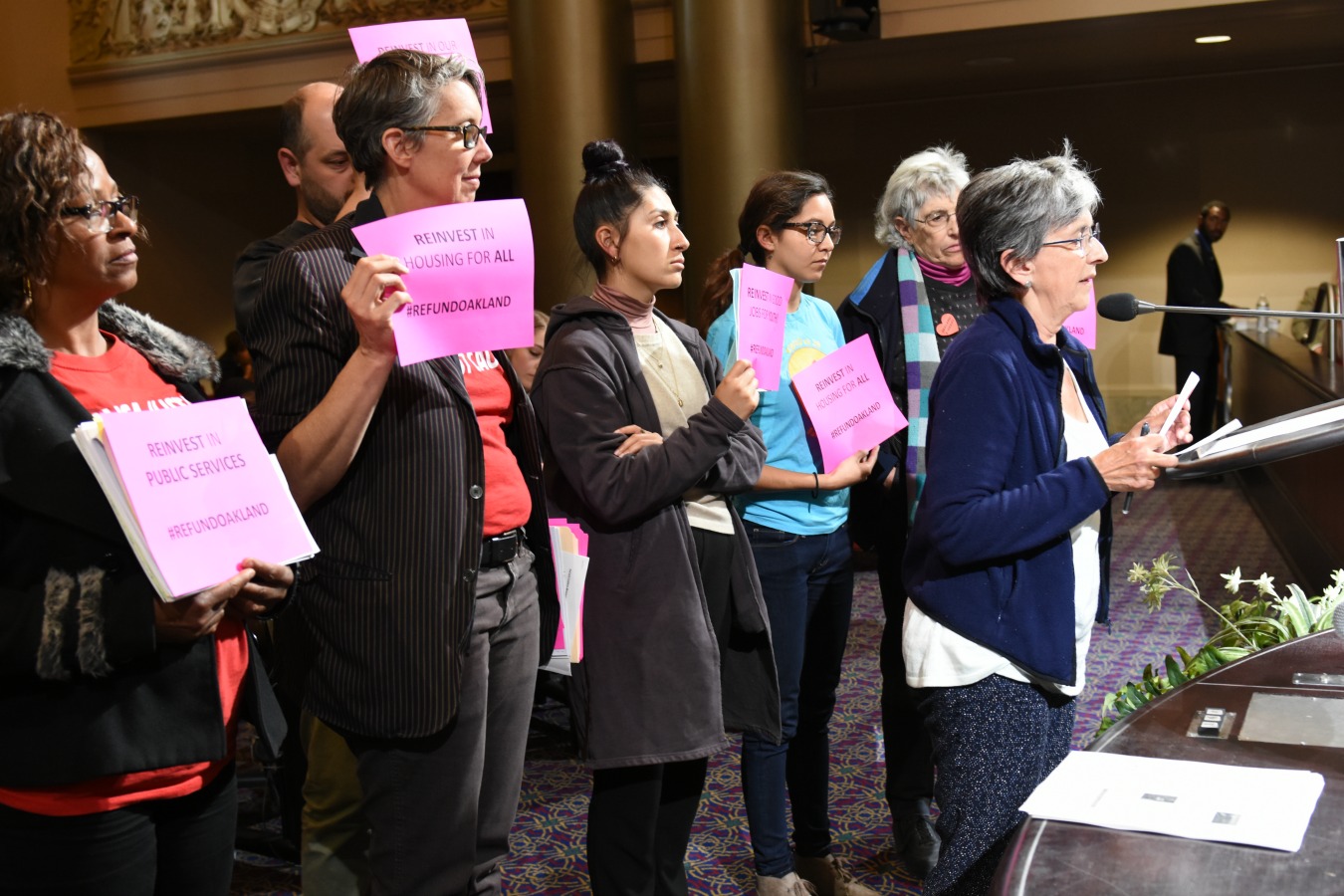
Caption: Nancy Nadel speaks at Tuesday night City Council meeting, calling on the council to pass a 2017-2019 budget that prioritizes “housing the unhoused.” Photo by Ken Epstein
Based on a survey conducted by the city on community budget priorities, Oaklanders overwhelming agree that homelessness and displacement are the most critical issues the city faces.
The survey found that the Oakland’s top issue to address in the new 2017-2019 budget was “Housing costs/affordability,” which jumped 29 percent from the previous survey and for the first time displaced “crime/violence/safety” as residents’ major concern.
As a result Mayor Libby Schaaf’s proposed budget came under fire at this week’s City Council meeting, as public speakers and council members criticized her administration’s proposal for allocating meager resources for affordable housing for low-income residents, including only $250,000 to meet housing and service needs for the city’s growing homeless population.
Speaking at the council meeting, Councilmember Dan Kalb said his top budget priority was funding for homeless services and developing housing. “It is lacking and needs to be upped significantly,” said Kalb.
“$250,000 is completely inadequate,” said Councilmember Annie Campbell Washington.
“What we can fund and should fund (should be sufficient) to make a real dent,” she said, pointing out that the budget also lacks any funding for the usual summer job program for Oakland youth.
Stating that “”$250,000 not enough,” Councilmember Desley Brooks proposed expediting funds from the Measure KK infrastructure, bond which voters approved in November, to begin spending money on acquisition and construction of affordable housing units as quickly as possible.
Calling for a “humane and” sensible budget,” Kaplan said $250,000 is not a “serious proposal. ¨We have a homeless crisis.”
She said the first round of KK bond expenditures should fund “affordable housing construction and immediately buy existing (structures), including single-room-occupancy buildings (SROs),” before the market drives up SRO prices.
Many of the dozens of public speakers told the council called for the council to take action on homelessness and affordable housing. A number of speakers said the city could find additional funds if it eliminates what they view excessive spending on the Oakland Police Department, which accounts for the biggest chunk of the city’s budget
Nancy Nadel, a community activist and former West Oakland councilmember, said she was speaking for a group Oaklanders dedicated to “housing our unhoused residents.”
“I have been coming here for at least seven months with no discernable progress,” she said.
“We see a lot of finger pointing,” blaming the county for not doing enough. “We hope to see new units to house our unhoused residents (in the new budget.)”
In a statement published in the SF Chronicle on Sunday, Mayor Schaaf said, “It is disappointing not to have all the resources we want,” and that as a result the city has to make “hard choices.”
Schaaf said that Alameda County has the primary responsibility to provide homeless services.
A new budget must be approved by the end of June. The next city council discussion on the budget is scheduled for May 30.











Activism
Oakland Post: Week of September 23 – 29, 2026
The printed Weekly Edition of the Oakland Post: Week of September 23 – 29, 2026

To enlarge your view of this issue, use the slider, magnifying glass icon or full page icon in the lower right corner of the browser window.
Activism
Oakland Post: Week of September 16 – 22, 2026
The printed Weekly Edition of the Oakland Post: Week of September 16 – 22, 2026

To enlarge your view of this issue, use the slider, magnifying glass icon or full page icon in the lower right corner of the browser window.
Activism
Oakland Post: Week of September 9 – 15, 2026
The printed Weekly Edition of the Oakland Post: Week of September 9 – 15, 2026

To enlarge your view of this issue, use the slider, magnifying glass icon or full page icon in the lower right corner of the browser window.



Asm. Corey Jackson Announces Launch of 24-Hour Childcare in His District

IN MEMORIAM: The Rev. Leon “Sonny” Clark, Longtime Orange County Pastor and Community Leader, Dies at 72

Poll: Becerra Widens His Lead Over Hilton; Californians Split on Wealth Tax

From Historic Memories to New Possibilities: Oakland Celebrates Coliseum 60

County Office of Education Says OUSD Finances Are Getting Healthier, Materially Stronger

LIVE FREE Sunday Dinner Brings Faith, Fellowship and Civic Conversation to Oakland

Remembering Chauncey Bailey as Student Journalists Face Threats to Truth-Telling

BLACspace Cooperative Invites Bay Area to Experience Oakland’s Black Cultural Ecosystem Through a BLAC Map Tour + Party

In Wake of Death on Doorstep, Williams Chapel Baptist Church Calls for Better Care, Funding for Unhoused

Oakland Centenarian Nuna McKee Honored!

Caribbean Nations Produce Action Plan Calling for UK Reparations Over Slavery

Oakland Post: Week of September 23 – 29, 2026

Doulas Are Helping Black California Moms Navigate Pregnancy–Even as High Mortality Rates Persist

Newsom Signs Addictive Social Media Law to Protect Kids

On Your November Ballot: Prop 38 Would Allocate $8.4 Billion to Immunology and Immunotherapy Funding

Standoff for Justice: Our Homes Are Worth Fighting For

Oakland Post: Week of August 26 – September 1, 2026

Frontier Airlines’ Return to Oakland Airport Brings Flights, Jobs and Opportunity

Gubernatorial Candidate Steve Hilton Blasts California New Tire Rules; Newsom Hits Back

Chef Sharon Lee Blends Culinary Excellence, Education and Empowerment

Jackie Wright Champions Bay Area Stories, Filmmakers and Cultural Institutions

Big City Mayors Ask for “Yes” Vote on Housing Bond Measure; Conservatives Say “No”

Oakland Coliseum Project Opens Door for Small Businesses to Build Bigger

Gov. Newsom’s Latest Appointees Include Sacramento Advocate for Formerly Incarcerated Students; State’s New Tech Chief

Misnamed ‘Parent’ PAC Seeks to Influence Oakland School Board Elections

Longtime BWOPA Member Brendalyn Goodall Appointed to California Workforce Development Board

Gov. Newsom Signs Law Shielding Immigration Aid Workers From Doxing Threats

Secretary of State Shirley N. Weber Urges Californians to Vote Early as Voter ID Battle Intensifies

From Palestine to Oakland: Seeds for Liberation Examines Shared Struggles for Freedom

IN MEMORIAM: Dolly Parton Dead at 80 — How She Built a Legacy of Love and Earned Her Place in Black Culture

The Conversation With Al McFarlane 6/23/26

Media Monday 6/22/26

LIVE! ASK ALMA! — TUES. 6.23.26 7PM EST

Car Buying Secrets: 4 Hidden Checks Before You Sign!

Is This 550 HP Charger Worth YOUR Money? AutoNetwork Review

Celebrating Juneteenth – Frederick Douglass on education and resistance

LIVE! — ASK ALMA! — TUES. 6.19.26 7PM EST

Hyundai Ioniq 5 Parking, Safety, and 360 View #shorts

2025 Ioniq 5 New Wiper & Powerful Performance! #shorts

Electric SUV Range: Is 259 Miles Enough? #shorts

EV Charging: How Fast Can You Charge an Electric Vehicle? #shorts

Biometric Cooling… Messaging Seats…Come on! 2025 Infiniti QX80 Autograph 4WD

Charged Up: Witness the Magic of a Fully Electric Car! #shorts

Range Rover Sport PHEV Included…: See What’s Inside This Luxury SUV! #shorts

Invisible Hood View: Perfect Parking with X-Ray Vision! #shorts
-
 Community3 weeks ago
Misnamed ‘Parent’ PAC Seeks to Influence Oakland School Board Elections
-

 Activism4 weeks ago
Oakland Post: Week of September 2 – 8, 2026
-

 Community3 weeks ago
Richmond Tiny House Village Farm & Garden Set to Open Gates on Sept. 26
-

 Activism3 weeks ago
Oakland Post: Week of September 9 – 15, 2026
-

 Black History3 weeks ago
Latest Massacre in Haiti Reveals Cruelty U.S. Deportations
-

 Black History3 weeks ago
OPINION: Nolan Wells’ Death One of Several Signifying Racial Terror Lives on in U.S. South
-

 Community3 weeks ago
Democratic Clubs Interview Candidates for Oakland School Board
-

 Business2 weeks ago
Mayor Lee Announces $1 Million Kaiser Permanente Grant for Pilot Program to Address Homelessness, Clean Up Public Spaces throughout Oakland
