
Bay Area
Mayor London Breed Announces Plan to Create Street Wellness Response Team to Expand Services for Those in Need
SCRT launched its fourth team on Monday, May 10. These teams are currently operating in the Tenderloin, the Castro/Mission, the Bayview, and the Northeast/Waterfront/Chinatown area. The program will be fully deployed by the end of the summer after a fifth team comes on board to cover remaining geographic areas while a sixth team provides city-wide 24/7 coverage.

Mayor London N. Breed today announced a plan to create a new Street Wellness Response Team to improve outcomes for people in need on San Francisco’s streets and advance the City’s efforts to implement alternatives to police responses to non-violent calls.
The Street Wellness Response Team will provide an appropriate medical and social service response for people who require immediate assistance but do not have emergent behavioral health care needs.
San Francisco’s Street Crisis Response Teams (SCRT) will continue operating to address the needs of people experiencing behavioral health crises.
“Building on the early success of the Street Crisis Response Team, we are continuing our work to make a significant change to improve how we effectively serve people in need on our streets,” said Breed. “Many calls to 911 or 311 about someone who appears to need help on our streets don’t require an armed police response, and often the services and care people need would be best provided by a paramedic or outreach worker instead of a police officer.
“As we work to recover from COVID-19, part of making our city stronger and healthier requires pushing forward on our efforts to help people experiencing homelessness and who are on our streets in need of assistance and connections to housing. The Street Wellness Response Team will work alongside the Street Crisis Response Teams. Together, these Street Response Teams will meet people where they are and provide the level of care that is needed.”

The Street Wellness Response Team will consist of community paramedics and EMTs from the San Francisco Fire Department (SFFD) and Homeless Outreach Team members from the Department of Homelessness and Supportive Housing (HSH).
They will be dispatched to focus on well-being checks and situations that require immediate attention, but do not meet the threshold of an acute behavioral health crisis. This includes situations such as someone with obvious wounds, people who are lying down or sleeping, or someone inappropriately clothed for the weather.
SFFD community paramedics, which also support the Street Crisis Response Team, will perform medical, behavioral, and social needs assessments, render immediate aid if needed, and along with the homeless outreach worker, will be able to offer meaningful connections to services and housing.
The new team will be deployed on 12-hour shifts in an SFFD vehicle and have the ability to provide transportation services to individuals who might need that as part of the engagement.
As with SCRT, the new Street Wellness Response Team will be able to respond directly to 911 and 311 calls for service. The team will analyze 911 and 311 calls for service to strategically assign teams to be in areas where there is high need and proactively respond to people in distress on the street who are not in an acute behavioral health crisis.
Integrating these teams with 911 and 311 dispatch will also help with tracking data and outcomes to ensure the efficacy of the program.
Existing outreach teams like the Homeless Outreach Team and Harm Reduction Outreach teams will continue to operate, complementing the Community Response Teams by providing ongoing, specialized outreach to people experiencing homelessness who need support to stabilize and move from streets to housing.
The Mayor’s proposed budget for Fiscal Years 2021-22 and 2022-23, which will be submitted by June 1, 2021, will include $9.6 million to fund five teams over two years. If this team is approved in the Budget when it is finalized at the end of July, they would begin the operational planning, developing protocols — including risk assessment and dispatch—and launch at least one team by January 2022 and build up to five teams total by April 2022.
“The San Francisco Fire Department’s Community Paramedic Division stands ready to build another team to deliver the much-needed services to people of the City and County of San Francisco,” said Chief Jeanine Nicholson of the San Francisco Fire Department. “Mayor Breed has recognized the positive impact that community paramedicine has had with the recently implemented Street Crisis Response Team and EMS6. The SFFD looks forward to being a part of the solution to improving people’s lives as well as overall street conditions.”
“The Street Wellness Response Team will provide dignified and compassionate care to people experiencing homelessness on our streets and in our neighborhoods,” said Shireen McSpadden, director of the San Francisco Department of Homelessness and Supportive Housing. “We appreciate this investment in making our communities safer and more humane for all residents of San Francisco.”
During the rollout of SCRT, the City has continued to focus on the next steps needed to provide better services and outcomes for people on the street and end the use of police as first responders when an armed response is not needed. Led by the Mayor’s office, City departments including SFFD, Department of Emergency Management, San Francisco Police Department, the Department of Public Health, HSH, San Francisco Municipal Transportation Agency, City Administrator’s office, and Public Works, have been identifying and analyzing further calls that could be diverted from the police and handled by different non-law enforcement entities in a manner that is safe, sustainable for the long-term, and delivers better service for those in need of assistance.
In 2019, there were approximately 18,000 calls for assistance regarding “well-being checks” that were fielded by both 911 and 311 in which the police were ultimately deployed to respond.
This is one of the highest-volume call categories currently being answered by police after the calls regarding “mentally disturbed adults” that have already been diverted to SCRT. To address these “well-being” requests and provide more proactive outreach, Breed is proposing these new teams to operate in concert with SCRT and the City’s continuum of services.
“There is a lot of stigma against people having a mental health crisis on the streets,” said Miguel Levya, a peer counselor for SCRT. “We find we can de-escalate most situations by treating them the way everyone wants to be treated – with kindness and respect. This offers the best approach for getting them the help they need and resolving any disturbances that have happened.”
Street Crisis Response Team Background
In June 2020, Mayor Breed announced a roadmap to fundamentally change the nature of policing in San Francisco and issued a set of policies to address structural inequities. She proposed four priorities to achieve this vision: ending the use of police in response to non-criminal activity; addressing police bias and strengthening accountability; demilitarizing the police, and promoting economic justice.
The Street Crisis Response Team launched in November 2020 to change the way San Francisco responds to non-violent, mental health crises on our streets. The SCRT pilot program offers a unique model for the nation with a behavioral health and harm reduction approach to people in distress. Each SCRT neighborhood team consists of a paramedic, a behavioral health clinician, and a peer health worker.
SCRT launched its fourth team on Monday, May 10. These teams are currently operating in the Tenderloin, the Castro/Mission, the Bayview, and the Northeast/Waterfront/Chinatown area. The program will be fully deployed by the end of the summer after a fifth team comes on board to cover remaining geographic areas while a sixth team provides city-wide 24/7 coverage.
By April, the teams had responded to more than 700 calls with an average response time of 15 minutes. The vast majority of those calls, or 82%, were dispatched from 911. All in all, the SCRT diverted 19% of “mentally disturbed person” calls from dispatch, demonstrating that the SCRT program can be a clear alternative to law enforcement. In 53% of the cases, the SCRT was able to resolve the crisis on the scene, and in 37% of the cases, the client was transported to the hospital or a social or behavioral provider who could provide more intensive medical support or behavioral health treatment.
The San Francisco Mayor’s Office of Communication is the source of this report.













Activism
Oakland Post: Week of September 30 – October 6, 2026
The printed Weekly Edition of the Oakland Post: Week of September 30 – October 6, 2026

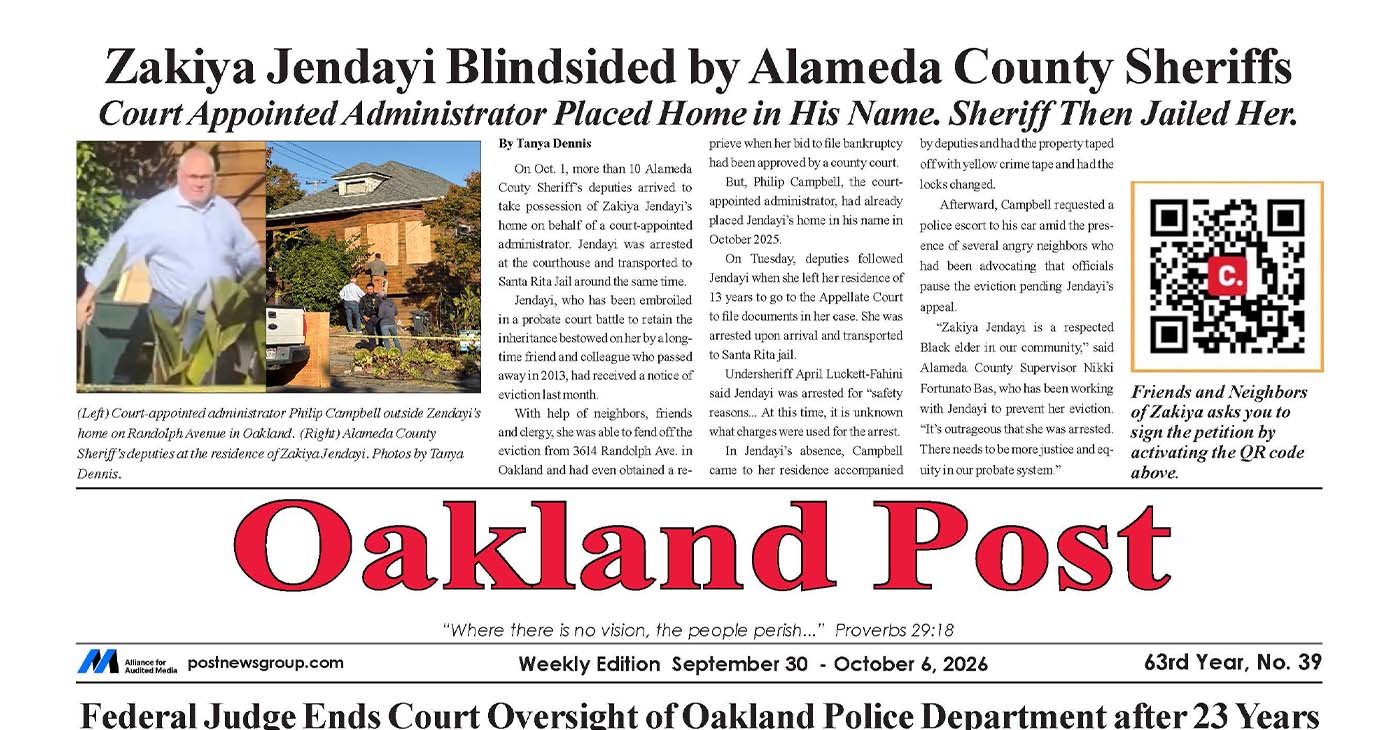
To enlarge your view of this issue, use the slider, magnifying glass icon or full page icon in the lower right corner of the browser window.

Activism
Oakland Post: Week of September 23 – 29, 2026
The printed Weekly Edition of the Oakland Post: Week of September 23 – 29, 2026

To enlarge your view of this issue, use the slider, magnifying glass icon or full page icon in the lower right corner of the browser window.
Activism
Oakland Post: Week of September 16 – 22, 2026
The printed Weekly Edition of the Oakland Post: Week of September 16 – 22, 2026

To enlarge your view of this issue, use the slider, magnifying glass icon or full page icon in the lower right corner of the browser window.



Listening as a Lifeline: A Doula’s Witness to Black Maternal Health

New Protections for Ticket Buyers: Gov. Newsom Signs Assemblymember Isaac Bryan’s Bill

‘We Don’t Talk Trash — We Pick Up Trash!’

Zakiya Jendayi Arrested, Locked Out of Home by Sheriff’s Deputies

Oakland Post: Week of September 30 – October 6, 2026

Asm. Corey Jackson Announces Launch of 24-Hour Childcare in His District

IN MEMORIAM: The Rev. Leon “Sonny” Clark, Longtime Orange County Pastor and Community Leader, Dies at 72

Poll: Becerra Widens His Lead Over Hilton; Californians Split on Wealth Tax

From Historic Memories to New Possibilities: Oakland Celebrates Coliseum 60

County Office of Education Says OUSD Finances Are Getting Healthier, Materially Stronger

LIVE FREE Sunday Dinner Brings Faith, Fellowship and Civic Conversation to Oakland

Remembering Chauncey Bailey as Student Journalists Face Threats to Truth-Telling

BLACspace Cooperative Invites Bay Area to Experience Oakland’s Black Cultural Ecosystem Through a BLAC Map Tour + Party

In Wake of Death on Doorstep, Williams Chapel Baptist Church Calls for Better Care, Funding for Unhoused

Oakland Centenarian Nuna McKee Honored!

Standoff for Justice: Our Homes Are Worth Fighting For

Oakland Post: Week of August 26 – September 1, 2026

Frontier Airlines’ Return to Oakland Airport Brings Flights, Jobs and Opportunity

Gubernatorial Candidate Steve Hilton Blasts California New Tire Rules; Newsom Hits Back

Chef Sharon Lee Blends Culinary Excellence, Education and Empowerment

Jackie Wright Champions Bay Area Stories, Filmmakers and Cultural Institutions

Misnamed ‘Parent’ PAC Seeks to Influence Oakland School Board Elections

Oakland Coliseum Project Opens Door for Small Businesses to Build Bigger

Big City Mayors Ask for “Yes” Vote on Housing Bond Measure; Conservatives Say “No”

Gov. Newsom’s Latest Appointees Include Sacramento Advocate for Formerly Incarcerated Students; State’s New Tech Chief

Longtime BWOPA Member Brendalyn Goodall Appointed to California Workforce Development Board

Gov. Newsom Signs Law Shielding Immigration Aid Workers From Doxing Threats

Secretary of State Shirley N. Weber Urges Californians to Vote Early as Voter ID Battle Intensifies

Oakland Post: Week of September 2 – 8, 2026

IN MEMORIAM: Dolly Parton Dead at 80 — How She Built a Legacy of Love and Earned Her Place in Black Culture

The Conversation With Al McFarlane 6/23/26

Media Monday 6/22/26

LIVE! ASK ALMA! — TUES. 6.23.26 7PM EST

Car Buying Secrets: 4 Hidden Checks Before You Sign!

Is This 550 HP Charger Worth YOUR Money? AutoNetwork Review

Celebrating Juneteenth – Frederick Douglass on education and resistance

LIVE! — ASK ALMA! — TUES. 6.19.26 7PM EST

Hyundai Ioniq 5 Parking, Safety, and 360 View #shorts

2025 Ioniq 5 New Wiper & Powerful Performance! #shorts

Electric SUV Range: Is 259 Miles Enough? #shorts

EV Charging: How Fast Can You Charge an Electric Vehicle? #shorts

Biometric Cooling… Messaging Seats…Come on! 2025 Infiniti QX80 Autograph 4WD

Charged Up: Witness the Magic of a Fully Electric Car! #shorts

Range Rover Sport PHEV Included…: See What’s Inside This Luxury SUV! #shorts

Invisible Hood View: Perfect Parking with X-Ray Vision! #shorts
-
 Community3 weeks ago
Misnamed ‘Parent’ PAC Seeks to Influence Oakland School Board Elections
-
 Activism4 weeks ago
Oakland Post: Week of September 2 – 8, 2026
-

 Community3 weeks ago
Richmond Tiny House Village Farm & Garden Set to Open Gates on Sept. 26
-

 Activism3 weeks ago
Oakland Post: Week of September 9 – 15, 2026
-

 Black History3 weeks ago
Latest Massacre in Haiti Reveals Cruelty U.S. Deportations
-

 Black History3 weeks ago
OPINION: Nolan Wells’ Death One of Several Signifying Racial Terror Lives on in U.S. South
-

 Business2 weeks ago
Mayor Lee Announces $1 Million Kaiser Permanente Grant for Pilot Program to Address Homelessness, Clean Up Public Spaces throughout Oakland
-

 Community3 weeks ago
Democratic Clubs Interview Candidates for Oakland School Board
