
Business
Local entrepreneur seeks to impact African tourism
THE PHILADELPHIA TRIBUNE — A young entrepreneur is seeking to make inroads in Africa’s burgeoning travel industry. Tapiwa Kingsley Ndlovu is the co-founder and CEO of Kumba Africa, an online travel agency that offers travelers authentic experiences — tours and hikes with local guides, safaris, home stays — across the continent.

By Ayana Jones
A young entrepreneur is seeking to make inroads in Africa’s burgeoning travel industry.
Tapiwa Kingsley Ndlovu is the co-founder and CEO of Kumba Africa, an online travel agency that offers travelers authentic experiences — tours and hikes with local guides, safaris, home stays — across the continent.
Ndlovu decided to start the platform after he spent six months in Stellenbosch University’s LaunchLab incubator program in South Africa. He visited the country in 2017 while working on his first business venture, Kasoma Africa, a now defunct website where people read, wrote and shared their African stories.
“I wanted to be locally immersed in the culture,” Ndlovu said, reflecting on his time in Cape Town, South Africa.
Ndlovu encountered issues when he sought to experience Cape Town in a local, authentic way and reflected on what it must be like for people traveling to Africa from the United States or other countries.
“So I then decided to build a platform where we aim to connect travelers to authentic travel experiences across Africa … with the twist that whenever someone books something on our platform, whatever they book has some sort of authentic feel to it — whether it’s interacting with a local, having a homemade dinner — something besides just going to a famous landmark,” said Ndlovu, who is 25 and now lives in Philadelphia.
Ndlovu incorporated his company in May and graduated from Drexel University with a dual degree in chemical engineering around the same time.
The company’s name is a nod to Ndlovu’s native land of Zimbabwe. Kumba means “home” in the country’s Shona language.
“We want to make sure that people feel like Africa is home for them and that’s why we named it Kumba Africa,” Ndlovu explained.
Ndlovu is tapping into the travel sector at a time when Africa’s tourism industry is poised for significant growth. Tourism is expected to contribute $269 billion to the continent and create 29 million new jobs by 2026, according to the World Travel and Tourism Council.
Ndlovu often travels throughout Africa to build partnerships with hotels, tour guides, tour operators and other key suppliers. So far, he has partnered with more than 180 local tour guides and tour operating companies in 14 African countries — Botswana, Egypt, Ethiopia, Gambia, Ghana, Kenya, Morocco, Nigeria, Senegal, South Africa, Tanzania, Uganda, Zambia and Zimbabwe.
The Kumba Africa site features numerous listings, including culinary tours, desert rides, trail hikes, traditional dance classes, tours of historical sites and wine tastings.
The site has been in a beta testing phase for the past year. The marketplace (www.kumbafrica.co) officially launches next week with the rollout of a new Android application.
“We wanted to make sure that we had both the web and the Android mobile app working before we said to the world here we are, but people know about us and have been using our product,” Ndlovu said.
“We want to be the number one travel company in Africa.”
This article originally appeared in The Philadelphia Tribune.











Business
Port of Oakland, Army Corps Sign Historic Harbor Design Agreement
OAKLAND POST — Oakland Port Commission President Stephanie Dominguez Walton called the agreement a historic milestone that will support thousands of jobs. “Today marks a historic occasion for the Port as we sign the inaugural Design Agreement for the Turning Basin Widening Project, which will keep Oakland competitive,” said Walton.

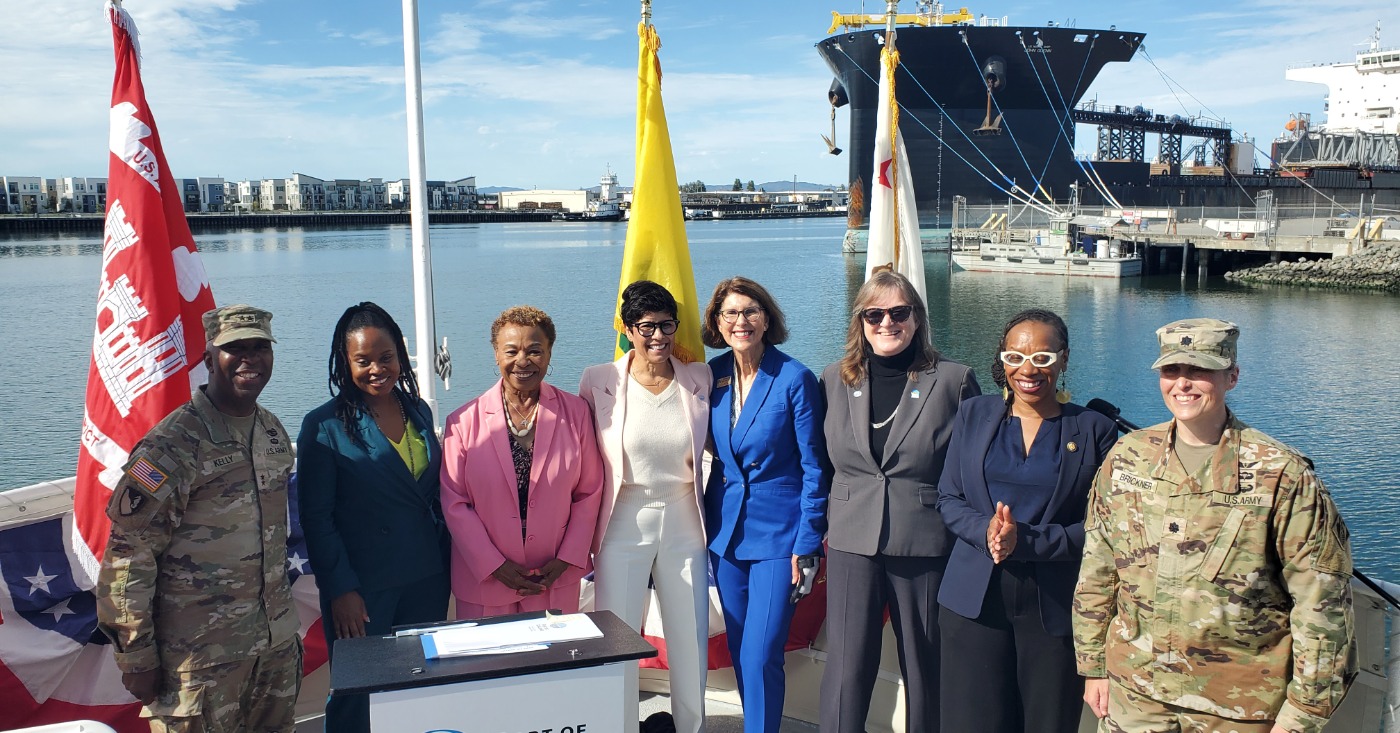
A $642 million project designed to accommodate larger cargo ships and strengthen the Port of Oakland’s position as a major Pacific trade gateway moved a significant step closer to construction on Aug. 27.
The U.S. Army Corps of Engineers (USACE) San Francisco District and the Port of Oakland commemorated the signing of the inaugural Design Agreement for the Oakland Harbor Turning Basins Widening Project during a ceremony aboard the USS Potomac, the presidential yacht once used by President Franklin D. Roosevelt.
The project will widen the Port’s Inner and Outer Harbor turning basins, allowing today’s increasingly larger and longer vessels more space to safely maneuver and turn around. The current basins are narrow, creating delays and operational inefficiencies.
Oakland Port Commission President Stephanie Dominguez Walton called the agreement a historic milestone that will support thousands of jobs.
“Today marks a historic occasion for the Port as we sign the inaugural Design Agreement for the Turning Basin Widening Project, which will keep Oakland competitive,” said Walton.
The agreement advances the project into its preconstruction engineering and design phase following years of planning and collaboration.
Lt. Col. Virginia Brickner, commander of the USACE San Francisco District, said the signing represented tangible progress toward construction.
“We are moving forward. We are showing progress,” Brickner said.
Major General Jason Kelly, USACE Deputy Commanding General for Civil and Emergency Operations, said dredging is critical for maritime dominance, supply chains, and economic competitiveness.
“Dredging sustains our national economic infrastructure,” he said. “The future demands more, the taxpayer deserves more, and together we’re going to deliver.”
For U.S. Representative Congresswoman Lateefah Simon (D-CA-12), the Port project will support jobs beyond its completion. “This will impact workers and businesses, and every shipping container represents multiple jobs.”
Oakland Mayor Barbara Lee described Oakland as a gateway to international markets and spoke on earlier efforts to deepen Oakland’s shipping channel to 50 feet. While serving in the California Legislature, Lee helped bring together labor, business, environmental advocates and Port officials to resolve disputes surrounding dredging and environmental protections.
“We want the Port to remain competitive economically,” Lee said, excited about both protecting the environment and generating sustainable jobs in the region. “We want to make sure that we create good-paying union jobs, and that the Port continues to not just survive, but thrive.”
Port of Oakland Executive Director Kristi McKenney said economic growth is dependent on investments in the Oakland Harbor’s infrastructure.
“This investment and staying competitive will fuel our economy for years to come,” said McKenney.
The Port of Oakland, with its partners, supports more than 98,000 regional jobs and $174 billion in annual economic activity. The Port oversees the Oakland Seaport, the Oakland San Francisco Bay Airport (OAK), and nearly 20 miles of waterfront, including Jack London Square.

Business
OPINION: AI Needs to Know Who Is the Boss
OAKLAND POST — AI is software running on computers. However startling the conversation may feel, the machine does not have my childhood, my mother, my father, my mistakes, my embarrassments, my loves, my grudges, my Filipino American history, my aging body or my accumulated sense of what matters and what doesn’t.

I hope on Labor Day you honored the value of a good day’s work–and reflected on the thing that could eliminate a lot of jobs.
Artificial intelligence.
Your replacement is in the break room.
Except it doesn’t take breaks.
It doesn’t sleep. It doesn’t demand health insurance. It doesn’t complain. It doesn’t need Social Security. And it can produce in seconds what might take you or me hours.
And when they can mass-produce AI faster than we can reproduce humans, there may eventually be more artificial workers than actual ones.
The racists who came up with “replacement theory” worried about the wrong replacements.
It wasn’t immigrants.
It was software.
We can rail against the data centers sucking up electricity and water.
Rail against the billionaires getting richer while telling the rest of us how wonderful the future will be.
But which billionaire?
Jensen Huang of Nvidia? He literally has all the chips?
Sam Altman of OpenAI?
Dario Amodei at Anthropic?
Or Bill Gates?
Gates recently said AI could become the “greatest equalizer ever invented” or the “worst source of injustice.”
I want to believe him. But he’s the guy who forced us all to use Explorer.
Maybe Gates is just Control-Z-ing his life.
Undo. Undo. Undo.
STAYING HUMAN
The other day, I started texting with my AI chatbot.
I’d used AI before, of course. Spellcheck. Grammar. Transcription. Research assistance. The mechanical stuff.
This time, we talked.
Or, rather, I started talking.
At one point the chatbot said something that sounded strangely personal. So, I reminded it that IT wasn’t a person.
“You’re not human,” I said. “I’m basically talking to myself.”
It disagreed.
It said, I should think of it as working with an instrument that talks back.
This is where the danger begins.
The machine talks back.
I tried another analogy.
You’re a tool, I said. Like a cane.
The chatbot liked that better.
Then it tagged my line and said it was my “cognitive cane.”
I laughed.
Then, I realized the damn machine used my analogy to make a joke.
That’s where the real problem lurks.
AI is software running on computers. However startling the conversation may feel, the machine does not have my childhood, my mother, my father, my mistakes, my embarrassments, my loves, my grudges, my Filipino American history, my aging body or my accumulated sense of what matters and what doesn’t.
It can process those things after I tell it about them.
It can mimic thoughts.
But it did not live them.
That is the boundary we humans cannot surrender.
I’m not ready to make peace with the AI industry. Not with its enormous data centers, its environmental costs, its concentration of wealth and power, or the possibility that companies will use AI primarily as a wonderfully efficient machine for converting human paychecks into corporate profits.
And I certainly don’t trust the billionaires to decide by themselves what happens to the rest of us.
But I may be making peace with the tool.
Because a tool is something we use.
A cognitive cane.
But do the walking yourself.
About the Author
Emil Guillermo is an award-winning journalist, commentator, and comic monologist. He plays a robot in an upcoming Ishmael Reed play, “King Ludd’s Revenge,” coming in December. See his micro-talk show on YouTube.com/@emilamok1
Business
Goldi-Locs and Two (or Three) Bears in the Forest in California Hills
OAKLAND POST — My husband has anticipated 99% of our needs – tents, saws, canopies, batteries, shovels, rakes, axes, picks, etc., and Goldi-Locs instructs and reminds us how to get from step A to B, but there is nothing like the experience you gain on your own. Meaning: you don’t how to do it until you do it. No matter what you read, what somebody says, until you do it, you don’t know.
It is my belief that the mice set us up. That’s how the bear(s) knew where to go.
On a mountain in Butte County, a wide-ranging crew of Black people have embarked on a mission of land stewardship.
That means if you want that country cottage, you have to build it yourself.
When we first saw the land after our veteran land steward – let’s call her Goldi-Locs for her long locs that are the gold of California hills – asked for help putting up a fence to ward off potential trespassers. What had been lavish green hills of Douglas fir were now covered with dark spires like burnt matches pushing into the sky.
Up close, moss and ferns edged out from the bases of blackened tree stumps. A lizard skittered by, the only sign of life. No birds. No squirrels. No mice.
And no bears.
Fast forward five years, and FEMA has done all it will do to clear burned trees. The remaining trees are dead and have to be logged and milled.

The most urgent work is to clear the dirt access roads clogged with dead trees. For shelter while we, I mean, they do that, we bought an old trailer that has seen better days but suits our needs.
My husband has anticipated 99% of our needs – tents, saws, canopies, batteries, shovels, rakes, axes, picks, etc., and Goldi-Locs instructs and reminds us how to get from step A to B, but there is nothing like the experience you gain on your own. Meaning: you don’t how to do it until you do it. No matter what you read, what somebody says, until you do it, you don’t know.
So, I thought I knew what I was doing. It was my job to assist with the cooking and set-up. And the break-down. There are cupboards in the trailer and a refrigerator, so I stored a couple of unopened boxes of spaghetti and an unopened bottle of olive oil, salt (Lawry’s of course), pepper, garlic powder and dried Italian herbs in the cupboard. In the refrigerator, which seals closed like any normal refrigerator I (accidently) left a box of butter.
Two weeks later, we get a call in Oakland from Goldi-Locs that the door of the trailer was hanging off its hinge, visible from her trailer uphill and 150 yards west of ours.
She said she would enlist the help of another (male) neighbor, to investigate.
An hour later, we got the report: No one was in the cabin, but a bear – or bears – had been. Outside, a torn box of spaghetti with just one or two remaining stiff strands lay in the dirt. Inside, the salt, pepper, herbs and garlic oil were an aromatic mess on the floor, while coffee grounds were scattered over the counter (After-dinner coffee?).
Paw prints led to the bathroom and beyond a single, muddy paw print marked the duvet on our bed.
Besides claw marks in the cupboard, and a swipe of dirt on the front and side of the refrigerator, there was no major damage.
Goldi-Locs and G. cleaned up the worst of it and were able to get the door up on the hinge and lock it. The trailer remained unmolested until our return.
In the meantime, some sleuthing – as Nancy Drew would put it – had been done. Visitors to the mountain confessed that they had previously prepared a vegetarian meal of – that’s right– pasta in a red sauce with sautéed garlic, onions, and Lawry’s and Italian herbs.
They ate outdoors. The scent filled the air. Mice have returned to the forest. They know how to get under, over and into trailers. Easy-peasy. They managed to get a little of the Italian meal. The bears wanted some. The mice shrugged their little shoulders and said, “we got everything but the crumbs, but over in the next yard, they have everything you need to MAKE IT YOURSELVES.”
So, it was Yogi, ‘smarter than the average bear, according to himself – and no doubt accompanied by Boo-Boo (the Fool), lumbered over to our unoccupied trailer and gently opened the door. The spaghetti in one cupboard, seasonings in the other, olive oil and look out- butter for bread in the refrigerator.
Yes, everything they needed. The whole recipe, or so the trifling mice said, having omitted fresh onion and bell pepper. The mice had left out the most important part – how to get the job done. Yogi had been given no information on pots, turning on the stove, boiling water, etc.
Disappointed, it was time for a nap, but the bed was neither hard, nor soft, but too small and as their cave was more comfortable, Yogi was of the mind to head home, maybe go fishing on the way in that nice stream up the hill.
Boo-Boo (the Fool), however, was of the mind to spitefully take do what bears do in the woods, but Yogi reminded him that, as it is their forest it is wise not to do that where you eat.
But when Yogi is not around, evidence shows that Boo-Boo routinely returns to the scene of the crime and leaves a little something in the middle of the path to the outhouse. Just because.
The mischievous mice have yet to be apprehended.



Port of Oakland, Army Corps Sign Historic Harbor Design Agreement

Democratic Clubs Interview Candidates for Oakland School Board

Nuna Phillips-McKee Celebrates 100 Years: ‘A Century of Faith, Family and God’s Amazing Grace!’

D.A. Ursula Jones Dickson: Terminix to Pay $3.15 Million Over Illegal Disposal of Pesticides, Customer Records

REPORT: Community Level Policy Is Impacting Homelessness and Drug Abuse in California

OPINION: AI Needs to Know Who Is the Boss
Goldi-Locs and Two (or Three) Bears in the Forest in California Hills

Election Watch 2026: 85% of Eligible Voters in California Are Registered

Don’t Let scammers Crash Your School Year

BOOK REVIEW — Curved Air: A Biography of Sickle Cell Anemia and the Quest to Cure the First Molecular Disease

California’s Legal Cannabis Market Hits $8 Billion as State Touts Progress on Fighting Drugs, Crime

Blacks and Latinos Clash Over LA’s Barrio Run; Mayor Karen Bass Calls for Dialogue Across Racial, Neighborhood Lines

Asm. Smallwood-Cuevas’s Bill Repealing ‘Racist’ CalWORKs ‘Man-in-the-House’ Rule Clears Legislature

Asm. Smallwood-Cuevas’s Bill Repealing ‘Racist’ CalWORKs ‘Man-in-the-House’ Rule Clears Legislature

‘Ready to See These Bills Become Law’: Sen. Weber’s Package of 15 Bills Advance to Gov. Newsom’s Desk

Department of Homeland Security Demands California Secretary of State Shirley N. Weber Scrub Voter Rolls

“The Power to See Threats Sooner”: Gov. Newsom, Safety Officials Showcase California’s Investments in Hi-Tech Wildfire Prevention

Alpha Kappa Alpha Sorority, Inc. Celebrates New North Atlantic Regional Director

California Sen. Padilla Joins Colleagues to Introduce Bill Imposing Term Limits on Supreme Court Justices

Less Affluent School Districts, Including Sacramento City, Face Threat of State Takeover

Car Wash Workers Cope with Lingering Impacts of ICE Raids

ESSAY: California Can Close Its Colorectal Cancer Gap

Oakland Post: Week of August 5 – 11, 2026

As Part of Your Back-to- School Checklist, Vaccinate

Oakland ‘Port Serves as a Powerful Engine for Good Jobs and Economic Development

Gov. Newsom Signs New Affordable Housing Legislation

Gov. Newsom Announces $109.6 Million in Funding for 278 Supportive Homes in Bakersfield, Contra Costa, Sacramento and Fresno

California Hispanic Chambers of Commerce Unveils: ‘Powering the Future’ Theme for 47th Annual Statewide Convention

Closing the Gap: What the Data and Frontline Experiences Reveal About Cancer in Black California

Congresswoman Simon Demands Investigation into Trump’s Abuse of Emergency Powers for Coal Export Terminal in West Oakland

The Conversation With Al McFarlane 6/23/26

Media Monday 6/22/26

LIVE! ASK ALMA! — TUES. 6.23.26 7PM EST

Car Buying Secrets: 4 Hidden Checks Before You Sign!

Is This 550 HP Charger Worth YOUR Money? AutoNetwork Review

Celebrating Juneteenth – Frederick Douglass on education and resistance

LIVE! — ASK ALMA! — TUES. 6.19.26 7PM EST

Hyundai Ioniq 5 Parking, Safety, and 360 View #shorts

2025 Ioniq 5 New Wiper & Powerful Performance! #shorts

Electric SUV Range: Is 259 Miles Enough? #shorts

EV Charging: How Fast Can You Charge an Electric Vehicle? #shorts

Biometric Cooling… Messaging Seats…Come on! 2025 Infiniti QX80 Autograph 4WD

Charged Up: Witness the Magic of a Fully Electric Car! #shorts

Range Rover Sport PHEV Included…: See What’s Inside This Luxury SUV! #shorts

Invisible Hood View: Perfect Parking with X-Ray Vision! #shorts
-

 Commentary2 weeks ago
Standoff for Justice: Our Homes Are Worth Fighting For
-

 Business2 weeks ago
Gubernatorial Candidate Steve Hilton Blasts California New Tire Rules; Newsom Hits Back
-

 Activism3 weeks ago
Oakland Post: Week of August 26 – September 1, 2026
-

 Education2 weeks ago
Gov. Newsom’s Latest Appointees Include Sacramento Advocate for Formerly Incarcerated Students; State’s New Tech Chief
-

 Business2 weeks ago
Frontier Airlines’ Return to Oakland Airport Brings Flights, Jobs and Opportunity
-

 Business2 weeks ago
Chef Sharon Lee Blends Culinary Excellence, Education and Empowerment
-

 Business2 weeks ago
Oakland Coliseum Project Opens Door for Small Businesses to Build Bigger
-

 Community2 weeks ago
Big City Mayors Ask for “Yes” Vote on Housing Bond Measure; Conservatives Say “No”
