
Activism
Local Black Leaders Break Silence on “Politicization” of Oakland NAACP Branch
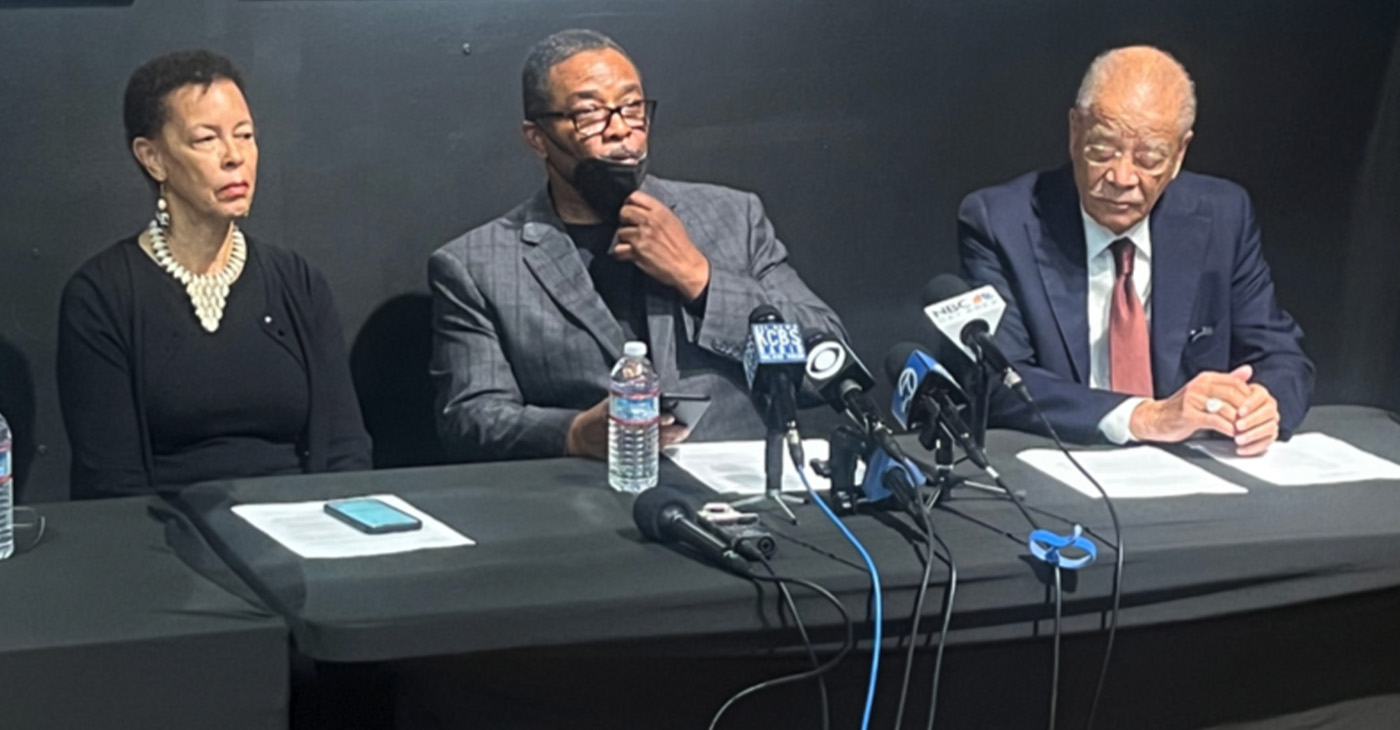
Several lifelong NAACP members, including Black Business Round Table host Doug Blacksher and civil rights attorney Walter Riley, held a press conference this week criticizing the conduct of the Oakland NAACP chapter for its attacks on criminal justice reform and on reformer Black DA Pamela Price, the repetition of false narratives about crime and criminal justice, and the use of historic fear-mongering that props up the system of mass incarceration.

By Ken Epstein
Several lifelong NAACP members, including Black Business Round Table host Doug Blacksher and civil rights attorney Walter Riley, held a press conference this week criticizing the conduct of the Oakland NAACP chapter for its attacks on criminal justice reform and on reformer Black DA Pamela Price, the repetition of false narratives about crime and criminal justice, and the use of historic fear-mongering that props up the system of mass incarceration.
The speakers also said the Oakland NAACP has acted in alliance with Republican anti-Black and anti-democratic forces and served as a vehicle for the self-interest actions of failed candidates in opposition to the national NAACP’s promulgated policy and positions.
Oakland “NAACP leadership is reverting to lies, fear-mongering, and the ‘tough-on-crime’ rhetoric that has targeted African Americans throughout our entire history in this country, evoking stereotypical narratives of Black criminality that maintains the United States incarcerating more Black people than there were enslaved Africans,” said Blacksher, in a media release.
“We call upon the national NAACP to reign in the Oakland Chapter and demand that Branch 1051 align itself with the mandate of the national NAACP such as addressing policies that unfairly target or penalize Black people in the criminal justice system,” Blacksher said.
Speakers at the press conference, held Tuesday at the Dr. Huey P. Newton Center for Research & Action at 1427 Broadway in Oakland were: Blacksher and Riley, as well as Chaney Turner, Oakland-born entrepreneur and organizer; Desmond Jeffries, Oakland activist; and Cathy Leonard, longtime police accountability activist.
“Interestingly, when previous district attorneys were overcharging African Americans with excessive sentences and previous councils presided over unprecedented Black displacement and homelessness, the (Oakland) NAACP was silent. Now, they are taking positions and aligning themselves with those who wish a return to the unjust status quo,” said Leonard, an Oakland native.
Riley said the Oakland NAACP chapter is working against policies and positions that the national NAACP supports. “We seek to be in alignment with the national NAACP on topics of education, public safety, housing and economic justice, but our chapter constantly contradicts this aspiration,” he said.
In a letter to national NAACP President Derrick Johnson, the press conference organizers accused current Oakland NAACP leaders of advocating conservative positions that align with the Republican Party, such as “singular support of charter school (Board of Education) candidates, efforts to recall the first Black female District Attorney in our county’s history, support (for) legislation that defunds public education in favor of tax breaks for the powerful real estate lobby over renters, and taking payouts from big tobacco and big pharmaceutical corporations.”
Letter signers included press conference speakers Blacksher, Riley, and Leonard, as well as Millie Cleveland, retired SEIU 1021 Field Representative; Ben “Coach” Tapscott, public education advocate; and Sheryl Walton, community activist and Oakland native.
The letter signers said that as NAACP members, they support formal positions taken by the East Bay Stonewall Democratic Club and the Alameda County Democratic Party denouncing the hateful accusations and homophobic statements made by Oakland NAACP leader Seneca Scott.
According to the letter, Oakland NAACP leaders are utilizing Republican talking points to attack “women of color who are currently serving in Oakland, creating stark divisions in the public discourse,” and seeking to “agitate people around a divisive, yet organizable conservative agenda.”
The letter said local NAACP leaders are seeking to misdirect people on the sources of crime and disorder in Oakland, instead blaming ‘wokeness,’ progressive policies, ‘liberal Democrats,’ and debunked claims that ‘defund the police’ are the sources of everything wrong in the city.”
Proposals for reform of the Oakland chapter include:
- “Cease the spread of false information. Factcheck first.”
- Remove any member, officer, or former elected official …who seeks to weaponize Oakland NAACP for personal gain.
- Disentangle the Oakland NAACP from the political agenda of the Alameda County Republican Party.
- “Reject all connections with Sam Singer,” a corporate public relations operative.
- “Provide transparency on all financial contributions.”












Activism
Oakland Post: Week of September 23 – 29, 2026
The printed Weekly Edition of the Oakland Post: Week of September 23 – 29, 2026

To enlarge your view of this issue, use the slider, magnifying glass icon or full page icon in the lower right corner of the browser window.
Activism
Oakland Post: Week of September 16 – 22, 2026
The printed Weekly Edition of the Oakland Post: Week of September 16 – 22, 2026

To enlarge your view of this issue, use the slider, magnifying glass icon or full page icon in the lower right corner of the browser window.
Activism
Oakland Post: Week of September 9 – 15, 2026
The printed Weekly Edition of the Oakland Post: Week of September 9 – 15, 2026

To enlarge your view of this issue, use the slider, magnifying glass icon or full page icon in the lower right corner of the browser window.



Asm. Corey Jackson Announces Launch of 24-Hour Childcare in His District

IN MEMORIAM: The Rev. Leon “Sonny” Clark, Longtime Orange County Pastor and Community Leader, Dies at 72

Poll: Becerra Widens His Lead Over Hilton; Californians Split on Wealth Tax

From Historic Memories to New Possibilities: Oakland Celebrates Coliseum 60

County Office of Education Says OUSD Finances Are Getting Healthier, Materially Stronger

LIVE FREE Sunday Dinner Brings Faith, Fellowship and Civic Conversation to Oakland

Remembering Chauncey Bailey as Student Journalists Face Threats to Truth-Telling

BLACspace Cooperative Invites Bay Area to Experience Oakland’s Black Cultural Ecosystem Through a BLAC Map Tour + Party

In Wake of Death on Doorstep, Williams Chapel Baptist Church Calls for Better Care, Funding for Unhoused

Oakland Centenarian Nuna McKee Honored!

Caribbean Nations Produce Action Plan Calling for UK Reparations Over Slavery

Oakland Post: Week of September 23 – 29, 2026

Doulas Are Helping Black California Moms Navigate Pregnancy–Even as High Mortality Rates Persist

Newsom Signs Addictive Social Media Law to Protect Kids

On Your November Ballot: Prop 38 Would Allocate $8.4 Billion to Immunology and Immunotherapy Funding

Standoff for Justice: Our Homes Are Worth Fighting For

Oakland Post: Week of August 26 – September 1, 2026

Frontier Airlines’ Return to Oakland Airport Brings Flights, Jobs and Opportunity

Gubernatorial Candidate Steve Hilton Blasts California New Tire Rules; Newsom Hits Back

Chef Sharon Lee Blends Culinary Excellence, Education and Empowerment

Jackie Wright Champions Bay Area Stories, Filmmakers and Cultural Institutions

Big City Mayors Ask for “Yes” Vote on Housing Bond Measure; Conservatives Say “No”

Oakland Coliseum Project Opens Door for Small Businesses to Build Bigger

Gov. Newsom’s Latest Appointees Include Sacramento Advocate for Formerly Incarcerated Students; State’s New Tech Chief

Misnamed ‘Parent’ PAC Seeks to Influence Oakland School Board Elections

Longtime BWOPA Member Brendalyn Goodall Appointed to California Workforce Development Board

Gov. Newsom Signs Law Shielding Immigration Aid Workers From Doxing Threats

Secretary of State Shirley N. Weber Urges Californians to Vote Early as Voter ID Battle Intensifies

From Palestine to Oakland: Seeds for Liberation Examines Shared Struggles for Freedom

IN MEMORIAM: Dolly Parton Dead at 80 — How She Built a Legacy of Love and Earned Her Place in Black Culture

The Conversation With Al McFarlane 6/23/26

Media Monday 6/22/26

LIVE! ASK ALMA! — TUES. 6.23.26 7PM EST

Car Buying Secrets: 4 Hidden Checks Before You Sign!

Is This 550 HP Charger Worth YOUR Money? AutoNetwork Review

Celebrating Juneteenth – Frederick Douglass on education and resistance

LIVE! — ASK ALMA! — TUES. 6.19.26 7PM EST

Hyundai Ioniq 5 Parking, Safety, and 360 View #shorts

2025 Ioniq 5 New Wiper & Powerful Performance! #shorts

Electric SUV Range: Is 259 Miles Enough? #shorts

EV Charging: How Fast Can You Charge an Electric Vehicle? #shorts

Biometric Cooling… Messaging Seats…Come on! 2025 Infiniti QX80 Autograph 4WD

Charged Up: Witness the Magic of a Fully Electric Car! #shorts

Range Rover Sport PHEV Included…: See What’s Inside This Luxury SUV! #shorts

Invisible Hood View: Perfect Parking with X-Ray Vision! #shorts
-
 Community2 weeks ago
Misnamed ‘Parent’ PAC Seeks to Influence Oakland School Board Elections
-

 Activism3 weeks ago
Oakland Post: Week of September 2 – 8, 2026
-

 Community2 weeks ago
Richmond Tiny House Village Farm & Garden Set to Open Gates on Sept. 26
-

 Black History2 weeks ago
OPINION: Nolan Wells’ Death One of Several Signifying Racial Terror Lives on in U.S. South
-

 Black History2 weeks ago
Latest Massacre in Haiti Reveals Cruelty U.S. Deportations
-

 Activism2 weeks ago
Oakland Post: Week of September 9 – 15, 2026
-

 Community2 weeks ago
Democratic Clubs Interview Candidates for Oakland School Board
-
 Featured2 weeks ago
‘Ready to See These Bills Become Law’: Sen. Weber’s Package of 15 Bills Advance to Gov. Newsom’s Desk
