
Opinion
I Do Not Believe you are a Racists

At the Miami Democratic Presidential Debate, Kamala Harris questioned Joe Biden about his opposition to integrating the schools through court-ordered busing. Biden responded: “I did not oppose busing in America. What I opposed is busing ordered by the Department of Education.” After the debate, Biden spoke at the Rainbow Push Convention in Chicago. He said, “I want to be absolutely clear about my record and position on racial justice, including busing. I never, never, ever opposed voluntary busing.”
As Harris noted in the debate, Biden is not a racist. He served the country well as a senator and as Barack Obama’s vice president. On this question, however, he has lined up with the opposing team.
In the struggle for civil rights, the stakes were clear. After the Civil War brought an end to slavery, the Reconstruction — the effort to integrate the slave states of the South — was resisted widely, and rapidly brought to an end. The former slave states claimed to have state’s rights over laws concerning labor, voting rights, education, health care and civil rights. Under the banner of states’ rights, they enforced legal segregation — apartheid, stripping black citizens of their rights. Blacks were banned from restaurants and hotels. Schools were segregated. Voting rights were suppressed. Blacks were forced to sit at the back of the bus.
In 1954 in Brown v. Board of Education, the Supreme Court ruled that segregation — specifically segregation of schools — violated the Constitution. Separate but equal was inherently unequal. They ordered communities to integrate their schools. Once again resistance was immediate and widespread. African Americans were forced to go to court to enforce their rights. One result was court-ordered busing.
For Dr. King and the civil rights movement, the claim of states’ rights was always the segregationist dodge.
It took federal intervention to gain the right to public accommodations, to enforce the right to vote, to enforce desegregation of schools. To this day, federal intervention is vital, as Vice President Biden knows, to deal with the structural racism of police forces, voting rights, racially motivated hate crimes and more.
When Ronald Reagan opened his presidential campaign in Mississippi talking about states’ rights, everyone got the message. There were two sides of history and he was on the other side from those seeking equal justice for all.
As a senator, Biden initially supported busing. Then the white backlash grew. Racially separate communities in the North — often forged with red-lining and restrictive covenants that effectively segregated communities — started to get challenged in court.
The schools in Black communities were often more crowded, shabbier and less well-funded than those in the white suburbs. Communities resisted integration — and so courts began to order busing and redistricting to integrate schools.
Communities like Wilmington, Delaware faced the threat of court ordered integration, so the pressure on Biden grew to oppose busing. It was then that he called busing “asinine,” and voted with segregationists like Jesse Helms and Strom Thurmond on resolutions designed to prohibit the federal government — specifically the Department of Education -from enforcing court-ordered busing.
The problem wasn’t busing. Children are bused to school across America every day. The problem was where the bus was going.
As Matthew Delmont, author of “Why Busing Failed: Race, Media, and the National Resistance to School Desegregation,” concluded, “Describing opposition to busing as something other than resistance to school desegregation was a move that obscured the histories of racial discrimination and legal contexts for desegregation orders.”
In 1975, Biden offered his own amendment to the education bill, mandating that no funds could be used to “assign teachers or students to schools … for reasons of race.”
When the Biden amendment passed, Massachusetts Republican Edward Brooke, the only African American in the Senate, called it the “greatest symbolic defeat for civil rights since 1964.” It was later stripped from the bill.
Court-ordered busing to integrate schools has remained unpopular, and courts have retreated from enforcing it. Schools, particularly in the North, remain deeply segregated by race.
And too often, schools populated by people of color are still unequal — with fewer resources, dilapidated facilities and less prepared teachers than those in the suburbs.
Like Harris, I don’t believe Biden is a racist. But I do know that he was on the wrong side of history.
Invoking states’ rights or community choice is not a defense. It is an admission.
(You can write to the Rev. Jesse Jackson in care of this newspaper or by email at jjackson@rainbowpush.org. Follow him on Twitter @RevJJackson.)

Activism
Oakland Post: Week of September 9 – 15, 2026
The printed Weekly Edition of the Oakland Post: Week of September 9 – 15, 2026


To enlarge your view of this issue, use the slider, magnifying glass icon or full page icon in the lower right corner of the browser window.

Activism
Oakland Post: Week of September 2 – 8, 2026
The printed Weekly Edition of the Oakland Post: Week of September 2 – 8, 2026
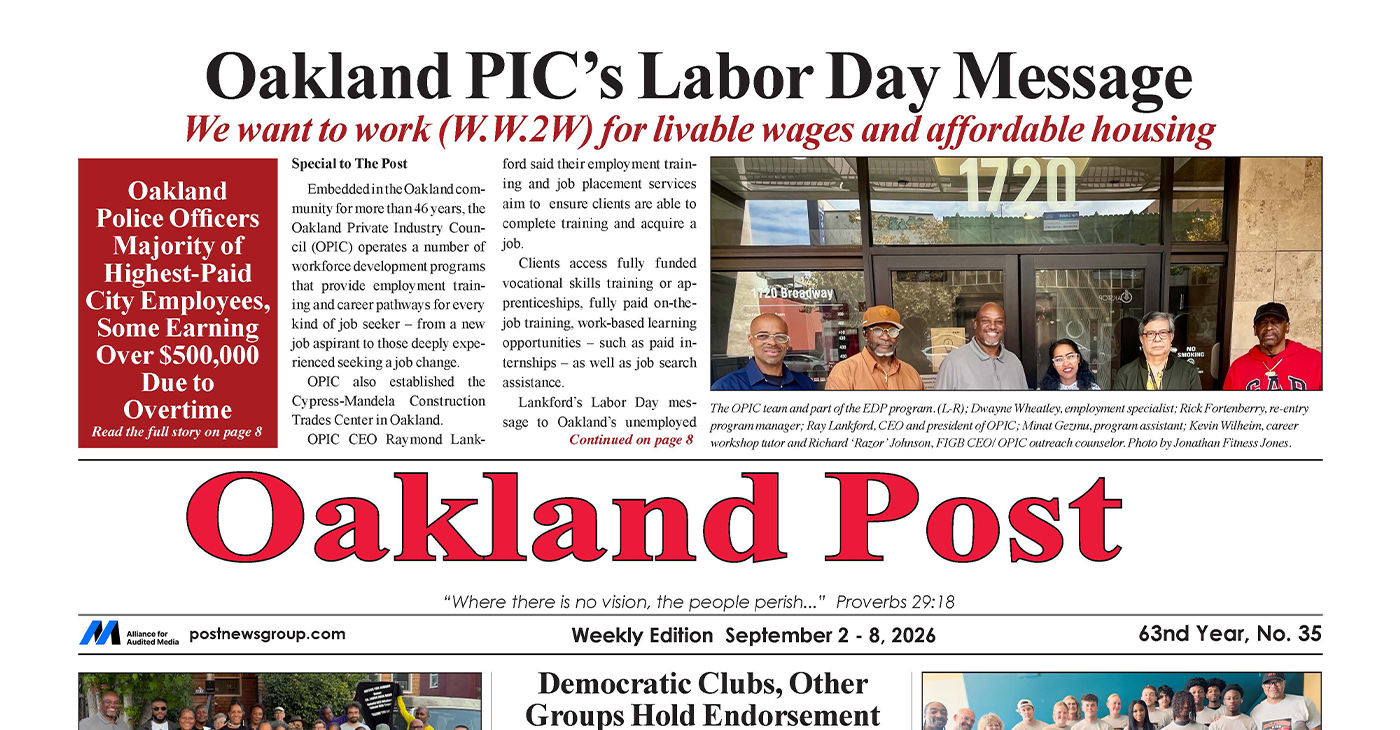
To enlarge your view of this issue, use the slider, magnifying glass icon or full page icon in the lower right corner of the browser window.
Activism
Oakland Post: Week of August 26 – September 1, 2026
The printed Weekly Edition of the Oakland Post: Week of August 26 – September 1, 2026
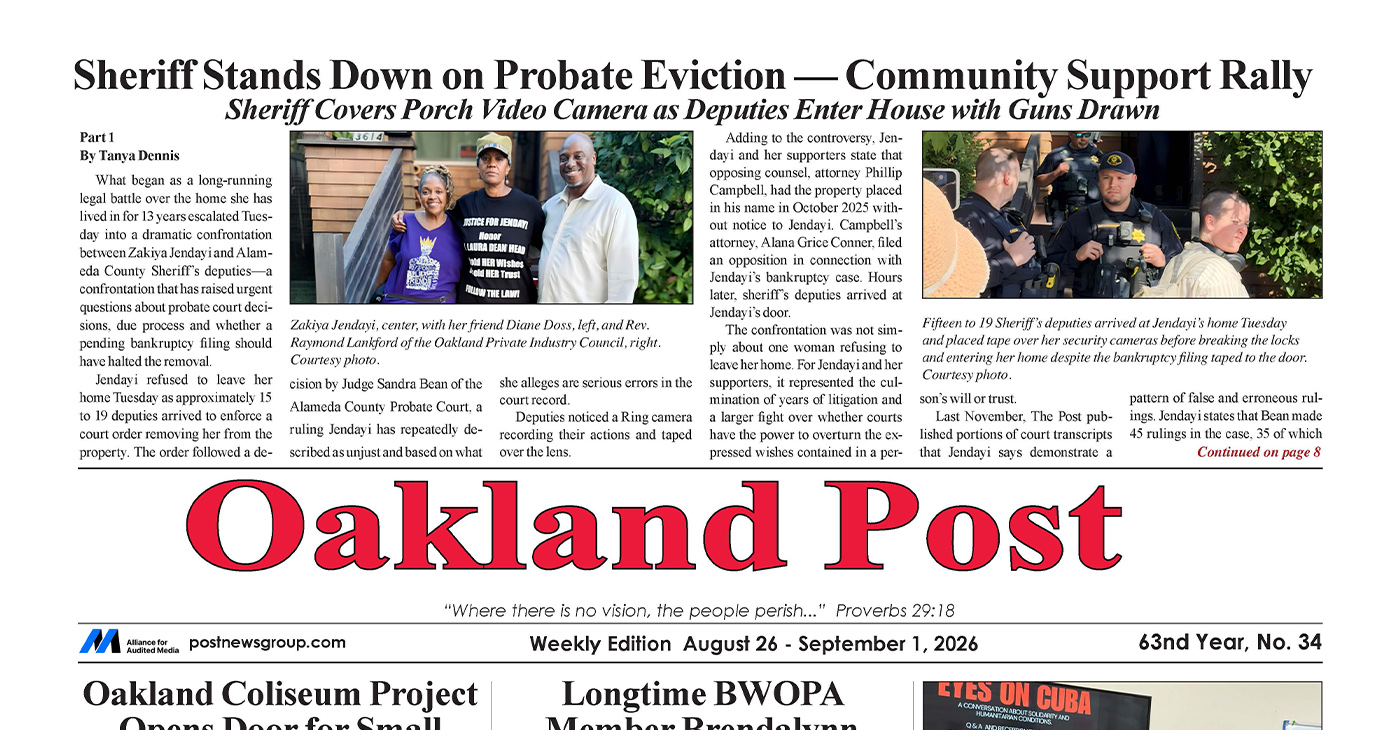
To enlarge your view of this issue, use the slider, magnifying glass icon or full page icon in the lower right corner of the browser window.



Port of Oakland, Army Corps Sign Historic Harbor Design Agreement

Democratic Clubs Interview Candidates for Oakland School Board

Nuna Phillips-McKee Celebrates 100 Years: ‘A Century of Faith, Family and God’s Amazing Grace!’

D.A. Ursula Jones Dickson: Terminix to Pay $3.15 Million Over Illegal Disposal of Pesticides, Customer Records

REPORT: Community Level Policy Is Impacting Homelessness and Drug Abuse in California
OPINION: AI Needs to Know Who Is the Boss
Goldi-Locs and Two (or Three) Bears in the Forest in California Hills

Election Watch 2026: 85% of Eligible Voters in California Are Registered

Don’t Let scammers Crash Your School Year

BOOK REVIEW — Curved Air: A Biography of Sickle Cell Anemia and the Quest to Cure the First Molecular Disease

California’s Legal Cannabis Market Hits $8 Billion as State Touts Progress on Fighting Drugs, Crime

Blacks and Latinos Clash Over LA’s Barrio Run; Mayor Karen Bass Calls for Dialogue Across Racial, Neighborhood Lines

Asm. Smallwood-Cuevas’s Bill Repealing ‘Racist’ CalWORKs ‘Man-in-the-House’ Rule Clears Legislature

Asm. Smallwood-Cuevas’s Bill Repealing ‘Racist’ CalWORKs ‘Man-in-the-House’ Rule Clears Legislature

‘Ready to See These Bills Become Law’: Sen. Weber’s Package of 15 Bills Advance to Gov. Newsom’s Desk

Department of Homeland Security Demands California Secretary of State Shirley N. Weber Scrub Voter Rolls

New Judge Could Decide if Karmelo Anthony Gets a New Trial

“The Power to See Threats Sooner”: Gov. Newsom, Safety Officials Showcase California’s Investments in Hi-Tech Wildfire Prevention

Alpha Kappa Alpha Sorority, Inc. Celebrates New North Atlantic Regional Director

California Sen. Padilla Joins Colleagues to Introduce Bill Imposing Term Limits on Supreme Court Justices

Less Affluent School Districts, Including Sacramento City, Face Threat of State Takeover

Car Wash Workers Cope with Lingering Impacts of ICE Raids

Oakland Post: Week of July 29 – August 4, 2026

How Oakland’s Courtsmith is Scaling its Business and Local Impact

ESSAY: California Can Close Its Colorectal Cancer Gap

Oakland Post: Week of August 5 – 11, 2026

As Part of Your Back-to- School Checklist, Vaccinate

Oakland ‘Port Serves as a Powerful Engine for Good Jobs and Economic Development

Gov. Newsom Signs New Affordable Housing Legislation

Gov. Newsom Announces $109.6 Million in Funding for 278 Supportive Homes in Bakersfield, Contra Costa, Sacramento and Fresno

The Conversation With Al McFarlane 6/23/26

Media Monday 6/22/26

LIVE! ASK ALMA! — TUES. 6.23.26 7PM EST

Car Buying Secrets: 4 Hidden Checks Before You Sign!

Is This 550 HP Charger Worth YOUR Money? AutoNetwork Review

Celebrating Juneteenth – Frederick Douglass on education and resistance

LIVE! — ASK ALMA! — TUES. 6.19.26 7PM EST

Hyundai Ioniq 5 Parking, Safety, and 360 View #shorts

2025 Ioniq 5 New Wiper & Powerful Performance! #shorts

Electric SUV Range: Is 259 Miles Enough? #shorts

EV Charging: How Fast Can You Charge an Electric Vehicle? #shorts

Biometric Cooling… Messaging Seats…Come on! 2025 Infiniti QX80 Autograph 4WD

Charged Up: Witness the Magic of a Fully Electric Car! #shorts

Range Rover Sport PHEV Included…: See What’s Inside This Luxury SUV! #shorts

Invisible Hood View: Perfect Parking with X-Ray Vision! #shorts
-

 Community4 weeks ago
Four Candidates, Including Incumbent Barbara Lee, Qualify for Oakland Mayor’s Race
-

 Activism4 weeks ago
Oakland Post: Week of August 12 – 18, 2026
-
 Black History4 weeks ago
Oakland Observes Black August with Block Parties, Film Showings, Workshops
-

 Commentary4 weeks ago
COMMENTARY: Why Local School Tax Measure G1 Will Not Be on the November Ballot
-

 Commentary2 weeks ago
Standoff for Justice: Our Homes Are Worth Fighting For
-

 Business2 weeks ago
Gubernatorial Candidate Steve Hilton Blasts California New Tire Rules; Newsom Hits Back
-

 Activism2 weeks ago
Oakland Post: Week of August 26 – September 1, 2026
-

 Education2 weeks ago
Gov. Newsom’s Latest Appointees Include Sacramento Advocate for Formerly Incarcerated Students; State’s New Tech Chief
